Plot Explained Spoilers guaranteed!
Plot Explained

Browse by genre

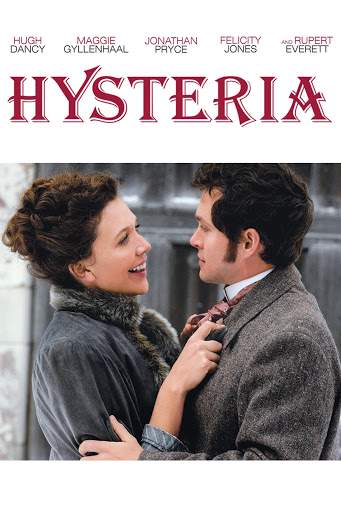
Hysteria (2012) movie poster

Plot Summary

Hysteria (2012) Plot Summary Explained

Release, runtime and language
2012 · 100 min · Korean
JustWatch #22,974 10
Directed by
Tanya Wexler
Starring
Felicity Jones, Jonathan Pryce, Hugh Dancy, Rupert Everett

During the 1800s in England, a doctor pioneers a novel treatment for female hysteria, leading to unexpected romantic entanglements. He collaborates with a clever inventor and develops a surprising connection with a patient, all while navigating the social conventions of the era. The story blends humor and charm as it explores the intersection of medical innovation, burgeoning relationships, and the pursuit of pleasure.

On this page (6)
  1. 1 Where to watch
  2. 2 What happens: full plot
  3. 3 Plot questions answered
  4. 4 Movie threads
  5. 5 Movies like Hysteria
  6. 6 Every angle

Where to watch

Where to Watch Hysteria (2012)

Where can you watch Hysteria? Stream, rent or buy it in the US, including on Amazon Video, Apple TV Store and Google Play Movies: current JustWatch availability with up-to-date prices.

Streaming availability powered by JustWatch

Full plot summary · contains spoilers

What Happens in Hysteria: Full Plot Summary

The whole story of Hysteria (2012) explained, from the opening scene to the final frame: every key event, every twist and what it all adds up to. Read it as a quick recap before the sequel, to check a scene you missed, or to finally understand what really happened.

Set in the vibrant backdrop of 1880, this film explores the groundbreaking invention of the vibrator through the eyes of Dr. Mortimer Granville, a young physician struggling to find his footing amidst the ongoing debates surrounding modern medicine. Initially, he takes a position assisting Dr. Dalrymple, a physician renowned for his unconventional practice that caters to women diagnosed with "hysteria." During this era, "hysteria" was often treated through a rather peculiar method involving the massage of the genital area, performed discreetly behind a curtain to provoke what they referred to as “paroxysmal convulsions.” However, unbeknownst to them, these methods were inducing orgasms instead.

As Dr. Granville delves deeper into this unique medical practice, he encounters Dr. Dalrymple’s two daughters: Emily and her spirited older sister Charlotte, who is portrayed as a pioneering feminist dedicated to running a settlement house in a struggling area of East London. Granville's talent for the unconventional treatment quickly earns him a devoted clientele, and Dr. Dalrymple envisions a future where Granville might take over his practice, as well as marry Emily, which adds a layer of personal complication to their professional relationship.

One evening, Charlotte arrives with her friend Fannie, who has suffered an ankle injury. Granville’s willingness to assist prompts Dr. Dalrymple to forbid him from helping her again, hoping to sway Charlotte from her work in the less fortunate neighborhoods. The growing demands of his practice take a toll on Granville’s physical capability, leading to a debilitating cramp that ultimately results in his dismissal. Fortunately, his inventive friend, Lord Edmund St. John-Smythe, shows him an innovative electrical feather duster; its vibrations spark an idea in Granville's mind about adapting it into an electric massager.

After successfully testing this new device on the Dalrymple's maid, Molly, Granville convinces Dr. Dalrymple to employ it with his patients, resulting in an overwhelming success for the practice. This unfolds as Mortimer and Emily get engaged, while Charlotte tirelessly works to sustain her settlement house.

The story takes a dramatic turn during the engagement celebration as Charlotte is arrested while defending Fannie from a police officer. Both Emily and Dr. Dalrymple pressure Granville to testify in a way that would suggest Charlotte is merely "hysterical," in hopes of sparing her from more severe punishment. When the trial unfolds, the prosecutor calls for her commitment to a sanatorium and a hysterectomy. In a powerful moment, Mortimer asserts that the symptoms of hysteria are too widespread to qualify as a mental disorder, emphasizing Charlotte’s inherently benevolent nature. The judge agrees with his reasoning, resulting in Charlotte receiving a 30-day sentence instead of harsher repercussions.

After this tumultuous incident, Emily comes to realize that her engagement to Granville was primarily an attempt to appease her father rather than stemming from true love. As the vibrator begins to be recognized as a legitimate medical device—significantly cutting down treatment times and enhancing patient satisfaction—Granville finds himself financially independent, but acknowledges that his heart belongs to Charlotte.

In a grand gesture, he vows to utilize a portion of his new wealth to create a clinic at her settlement house, leading him to propose marriage to Charlotte. Their shared passion and vision ultimately bring them together, culminating in her acceptance of his heartfelt offer.
Last updated: September 26, 2026 at 05:35

Was this helpful?

Plot questions answered

Hysteria Plot Explained: Your Questions Answered

The questions people ask most about Hysteria (2012): what happens in the confusing scenes, why the characters do what they do, the twists, hidden details and what the ending means. Each answer contains spoilers.

Q1

What is "hysteria" and how is it treated in the film?

In Hysteria, "hysteria" is presented as a common 19th-century diagnosis given to women experiencing symptoms like anxiety, irritability, and insomnia. Dr. Dalrymple treats it by manually massaging the genital area behind a curtain until the patient reaches "paroxysmal convulsions." The film reveals that what doctors believed were medical convulsions were actually orgasms, framing the entire practice as an unwitting workaround that brought relief to countless women.

Foreshadowing: The very name of the condition is set up early as a joke when Granville first hears Dr. Dalrymple describe the treatment's results.

  • hysteria
  • paroxysmal convulsions
  • dr dalrymple
  • female treatment
  • 1880
Q2

Why did Dr. Dalrymple forbid Granville from treating Fannie?

Dr. Dalrymple forbids Granville from helping Fannie because he wants to discourage Charlotte from continuing her charitable work in the poorer neighborhoods of East London. By cutting off Granville's ability to treat her injured friend, Dalrymple hopes to make the dangerous area feel more off-limits and steer his daughter away from the settlement house she runs.

Foreshadowing: Dalrymple's controlling attitude toward his daughters is first hinted at when he arranges Granville's introduction to Emily and envisions him as a future son-in-law.

  • fannie
  • dr dalrymple
  • charlotte
  • east london
  • settlement house
Q3

Why did Dr. Dalrymple dismiss Granville from the practice?

Granville is dismissed after developing a debilitating cramp in his hand from performing so many manual treatments. The injury made him unable to continue working at the pace Dr. Dalrymple's booming hysteria practice required, forcing the doctor to let him go. The dismissal ultimately pushes Granville toward the invention that defines his career.

Foreshadowing: Granville's complaints about sore wrists foreshadow his dismissal and set up the need for a mechanical solution.

  • granville fired
  • hand cramp
  • manual massage
  • dr dalrymple
Q4

How did Dr. Granville invent the electric vibrator?

After his dismissal, Granville's old friend Lord Edmund St. John-Smythe shows him a vibrating electric feather duster he has been working on. Granville realizes the same oscillating mechanism could be adapted into a medical device, and he modifies it into a handheld electric massager. After a successful test on the Dalrymples' maid, Molly, he convinces Dr. Dalrymple to adopt it in the practice.

Foreshadowing: Granville's friendship with Lord Edmund, an eccentric inventor, is established early as a source of unlikely inspiration.

  • vibrator invention
  • lord edmund
  • electric feather duster
  • molly
  • electric massager
Q5

Why did Mortimer and Emily get engaged if he really loved Charlotte?

Granville agrees to marry Emily largely to satisfy Dr. Dalrymple, who envisions him as both his professional successor and his son-in-law. Granville is pulled into the arrangement by gratitude, ambition, and the social pressure of working in his mentor's home. The engagement only becomes untenable when Emily herself recognizes she agreed to it mainly to please her father.

Foreshadowing: Granville's awkwardness around Emily during early family dinners hints that the relationship lacks real romantic spark.

  • engagement
  • emily
  • dr dalrymple
  • social pressure
  • granville
Q6

Why did Charlotte get arrested at the engagement party?

During Mortimer and Emily's engagement celebration, Charlotte steps in to defend her friend Fannie from an aggressive police officer. Her protective impulse leads to a confrontation that ends with her arrest, setting up the trial that becomes the film's most dramatic moment and forces Mortimer to publicly take a side.

Foreshadowing: Charlotte's fierce loyalty to Fannie has been shown throughout the film, beginning when she first brings her injured friend to the Dalrymple home.

  • charlotte arrest
  • fannie
  • engagement party
  • police officer
Q7

How did Mortimer's testimony save Charlotte from a harsher sentence?

At the trial, the prosecutor pushes for Charlotte to be committed to a sanatorium and given a hysterectomy. Mortimer takes the stand and argues that the symptoms of hysteria are so widespread among women that they cannot qualify as evidence of mental illness, emphasizing Charlotte's genuinely good character. The judge is persuaded and sentences her to only thirty days instead.

Foreshadowing: Granville's medical expertise with hysteria, learned at the Dalrymple practice, becomes the precise tool he needs to dismantle the prosecution's case.

  • trial
  • hysterectomy
  • sanatorium
  • mortimer testimony
  • hysteria diagnosis
Q8

Why did Emily call off her engagement to Mortimer?

After watching Mortimer defend Charlotte in court and seeing how clearly his heart belongs to her sister, Emily realizes that her agreement to marry him was mostly an attempt to please her father. She chooses honesty over family expectation and ends the engagement, freeing both of them to pursue what they actually want.

Foreshadowing: Emily's polite but cool demeanor toward Mortimer in earlier scenes suggests her feelings are more dutiful than romantic.

  • emily
  • engagement broken
  • dr dalrymple
  • charlotte
Q9

Why does Mortimer ultimately choose Charlotte over Emily?

Over the course of the film, Mortimer comes to admire Charlotte's independence, her activism in East London, and her refusal to be defined by Victorian expectations. While Emily represents the safe, socially approved path, Charlotte represents the life and ideals Mortimer genuinely values. His choice reflects both romantic love and a desire to align his success with something meaningful.

Foreshadowing: Their charged conversations about the East End poor foreshadow that Mortimer is drawn to Charlotte's convictions, not just her personality.

  • charlotte
  • mortimer
  • emily
  • east london
  • romance
Q10

What does Mortimer plan to do with the money he earns from the vibrator?

Once the electric massager becomes a legitimate and widely used medical device, Granville achieves financial independence. Instead of retreating into private wealth, he pledges a portion of it to fund a clinic at Charlotte's settlement house in East London. The proposal turns his personal fortune into a shared mission and leads directly to his marriage proposal to Charlotte.

Foreshadowing: Granville's earlier curiosity about Charlotte's settlement work hints that he would one day want to support it.

  • settlement house
  • financial independence
  • clinic
  • east london
  • philanthropy
Q11

How does the electric massager change Dr. Dalrymple's practice?

The device dramatically shortens the time needed to treat each patient and removes the physical strain from the doctor, allowing far more women to be treated in a single day. Patient satisfaction soars because the treatment is faster and more effective, and the practice's reputation and income grow as a result.

Foreshadowing: The first successful test on Molly demonstrates exactly how much quicker and easier the procedure could be.

  • electric massager
  • dr dalrymple
  • patient satisfaction
  • practice
Q12

Who is Lord Edmund St. John-Smythe and why is he important?

Lord Edmund is Granville's old university friend, a wealthy eccentric inventor with a talent for tinkering with electrical gadgets. He is important because his vibrating feather duster is the direct inspiration for the electric massager, making him the unlikely co-creator of the device that transforms Granville's career and reshapes the treatment of hysteria.

Foreshadowing: Lord Edmund is introduced as a man of leisure with unusual hobbies, signaling that his inventions will matter later.

  • lord edmund
  • feather duster
  • inventor
  • vibrator origin

Movie threads

More Movies Like Hysteria, by Mood & Story

Curated lists built around what makes Hysteria tick: the same mood, the same kind of story or the same emotional payoff. Each list explains why these movies belong together.

Whimsical period romances with a wink like Hysteria

Charming love stories set in elegant eras where wit and warmth outshine the corsets. If you enjoyed the charming, witty tone of Hysteria, these period romance films offer similar warmth and historical flair. Movies like Hysteria blend Victorian-era elegance with playful humor, gentle social commentary, and tender love stories, all wrapped in beautiful costumes, clever dialogue, and a lighthearted heart.

  • whimsical
  • period charm
  • witty banter
  • romantic
  • lighthearted
  • elegant era
  • Tone: whimsical, charming, romantic
  • Pacing: steady, character driven
Why these movies?

The story pattern: A spirited protagonist navigates restrictive social norms while pursuing passion or purpose, often as a professional or reformer in a gilded cage. A central romance develops through clever banter and shared ideals rather than dramatic obstacles, while secondary characters provide comic relief. Subplots quietly address gender, class, or reform, and conflicts arise from convention or misunderstanding but resolve warmly into engagement and mutual respect.

Why they belong together: Grouped for their shared tone of gentle humor set against historical backdrops, their focus on romance that feels hopeful rather than tragic, and their willingness to weave social commentary into lighthearted storytelling without becoming preachy or bleak. They balance elegant production design with playful spirit.

Movies like Hysteria where invention sparks unexpected love

Brilliant ideas, eccentric creators, and the romances that catch them by surprise. Movies like Hysteria that pair quirky innovation with charming romance. If you loved how Hysteria wove the invention of the vibrator into a witty love story, these films share that magical blend of creative genius, eccentric characters, and tender romantic discovery, where pursuing a wild idea leads to finding the right person.

  • inventive
  • quirky genius
  • romantic spark
  • witty
  • uplifting
  • charming
  • Tone: charming, witty, hopeful
  • Pacing: steady, unfolding
Why these movies?

The story pattern: A passionate but socially awkward inventor or visionary pursues a radical idea, often facing skepticism from polite society. Along the way, they meet someone whose warmth, values, or shared curiosity complement their obsession. Romance develops through collaboration and mutual purpose rather than conventional courtship, with the invention's triumph or failure intertwining with the emotional arc toward a happy resolution.

Why they belong together: These stories share a narrative engine where curiosity, invention, or unconventional thinking drives both the plot and the romance. They feature protagonists whose brilliance is matched by emotional growth, and they balance intellectual excitement with tender human connection, often set against a historical or period backdrop that heightens the sense of social risk.

If you liked this

Movies Like Hysteria

Similar movies to Hysteria: the same genre, themes or kind of story. Each one comes with its own plot summary, timeline and ending explained.

Browse all movie summaries

Every angle

Hysteria (2012) Explained: Plot, Timeline & Characters

Everything about Hysteria in one place: what happens in the plot summary, the timeline in chronological order, the characters and meaning and a spoiler-free summary. What's After the Movie adds the cast, box office and post-credit scenes.

Coming soon on iOS and Android

The Plot Explained Movie Summary App

Plot summaries, endings explained and timelines on your phone. Catch up on any movie in minutes, save your favorites and never miss a twist again.

Be the first to know when we launch. Your email stays private, always.

Learn more about the app