Plot Explained Spoilers guaranteed!
Plot Explained

Browse by genre

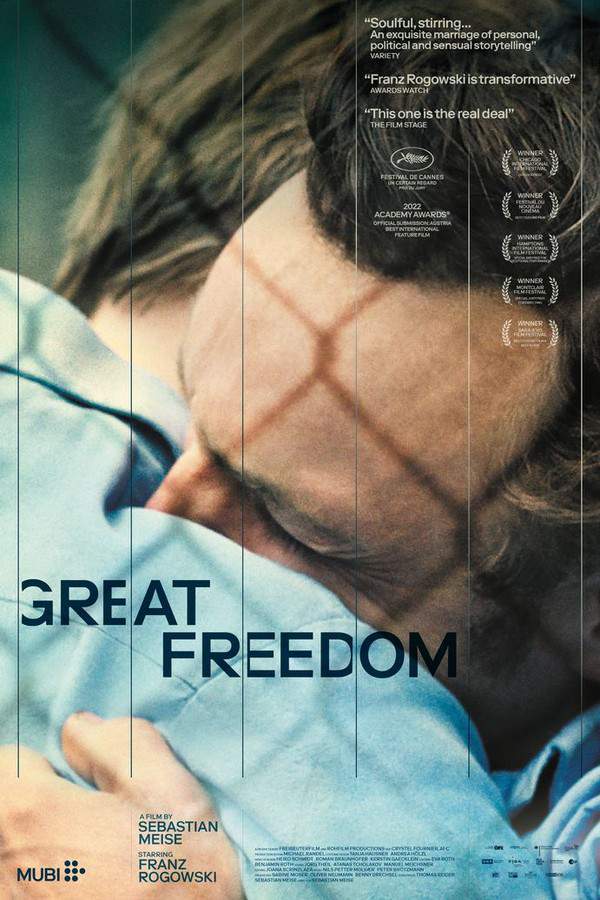
Great Freedom (2022) movie poster

Plot Summary

Great Freedom (2022) Plot Summary Explained

Release, runtime and language
2022 · 116 min · German
Echo score 88
JustWatch #22,033 4
Directed by
Sebastian Meise
Starring
Franz Rogowski, Anton von Lucke, Georg Friedrich, Klaus Huhle, Alfred Hartung, Andreas Patton

In post-war Germany, Hans is wrongly imprisoned due to his sexuality under Paragraph 175, a law criminalizing homosexual acts. As he repeatedly cycles through the prison system, he develops a profound and unbreakable bond with Viktor, a fellow inmate serving a life sentence. Their friendship offers solace and strength amidst the harsh realities of incarceration. The film explores themes of love, loss, and resilience, portraying a nation grappling with its complex and troubling history while two men fight for dignity and connection.

On this page (6)
  1. 1 Where to watch
  2. 2 What happens: full plot
  3. 3 Plot questions answered
  4. 4 Movie threads
  5. 5 Movies like Great Freedom
  6. 6 Every angle

Where to watch

Where to Watch Great Freedom (2022)

Where can you watch Great Freedom? Stream, rent or buy it in the US, including on MUBI, Amazon Video and Apple TV Store: current JustWatch availability with up-to-date prices.

Streaming availability powered by JustWatch

Full plot summary · contains spoilers

What Happens in Great Freedom: Full Plot Summary

The whole story of Great Freedom (2022) explained, from the opening scene to the final frame: every key event, every twist and what it all adds up to. Read it as a quick recap before the sequel, to check a scene you missed, or to finally understand what really happened.

In 1968, Hans Hoffmann finds himself behind bars due to his involvement in cottaging, a practice that leads to his imprisonment. His prison companion, Viktor Bix, is serving a daunting 20-year sentence for murder. Amid the grim surroundings, during their time in the yard, Hans spots a familiar face, a young gay man named Leo, who was once his partner in illicit encounters. Unfortunately, Hans's journey takes a darker turn as he faces solitary confinement, a time where he reflects on his tumultuous life.

Flashback to 1945, Hans was among the countless victims imprisoned in a concentration camp, targeted for his sexual orientation. Following the camp's liberation by Allied forces, instead of freedom, Hans is thrust into the same prison that will confine him again in 1968, since homosexuality remains a criminal offense. It is there he encounters Viktor, who initially displays aggression towards Hans. However, upon noticing the number tattooed on Hans's arm, a symbol of his past torment, Viktor's demeanor shifts, and he offers to mask the tattoo with a new design, to which Hans consents.

In 1957, Hans faces imprisonment once more after being caught living with his boyfriend, Oskar. Tragically, Oskar, who struggles with the societal constraints of their relationship, takes his own life. The devastating news is delivered to Hans by Viktor during their yard time, resulting in an emotional outburst as Hans weeps uncontrollably. In a bid to comfort him, Viktor embraces Hans, leading both to solitary confinement once again.

As Hans reenters the prison in 1968, he is struck by Viktor's drastic decline, marked by substance abuse. Leo, revealing a shocking betrayal, declares to the authorities that Hans coerced him into sexual acts. In a desperate attempt to ensure Leo's release, Hans signs a confession implicating himself. Soon after, convinced of Viktor's need for assistance, Hans proposes to help him overcome his drug addiction. Through bribery, Viktor secures a transfer to share a cell with Hans. During the harrowing withdrawal period, Viktor struggles, attempting to clandestinely use drugs. However, Hans intervenes, flushing the drugs down the toilet and embracing Viktor as he fights his addiction.

The following year, Hans comes across an issue of Der Spiegel that heralds the significant news of the partial repeal of Paragraph 175, which decriminalizes homosexual acts. This leads to mixed emotions as Hans informs Viktor of his impending release, stating he won’t return to prison.

Upon his release, Hans seeks solace at a local gay bar, where he witnesses men freely engaging in sexual acts. Overwhelmed by the stark contrast to his previous life, he abruptly exits the establishment. In a moment of desperation and rebellion, Hans grabs a brick and shatters the window of a jewelry store, filling his pockets with stolen items while waiting for the police to arrive, a poignant testament to his chaotic and tumultuous existence.
Last updated: May 12, 2025 at 07:03

Was this helpful?

Plot questions answered

Great Freedom Plot Explained: Your Questions Answered

The questions people ask most about Great Freedom (2022): what happens in the confusing scenes, why the characters do what they do, the twists, hidden details and what the ending means. Each answer contains spoilers.

Q1

Why is Hans still imprisoned after the concentration camp is liberated?

After Allied forces liberate the concentration camp in 1945, Hans is transferred directly to prison because homosexuality remains a criminal offense under German law. The Nazis' Paragraph 175, which criminalized homosexual acts, was never repealed, only slightly modified. This means Hans's liberation from the concentration camp does not grant him freedom; instead, he enters another prison system that continues to punish him for his sexual orientation.

  • paragraph 175
  • concentration camp
  • liberation
  • imprisonment
  • homosexuality
Q2

Why does Viktor offer to cover Hans's concentration camp tattoo?

Viktor initially treats Hans with aggression, but when he notices the number tattooed on Hans's arm, a Nazi concentration camp identifier, his demeanor shifts completely. Viktor recognizes that Hans is a survivor of the Holocaust who was imprisoned for being gay, not for criminal behavior. This moment creates a bond between them, and Viktor offers to cover the traumatic tattoo with a new design, showing compassion and solidarity with Hans's suffering.

  • viktor
  • tattoo
  • concentration camp
  • compassion
  • solidarity
Q3

Why does Oskar commit suicide in prison?

Oskar, Hans's boyfriend, struggles with the immense pressure of living authentically in a society that criminalizes their relationship. The weight of concealment, combined with the oppressive prison environment and societal constraints, becomes unbearable. He takes his own life while imprisoned, a tragic consequence of the homophobia that traps both men. Hans learns of this devastating news from Viktor during yard time, leading to an emotional breakdown.

  • oskar
  • suicide
  • prison
  • societal pressure
  • homosexuality
Q4

Why does Leo betray Hans to the authorities?

Leo, a former partner of Hans whom he encounters in prison in 1968, informs the authorities that Hans coerced him into sexual acts. This betrayal appears to be motivated by Leo's desire to secure his own release or gain favorable treatment from the authorities. Hans, desperate to ensure Leo gets out of prison, signs a false confession implicating himself, demonstrating how the oppressive system forces queer individuals to turn against each other.

  • leo
  • betrayal
  • confession
  • police
  • coercion
Q5

Why does Hans help Viktor overcome his drug addiction?

Hans proposes to help Viktor through his drug addiction because he sees how badly Viktor has deteriorated since their last encounter. Through bribery, Hans secures a cell transfer so they can be together, then supports Viktor through the agonizing withdrawal process. When Viktor secretly attempts to use drugs, Hans intervenes by flushing them down the toilet and embracing Viktor as he fights his addiction, demonstrating the profound loyalty and mutual support that defines their relationship.

  • viktor
  • drug addiction
  • withdrawal
  • prison
  • support
Q6

What happens after Paragraph 175 is partially repealed?

In 1969, Hans reads a Der Spiegel article announcing the partial repeal of Paragraph 175, which decriminalizes homosexual acts between consenting adults. This landmark legal change gives Hans hope for the first time. He informs Viktor of his impending release, stating he won't return to prison. However, the news brings mixed emotions, while legally a victory, Hans has been institutionalized for so long that freedom feels disorienting rather than liberating.

  • paragraph 175
  • decriminalization
  • repeal
  • freedom
  • legal change
Q7

Why does Hans vandalize the jewelry store at the end?

After his release, Hans visits a gay bar where he witnesses men engaging freely, something he was never allowed to experience. Overwhelmed by the stark contrast to his life of imprisonment and unable to process this new freedom, he abruptly leaves. In a desperate act of rebellion and chaos, he grabs a brick and smashes a jewelry store window, filling his pockets with stolen items while waiting for police. This act reflects his inability to adapt to freedom; institutionalized for decades, he chooses to return to the only world he understands, prison.

Foreshadowing: Earlier in the film, Hans repeatedly returns to prison, suggesting he cannot function outside it.

  • jewelry store
  • vandalism
  • freedom
  • prison
  • institutionalization
Q8

What crime did Viktor commit to receive a life sentence?

Viktor Bix is serving a 20-year sentence for murder, though the specific details of his crime are not detailed in the summary. His violent past initially creates tension with Hans, but over time, the two form a deep bond despite their different backgrounds, Viktor a murderer and Hans a political prisoner persecuted for his sexuality. Their friendship becomes the emotional core of the film, showing how shared suffering creates powerful connections.

  • viktor
  • murder
  • life sentence
  • cellmate
  • friendship
Q9

What is cottaging and why is Hans imprisoned for it?

Cottaging is a term for engaging in homosexual acts in public places, typically outdoor settings like public toilets or parks. In 1968, Hans is imprisoned for this offense under Paragraph 175, which criminalized homosexual acts between men. This relatively minor charge, compared to murder, highlights the disproportionate punishment faced by gay men in postwar Germany, setting the stage for Hans's continued cycle of imprisonment.

  • cottaging
  • imprisonment
  • paragraph 175
  • homosexuality
Q10

Why is Hans placed in solitary confinement?

Hans is placed in solitary confinement multiple times throughout the film. In 1968, it follows his emotional breakdown upon learning about Oskar's suicide, when his grief becomes visible to prison authorities. Both Hans and Viktor are punished for their emotional reaction, showing vulnerability in an environment that demands emotional suppression. The solitary confinement becomes a space for reflection, though it also intensifies the isolation they already experience.

  • solitary confinement
  • grief
  • punishment
  • isolation

Movie threads

More Movies Like Great Freedom, by Mood & Story

Curated lists built around what makes Great Freedom tick: the same mood, the same kind of story or the same emotional payoff. Each list explains why these movies belong together.

Prison and institutional oppression dramas like Great Freedom

Stories of enduring humanity within punishing systems designed to break the spirit. Viewers seeking movies like Great Freedom will find powerful dramas set within confining systems. These films explore themes of resilience, forbidden connections, and the fight for personal dignity against overwhelming institutional power, often with a heavy emotional weight and a slow, deliberate pacing.

  • claustrophobic
  • oppressive
  • resilient
  • somber
  • desperate
  • lonely
  • Tone: dark, somber, resilient
  • Pacing: slow, deliberate
Why these movies?

The story pattern: Narratives in this thread often unfold within a single, oppressive location, charting characters' long-term struggles against an unfeeling system. The plot is driven by internal resilience and the relationships that become lifelines, showing how people adapt, resist, or become tragically shaped by their confinement over extended periods.

Why they belong together: These movies are grouped by their shared setting of systemic confinement and their exploration of the human spirit under duress. They create a palpable sense of claustrophobia and focus on the slow burn of emotional survival, making the few moments of connection feel monumental.

Movies with tragic resilience and bleak endings like Great Freedom

Journeys where the system is challenged, but personal freedom remains an elusive dream. If you appreciated the complex, bittersweet conclusion of Great Freedom, this thread collects films where characters overcome injustice but are personally defeated. These narratives explore the deep psychological costs of survival, often ending on a poignant or heartbreaking note despite external success.

  • bleak
  • tragic
  • resilient
  • melancholic
  • somber
  • psychological
  • Tone: bleak, melancholic, tragic
  • Pacing: slow, cyclical
Why these movies?

The story pattern: The narrative pattern involves a long, arduous fight against an unjust system, leading to a nominal win—a legal change, an exposed truth. However, the emotional arc concludes with the protagonist's personal defeat, unable to escape the psychological prison their experiences have built, resulting in a deeply resonant and tragic ending.

Why they belong together: These films are united by their specific emotional trajectory: the dissonance between external success and internal collapse. They resonate because they honestly portray the deep, often permanent, scars left by prolonged trauma and oppression, offering a more complex and somber reflection on victory.

If you liked this

Movies Like Great Freedom

Similar movies to Great Freedom: the same genre, themes or kind of story. Each one comes with its own plot summary, timeline and ending explained.

Browse all movie summaries

Every angle

Great Freedom (2022) Explained: Plot, Timeline & Characters

Everything about Great Freedom in one place: what happens in the plot summary, the timeline in chronological order, the characters and meaning and a spoiler-free summary. What's After the Movie adds the cast, box office and post-credit scenes.

Coming soon on iOS and Android

The Plot Explained Movie Summary App

Plot summaries, endings explained and timelines on your phone. Catch up on any movie in minutes, save your favorites and never miss a twist again.

Be the first to know when we launch. Your email stays private, always.

Learn more about the app