Plot Explained Spoilers guaranteed!
Plot Explained

Browse by genre

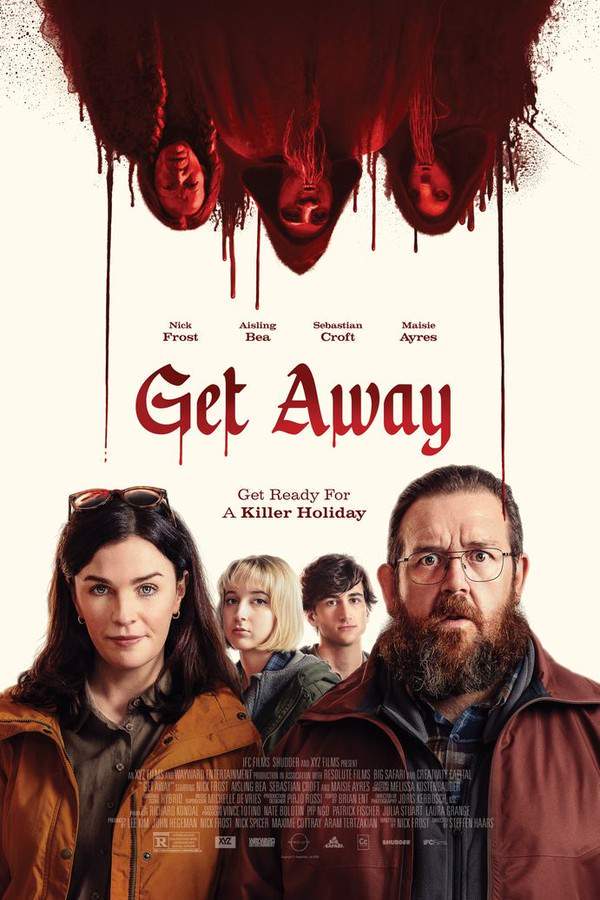
Get Away (2024) movie poster

Plot Summary

Get Away (2024) Plot Summary & Ending Explained

Release, runtime and language
2024 · 1 h 26 m · British english
Echo score 45
Directed by
Steffen Haars
Starring
Nick Frost, Aisling Bea, Ville Virtanen, Eero Milonoff, Jouko Ahola, Sebastian Croft

A family’s vacation to the isolated Swedish island of Svalta takes an unsettling turn when they arrive during preparations for a local festival with a dark history. Finding the islanders unwelcoming and the rituals strange, the Smiths struggle to enjoy their trip, clinging to the island’s natural beauty. As the festival approaches, they uncover a sinister secret and a terrifying reality: a serial killer is preying on the island.

On this page (6)
  1. 1 What happens: full plot
  2. 2 Plot questions answered
  3. 3 How it ends
  4. 4 Movie threads
  5. 5 Movies like Get Away
  6. 6 Every angle

Full plot summary · contains spoilers

What Happens in Get Away: Full Plot Summary

The whole story of Get Away (2024) explained, from the opening scene to the final frame: every key event, every twist and what it all adds up to. Read it as a quick recap before the sequel, to check a scene you missed, or to finally understand what really happened.

We are introduced to the Smith family—a quintessentially British clan about to swap city life for a coastal holiday. Father Richard, mother Susan, sister Jessie, and brother Sam appear to be a typical modern family, with the teenagers rubbing against their parents’ more measured pace. Their plan to catch a ferry to a remote island starts to feel off almost as soon as they arrive at the seaside restaurant, where the locals’ reactions run from wary to unnatural. The restaurateur and his wife warn them that the island is “forbidden” during Karantan, a superstition that is echoed by the ferry conductor and the ferry’s passengers, who stare with something more than ordinary curiosity.

When the Smiths disembark, the shoreline greets them with an uneasy silence—the kind that signals that things on the island are not as welcoming as they seem. The islanders, led by the stern elder Klara, make it clear that outsiders are not welcome. Susan’s curiosity is piqued by a buried family history—an ancestor who fought in a brutal massacre that one of Karantan’s stories claims as its center—and she wonders what truth might lie behind the island’s strict rules. Yet the locals’ hostility remains, and the family’s attempt to stay and understand what’s happening is met with mounting tension.

The plot thickens when Mats Larsson [Eero Milonoff], the owner of the bed-and-breakfast where the Smiths are staying, steps forward to invite them into the house. Mats’s warmth feels calculated, and his behavior oscillates between cordial and unsettling. The interior of the cottage is cozy and inviting, a stark contrast to Mats’s odd, almost obsessive demeanor—especially around Jessie. As Jessie begins to sense that she’s being watched, even during a private moment in her room, a sense of claustrophobic danger settles in.

That night, ominous signs intensify. Torches flare outside their home, and the Smiths discover the islanders’ troubling habit of gathering at their courtyard and leaving a chilling foreboding scene—an animal’s carcass on the doorstep that stirs fear and confusion in the family. Richard’s guarded calm and Susan’s suspicions reveal a marriage under strain, with hints of hidden experiences from Richard’s past that surface as the day’s quiet unease grows.

The islanders’ vigilance grows sharper as the Smiths explore the area. Richard and Susan notice boats from the mainland carrying coffins, a disturbing reminder that death and ritual are never far from the surface here. Jessie and Sam, too, encounter the locals’ strange hospitality—mask-wearing figures and coffins marked with ominous hints—before being pushed to leave the breakfast room. The siblings’ reactions are more defiant than their parents’, a small strand of resistance in a setting designed to break outsiders down.

A chilling moment unfolds when Jessie discovers a personal item out of place and a hidden danger behind a full-length mirror in her room, hinting at Mats’s secret life and his invasive interest in her. The elder Klara remains relentless, pressing on with a ritualistic fervor that she believes will secure the community’s future, even as younger members show signs of reluctance.

As the Karantan ritual advances, Mats is drawn deeper into the scheme. He uses a scheme involving drugged biscuits to entice the guests, seeking to satisfy a perverse appetite in exchange for delivering bodies to the community for feasting. The Smiths’ true nature is revealed in a shocking twist: they are not ordinary vacationers but a family with a history of killing, who have come to enact what they call a “slaycation.”

The chilling premise—Britain’s ostensibly ordinary family reveals itself as serial killers—unfolds with brutal clarity. The earlier hints of violence, including the restaurant beheading of a swan and a past murder by Richard, align with the present carnage as the Smiths begin to turn on the islanders with ruthless efficiency. As the islanders push back, the family’s plan to remain undetected begins to crumble. Sam and Jessie play key roles in resisting the locals and confronting the broader conspiracy at the heart of the island’s traditions.

The confrontation intensifies as Klara’s dogmatic grip on the community collides with the Smiths’ predatory pragmatism. The Smiths, in turn, uncover the island’s surveillance setup and a hidden tunnel, which give them a tactical edge in their deadly game. In a climactic turn, police involvement arrives via a mainland detective who misreads the situation, seeing the islanders as aggressors while the Smiths’ violent spree continues to unfold. The detective’s arrival barely postpones the inevitable.

In the final act, the Smiths escape into a rough, bloody relief—though not without cost. A brutal standoff leaves one of the siblings gravely wounded, and the truth about Sam’s role—revealed as a hired killer—casts a new light on the group’s dynamics and Richard’s erratic, explosive temper. Klara’s last attempt to salvage control ends in a shocking confrontation with the law, as she is shot by the police inspector, who has been chasing the truth behind the killings.

The story closes on a paradoxical note: the Smith family is alive, albeit battered and scarred, and they depart the island by speedboat with a grim, almost delirious satisfaction. What begins as a misfit holiday becomes a savage, if darkly comic, meditation on family, ritual, and the lure of violence. The island’s strange, deadly customs collide with a family’s long-buried impulses, producing a tonal blend of suspense and teeth-clenching dark humor that lingers long after the credits roll.
Last updated: December 30, 2025 at 11:34

Was this helpful?

Plot questions answered

Get Away Plot Explained: Your Questions Answered

The questions people ask most about Get Away (2024): what happens in the confusing scenes, why the characters do what they do, the twists, hidden details and what the ending means. Each answer contains spoilers.

Q1

Why are the islanders so hostile to the Smith family?

The islanders are hostile because the Smiths arrived during Karantan, a festival with a dark history tied to a brutal massacre. Additionally, outsiders are generally unwelcome, and the locals are protective of their rituals. The hostility intensifies as the family refuses to leave despite multiple warnings.

Foreshadowing: Early scenes at the restaurant and ferry show locals warning the family that the island is forbidden during this time.

  • islanders
  • hostility
  • karantan
  • warnings
  • ritual
Q2

What is the Karantan festival?

Karantan is a Swedish island festival with a dark history involving ritual sacrifice and cannibalism. The locals treat it as a sacred time when certain traditions are observed, traditions that involve death and preparation of bodies for consumption. The festival occurs annually and is kept secret from outsiders.

Foreshadowing: The restaurateur warns the Smiths that the island is 'forbidden' during Karantan, and coffins arriving from the mainland hint at the festival's grim nature.

  • karantan
  • festival
  • sacrifice
  • cannibalism
  • ritual
Q3

Who is Mats Larsson and why is he creepy?

Mats owns the bed-and-breakfast where the Smiths stay. His behavior is unsettling because he has perverse intentions, particularly toward Jessie. He installs a hidden mirror in her room to watch her, and during Karantan, he drugs biscuits hoping to control and exploit his guests before delivering their bodies to the community for feasting.

Foreshadowing: Jessie discovers voices behind her mirror and notices personal items disturbed, revealing Mats's secret surveillance.

  • mats larsson
  • bed and breakfast
  • mirror
  • surveillance
  • drugged biscuits
Q4

What does 'slaycation' mean in the movie?

Slaycation is the Smith family's dark term for a murder vacation, a trip designed specifically to kill people. The family are revealed to be serial killers who chose Karantan island deliberately because they knew it would provide cover for their crimes, with the festival's violence making their murders blend in.

Foreshadowing: Earlier hints include Richard's calm demeanor during threats and a reference to a past murder Richard committed.

  • slaycation
  • serial killers
  • murder vacation
  • smith family
Q5

Why does the Smith family stay on the island despite all the warnings?

The family stays because they are not innocent tourists, they are serial killers who came to the island intentionally. The warnings about Karantan actually appeal to them because the festival's violent traditions provide the perfect cover for their own killing spree. Their 'vacation' is actually a planned murder trip.

Foreshadowing: The family's unnatural calm amid escalating threats contrasts with typical tourist behavior.

  • warnings
  • stay
  • serial killers
  • intentions
Q6

What's behind the mirror in Jessie's room?

Behind the full-length mirror in Jessie's room is a hidden observation point that Mats uses to watch her. She hears voices coming from behind it and discovers her personal items have been moved, revealing that he's been secretly observing her, particularly during private moments like her bath.

Foreshadowing: Jessie notices something feels wrong in her room before she discovers the mirror's secret.

  • mirror
  • hidden room
  • surveillance
  • jessie
  • mats
Q7

Why do the Smiths kill Mats?

The Smiths kill Mats because they are serial killers who came to the island to murder. When Mats brings drugged biscuits hoping to incapacitate them, they pretend to eat them and use the opportunity to lure him in. They reveal their true nature and kill him as part of their planned killing spree during Karantan.

Foreshadowing: Mats's drugged biscuits and the family's earlier threats establish their violent capabilities.

  • mats
  • kill
  • serial killers
  • drugged biscuits
  • reveal
Q8

Is Sam actually a hired killer?

Yes, Sam is revealed to be a hired killer, not biologically related to the Smiths in that sense. During the climax, Richard stabs Sam and reveals that Sam was hired as a professional killer to assist the family. This revelation comes during a moment when the family's facade breaks down and internal tensions surface.

Foreshadowing: Sam's combat skills and cold efficiency during the massacre hint at professional killing experience.

  • sam
  • hired killer
  • reveal
  • richard
  • family dynamic
Q9

Why does Richard stab Sam?

Richard stabs Sam to reveal that Sam is a hired killer, not a biological son. This violent moment exposes the family's true nature, their relationships are built on hired help rather than blood ties. The stabbing also serves as a turning point showing the family's willingness to turn on each other under pressure.

Foreshadowing: Earlier family tensions and Richard's explosive temper foreshadow this violent reveal.

  • richard
  • sam
  • stab
  • hired killer
  • reveal
Q10

Why does the detective shoot Klara?

The detective misinterprets the situation, believing the islanders are attacking the Smiths as tourists. When Klara confronts him during the chaotic climax, he shoots her in what he sees as protecting the family from the 'aggressive' locals. This misunderstanding allows the Smiths to escape while the local authority is eliminated.

Foreshadowing: The detective's arrival is foreshadowed by mainland coffins and the escalating conflict.

  • detective
  • klara
  • shoot
  • misunderstanding
  • police
Q11

Do the Smiths escape the island?

Yes, the Smiths escape the island. Despite being battered and having one family member gravely wounded, they are taken by speedboat back to the mainland. The film ends with them returning home, bloodied but alive, and displaying a disturbing sense of triumph from their killing spree.

Foreshadowing: The family's survival is established early through their calculated, cold-blooded efficiency.

  • escape
  • mainland
  • speedboat
  • survival
  • ending
Q12

What is the main twist in Get Away?

The main twist is that the Smith family are not ordinary tourists but serial killers who deliberately chose to visit the island during Karantan. Their 'vacation' is actually a planned 'slaycation', a murder trip designed to exploit the festival's chaos. The family has killed before and came to the island specifically to kill again, using the festival's dark traditions as cover.

Foreshadowing: Early hints include the restaurant swan beheading, Richard's unexplained calm, and the family's reluctance to leave despite danger.

  • twist
  • serial killers
  • slaycation
  • reveal
  • smith family

Ending explained

What Happens at the End of Get Away?

How Get Away (2024) ends, in short: the final scene, the last twist and what it means for the characters. The full ending explained, with every spoiler, lives on its own page.

Read the full ending explained

In the end, it is revealed that the Smith family, who initially appeared to be normal tourists, were actually a family of serial killers. They had come to the island with the intention of repeating the brutal history of the locals’ ancestors—who once resorted to cannibalism to survive. The family’s true nature was uncovered after they drugged themselves with Matts’ cookies, which contained a sleeping agent. While unconscious, they were vulnerable and revealed their murderous side: Robert and Susan had been working together for some time to kill and hunt for their own thrill, with Jessie and Sam joining in their bloodlust. The family stabbed Matts in retaliation for his voyeurism and then turned on the remaining inhabitants, killing people at random and mimicking the island’s gruesome past.

Klara, the community leader, refused to accept the massacre and plotted to continue the tradition of sacrifice, hoping to offer the English family to their ancestors. However, her obsession blinded her to the chaos unfolding, and she was ultimately shot by Detective Forsberg, who mistook her for the true culprit. In the chaos, the family managed to escape with the help of the police, who believed them to be victims. As the dust settled, it became clear that the Smith family had successfully hidden their murderous nature by pretending to be an ordinary family. Their ability to blend in undetected allowed them to continue their pattern of hidden violence, setting the stage for their continued presence as a dangerous, untraceable serial killer family. The island was left silent, with the horrific cycle of violence repeating itself, seemingly never to be stopped. The ending underscores how appearances can be deceiving and how evil can lurk behind the most ordinary facades.

Get Away ending explained in full

Movie threads

More Movies Like Get Away, by Mood & Story

Curated lists built around what makes Get Away tick: the same mood, the same kind of story or the same emotional payoff. Each list explains why these movies belong together.

Movies like Get Away with sinister isolated communities

Stories of outsiders discovering a peaceful-seeming community with a horrifying secret. If you enjoyed the unsettling discovery of the island's dark secret in Get Away, you'll find more chills here. These films feature ordinary people stumbling upon communities with terrifying rituals and hidden agendas, blending horror with a slow-burn sense of paranoia.

  • claustrophobic
  • sinister
  • unsettling
  • paranoid
  • ritualistic
  • isolated
  • Tone: dark, unsettling, sinister
  • Pacing: steady, methodical build
Why these movies?

The story pattern: The narrative typically follows protagonists as they arrive in a seemingly idyllic but remote setting. Initial unease grows as they observe strange local customs, leading to the shocking revelation of a sinister practice—be it cult-like behavior, cannibalism, or ritual sacrifice. The story becomes a desperate fight for survival against a unified, hostile group.

Why they belong together: Movies in this thread are united by the core theme of a 'utopia' that is actually a dystopia, creating a powerful sense of betrayal and claustrophobia. The shared experience is one of escalating dread as the protagonists realize the true nature of their hospitable captors.

Movies with a tone like Get Away's darkly comic horror

Horror stories where brutal survival is punctuated by wicked, unsettling humor. Fans of the grim humor mixed with savage survival in Get Away will appreciate these selections. These films balance horrific situations with a macabre sense of comedy, often featuring morally ambiguous characters and a palpable, tense atmosphere.

  • darkly comic
  • tense
  • savage
  • morally ambiguous
  • brutal
  • unsettling
  • Tone: dark, tense, darkly comic
  • Pacing: steady, escalating
Why these movies?

The story pattern: The narrative often follows characters who are either perpetrators or victims of extreme violence, using dark humor as a coping mechanism or as a reflection of their warped worldview. The plot balances moments of genuine terror with bursts of shocking or ironic comedy, maintaining a steady, tense pace that keeps the audience off-balance.

Why they belong together: These films are grouped together because they masterfully balance two contrasting tones without letting either one dominate. The shared vibe is one of uncomfortable laughter in the face of dread, creating a unique emotional mix that is both thrilling and thought-provoking.

If you liked this

Movies Like Get Away

Similar movies to Get Away: the same genre, themes or kind of story. Each one comes with its own plot summary, timeline and ending explained.

Browse all movie summaries

Every angle

Get Away (2024) Explained: Plot, Ending, Timeline & Characters

Everything about Get Away in one place: what happens in the plot summary, the timeline in chronological order, the characters and meaning, the ending explained and a spoiler-free summary. What's After the Movie adds the cast, box office and post-credit scenes.

Coming soon on iOS and Android

The Plot Explained Movie Summary App

Plot summaries, endings explained and timelines on your phone. Catch up on any movie in minutes, save your favorites and never miss a twist again.

Be the first to know when we launch. Your email stays private, always.

Learn more about the app