






Plot Explained Spoilers guaranteed!
Plot Explained

Browse by genre

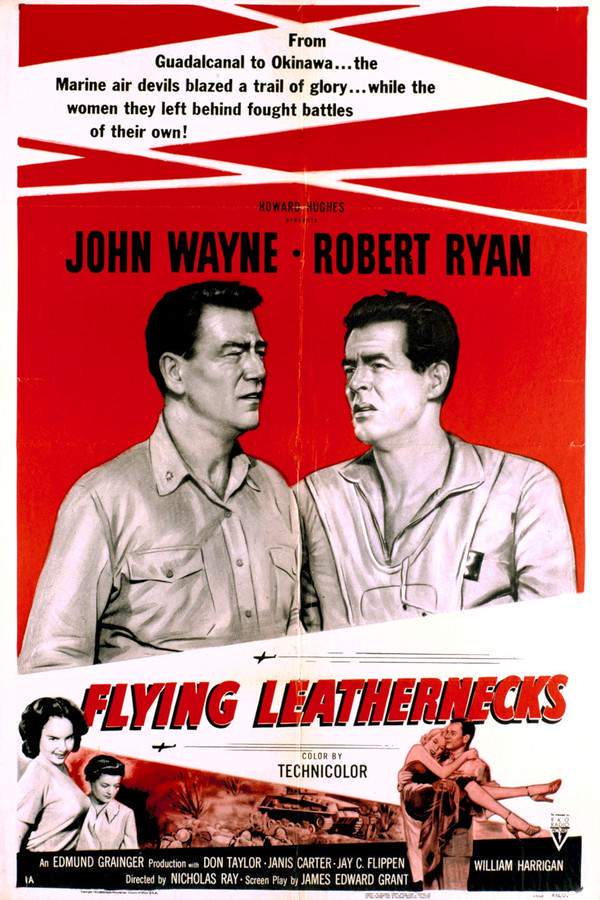
Flying Leathernecks (1951) movie poster

Timeline

Flying Leathernecks (1951) Timeline Explained – Every Event in Order

Release, runtime and language
1951 · 102 min · English
Directed by
Nicholas Ray
Starring
John Wayne, Robert Ryan, Barry Kelley, Jay C. Flippen, Adam Williams, Don Taylor

During the Korean War, Marine Major Daniel Kirby demands strict adherence to discipline among his fighter pilots. His intense leadership style puts him at odds with Captain Carl Griffin, whose independent spirit challenges Kirby’s authority. As tensions rise, the men face intense aerial combat and must confront their personal boundaries and make critical decisions under pressure, testing their courage and loyalty in the face of war.

On this page (6)
  1. 1 Where to watch
  2. 2 Events in order (14)
  3. 3 Timeline questions answered
  4. 4 Movie threads
  5. 5 Movies like Flying Leathernecks
  6. 6 Every angle

Where to watch

Where to Watch Flying Leathernecks (1951)

Where can you watch Flying Leathernecks? Stream, rent or buy it in the US, including on YouTube Free, Amazon Video and Apple TV Store: current JustWatch availability with up-to-date prices.

Streaming availability powered by JustWatch

14 events in order · contains spoilers

Flying Leathernecks Timeline: Events in Chronological Order

Every key event of Flying Leathernecks (1951) in order, scene by scene, with when and where it takes place. Use it to untangle flashbacks, time jumps and parallel storylines, to refresh your memory before the sequel or to find the exact scene you are thinking of.

  1. Major Dan Kirby Joins VMF-247

    Major Dan Kirby unexpectedly takes command of the VMF-247 squadron, also known as the 'Wildcats.' The squadron had anticipated Captain Carl 'Grif' Griffin to lead them, but Kirby's arrival ushers in a more rigorous leadership style.

  2. Chaos in the Guadalcanal Campaign

    As the Guadalcanal campaign intensifies, Kirby faces the enormous challenge of leading with limited aircraft against relentless enemy assaults. The airfield becomes a focal point of conflict as the enemy increasingly targets their position.

    Where
    Guadalcanal
  3. Struggles with Youthful Pilots

    Kirby's pilots, composed of young and often reckless aviators, struggle to adhere to his strict orders. This recklessness poses a significant risk to both their safety and the aircraft they are flying, further complicating Kirby's command during intense missions.

  4. Conflict with Griffin

    A notable friction develops between Kirby and Griffin due to their contrasting leadership styles. While Kirby is relentless and focused on tactics, Griffin tends to favor a more compassionate approach, particularly affecting their interactions during missions.

  5. Advocating for Low-Level Support

    Kirby passionately advocates for aggressive low-level ground support to assist the Marines on the battlefield. Initially faced with disapproval from higher command, his tactics later gain acceptance as the Marines find themselves in a dire situation.

  6. Success Despite Casualties

    Despite mounting casualties in his squadron, Kirby's tactics begin to show results. His leadership culminates in a daring attack on a significant Japanese convoy, marking one of the squadron's major victories during the campaign.

    Where
    Guadalcanal
  7. Clancy's Unconventional Strategies

    The squadron's line chief, MSgt Clancy, employs inventive methods to secure critical supplies for their operations. Although his strategies prove effective, they lead to a significant reduction in his rank by the story's end, highlighting the harsh realities of military life.

  8. Promotions and Reassignments

    As the campaign progresses, Kirby earns a promotion to Lieutenant Colonel, while Griffin rises to the rank of Major. Both officers receive reassignment orders, first to Hawaii and subsequently to Washington D.C.

    Where
    Hawaii, Washington D.C.
  9. Return to the Pacific Theater

    Seizing an opportunity to return to the Pacific, Kirby looks forward to reapplying his low-level attack tactics. He reunites with his aircrew, who are now equipped with the advanced F4U Corsair fighters as they prepare for their next challenge.

  10. Engagement in the Battle of Okinawa

    Kirby and his crew face intense resistance during the Battle of Okinawa, marked by fierce fighting and Kamikaze assaults. Their strategy emphasizes aggressive low-level engagements, putting their training and endurance to the ultimate test.

    Where
    Okinawa
  11. Griffin's Heartbreaking Decision

    Amidst the chaos of battle, Griffin faces a devastating choice when he withholds support from his brother-in-law Blithe. This critical decision results in Blithe's tragic death, leaving Griffin haunted by regret.

  12. Kirby's Catastrophic Crash

    During a dramatic confrontation, Kirby's aircraft malfunctions, leading to a catastrophic crash with a bomber. Although he survives the burning wreckage, his injuries necessitate a rescue by a Navy launch, further challenging his resolve.

  13. Entrusting Command to Griffin

    As he prepares to depart from the squadron, Kirby entrusts command of VMF-247 to Griffin. This gesture signifies Kirby's recognition of Griffin's leadership abilities, marking a transition in trust between the two men.

  14. The Promise of Reunion

    The parting between Kirby and Griffin is marked by a heartfelt promise of reunion, emphasizing the deep bond forged in the heat of battle. Kirby acknowledges the torment of leadership and the burden of decisions that both he and Griffin must carry.

Last updated: November 15, 2024 at 20:00

Was this helpful?

Timeline questions answered

Flying Leathernecks Timeline Explained: Your Questions Answered

When does it happen, and why in that order? The questions people ask about the chronology of Flying Leathernecks (1951): time jumps, flashbacks, cause and effect between scenes and the correct order of events, each answered with spoilers.

Q1

Why does Major Kirby take command instead of Captain Griffin?

Major Kirby unexpectedly takes command of VMF-247 because higher command assigns him to the position, despite the squadron expecting Captain Griffin to lead them. Kirby's strict, no-nonsense leadership style was specifically chosen to address the chaotic situation at Guadalcanal, where the squadron needed disciplined leadership to manage limited aircraft and reckless young pilots.

Foreshadowing: The tension between Kirby's arrival and the squadron's expectations foreshadows the ongoing conflict with Griffin throughout the film.

  • major kirby
  • captain griffin
  • vmf-247
  • command
  • leadership
Q2

Why is Kirby so strict with his pilots?

Kirby maintains strict discipline because he understands the gravity of sending young pilots into deadly combat missions. With limited aircraft and relentless enemy attacks on their airfield, any recklessness directly threatens both pilot lives and the squadron's ability to operate. His strictness stems from responsibility, he must ensure pilots follow orders to maximize survival rates during dangerous missions.

Foreshadowing: Early scenes showing Kirby's frustration with reckless pilots establish his tense relationship with Griffin, who favors a more compassionate approach.

  • kirby
  • pilots
  • discipline
  • strict
  • war
  • guadalcanal
Q3

Why does Griffin withhold support from Blithe, leading to his death?

Griffin makes the agonizing decision to withhold support from his brother-in-law Vern 'Cowboy' Blithe during a critical moment in battle. This tragic choice reflects the impossible burden of command, Griffin must prioritize the overall mission and his men's safety over personal relationships. The decision haunts Griffin because his brother-in-law died as a direct result of this tactical choice.

Foreshadowing: Earlier tensions between Griffin's compassionate nature and Kirby's tactical demands foreshadow this heartbreaking moment where Griffin must choose between personal loyalty and military duty.

  • griffin
  • blithe
  • brother-in-law
  • death
  • choice
  • command
Q4

Why are Kirby's low-level attack tactics initially disapproved by high command?

Kirby's aggressive low-level ground support tactics face disapproval from high command because they consider the approach too risky and unconventional. However, when Marines on the ground face grave danger during the Guadalcanal campaign, high command authorizes Kirby's tactics, proving effective against Japanese positions despite the inherent dangers.

Foreshadowing: The initial disapproval sets up Kirby's eventual success with these tactics during the major convoy attack.

  • low-level tactics
  • high command
  • disapproval
  • guadalcanal
  • attack
Q5

What causes Kirby's crash during the Battle of Okinawa?

Kirby's aircraft malfunctions during intense combat at Okinawa, causing him to collide with a bomber. Despite the catastrophic crash and burning wreckage, Kirby survives with injuries and is rescued by a Navy launch. This event marks a turning point where Kirby, physically incapacitated, must entrust his squadron to Griffin.

Foreshadowing: Earlier combat scenes with Kamikaze attacks foreshadow the extreme danger Kirby faces during Okinawa.

  • kirby
  • crash
  • okinawa
  • bomber
  • injury
  • rescue
Q6

Why is Clancy demoted from Sergeant to Private First Class?

MSgt Clancy, the squadron's line chief, employs unconventional strategies to secure essential supplies for their operations. Although his inventive methods effectively enhance the squadron's capabilities, military authorities reduce his rank to Private First Class. This demotion highlights the harsh realities of military discipline, where unauthorized methods, even successful ones, can result in consequences despite positive outcomes.

Foreshadowing: Clancy's resourceful behavior throughout the film establishes his willingness to bend rules for results.

  • clancy
  • demoted
  • sergeant
  • private first class
  • supply
  • rank
Q7

How does the relationship between Kirby and Griffin evolve throughout the film?

Kirby and Griffin begin at odds due to their contrasting leadership styles, Kirby's relentless discipline versus Griffin's compassion. Their relationship evolves through shared combat experiences and mutual respect. By the end, Kirby recognizes Griffin's capacity to prioritize pilot welfare and entrusts him with command of VMF-247, marking a complete transformation from conflict to trust.

Foreshadowing: Early friction between the two characters establishes the tension that resolves in Kirby's final decision.

  • kirby
  • griffin
  • relationship
  • evolution
  • command
  • trust
Q8

Why does Kirby entrust command of VMF-247 to Griffin at the end?

After surviving his crash and being rescued, Kirby leaves the squadron and explicitly chooses Griffin to take command because he finally recognizes Griffin's true leadership capability. Kirby acknowledges that Griffin possesses the crucial ability to prioritize his pilots' lives above all else, a quality Kirby admits he struggles with himself. This transfer represents Kirby's growth and acceptance of Griffin's different but equally valid approach to command.

Foreshadowing: The earlier conflict between Kirby's tactical approach and Griffin's compassionate style builds toward this moment of recognition.

  • kirby
  • griffin
  • command
  • vmf-247
  • leadership
  • trust
Q9

What does Kirby mean when he calls leadership a nightmare?

Kirby describes the burden of command as a nightmare because he must continuously make life-and-death decisions that send young pilots into dangerous missions. The weight of knowing his orders directly impact whether men live or die, combined with impossible choices like the one Griffin faced with Blithe, represents the psychological torment of leadership in war. Both Kirby and Griffin share this burden, making their parting emotional as Kirby acknowledges the heavy cost of command.

Foreshadowing: The buildup of casualties and difficult decisions throughout the film culminates in this acknowledgment of war's psychological toll.

  • kirby
  • leadership
  • nightmare
  • burden
  • decisions
  • war
Q10

What is the significance of the F4U Corsair fighters?

The F4U Corsair represents technological advancement in the Pacific theater. When Kirby returns to combat after his promotion, his aircrew is equipped with these advanced fighter planes. The Corsairs enable more effective low-level attacks against Japanese positions during the Battle of Okinawa, allowing the squadron to face intense Kamikaze resistance with improved capabilities.

Foreshadowing: Earlier scenes showing the squadron's limited aircraft establish the significance of receiving superior equipment.

  • f4u corsair
  • fighters
  • technology
  • okinawa
  • aircraft
Q11

Why is Griffin's relationship with Blithe significant to the story?

Vern 'Cowboy' Blithe is Griffin's brother-in-law, making his death under Griffin's command especially devastating. This personal connection creates the central emotional tragedy of the film, Griffin must order or withhold support for his own family member, and the consequences of his decision result in Blithe's death. This tragedy underscores the impossible personal sacrifices required of military leaders.

Foreshadowing: Early mentions of Blithe being Griffin's brother-in-law establish the personal stakes that culminate in the tragic decision.

  • griffin
  • blithe
  • brother-in-law
  • family
  • death
  • tragedy

Movie threads

More Movies Like Flying Leathernecks, by Mood & Story

Curated lists built around what makes Flying Leathernecks tick: the same mood, the same kind of story or the same emotional payoff. Each list explains why these movies belong together.

Military leadership dramas with heavy emotional weight like Flying Leathernecks

Stories of leaders grappling with the heavy responsibility of sending soldiers into battle. If you enjoyed the stressful command decisions in Flying Leathernecks, explore other movies about military leadership under fire. This thread features similar war stories where leaders face moral dilemmas, the heavy cost of orders, and the psychological strain of authority, perfect for fans of intense, character-driven war dramas.

  • commanding
  • stressful
  • oppressive
  • gripping
  • resigned
  • brooding
  • Tone: tense, brooding, melancholic
  • Pacing: fast, mission-driven
Why these movies?

The story pattern: These narratives follow a commanding officer or leader whose primary conflict is internal and interpersonal, often clashing with subordinates over strategy and morale. The plot is driven by a series of escalating crises that test their resolve, culminating in significant loss and a bittersweet recognition of the sacrifices made for the larger mission.

Why they belong together: They are grouped by their intense focus on the burden of command, a tense and oppressive tone driven by moral conflict, and a heavy emotional weight stemming from wartime casualties and psychological trauma.

High-intensity aerial combat war movies similar to Flying Leathernecks

Gripping stories of fighter pilots facing relentless combat and tragic losses. For fans who loved the fast-paced dogfights and high stakes of Flying Leathernecks, this thread collects movies focused on intense aerial combat. Discover similar films featuring stressful missions, pilot camaraderie, and the tragic cost of war in the skies, offering a gripping and melancholic look at warfare from above.

  • tense
  • gripping
  • stressful
  • melancholic
  • brooding
  • aerial combat
  • Tone: tense, gripping, melancholic
  • Pacing: fast, action-packed
Why these movies?

The story pattern: Stories in this thread unfold through a linear sequence of combat missions, each raising the stakes and inflicting losses on the central group of pilots. The narrative is straightforward, driven by action and survival, while exploring themes of sacrifice, loyalty, and the psychological impact of witnessing death from a unique, detached-yet-intimate perspective.

Why they belong together: They share a high-intensity, fast-paced structure centered on aerial battle sequences, a consistently tense and gripping mood, and a heavy emotional weight derived from wartime sacrifice and the high risk of casualty in every engagement.

If you liked this

Movies Like Flying Leathernecks

Similar movies to Flying Leathernecks: the same genre, themes or kind of story. Each one comes with its own plot summary, timeline and ending explained.

Browse all movie summaries

Every angle

Flying Leathernecks (1951) Explained: Plot, Timeline & Characters

Everything about Flying Leathernecks in one place: what happens in the plot summary, the timeline in chronological order, the characters and meaning and a spoiler-free summary. What's After the Movie adds the cast, box office and post-credit scenes.

Coming soon on iOS and Android

The Plot Explained Movie Summary App

Plot summaries, endings explained and timelines on your phone. Catch up on any movie in minutes, save your favorites and never miss a twist again.

Be the first to know when we launch. Your email stays private, always.

Learn more about the app