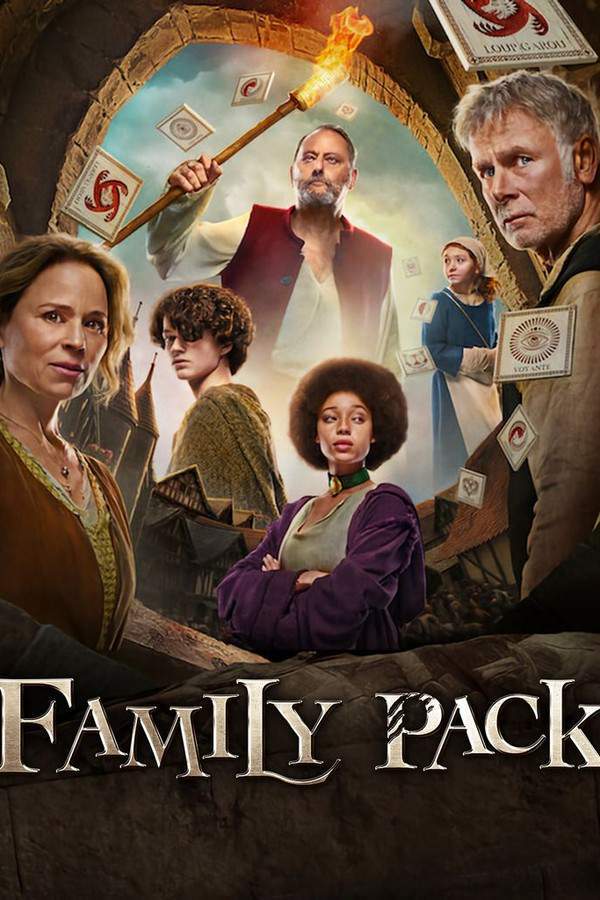
In 2024, Jérôme Vassier travels with his family to visit his father, Gilbert, who is living with Alzheimer's. He is accompanied by his wife, Marie, their daughter Louise, his daughter Clara from a previous union, and Théo, Marie’s son from a prior marriage. What begins as a playful nudge to play a game called Werewolves quickly spirals into an unsettling test of reality. When the family refuses the idea, the moment deflates, and an earthquake rattles the home.
As the tremor subsides, the house feels unfamiliar, and Clara vanishes. The Vassiers search for her and drift toward the village, noting eerie changes that initially seem tied to a medieval festival underway in the area. What they think might be staged appears to be something far more perilous: they witness the public execution of a shepherd condemned as a werewolf by the village captain, while reports of killings by beasts haunt the countryside. It becomes clear that the game has hurled them back to 1497, and the only way to win is to kill the four werewolves.
Their first obstacle is the captain and his retinue, who have seized Childéric’s house, an ancestor of the Vassiers suspected of witchcraft. The family manages a narrow escape when Jérôme frames them as a traveling troupe, “Daniel Baladin and the Baladettes,” a ruse strengthened by his musical skill. As a music teacher, he proves the claim by singing Mon fils ma bataille while playing the lute.
In this anachronistic world, Clara reappears as invisible and mute, tied to her role in the game as the “little girl” who can spy unseen. Only her father can hear her thoughts because he is a seer with telepathic gifts. That night, the werewolves prowl near the house, and Louise turns out to be one of them. By day, the little girl returns to normal, and the family slowly learns that each member of the clan has a role inherited from the game. Gilbert, the strong “hunter,” can fight, while Théo, the “thief,” can imitate others by using their belongings. Marie appears to have no powers, merely a common villager—yet she hides a deeper potential. With Louise revealed as the werewolf, the Vassiers reckon that killing the other three may spare the little girl.
Seeking clues, they question Childéric, who sits imprisoned as the crowd prepares for execution. He offers only a cryptic hint: the werewolves appeared after a “man with the skin of a wolf” departed the village. The clues multiply when the group encounters Piero, an Italian artist and scholar, who helps reveal Clara’s visibility with a rubber paste of his invention. Back in the village, a peasant woman about to be executed mutates into a werewolf and is shot dead. While saving her father from the beasts, Clara helps identify the last two monsters: a woman with whitened hands and a stout man who limps.
The Vassiers decide to use Louise’s sense of smell to track the remaining creatures during daylight. The stout man is killed by Gilbert, but Marie is soon imprisoned for witchcraft after defending a woman enduring domestic violence. The tension peaks when Childéric and Marie are slated for burning in the village square; Jérôme distracts the crowd by singing > Allumer le feu, allowing the others to free them. After escaping, Piero advises seeking refuge in a church through a secret tunnel, yet the tunnel remains elusive. The final werewolf arrives alongside the captain, who reveals himself to be “Cupid.” The werewolf is Cupid’s wife, and destroying her would mean Cupid’s death as well. United, the Vassiers face the monster, aided at times by Louise, who reverts to a werewolf before joining the fight as a form of shield and ally when the group sings > J'irai où tu iras, triggering a memory of parental love that helps her resist.
In a climactic turn, Marie unveils herself as the “witch” with the power to resurrect a player by killing another. She uses this power to slay the werewolf and simultaneously revive Clara. With three monsters eliminated, the game’s rule allows them to return to their own time by closing the game box. Before the transfer, Piero—who previously revealed his true self as an admirer of the art world—tells Jérôme that he has become his muse and dreams of returning to Florence to continue painting under his true name, “Leonardo Piero da Vinci.”
Back in the present, Jérôme discovers letters his father wrote at night, revealing that the game interrupted his illness and left him fully lucid. Their memory intact, the family visits the Louvre, where the Mona Lisa bears Jérôme’s likeness, a haunting reminder of the journey that linked love, memory, and time. The film closes on a meditation about family bonds, memory, and the way stories—whether games or memories—shape who we become.