Plot Explained Spoilers guaranteed!
Plot Explained

Browse by genre

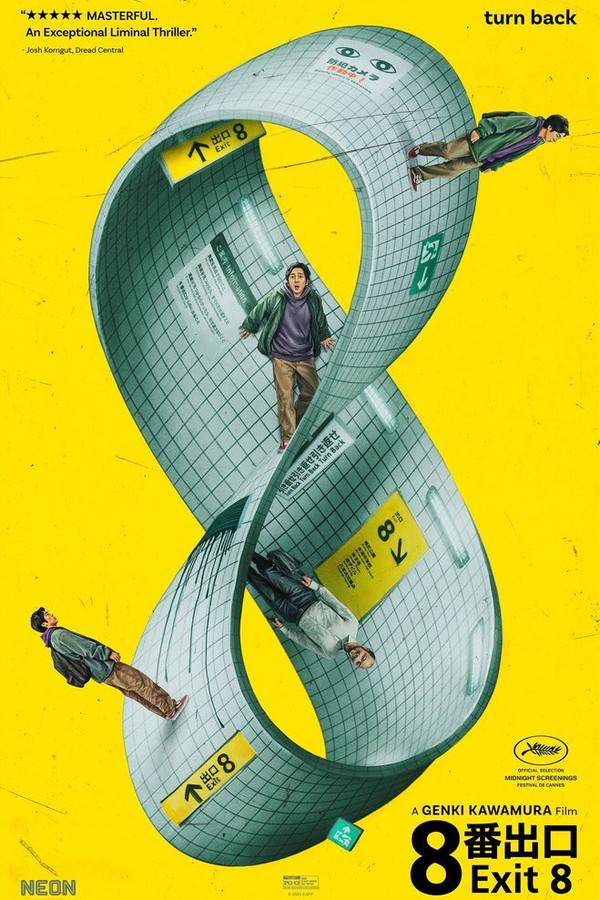
Exit 8 (2026) movie poster

Plot Summary

Exit 8 (2026) Plot Summary & Ending Explained

Release, runtime and language
2026 · 1 h 35 m · Japanese
Echo score 56
Loading streaming availability…
Directed by
Genki Kawamura
Starring
Kotone Hanase, Nana Komatsu, Kazunari Ninomiya, Naru Asanuma, Hirota Ôtsuka, Yamato Kôchi
Budget
$1.4M

Based on the worldwide‑popular video game by Kotake Create, the film follows a man (Kazunari Ninomiya) who becomes trapped in an endless, sterile subway corridor while searching for the elusive Exit 8. The sole rule of his ordeal is to notice every irregularity; spotting an anomaly forces an immediate retreat, while ignoring it means pressing onward.

On this page (6)
  1. 1 Where to watch
  2. 2 What happens: full plot
  3. 3 Plot questions answered
  4. 4 How it ends
  5. 5 Movie threads
  6. 6 Every angle
Loading streaming availability…

Full plot summary · contains spoilers

What Happens in Exit 8: Full Plot Summary

The whole story of Exit 8 (2026) explained, from the opening scene to the final frame: every key event, every twist and what it all adds up to. Read it as a quick recap before the sequel, to check a scene you missed, or to finally understand what really happened.

In the dim glow of a subway platform, The Lost Man [Kazunari Ninomiya] witnesses a man scolding a mother for her crying baby, a moment that presses hard on his sense of responsibility just as his girlfriend reveals she’s pregnant, asking him what he’ll do. A stark moment of doubt washes over him, and a sudden asthma attack forces him to confront whether he’s fit to become a father. The scene blurs and then drifts into a surreal, deserted corridor that loops on itself, a place where reality seems to stretch and snap at the edges of fear and resolve.

On the wall, a set of instructions appears, and The Lost Man discovers that progress depends on a strange rule: he must reach Exit 8 by turning back whenever the corridor presents an anomaly, and move forward when it remains still. Any misstep, any deviation from this fragile pattern, sends him all the way back to Exit 0, resetting the fragile progress he’s managed to claw out of the endless maze. The tension intensifies with each loop, as doors gain or lose their knobs, and rain of blood from the ceiling punctuates the bizarre math of survival.

In one loop, he encounters The Boy [Naru Asanuma], a small child who has been quietly shadowing The Walking Man [Yamato Kôchi], an unresponsive figure who seems to drift through every iteration of the corridor. Through a spare, haunting flashback, it’s revealed that The Walking Man was once lost too, but chose a false Exit 8, abandoning The Boy and becoming part of the loop itself. The Boy, initially reticent, proves perceptive and steadfast, slowly building trust with The Lost Man. He shares the truth of his own fear—he ran away from his mother—and offers a small hermit crab shell as a talisman of luck.

As they navigate deeper into the maze, the corridor turns suddenly dark, and a swarm of bald rats with human body parts bursts from the vents, their cries rising to a dreadful crescendo. The two protagonists sprint for safety, the claustrophobic walls closing in as the rats’ eerie wails echo behind them.

When they reach Exit 6, a blaring siren cuts through the air and the scene shifts to floodwaters that surge through the corridor. The Lost Man acts with quick courage, lifting The Boy above the rising water and keeping him safe as he himself is swept away by the tide. In a stark reversal of reality, The Boy finds himself on a beach, with his parents nearby, while The Lost Man and his girlfriend regain consciousness elsewhere. The Beach scene is fleeting yet visceral, a dreamlike waypoint that offers a glimmer of what could be real. Afterward, The Boy returns to the labyrinth, stepping toward Exit 8 once more, now sure of the path.

Back in the real world, The Lost Man materializes in a moment of clarity and calls his girlfriend, promising to meet her at the hospital. He steps onto a crowded subway car, and as the space fills with the hum of strangers, he hears the same baby’s cry and the same sharp admonition from a passerby about the mother’s child. This time, he gathers the resolve he’s been seeking and confronts the rude man, choosing to stand up for the vulnerable moment by moment, just as he has learned to navigate the echoes of the maze.

Throughout this ascent from doubt to action, the story threads a quiet, persistent message: that fatherhood, responsibility, and connection can emerge from the most disorienting loops of fear, memory, and choice. The journey tests not only the nerves but the heart, and it asks whether courage can be found in the very corridors that threaten to erase it.

Last updated: April 08, 2026 at 18:19

Was this helpful?

Plot questions answered

Exit 8 Plot Explained: Your Questions Answered

The questions people ask most about Exit 8 (2026): what happens in the confusing scenes, why the characters do what they do, the twists, hidden details and what the ending means. Each answer contains spoilers.

Q1

What is the rule about anomalies in the endless corridor?

The rule requires The Lost Man to notice every irregularity in the corridor. When he spots an anomaly, something changed or wrong, he must immediately retreat. When the corridor remains still and normal, he must move forward toward Exit 8. Making the wrong choice by missing an anomaly or retreating when unnecessary resets his progress all the way back to Exit 0, erasing any ground he has gained.

Foreshadowing: The word 'Test' appearing on his face during the subway scene foreshadows this trial of perception.

  • anomalies
  • rule
  • corridor
  • Exit 8
  • reset
  • loop
Q2

Why does The Walking Man never speak or respond?

The Walking Man was once a lost person who entered the same corridor maze. He found what he thought was Exit 8 but it was a false exit. At that moment, he abandoned The Boy to save himself, and that act trapped him permanently in the loop. His silence is the result of becoming part of the corridor itself, he now drifts through every iteration without agency or voice, a living consequence of his betrayal.

Foreshadowing: His unresponsive state and repetitive walking pattern hint at something beyond a simple survivor.

  • Walking Man
  • silence
  • trapped
  • loop
  • false exit
  • betrayal
Q3

What is The Boy's backstory and why is he in the corridor?

The Boy ran away from his mother in the real world, a choice driven by fear. When he entered the corridor, The Walking Man became his guide, but when they reached the false Exit 8, The Walking Man abandoned him to escape alone. This betrayal kept The Boy trapped in the maze. Unlike The Walking Man, The Boy maintained his humanity and ability to trust, eventually forming a bond with The Lost Man.

Foreshadowing: The Boy's initial reticence and wariness around The Walking Man hints at a history of betrayal.

  • The Boy
  • running away
  • mother
  • trapped
  • false Exit 8
Q4

What does the beach scene represent in the story?

The beach appears as a memory-like vision during the flood at Exit 6. The Lost Man sees The Boy on the beach with his parents, suggesting this is what awaits The Boy if he can truly escape, a return to his real life and family. The vision serves as a promise of what lies beyond the maze: reconciliation and healing. After regaining consciousness, The Boy turns toward Exit 8, now confident in the path, implying the beach was a glimpse of his possible future.

Foreshadowing: The flood at Exit 6 acts as the cleansing moment that makes the beach vision possible.

  • beach
  • vision
  • flood
  • Exit 6
  • future
  • reconciliation
Q5

How does The Lost Man finally escape the corridor?

The Lost Man escapes by reaching the real Exit 8 after surviving the flood at Exit 6. Unlike the false Exit 8 that trapped The Walking Man, this one is genuine. Evidence that it's real comes from The Boy's hermit crab shell that he left as a token of luck, the same shell The Lost Man finds on the floor at Exit 8, confirming The Boy made it through. This marks the genuine exit, allowing The Lost Man to return to reality.

Foreshadowing: The false Exit 8 was encountered earlier, making the genuine one distinguishable only by its outcome.

  • escape
  • real Exit 8
  • hermit crab shell
  • loop end
  • return to reality
Q6

What triggers The Lost Man's asthma attack in the subway?

The asthma attack is triggered by the overwhelming stress and anxiety of the moment. The Lost Man is already struggling with the weight of his girlfriend's pregnancy news and his uncertainty about fatherhood. Seeing the man berate the mother with the crying baby adds another layer of pressure, highlighting his fear of responsibility and inability to protect. The attack represents his psychological breaking point, forcing him to confront whether he's ready to become a father.

Foreshadowing: The word 'Test' appears on his face during this scene, linking the physical attack to his ultimate trial.

  • asthma attack
  • stress
  • pregnancy
  • fatherhood
  • subway
  • test
Q7

What causes The Lost Man to reset back to Exit 0?

The Lost Man resets to Exit 0 whenever he makes a wrong decision about an anomaly. If he fails to notice a change in the corridor (like a door gaining or losing a doorknob) and continues forward, or if he incorrectly retreats when the corridor is actually normal, he violates the rule. Each violation sends him back to the very beginning, erasing all progress. This creates constant tension and forces meticulous attention to detail.

Foreshadowing: The instructions on the wall establish this consequence early in his journey.

  • reset
  • Exit 0
  • mistake
  • anomaly detection
  • consequence
Q8

What does Exit 8 symbolize in the movie?

Exit 8 symbolizes escape from the循环 of fear and avoidance. For The Lost Man, reaching Exit 8 means confronting his anxieties about fatherhood instead of running from them. The corridor tests his ability to notice things that matter, the anomalies represent the hard truths and responsibilities he must acknowledge. The real Exit 8 is only found after he learns to help others (saving The Boy in the flood) and face difficult situations (confronting the rude man on the subway), proving he's ready to face life rather than escape it.

Foreshadowing: The Walking Man's false Exit 8 shows that shortcuts lead to permanent entrapment.

  • Exit 8
  • escape
  • symbolism
  • fatherhood
  • responsibility
  • growth
Q9

Why does The Boy go back into the corridor after reaching the beach?

The Boy returns to the corridor after his beach vision because he realizes the path to Exit 8 is now clear to him. The vision showed him what awaited at the real Exit 8, a reunion with his parents, giving him confidence. Unlike his previous fear-driven state, he now understands the maze well enough to navigate it successfully. His return demonstrates growth and trust in the path he's learned with The Lost Man.

Foreshadowing: The beach vision provided the clarity he needed to face the maze without fear.

  • The Boy
  • return
  • beach
  • Exit 8
  • confidence
  • path
Q10

How does the corridor test relate to The Lost Man's fear of fatherhood?

The corridor directly mirrors The Lost Man's internal struggle. The anomalies he must detect represent the difficult truths and responsibilities of parenthood he's been avoiding. His constant fear of making mistakes mirrors his fear of being an inadequate father. By learning to stay calm under pressure, notice what matters, and protect The Boy (symbolic child), he proves he can handle real responsibility. His final act of confronting the rude man shows this growth, he's ready to face life's challenges instead of retreating into anxiety.

Foreshadowing: The 'Test' appearing on his face ties the literal corridor trial to his psychological test about fatherhood.

  • fatherhood
  • test
  • responsibility
  • growth
  • courage
  • symbolism
Q11

What is the significance of the rat attack in the corridor?

The rat attack occurs when the corridor turns dark and represents one of the most dangerous anomalies The Lost Man must navigate. The bald rats with human body parts are a disturbing manifestation of the maze's horror, amplifying fear and testing survival instinct. The attack forces The Lost Man and The Boy to work together, deepening their bond. This sequence also heightens the stakes, showing that the corridor isn't just about observation but also physical danger.

Foreshadowing: Earlier, smaller anomalies like doorknob changes hint at the corridor's ability to shift into deadly forms.

  • rats
  • attack
  • darkness
  • danger
  • anomaly
  • survival
Q12

What distinguishes the real Exit 8 from the false one?

The false Exit 8 appears earlier in the maze but traps those who enter it permanently, as The Walking Man discovered. The real Exit 8 only appears after surviving the most dangerous trials, particularly the flood at Exit 6. The key confirmation is finding The Boy's hermit crab shell, the token of luck he received, which appears at the genuine exit, proving The Boy made it through. The false exit represents taking the easy path, while the real one requires earning escape through facing challenges.

Foreshadowing: The Walking Man's backstory reveals the danger of the false exit.

  • real Exit 8
  • false Exit 8
  • hermit crab shell
  • escape
  • differentiation

Ending explained

What Happens at the End of Exit 8?

How Exit 8 (2026) ends, in short: the final scene, the last twist and what it means for the characters. The full ending explained, with every spoiler, lives on its own page.

Read the full ending explained

The ending of Exit 8 leaves viewers with a deliberately ambiguous conclusion that questions whether true escape is ever possible without genuine internal change. After the Lost Man sacrifices himself to save the Boy from the flooding tunnel, he enters a dreamlike vision on a beach with his girlfriend and the child. In this peaceful moment, she presses him on whether he's ready to be a father—the same question that went unanswered at the start of the film. This vision serves as a turning point, giving him the clarity he desperately needed. When he wakes back in the tunnel, he still holds the crab shell the Boy gave him for luck, and this time he follows the rules correctly, walking through Exit 8 and finding himself back on the platform surrounded by other people.

However, the final scenes cast doubt on whether he's truly free. He calls his girlfriend and promises to meet her at the hospital, suggesting he's finally ready to embrace fatherhood and take responsibility. Yet when he encounters the same angry old man harassing a woman and her crying child—the exact situation that opened the film—he once again stays silent. He cannot bring himself to intervene. This failure to act suggests that while he may have physically left the loop, he hasn't actually grown. The movie seems to imply that the staircase he took wasn't a real exit but simply another anomaly he failed to recognize, trapping him in the cycle once more.

Continue reading the ending (1 more paragraphs)

The film uses the loop as a metaphor for self-sabotage and the paralyzing nature of indecision. The Walking Man, who was once a conscious person trying to escape, took the easy way out and became a hollow NPC, stripped of autonomy—a warning about what happens when you refuse to face difficult truths. The Lost Man, by contrast, learns to follow the rules and make choices, but his inability to stand up for others reveals that escaping the tunnel isn't the same as escaping yourself. Exit 8 ultimately suggests that breaking life's vicious cycles requires more than just following instructions—it demands genuine transformation, the courage to act, and the willingness to stop making the same mistakes over and over again.

Exit 8 ending explained in full

Movie threads

More Movies Like Exit 8, by Mood & Story

Curated lists built around what makes Exit 8 tick: the same mood, the same kind of story or the same emotional payoff. Each list explains why these movies belong together.

Claustrophobic Loop Thrillers like Exit 8

Characters trapped in a supernatural loop, fighting to break free by noticing subtle anomalies. If you liked the tense, anomaly-spotting gameplay of Exit 8, you'll enjoy these movies about characters trapped in supernatural loops. Discover more psychological horror and mystery films with similar high-stakes rules and claustrophobic settings.

  • claustrophobic
  • suspenseful
  • unsettling
  • anxious
  • psychological
  • puzzle
  • Tone: tense, unsettling, anxious
  • Pacing: variable, methodical with frantic bursts
Why these movies?

The story pattern: The narrative follows a character, often isolated in a confined space, who discovers they are trapped in a cycle. Progress is measured by their ability to perceive and react to subtle, often terrifying, irregularities in their environment. The story arc is about mastering the rules of the loop to achieve escape and often, personal redemption.

Why they belong together: These films are grouped by their shared premise of a supernatural loop, a tense and claustrophobic mood, and a gameplay-like structure where observation and rules are key to survival. They deliver a specific kind of anxious, puzzle-box experience.

Fatherhood Fear Stories like in Exit 8

A man's terrifying ordeal becomes a metaphor for his fears about becoming a father. Movies like Exit 8 that use a high-concept thriller or horror plot to explore a man's psychological journey toward accepting fatherhood. Find similar stories about facing personal fears and finding redemption through a terrifying trial.

  • hopeful
  • determined
  • tense
  • emotional
  • redemptive
  • suspenseful
  • Tone: tense, hopeful, determined
  • Pacing: variable
Why these movies?

The story pattern: The narrative uses a high-stakes genre framework (horror, thriller, adventure) as an allegory for a deeply personal crisis. The protagonist must overcome a terrifying external threat, and in doing so, he conquers his own internal demons and insecurities about his capability to be a parent. The ending is typically hopeful, resolving both plots positively.

Why they belong together: This thread connects films that share a specific character arc: a man using a life-threatening ordeal to work through his anxieties about fatherhood. They balance medium emotional weight with high-intensity plots, resulting in a cathartic and hopeful viewing experience.

Every angle

Exit 8 (2026) Explained: Plot, Ending, Timeline & Characters

Everything about Exit 8 in one place: what happens in the plot summary, the timeline in chronological order, the characters and meaning, the ending explained and a spoiler-free summary. What's After the Movie adds the cast, box office and post-credit scenes.

Coming soon on iOS and Android

The Plot Explained Movie Summary App

Plot summaries, endings explained and timelines on your phone. Catch up on any movie in minutes, save your favorites and never miss a twist again.

Be the first to know when we launch. Your email stays private, always.

Learn more about the app