Plot Explained Spoilers guaranteed!
Plot Explained

Browse by genre

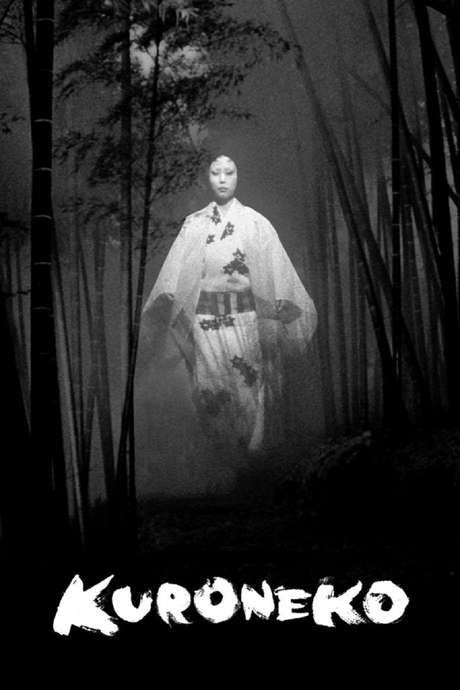
Black Cat Mansion (1958) movie poster

Plot Summary

Black Cat Mansion (1958) Plot Summary Explained

Release, runtime and language
1958 · 69 mins · Japanese
Directed by
Nobuo Nakagawa
Starring
Sakutarō Yamakawa, Hiroaki Kurahashi, Kan Sugi, Noriko Kitazawa, Arata Shibata, Fujie Satsuki

When the servant’s descendant returns to her birth town, she discovers that a vengeful cat — inhabited by the restless spirits of everyone the cruel samurai once murdered — is hunting her. The feline seeks retribution for the samurai’s brutal legacy.

On this page (5)
  1. 1 What happens: full plot
  2. 2 Plot questions answered
  3. 3 Movie threads
  4. 4 Movies like Black Cat Mansion
  5. 5 Every angle

Full plot summary · contains spoilers

What Happens in Black Cat Mansion: Full Plot Summary

The whole story of Black Cat Mansion (1958) explained, from the opening scene to the final frame: every key event, every twist and what it all adds up to. Read it as a quick recap before the sequel, to check a scene you missed, or to finally understand what really happened.

In a hospital during a power outage, Dr. Tetsuichiro Kuzumi [Toshio Hosokawa] finds his thoughts drifting to a chain of memories. A memory unfolds in which he and his wife, Yoriko, leave bustling Tokyo behind, moving to a centuries-old house in Kyushu to help cure her tuberculosis. They are not alone; Yoriko is accompanied by her elder brother Kenichi. As the car glides along the road, their driver [Eijir Kawai] notices a black cat cross their path, and a near accident sends them teetering toward a railing and the sea. They eventually reach Spiraea Mansion, a looming, spine-tingling estate, where Yoriko’s first impressions are filled with unease: a cat, a flock of crows, and a bloodstained wall, and a fleeting glimpse of an eerie old woman, Old Woman, who vanishes before others can confirm her presence.

Inside, Tetsuichiro transforms part of the mansion into a clinic, hoping the setting will aid Yoriko’s fragile health. The old woman reappears at the clinic, startling Tetsuichiro’s assistant and triggering the dog Taro to bark. When the assistant departs to fetch the doctor, the old woman vanishes—only to return moments later and choke Yoriko, though she does not kill her. Later, the same figure reappears and tells Tetsuichiro that a family has a sick child, prompting him to ride out on a rickshaw. He arrives and finds that the family did not summon him, and in his absence the old woman murders Taro and copies Tetsuichiro’s voice to gain entry, where she again strangles Yoriko. Yoriko later speaks of dreams in which cats bite her. Curious and unsettled, Tetsuichiro and Kenichi visit a Buddhist temple, where a priest begins to recount the mansion’s history and its dark reputation.

The story then slips back in time to the Sengoku period (c. 1467–1600). The house is revealed to be Spiraea Mansion, governed by the short-tempered lord Ishido Sakon no Shogen [Arata Shibata]. When Kokingo, a samurai, is ordered to teach Shogen how to play Go, Kokingo accuses the lord of cheating, and Shogen murders him with a sword. Miyaji, Kokingo’s blind mother, learns of her son’s death and Shogen’s role in it. In the wake of tragedy, Miyaji urges her cat Tama to avenge Kokingo and Miyaji. The cat licks up Miyaji’s blood as a cursed thread winds through the generations. Shogen’s son Shinnojo longs to marry a servant named Yae [Noriko Kitazawa], but their union faces class barriers. An attempted blessing from Shogen is refused, and Shogen’s abuse continues; Shinnojo confronts his father, and apparitions of Kokingo and Miyaji haunt the dining hall. The shape-shifting bakeneko (a supernatural cat) uses Miyaji’s appearance to strike, killing a servant named Sato, and ultimately both Shogen and Shinnojo perish in a sword fight. The tale—told by a temple priest—links Saheiji to Yoriko, revealing that Saheiji is Yoriko’s ancestor and offering a protective charm to ward off evil spirits.

As a storm rages that night, the wind tears away the charms. Tetsuichiro moves to close the shutters, and the old woman resurfaces to strangle Yoriko once more. The wall of Yoriko’s room crumbles, unveiling the mummified skeleton of Kokingo. Back in the present hospital, it’s explained that Yoriko and Tetsuichiro buried Kokingo’s remains properly, giving him a final rest. Yoriko, now sensing a new sense of peace, discovers a small cat and joyfully adopts it, a quiet and hopeful note after the long night of hauntings.

The film moves with an unhurried, steady rhythm that threads a medical crisis in the present with a tragic lineage from the past. The atmosphere blends clinical immediacy with an almost folkloric dread, as the house’s walls seem to whisper the stories of lovers and warriors, ghosts and go-sleep cat legends, and a family lineage that ties Yoriko to Saheiji and beyond. The performances fuse quiet, restrained emotion with supernatural suggestion, inviting viewers to feel the weight of history pressing down on a single family across centuries. In the end, the bone-deep resolve of Yoriko and Tetsuichiro to acknowledge and honor Kokingo’s memory offers a measure of closure, even as the mansion’s shadows linger in memory.


Last updated: October 09, 2025 at 09:34

Was this helpful?

Plot questions answered

Black Cat Mansion Plot Explained: Your Questions Answered

The questions people ask most about Black Cat Mansion (1958): what happens in the confusing scenes, why the characters do what they do, the twists, hidden details and what the ending means. Each answer contains spoilers.

Q1

Why does the old woman target Yoriko specifically?

The old woman targets Yoriko because she is a descendant of Saheiji, who was connected to the tragic events at Spiraea Mansion centuries earlier. The vengeful spirit seeks retribution against the bloodline of those responsible for Kokingo's murder. While Yoriko herself bears no direct guilt, the curse targets her family line as a whole.

Foreshadowing: Earlier, the priest reveals that Saheiji is Yoriko's ancestor, explaining why the spirit fixates on her.

  • yoriko
  • old woman
  • target
  • descendant
  • curse
  • saheiji
Q2

What is a bakeneko in this movie?

A bakeneko is a shape-shifting supernatural cat in Japanese folklore. In the film, Tama the cat becomes a bakeneko after licking Miyaji's blood during a curse ritual. It can transform into the appearance of Miyaji (the old woman) and mimic human voices, allowing it to manipulate and terrorize the living.

Foreshadowing: The black cat crossing the road at the beginning foreshadows the supernatural threat to come.

  • bakeneko
  • supernatural cat
  • tama
  • shape-shifting
  • folklore
Q3

Why does burying Kokingo's skeleton end the haunting?

Burying Kokingo's skeleton ends the haunting because it finally gives him proper funeral rites and rest. Throughout centuries, his body was hidden behind a wall, denied burial, a deeply disrespectful act in Buddhist tradition. By laying his remains to rest, Tetsuichiro and Yoriko fulfill the unresolved spiritual need that kept his angry spirit bound to the mansion.

Foreshadowing: The priest emphasizes the importance of proper burial and provides a protective charm earlier in the story.

  • kokingo
  • burial
  • skeleton
  • rest
  • haunting
  • proper funeral
Q4

How is Yoriko connected to the Sengoku period events?

Yoriko is connected to the Sengoku period through her ancestor Saheiji, who appears in the historical flashback recounting. While the exact relationship isn't fully detailed, the priest explicitly states that Saheiji is Yoriko's ancestor, linking her bloodline to the original tragedy at Spiraea Mansion. This connection explains why the curse targets her family.

Foreshadowing: The priest's revelation about Saheiji being Yoriko's ancestor directly establishes this connection.

  • yoriko
  • sengoku
  • ancestor
  • saheiji
  • bloodline
  • connection
Q5

Why does the old woman imitate Tetsuichiro's voice?

The old woman (the bakeneko in disguise) imitates Tetsuichiro's voice to deceive the household and gain access to Yoriko. By tricking the family into thinking the doctor has returned, she creates an opportunity to attack Yoriko while Tetsuichiro is away. This demonstrates the bakeneko's supernatural ability to mimic human speech.

Foreshadowing: Earlier, the old woman tricks Tetsuichiro with a false message about a sick child, showing her pattern of manipulation.

  • old woman
  • imitate voice
  • bakeneko
  • deception
  • impersonate
Q6

Why does Lord Shogen kill Kokingo?

Lord Shogen kills Kokingo after a dispute over a Go game. When Kokingo is ordered to teach Shogen how to play Go, he accuses the lord of cheating, triggering Shogen's short temper. Enraged, Shogen draws his sword and kills Kokingo on the spot. This unjust murder becomes the catalyst for the entire curse.

Foreshadowing: The Go game is introduced as an early scene in the Sengoku flashback, establishing its significance.

  • kokingo
  • shogen
  • go game
  • murder
  • sengoku
  • samurai
Q7

Why does the old woman kill the dog Taro?

The old woman kills Taro as part of her campaign to terrorize and isolate Yoriko. By killing the dog, she removes Yoriko's protector and deepens the psychological terror. Taro's death also demonstrates the spirit's malevolence beyond just targeting humans, showing the curse spreads to all associated with the mansion.

Foreshadowing: Taro barks at the old woman's presence from the very first appearance, showing his role as a guardian.

  • taro
  • dog
  • killing
  • old woman
  • terror
  • protection
Q8

What causes Kokingo's skeleton to be revealed?

Kokingo's skeleton is revealed when a storm blows away the protective charms that Tetsuichiro has placed throughout the mansion. With the spiritual wards removed, the wall in Yoriko's room crumbles, exposing the mummified remains that have been hidden there for centuries. The storm acts as a catalyst for the final confrontation.

Foreshadowing: The wind tearing away the charms earlier signals the breaking of the protective barrier.

  • skeleton
  • storm
  • wall
  • revelation
  • kokingo
  • charms
Q9

Why does the curse resume after receiving the protective charm?

The curse resumes because the protective charm is only a temporary measure, not a permanent solution. The priest provides the charm to ward off evil spirits, but it cannot truly end a curse rooted in unresolved historical injustice. The bakeneko's power ultimately overcomes the charm during the storm, forcing Tetsuichiro and Yoriko to confront the root cause, Kokingo's improper burial.

Foreshadowing: The charms are explicitly described as temporary protection, not a cure for the underlying spiritual problem.

  • curse
  • charm
  • protection
  • temporary
  • storm
  • bakeneko
Q10

Why does Yoriko dream about cats biting her?

Yoriko's dreams of cats biting her represent the supernatural connection between the bakeneko and herself. These dreams foreshadow the revelation that Yoriko is a descendant of the family tied to the original curse. The biting sensation symbolizes the curse's grip on her bloodline and the spiritual debt owed by her ancestors.

Foreshadowing: The cat imagery appears throughout: the black cat on the road, the cat at the mansion, and the bakeneko's true form.

  • yoriko
  • dreams
  • cats
  • biting
  • supernatural
  • bloodline
Q11

What role does Miyaji play in the curse?

Miyaji is Kokingo's blind mother who initiates the curse after learning of her son's murder by Shogen. Grief-stricken and vengeful, she orders her cat Tama to avenge her and Kokingo. When she cuts her own finger, Tama licks her blood, binding the curse to the cat. Miyaji's thirst for revenge transforms Tama into the bakeneko that continues the cycle of violence.

Foreshadowing: Miyaji's appearance is adopted by the bakeneko when it manifests as the old woman.

  • miyaji
  • kokingo
  • mother
  • curse
  • tama
  • revenge
  • initiates

Movie threads

More Movies Like Black Cat Mansion, by Mood & Story

Curated lists built around what makes Black Cat Mansion tick: the same mood, the same kind of story or the same emotional payoff. Each list explains why these movies belong together.

Atmospheric slow burn supernatural horror movies like Black Cat Mansion

Films where a folkloric curse or spirit builds a pervasive, melancholic dread. If you appreciated the slow-building folkloric dread of Black Cat Mansion, you'll find similar experiences here. This selection features movies where supernatural threats, often tied to a historical tragedy, create a pervasive, melancholic atmosphere through deliberate pacing and a focus on unease over shock.

  • atmospheric
  • slow burn
  • folk horror
  • melancholic
  • ghostly
  • uneasy
  • Tone: dark, melancholic, folkloric
  • Pacing: slow, deliberate, atmospheric
Why these movies?

The story pattern: Stories in this thread typically involve a present-day encounter with a supernatural force, the origin of which is explained through a significant historical flashback. The conflict is often one of understanding and resolving a past wrong, leading to a resolution that may offer closure but is tinged with the melancholy of the tragedy that preceded it.

Why they belong together: Movies are grouped here based on their shared commitment to a slow, atmospheric build-up of supernatural dread, a dark and melancholic tone, and narratives that explore the consequences of historical sins. They appeal to viewers who enjoy a more reflective, folkloric style of horror.

Movies about generational curses and haunted legacies like Black Cat Mansion

Stories where the sins of the past actively haunt and hunt the descendants. For viewers who were captivated by the theme of a samurai's bloody legacy haunting his descendant in Black Cat Mansion. These films explore similar ideas of inherited trauma, family curses, and supernatural retribution, where characters must face a past that isn't theirs to find peace.

  • generational curse
  • family secrets
  • supernatural revenge
  • historical guilt
  • tragic
  • investigative
  • Tone: dark, tragic, reflective
  • Pacing: steady, investigative
Why these movies?

The story pattern: The core pattern involves a protagonist discovering they are the target of a vendetta or curse stemming from an ancestor's violent or immoral actions. The story unfolds as they investigate the past to understand the present threat, culminating in an attempt to break the cycle, which may result in a bittersweet victory that acknowledges the irreversible cost of the original sin.

Why they belong together: These films are connected by their central theme of inherited guilt and supernatural retribution. They share a dark tone, a moderate narrative complexity due to dual timelines, and an emotional weight derived from confronting a tragic family history, often concluding with a resolution that is more about closure than pure triumph.

If you liked this

Movies Like Black Cat Mansion

Similar movies to Black Cat Mansion: the same genre, themes or kind of story. Each one comes with its own plot summary, timeline and ending explained.

Browse all movie summaries

Every angle

Black Cat Mansion (1958) Explained: Plot, Timeline & Characters

Everything about Black Cat Mansion in one place: what happens in the plot summary, the timeline in chronological order, the characters and meaning and a spoiler-free summary. What's After the Movie adds the cast, box office and post-credit scenes.

Coming soon on iOS and Android

The Plot Explained Movie Summary App

Plot summaries, endings explained and timelines on your phone. Catch up on any movie in minutes, save your favorites and never miss a twist again.

Be the first to know when we launch. Your email stays private, always.

Learn more about the app