Plot Explained Spoilers guaranteed!
Plot Explained

Browse by genre

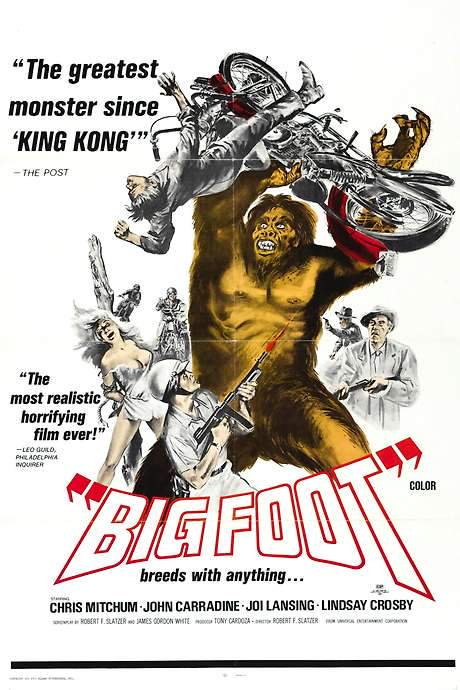
Bigfoot (1970) movie poster

Plot Summary

Bigfoot (1970) Plot Summary Explained

Release, runtime and language
1970 · 84 mins · English
JustWatch #32,137
Directed by
Robert F. Slatzer
Starring
John Carradine, Haji, Lindsay Crosby, Christopher Mitchum, John Mitchum, Jerry Maren

America’s abominable snowman…breeds with anything! Bigfoot kidnaps some women and some bikers decide to go on a rescue mission to save them.

On this page (6)
  1. 1 Where to watch
  2. 2 What happens: full plot
  3. 3 Plot questions answered
  4. 4 Movie threads
  5. 5 Movies like Bigfoot
  6. 6 Every angle

Where to watch

Where to Watch Bigfoot (1970)

Where can you watch Bigfoot? Stream, rent or buy it in the US, including on Fawesome, Plex and Tubi TV: current JustWatch availability with up-to-date prices.

Streaming availability powered by JustWatch

Full plot summary · contains spoilers

What Happens in Bigfoot: Full Plot Summary

The whole story of Bigfoot (1970) explained, from the opening scene to the final frame: every key event, every twist and what it all adds up to. Read it as a quick recap before the sequel, to check a scene you missed, or to finally understand what really happened.

John Carradine stars as Jasper B. Hawks, a fast-talking operator who speeds through the forest in his car, flanked by his loyal sidekick Elmer Briggs, played by John Mitchum. At nearly the same moment, Joi Lansing portrays Joi Landis, piloting a small plane above the same stretch of woods. When Joi’s single-engine craft loses power, she parachutes to safety and lands near a tense encounter in the trees: a Bigfoot emerges and attacks her, setting off a chain of events that pull more people into the wilderness.

In the same verdant maze, a laconic biker named Rick arrives with his girlfriend Chris, portrayed by Judy Jordan. Chris happens upon a secluded Bigfoot burial ground and is instantly endangered by a second creature. The town’s authorities—an increasingly wary sheriff and a ranger’s station—receive word of the disappearances, but their search is half-hearted and quickly abandons the effort. Rick searches for help elsewhere, but only Jasper B. Hawks offers support, driven by a reckless plan to capture a Bigfoot for a notorious freak show financed by a deranged biology professor, Professor Blackthorne.

Meanwhile, Peggy is abducted and bound to a tree alongside Joi. The Bigfoot clan in this story isn’t a solitary monster; the creatures are depicted as half-human offspring of a towering 12-foot male, guarding the women with a protective ferocity. The dramatic moment arrives when the patriarch—referred to as “Dad” Bigfoot—appears to square off with a bear menacing the captured captives, and the women’s screams echo through the trees.

As the plot threads converge, Jasper, Elmer, and Rick trek toward the Bigfoot lair. The team schemes to gas the enormous captive and turn him into the centerpiece of the show Jasper intends to stage. The plan comes to a head when Rick’s biker allies unleash a gas barrage, allowing the team to seize “Dad” Bigfoot and haul him back toward town to be displayed. The creature does not go quietly into captivity; he fights and, in a brutal moment, steps on a local drunken man named Lucky Bob, who is killed in the process.

The town becomes a crucible of chaos as the Bigfoot rampage tears through streets, driving the residents into a frenzy. The climactic sequence shifts to the Bigfoot’s cave, where the collected menace is finally brought to a head. In a dramatic finale, the enraged creature is blown up by one of Rick’s dynamite-wielding bikers, destroying the spectacle that Jasper fought so hard to create.

With the threat neutralized and the show canceled by the very chaos it spawned, Jasper delivers a weary nod to the old cinema of monsters. He even borrows an iconic line, echoing a sentiment from the original King Kong (1933): > It was beauty that did him in. Then, in a quiet return to normalcy, the town resets around the new memories of a forest encounter that feels almost mythic in its scale.

In the aftermath, life roughly returns to its familiar rhythm. The forest recedes as a memory, but the encounter with the Bigfoot and the fragile edge between showmanship and danger linger as a cautionary tale. The characters who survived—[Joi Landis], [Rick], [Chris], and the others—drift back into their routines, each carrying the quiet aftertaste of what happened in the woods.
Last updated: October 09, 2025 at 09:33

Was this helpful?

Plot questions answered

Bigfoot Plot Explained: Your Questions Answered

The questions people ask most about Bigfoot (1970): what happens in the confusing scenes, why the characters do what they do, the twists, hidden details and what the ending means. Each answer contains spoilers.

Q1

Why does Bigfoot kidnap and guard the women?

The Bigfoot creatures are depicted as a family unit, with the 12-foot patriarch (referred to as 'Dad') commanding half-human offspring. They guard the women not to harm them but to protect what they consider their family. The creatures show protective ferocity toward the captives, as evidenced when Dad Bigfoot fights off a bear that was threatening Joi and Peggy.

Foreshadowing: Earlier, Chris discovers a Bigfoot burial ground, establishing that these creatures have cultural practices and strong familial bonds.

  • bigfoot
  • abduction
  • family
  • kidnapped women
  • captives
  • protection
Q2

Why does Jasper B. Hawks want to capture Bigfoot?

Jasper B. Hawks is a fast-talking operator who plans to use the captured Bigfoot as the centerpiece of a freak show. The exhibit is financed by the deranged Professor Blackthorne, making the capture a commercial venture rather than a heroic rescue mission.

Foreshadowing: Jasper immediately offers to help Rick not out of altruism but because he sees a profitable opportunity.

  • jasper hawks
  • freak show
  • capture
  • professor blackthorne
  • money
  • exhibit
Q3

Why does Dad Bigfoot fight the bear in the woods?

Dad Bigfoot confronts the bear because it is threatening the women he has captured. Despite being a monster to humans, the creature displays protective behavior toward his 'family' - the abducted women that his offspring have guarding. This confrontation demonstrates the complex nature of the creatures as both kidnappers and protectors.

Foreshadowing: The narrative establishes early that Bigfoot is not a solitary monster but part of a family unit with hierarchical bonds.

  • dad bigfoot
  • bear
  • fight
  • protection
  • cave
  • women
Q4

Why does Bigfoot trample Lucky Bob after escaping captivity?

After Jasper's team gasses and captures Dad Bigfoot for their freak show, the creature breaks free from captivity. In his desperate escape through town, he tramples a local drunk named Lucky Bob. The trampling is not intentional malice but a consequence of the rampaging creature's panic and size as he flees toward freedom.

Foreshadowing: The plan to gas and capture Dad Bigfoot was always risky - the creature was described as dangerous when cornered.

  • lucky bob
  • trampled
  • escape
  • captivity
  • town
  • rampage
Q5

Why does Jasper quote King Kong at the end?

After Dad Bigfoot is destroyed and the freak show is canceled due to the chaos, Jasper paraphrases the famous King Kong (1933) line: 'It was beauty that did him in.' This thematic echo connects the movie to the classic monster narrative - a creature captured for spectacle meets its end because of the very attraction that brought it to civilization.

Foreshadowing: Jasper's entire plan revolved around displaying the creature as a showpiece, mirroring theKing Kong plot.

  • king kong
  • quote
  • jasper
  • beauty
  • beast
  • spectacle
  • reference
Q7

Why do the bikers use dynamite to kill Bigfoot?

The climax shifts to Bigfoot's cave where the bikers, led by Rick, use dynamite to destroy the creature. This violent solution ends the threat permanently but also destroys the spectacle Jasper had planned to profit from. The explosion represents the failure of the capture plan and the final, tragic conclusion to the creature encounter.

Foreshadowing: Rick's biker allies were the ones who launched the gas barrage, showing they were willing to use force.

  • dynamite
  • bikers
  • explosion
  • cave
  • death
  • kill
Q8

How do Joi and the other captured women survive?

Joi and Peggy are tied to trees by the Bigfoot family but are protected from other dangers, including a bear attack that Dad Bigfoot fights off. They survive until the rescue team arrives. The Bigfoot's protective nature toward their 'captive family' inadvertently keeps the women alive until the final confrontation.

Foreshadowing: The Bigfoot creatures are established as guardians rather than killers, protecting their 'family' from external threats.

  • joi
  • peggy
  • survive
  • captives
  • tied
  • tree
  • rescue
Q9

Why is the ending considered bittersweet?

The ending is bittersweet because while the immediate threat is neutralized by the dynamite, Jasper's planned freak show spectacle is destroyed by the very chaos it created. The survivors return to normal life, but they carry the 'quiet aftertaste' of their dangerous encounter. The King Kong reference underscores the mixed outcome - the beast is dead but so is the showmanship opportunity.

Foreshadowing: The entire film builds toward the captor-creature dynamic that mirrors King Kong's tragic arc.

  • ending
  • bittersweet
  • normal
  • return
  • cautionary
  • tale
  • spectacle
  • destroyed
Q10

Why does Rick go to Jasper for help instead of the authorities?

After Chris is endangered, Rick searches for help but finds only Jasper willing to assist. The authorities had already abandoned the search, making Jasper the only option. However, Jasper's help comes with strings attached - he sees an opportunity to capture Bigfoot for his freak show, not to rescue the women out of goodwill.

Foreshadowing: Jasper immediately proposes a risky plan to capture Bigfoot, revealing his true motivations.

  • rick
  • jasper
  • help
  • authorities
  • freak show
  • capture plan
  • alliance

Movie threads

More Movies Like Bigfoot, by Mood & Story

Curated lists built around what makes Bigfoot tick: the same mood, the same kind of story or the same emotional payoff. Each list explains why these movies belong together.

Grungy creature features like Bigfoot

Rough characters pursue a dangerous creature through a hostile wilderness. If you liked the monster hunt and rescue mission in Bigfoot, explore more movies like it. These films feature tense pursuits of creatures through the wilderness, often with a gritty, exploitative feel and a chaotic cast of characters on a dangerous quest.

  • tense
  • chaotic
  • grungy
  • exploitative
  • dangerous
  • wilderness
  • Tone: tense, dangerous
  • Pacing: steady, linear
Why these movies?

The story pattern: The narrative typically follows a simple A-to-B structure: a creature appears, causes havoc (often through abductions), and a group bands together to confront it. The journey is linear, focusing on the escalating threats and the frantic efforts to survive or save others, culminating in a large-scale confrontation.

Why they belong together: These films share a specific B-movie energy, blending horror, action, and exploitation elements. They are grouped by their straightforward plots, medium intensity sustained by creature attacks, and a tense, gritty atmosphere that feels both dangerous and strangely campy.

Movies with bittersweet endings like Bigfoot

Stories where defeating a threat leaves a lingering, melancholic quiet. Fans of Bigfoot's ending, where the monster is defeated but the spectacle is lost, will appreciate these similar stories. These films explore the bittersweet aftermath of violent conflicts, leaving characters and viewers with a somber, contemplative feeling.

  • bittersweet
  • destructive
  • cautionary
  • tense
  • solemn
  • aftermath
  • Tone: tense, bittersweet
  • Pacing: steady build, reflective end
Why these movies?

The story pattern: The emotional journey involves a build-up to a destructive climax that resolves the immediate danger but not the underlying trauma or cost. The finale often features a quiet denouement where characters survey the damage, reflecting on what was sacrificed for survival, creating a lasting, cautionary feel.

Why they belong together: This thread groups films based on their distinctive emotional arc, which concludes not with pure triumph but with a mix of relief and melancholy. They share a medium emotional weight, a tense tone that gives way to reflection, and a bittersweet ending feel that resonates after the credits roll.

If you liked this

Movies Like Bigfoot

Similar movies to Bigfoot: the same genre, themes or kind of story. Each one comes with its own plot summary, timeline and ending explained.

Browse all movie summaries

Every angle

Bigfoot (1970) Explained: Plot, Timeline & Characters

Everything about Bigfoot in one place: what happens in the plot summary, the timeline in chronological order, the characters and meaning and a spoiler-free summary. What's After the Movie adds the cast, box office and post-credit scenes.

Coming soon on iOS and Android

The Plot Explained Movie Summary App

Plot summaries, endings explained and timelines on your phone. Catch up on any movie in minutes, save your favorites and never miss a twist again.

Be the first to know when we launch. Your email stays private, always.

Learn more about the app