Plot Explained Spoilers guaranteed!
Plot Explained

Browse by genre

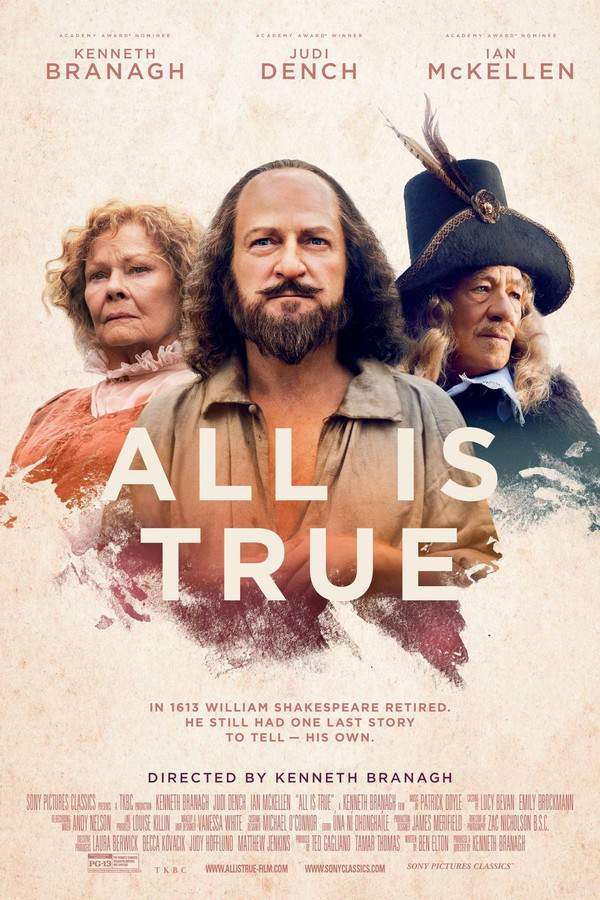
All Is True (2018) movie poster

Timeline

All Is True (2018) Timeline Explained – Every Event in Order

Release, runtime and language
2018 · 101 min · English
Echo score 67
Loading streaming availability…
Directed by
Kenneth Branagh
Starring
Ian McKellen, Judi Dench, Phil Dunster, Kathryn Wilder, Michael Rouse, Doug Colling

In 1613, celebrated playwright William Shakespeare returns to his hometown of Stratford after his Globe Theatre burns down. He is confronted by a difficult past and a family he’s left behind, including his wife and daughters. Haunted by the loss of his son Hamnet, Shakespeare must reconcile with his failings as a husband and father. The playwright's journey leads him to uncover deeply buried secrets and lies that challenge his family's stability and force him to examine his own identity.

On this page (6)
  1. 1 Where to watch
  2. 2 Events in order (15)
  3. 3 Timeline questions answered
  4. 4 Movie threads
  5. 5 Movies like All Is True
  6. 6 Every angle
Loading streaming availability…

15 events in order · contains spoilers

All Is True Timeline: Events in Chronological Order

Every key event of All Is True (2018) in order, scene by scene, with when and where it takes place. Use it to untangle flashbacks, time jumps and parallel storylines, to refresh your memory before the sequel or to find the exact scene you are thinking of.

  1. Globe Theatre Fire

    In 1613, the Globe Theatre is engulfed in flames during a performance of *Henry VIII*. This catastrophic event marks a turning point in William Shakespeare's life, leading him to return to his family in Stratford-upon-Avon.

    When
    1613
    Where
    Globe Theatre, London
  2. Return to Stratford-upon-Avon

    William Shakespeare, now 49 years old, returns home to Stratford-upon-Avon seeking to reconnect with his estranged wife, Anne Hathaway. Their relationship has deteriorated over years of separation exacerbated by personal tragedy.

    Where
    Stratford-upon-Avon
  3. Loss of Hamnet

    The couple's bond suffers severely from the tragic loss of their son, Hamnet, who dies of the plague at just 11 years old. The absence of their son weighs heavily on both William and Anne, complicating their already strained marriage.

  4. Struggles in the Garden

    Upon his return, Shakespeare attempts to immerse himself in tending the family garden. However, he finds little solace in this endeavor, reflecting his internal struggles and feelings of inadequacy in the face of family grief.

  5. Susanna's Marriage

    Shakespeare's elder daughter, Susanna, is married to John Hall, a strict Puritan doctor. As she wrestles with the confines of her marriage, Susanna faces public ridicule and is forced to suppress her true self under the moral standards imposed by her husband.

  6. Defending Susanna

    When Susanna finds herself accused of infidelity, Shakespeare steps in to defend her honor. He fabricates a story about an African actor who would protect her, which successfully intimidates her accuser into silence, leading to Susanna's exoneration.

  7. Judith's Secret

    Judith, Shakespeare's younger daughter, confides in her father about a painful secret concerning her deceased brother. She reveals that she is actually the true author of the poems attributed to Hamnet, showcasing both her frustration and need for recognition.

  8. Visit from the Earl of Southampton

    The arrival of the Earl of Southampton, Shakespeare's former patron, stirs unease in Anne, who suspects romantic ties. During an intimate moment, Shakespeare expresses his feelings through Sonnet 29, prompting a vague and ambiguous response from Southampton.

  9. Reconciliation with Anne

    An emotional reconciliation occurs between William and Anne, leading to a renewal of intimacy in their marriage. Anne chooses to share their second-best bed with Shakespeare, a symbolic gesture that represents their rekindled love.

  10. Judith's Marriage Plans

    Judith expresses a desire to marry Thomas Quiney, bringing a mix of joy and concern to her father. This development is colored by the past scandal surrounding Quiney, yet Shakespeare finds solace in Judith's impending motherhood, signaling hope for the family.

  11. Hamnet's Death Investigation

    Shakespeare delves into the circumstances surrounding Hamnet's death, questioning the initial belief that he succumbed to the plague. Through this painful investigation, he uncovers the truth of Hamnet's drowning and Judith's complicity in the secret of authorship.

  12. Reflective Conversation with Ben Jonson

    In April 1616, Shakespeare engages in a reflective conversation with fellow playwright Ben Jonson. However, amidst the deep discussions, Shakespeare begins to feel unwell, foreshadowing the tragic events to come.

    When
    April 1616
  13. Anne's Triumph in Literacy

    On a significant day, Susanna surprises Anne and Judith by teaching them to read and write. Anne discovers her marriage certificate and triumphantly signs her name for the first time, a milestone that embodies the family's growth and newfound understanding.

  14. Shakespeare's Death

    Tragically, on his birthday, Shakespeare passes away, leaving behind a legacy of literature and a family united by literacy. His death marks the end of an era and the beginning of a journey for his family towards healing.

  15. Funeral and Remembrance

    At Shakespeare's funeral, his three women gather to pay their respects and honor his memory. They recite the poem “Fear No More” from his play *Cymbeline*, symbolizing their collective growth and recognition of his enduring influence.

Last updated: October 27, 2024 at 22:13

Was this helpful?

Timeline questions answered

All Is True Timeline Explained: Your Questions Answered

When does it happen, and why in that order? The questions people ask about the chronology of All Is True (2018): time jumps, flashbacks, cause and effect between scenes and the correct order of events, each answered with spoilers.

Q1

Why did Shakespeare return to Stratford in 1613?

Shakespeare returned to Stratford-upon-Avon after the Globe Theatre burned down during a performance of Henry VIII in 1613. At age 49, he sought to reconnect with his estranged wife Anne Hathaway after years of separation, particularly strained since the death of their son Hamnet.

Foreshadowing: Earlier references to the Globe fire and Shakespeare's weariness hint at his need for escape from London.

  • globe theatre fire
  • return to stratford
  • 1613
  • william shakespeare
Q2

Why was Shakespeare's relationship with Anne Hathaway strained?

Their marriage suffered from years of separation, Shakespeare spent most of their marriage in London while Anne remained in Stratford. The distance was deepened by the tragic loss of their son Hamnet, who died of the plague at age 11 while Shakespeare was away, leaving both parents grief-stricken and emotionally distant from each other.

Foreshadowing: The opening scenes establish their cold greeting and separate bedrooms.

  • anne hathaway
  • marriage strain
  • hamnet death
  • separation
Q3

What happened to Shakespeare's son Hamnet?

Hamnet, Shakespeare's only son, died at age 11 from the plague while his father was in London. His death occurred roughly seven years before the film begins, and the loss haunts both Shakespeare and Anne throughout the movie, affecting their ability to reconnect.

Foreshadowing: The film opens with Shakespeare's grief and references to Hamnet throughout.

  • hamnet
  • son died
  • plague
  • shakespeare son
Q4

Why was Susanna accused of adultery?

Susanna Hall, Shakespeare's elder daughter, was accused of committing adultery with a man named Roderick. The accusation threatened her reputation in their strict Puritan community, where her husband John Hall was a prominent doctor known for his moral standards.

Foreshadowing: Susanna's suppressed personality and uneasy marriage to John Hall hint at her vulnerability.

  • susanna hall
  • adultery accusation
  • john hall
  • puritan
Q5

How did Shakespeare defend Susanna against the accusations?

Shakespeare confronted Susanna's accuser by fabricating a story about an African actor who would fiercely defend her honor. The ruse worked, the accuser failed to appear in court, and Susanna was exonerated, earning admiration from Anne despite Shakespeare's embellishments.

Foreshadowing: This scene demonstrates Shakespeare's skill with words and theater even in domestic settings.

  • defend daughter
  • african actor
  • court
  • exoneration
Q6

What secret did Judith reveal to Shakespeare about the poems?

Judith, Shakespeare's younger daughter, revealed that she was the true author of the poems attributed to Hamnet. Unable to write herself, she had dictated the poems in her brother's handwriting. She confessed this to explain her bitterness toward her brother, feeling unloved compared to him.

Foreshadowing: Judith's resentment toward Hamnet is evident throughout the film before this revelation.

  • judith
  • poems
  • hamnet
  • secret author
  • authorship
Q7

Who was the Earl of Southampton to Shakespeare?

The Earl of Southampton was Shakespeare's former patron and the rumored muse behind his 154 sonnets. Anne suspected a romantic relationship between them. During his visit, Shakespeare recited Sonnet 29 to express his feelings, receiving an ambiguous response that hinted at mutual sentiment.

Foreshadowing: Anne's unease about Southampton's visit foreshadows the romantic subtext.

  • earl of southampton
  • sonnets
  • patron
  • sonnet 29
Q8

What did the second-best bed represent in Shakespeare's reconciliation?

When Shakespeare and Anne reconciled, she chose to share their second-best bed with him, a symbolic gesture representing their renewed intimacy and love. In Shakespeare's household, the best bed was reserved for guests, making the second-best bed the marital bed, signifying their return to each other.

Foreshadowing: Earlier scenes show them in separate beds, emphasizing their estrangement.

  • second best bed
  • reconciliation
  • anne
  • intimacy
  • marriage
Q9

How did Shakespeare discover the truth about Hamnet's death?

Shakespeare investigated Hamnet's death, questioning whether his son died from the plague as believed. He discovered Hamnet drowned while trying to escape learning the truth about Judith's secret, the fact that she, not Hamnet, was the true author of the poems. Judith's confession to Hamnet about claiming authorship may have driven him to flee, leading to his drowning, raising suspicions of suicide.

Foreshadowing: The investigation begins after Judith's secret is revealed, connecting her guilt to Hamnet's fate.

  • hamnet drowned
  • truth about death
  • investigation
  • suicide
  • poems secret
Q10

How and when did Shakespeare die in the film?

Shakespeare died on his birthday in April 1616, after a reflective conversation with fellow playwright Ben Jonson. His death occurred on the same day Susanna taught Anne and Judith to read and write, with Anne triumphantly signing her marriage certificate for the first time, a bittersweet ending where personal growth and loss coincided.

Foreshadowing: Earlier scenes show Shakespeare feeling unwell during his birthday gathering with Jonson.

  • death
  • april 1616
  • birthday
  • ben jonson
  • funeral
Q11

Why did Susanna teach Anne and Judith to read and write?

Susanna surprised Anne and Judith by teaching them to read and write, a transformative moment for the family. On that same day, Anne discovered her marriage certificate and signed her name for the first time, symbolizing her newfound independence and the family's growth in literacy and understanding.

Foreshadowing: Anne's struggles with literacy were established earlier in the film.

  • read and write
  • anne
  • susanna
  • literacy
  • marriage certificate
Q12

Why did Shakespeare allow Judith to marry Thomas Quiney?

Despite Thomas Quiney's past scandal involving another woman, Shakespeare supported Judith's decision to marry him. The marriage brought Shakespeare joy because Judith became pregnant, representing hope and continuation for the family after years of loss and tragedy.

Foreshadowing: Quiney's problematic past was mentioned earlier, creating tension about the marriage.

  • judith
  • thomas quiney
  • marriage
  • pregnancy
  • hope

Movie threads

More Movies Like All Is True, by Mood & Story

Curated lists built around what makes All Is True tick: the same mood, the same kind of story or the same emotional payoff. Each list explains why these movies belong together.

Quiet Historical Reckonings like in All Is True

Aging figures confront their personal legacy and familial regrets in a historical setting. If you enjoyed the reflective and melancholic tone of All Is True, explore more movies like it. This collection features similar historical dramas where celebrated figures retire from public life to grapple with family estrangement, grief, and their own failings in a slow, contemplative style.

  • reflective
  • melancholic
  • somber
  • historical
  • introspective
  • grieving
  • Tone: melancholic, reflective, reconciliatory
  • Pacing: slow, deliberate
Why these movies?

The story pattern: The narrative follows a renowned individual returning to a private life, often after a career-defining event. They are forced to face the family they neglected and the emotional debts they accrued, leading to a gradual, often painful, process of reconciliation and self-examination set against a richly detailed historical backdrop.

Why they belong together: Movies in this thread are grouped by their shared focus on legacy versus personal failing, a melancholic and reflective tone, and a slow pacing that allows for deep character introspection. They all feature heavy emotional weight centered on themes of regret, grief, and late-in-life reconciliation.


Bittersweet Family Reconciliation stories like All Is True

Estranged families slowly mend broken bonds amidst grief and long-buried secrets. For viewers who appreciated the heavy emotional journey of family mending in All Is True, this thread highlights similar movies about reconciliation. Discover dramas where grief and secrets force estranged families to confront the past, leading to a bittersweet but meaningful resolution.

  • grieving
  • regretful
  • somber
  • introspective
  • reconciliatory
  • quiet
  • Tone: melancholic, somber, bittersweet
  • Pacing: slow, character-driven
Why these movies?

The story pattern: A central character, often a parent, returns to or re-engages with a family they have been distant from. A catalyst, such as the death of a loved one, forces long-suppressed conflicts and secrets to the surface. The story unfolds slowly as characters navigate guilt, regret, and awkward attempts at connection, culminating in an acceptance that is poignant and bittersweet rather than perfectly happy.

Why they belong together: These films share a core narrative of familial estrangement and reconciliation, driven by heavy themes of grief and regret. They are united by a slow, deliberate pacing that allows the emotional weight to build, a consistently melancholic tone, and an ending that feels bittersweet—acknowledging both the scars of the past and the hope of a mended future.

If you liked this

Movies Like All Is True

Similar movies to All Is True: the same genre, themes or kind of story. Each one comes with its own plot summary, timeline and ending explained.

Browse all movie summaries

Every angle

All Is True (2018) Explained: Plot, Timeline & Characters

Everything about All Is True in one place: what happens in the plot summary, the timeline in chronological order, the characters and meaning and a spoiler-free summary. What's After the Movie adds the cast, box office and post-credit scenes.

Coming soon on iOS and Android

The Plot Explained Movie Summary App

Plot summaries, endings explained and timelines on your phone. Catch up on any movie in minutes, save your favorites and never miss a twist again.

Be the first to know when we launch. Your email stays private, always.

Learn more about the app