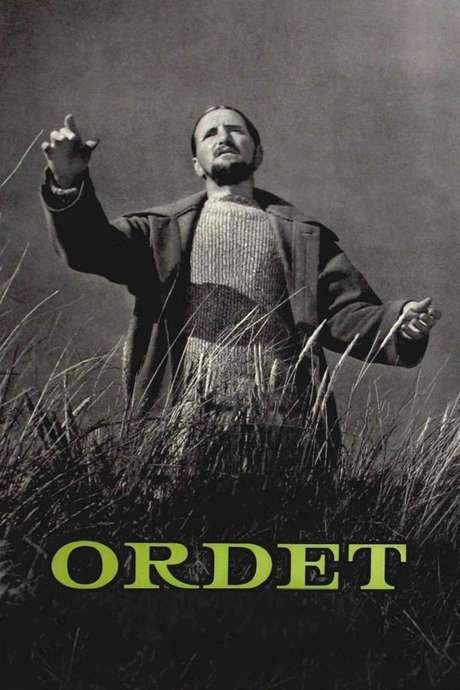
In the final moments of Pastor Tomas Ericsson, Gunnar Björnstrand delivering a noon service, the chapel is populated by only a few: fisherman Jonas Persson and his pregnant wife Karin Persson, plus Tomas’s ex-mistress, the atheistic Märta Lundberg. After the service, Tomas, though battling a cold, is preparing for his three o’clock commitment in another town. Before he leaves, the Perssons arrive to speak with him. No sooner have they departed than substitute teacher Märta Lundberg reappears, seeking comfort for the troubled pastor and asking if he has read the letter she wrote. He admits he has not, and he confesses his sense of failure to aid Jonas. Märta declares her love for him, while also claiming that he does not love her back. She leaves, and Tomas turns to the letter and reads it.
In her letter, Märta recounts Tomas’s neglect of her, telling of a rash that disfigured her body and how neither his faith nor his prayers could heal it. She writes about a family that was warm and loving without religion and wonders at his stubborn indifference to Jesus. Tomas finishes reading and, exhausted, drifts into sleep. He is awakened by Jonas’s return moment later, and Tomas awkwardly offers counsel before finally admitting that he has lost his faith as well. He explains that his earlier faith was an egoistic one—God loved humanity, but Tomas loved himself most. He recalls serving in Lisbon during the Spanish Civil War and how he could not reconcile a loving God with the atrocities he witnessed, so he chose to deny God as a way of making sense of human cruelty. Jonas leaves, and Tomas stares at the crucifix, declaring himself finally free. Märta, who has lingered in the chapel, seems secretly thrilled by this revelation, and she embraces him, though Tomas remains emotionally distant.
They are interrupted by the widow Magdalena Ledfors, who announces that Jonas has just taken his own life with a rifle. Tomas drives to the Persson house, where he stoically helps lay Jonas’s body under a tarp. Märta arrives on foot and, later, she and Tomas drive to her home, where she invites him in to take some medicine for his cold. Waiting in Märta’s classroom attached to her house, Tomas erupts, telling her that he stayed because of gossip and she could never measure up to his dead wife—the only woman he ever truly loved. Shocked but resolute, Märta endures the rebuke.
They then drive to the second church for the three o’clock service. Inside, the space is empty except for Algot, the handicapped sexton [Allan Edwall], and Fredrik, the organist [Olof Thunberg]. In the vestry, Algot presses Tomas about the Passion, wondering why the emphasis was placed on Jesus’s physical suffering, which Klaus? The question leads Algot to reflect on the deeper betrayals—by the disciples who denied him and, most painfully, by God’s silence on the cross. Tomas, listening intently, agrees that God’s silence can be worse. Fredrik counsels Märta to leave the town and pursue her life, but she chooses to stay and pray. The two men wonder whether they should hold a service if no one attends. Tomas chooses to go ahead, and the bells toll as he begins the service, reciting the Sanctus: “Holy Holy Holy, Lord God Almighty; heaven and earth are full of your glory.”
Throughout, Tomas’s crisis reframes the town’s quiet despair, and the narrative hovers between fear, duty, and an austere honesty about faith and doubt. Märta’s steadfast love stands in stark relief against Tomas’s self-imposed renunciation, while the surrounding community—Algot’s quiet theological questions, Fredrik’s pragmatic advice, and Magdalena’s grim revelation—underscore a town wrestling with meaning in the wake of tragedy. The final act leaves Tomas standing before his congregation and his own absolved conscience, compelled to navigate the uneasy boundary between faith and freedom.
> Holy Holy Holy, Lord God Almighty; heaven and earth are full of your glory