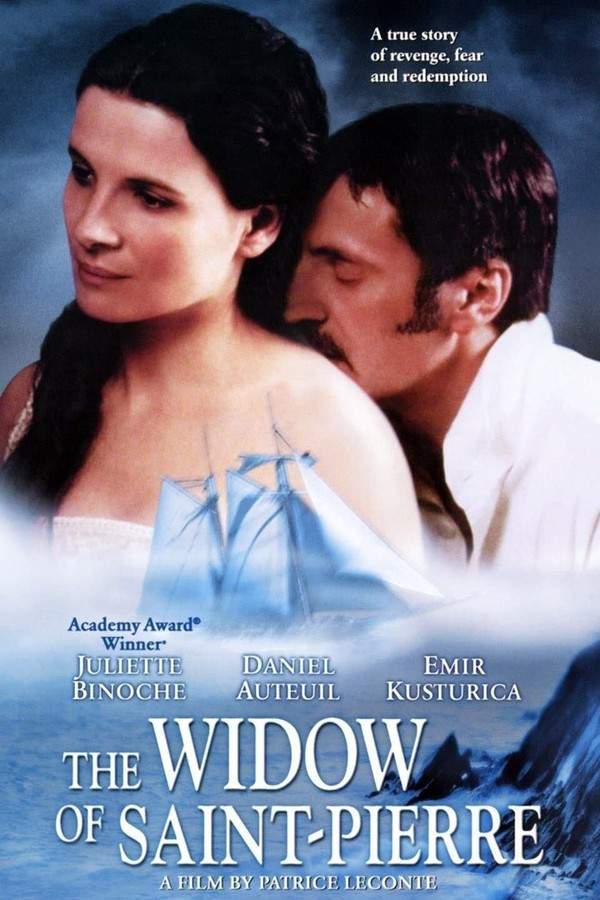
Year: 2001
Runtime: 112 min
Language: French
Director: Patrice Leconte
Set on the Isle of Saint-Pierre, a woman finds her life torn between the affections of two men during a period of significant change. The story explores her struggle as she navigates intense emotions and the potential for heartbreak. As she grapples with her choices, she must confront the consequences that will irrevocably alter her destiny and the lives of those around her.
Warning: spoilers below!
Haven’t seen The Widow of Saint-Pierre yet? This summary contains major spoilers. Bookmark the page, watch the movie, and come back for the full breakdown. If you're ready, scroll on and relive the story!
Read the complete plot breakdown of The Widow of Saint-Pierre (2001), including all key story events, major twists, and the ending explained in detail. Discover what really happened, and what it all means.
In the year 1849, on the remote French islands of Saint-Pierre and Miquelon, a tragic incident unfolds when two sailors, after being rescued, indulge in alcohol and commit an act of violence, resulting in the death of a man. Following their arrest, a trial ensues, leading to a harsh sentence. While one of the sailors succumbs to life’s trials in custody, the other, Néel, finds himself in a precarious position, awaiting execution in a place devoid of a guillotine or executioner.
Néel is detained in the army barracks under the watch of the Captain, who is devoted to his wife, known as Madame La. With no children of her own, she develops an interest in the convict, seeking to redeem him. Under her nurturing guidance, Néel engages in hard work and performs good deeds, gradually earning the islanders’ respect. Despite his transformation, the authorities remain resolute in their decision that he must face the gallows.
As time passes, a year goes by before the news reaches the islands that an old guillotine is en route from Martinique. However, by this point, Néel has undergone a significant change; he has learned to read and unexpectedly becomes a father through a brief affair with a grieving widow he assisted. In a shocking act against regulations, the Captain arranges for a priest to wed the couple, inciting the ire of the authorities.
When the long-awaited guillotine finally arrives, its rudder sustains damage, prompting the island’s men, including Néel, to lend their strength in towing it to shore using rowboats. In a critical moment, Madame La, witnessing Néel’s powerful rowing, fills a boat with provisions and urges him to escape to the British island of Newfoundland. Nevertheless, in a poignant act of loyalty, he chooses to return to his cell instead.
As the situation escalates, the islanders refuse to take on the ghastly role of executioner. Consequently, a newcomer is forced into the position under the threat of deportation. In a brave stand, the Captain informs the authorities that he will not command his men to fire upon the citizens who obstruct the impending execution. This act of defiance leads to his transfer to a warship destined for France, where he faces a court-martial, with Madame La choosing to accompany him.
Tragically, the Captain is ultimately sentenced to death and meets his end by a firing squad. Back on Saint-Pierre, when the anticipated execution finally takes place, the old guillotine malfunctions, forcing the authorities to resort to the grim method of beheading Néel with an axe.
Last updated: November 15, 2024 at 17:58
Explore frequently asked questions about The Widow of Saint-Pierre (2001) with spoiler-rich answers covering the full plot summary, major story beats, character motivations, hidden details, and ending meaning. This movie summary FAQ helps explain confusing scenes, plot twists, and narrative decisions in clear, searchable detail.
Madame La, the Captain's wife, develops an interest in Néel partly because she has no children of her own. Her compassion drives her to seek his redemption through nurturing guidance, encouraging him to work hard and perform good deeds. This maternal instinct, combined with her humanitarian impulses, leads her to transform him from a despised convict into a respected member of the island community.
When Madame La fills a boat with provisions and urges Néel to escape to Newfoundland, he makes the poignant decision to return to his cell out of loyalty. Despite having the opportunity for freedom, his sense of duty and commitment to facing his fate prevents him from fleeing. This choice demonstrates his transformation and moral growth, showing he would rather accept his consequences than live as a fugitive.
The Captain defies regulations by arranging for a priest to marry Néel and the grieving widow he helped, despite it being against the law. This act stems from his growing compassion for Néel, who has transformed under his watch. However, this forbidden marriage angers the authorities, who remain determined to carry out the execution regardless of Néel's reformation or new family responsibilities.
The islanders collectively refuse to take on the ghastly role of executioner, showing their moral opposition to carrying out Néel's death. Their refusal highlights the community's transformation in perception of Néel, he has earned their respect through his good deeds and hard work. This collective resistance demonstrates how the islanders have come to see him as a valued member of their community rather than a condemned criminal.
The Captain is executed because he confronts the authorities and declares he will not command his men to fire upon citizens who oppose the execution. This act of defiance against the government's inflexible stance leads to his transfer to a warship destined for France, where he faces a court-martial. He is ultimately sentenced to death and executed by a firing squad, a tragic end to his moral stand against injustice.
The Captain's defiance is foreshadowed by his earlier compassion in arranging the forbidden marriage.
When the execution day finally arrives, the old guillotine that traveled from Martinique malfunctions. The specific nature of the malfunction is not detailed in the summary, but the mechanical failure of this antiquated device leads authorities to resort to the grim method of beheading Néel with an axe. This tragic mechanical failure adds another layer of brutality to his execution.

The guillotine's rudder damage earlier during its arrival foreshadows mechanical issues.
During his time on the island under Madame La's guidance, Néel learns to read, which represents his profound personal transformation. This education symbolizes his redemption and intellectual growth, marking his evolution from a violent drunkard into an educated, reformed man. Learning to read also contrasts sharply with his previous state and highlights the effectiveness of Madame La's humanitarian efforts.
After being rescued, the two sailors indulge in alcohol and commit an act of violence that results in a man's death. Their subsequent arrest leads to a trial that delivers a harsh sentence. While one sailor succumbs to the harsh realities of prison life, Néel faces execution, setting in motion the central conflict of the story.
Madame La's bond with the Captain is central to the narrative. As he is devoted to her, he becomes the one tasked with watching over Néel in custody. This connection allows Madame La to pursue her mission of redeeming the convict. When the Captain is sent to France to face court-martial, Madame La chooses to accompany him, demonstrating their strong partnership even in the face of dire consequences.
During his year-long wait for execution, Néel has a brief affair with a grieving widow he assisted. This relationship results in him becoming an unexpected father. The birth of his child adds another layer of tragedy to his story, as he now has family responsibilities he cannot fulfill due to his impending execution.
Saint-Pierre lacks both a guillotine and an executioner, creating a practical dilemma for carrying out Néel's death sentence. A year passes before news arrives that an old guillotine is being sent from Martinique. The journey of this antiquated device becomes a central element of the story, with its eventual arrival and damaged rudder requiring the islanders' assistance to bring it ashore.
Discover curated groups of movies connected by mood, themes, and story style. Browse collections built around emotion, atmosphere, and narrative focus to easily find films that match what you feel like watching right now.
Characters trapped by geography and a rigid system confront their own humanity.Explore movies like The Widow of Saint-Pierre where characters face impossible moral choices in isolated settings. If you liked the tension between personal justice and colonial authority in a remote outpost, you'll find similar heavy dramas here.
The narrative pattern involves characters, often outsiders or authorities, stationed in a remote location. Their inherent sense of decency is tested when they encounter someone condemned by the system they represent. Their attempts at mercy or redemption inevitably clash with the established order, escalating towards a tragic and inevitable conclusion.
Movies are grouped here by their shared setting of isolation and their central theme of a personal moral code colliding with an impersonal institution. They generate tension and emotional weight from the futility of defiance in a closed system.
A condemned soul finds humanity, only for the system to crush any hope of salvation.Discover movies similar to The Widow of Saint-Pierre that feature a powerful but ultimately tragic redemption story. If you were moved by the convict's transformation and the bleak inevitability of his fate, these heavy dramas explore similar themes of mercy versus justice.
The narrative follows a character marked for death or ruin who is given a chance at rehabilitation, often through the kindness of others. They demonstrate significant positive change, offering a glimmer of hope. Yet, the story's fatalistic structure ensures that this redemption is personal, not judicial, and does not spare them from their predetermined, harsh destiny.
These films are united by the specific emotional arc of a character achieving spiritual redemption while facing physical condemnation. The shared experience is the crushing weight of a system that values punishment over transformation, resulting in a deeply melancholic and heavy viewing experience.
Don't stop at just watching - explore The Widow of Saint-Pierre in full detail. From the complete plot summary and scene-by-scene timeline to character breakdowns, thematic analysis, and a deep dive into the ending - every page helps you truly understand what The Widow of Saint-Pierre is all about. Plus, discover what's next after the movie.
Track the full timeline of The Widow of Saint-Pierre with every major event arranged chronologically. Perfect for decoding non-linear storytelling, flashbacks, or parallel narratives with a clear scene-by-scene breakdown.
Discover the characters, locations, and core themes that shape The Widow of Saint-Pierre. Get insights into symbolic elements, setting significance, and deeper narrative meaning - ideal for thematic analysis and movie breakdowns.
Discover movies like The Widow of Saint-Pierre that share similar genres, themes, and storytelling elements. Whether you’re drawn to the atmosphere, character arcs, or plot structure, these curated recommendations will help you explore more films you’ll love.
The Widow of Saint-Pierre (2001) Scene-by-Scene Movie Timeline
The Widow of Saint-Pierre (2001) Movie Characters, Themes & Settings
The Widow of Saint-Pierre (2001) Spoiler-Free Summary & Key Flow
Movies Like The Widow of Saint-Pierre – Similar Titles You’ll Enjoy
Lady J (Mademoiselle de Joncquières) (2019) Complete Plot Breakdown
In the Shadow of Women (2016) Full Movie Breakdown
A Woman's Life (2017) Full Summary & Key Details
The Sower (2019) Full Summary & Key Details
Place Vendôme (2000) Detailed Story Recap
Villa Des Roses (2002) Spoiler-Packed Plot Recap
The Merry Widow (2007) Detailed Story Recap
A Woman’s Revenge (1990) Plot Summary & Ending Explained
The Husbands, the Wives, the Lovers (1989) Plot Summary & Ending Explained
A Woman at Her Window (1976) Complete Plot Breakdown
A French Woman (1995) Story Summary & Characters
A Woman Kills (1968) Full Summary & Key Details
Marie of the Port (1950) Full Movie Breakdown
I, Pierre Rivière, Having Slaughtered My Mother, My Sister and My Brother… (1976) Spoiler-Packed Plot Recap
A Woman of Paris: A Drama of Fate (1923) Detailed Story Recap