Plot Explained Spoilers guaranteed!
Plot Explained

Browse by genre

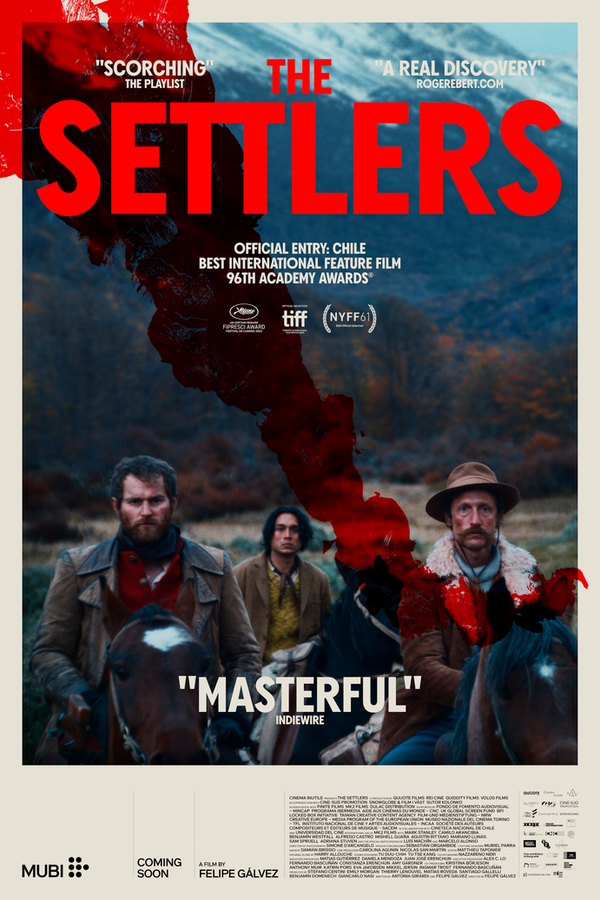
The Settlers (2024) movie poster

Timeline

The Settlers (2024) Timeline Explained – Every Event in Order

Release, runtime and language
2024 · 1 h 37 m · English
Echo score 70
Loading streaming availability…
Directed by
Felipe Gálvez Haberle
Starring
Sam Spruell, Alfredo Castro, Mark Stanley, Camilo Arancibia, Marcelo Alonso, Agustín Rittano

In the early 1900s, three men journey into the harsh, remote territory of Tierra del Fuego, seeking survival and fortune. As they navigate the challenging environment, a skilled marksman named Segundo finds himself caught between loyalty to his companions and the need to protect himself in a town governed by few rules.

On this page (5)
  1. 1 Where to watch
  2. 2 Events in order (12)
  3. 3 Timeline questions answered
  4. 4 Movie threads
  5. 5 Every angle
Loading streaming availability…

12 events in order · contains spoilers

The Settlers Timeline: Events in Chronological Order

Every key event of The Settlers (2024) in order, scene by scene, with when and where it takes place. Use it to untangle flashbacks, time jumps and parallel storylines, to refresh your memory before the sequel or to find the exact scene you are thinking of.

  1. Expedition sets out to delimit lands

    In 1893, Segundo, MacLennan, and Bill embark on an on horseback expedition to delimit and reclaim lands granted to José Menéndez. What begins as an administrative mission soon becomes a violent hunt as the trio encounters the Tierra del Fuego frontier. The trip establishes the power dynamic among the three men, especially Segundo's discipline compared to Bill's and MacLennan's ambitions.

    When
    1893
    Where
    Tierra del Fuego
  2. Bill joins the expedition and questions Segundo

    On the departure day, Menéndez insists Bill accompany the team, and he joins the group. Bill challenges Segundo's reliability and wonders why a supposed lieutenant commands so few men. MacLennan defends Segundo's discipline as more valuable than sheer numbers.

    When
    1893
    Where
    Departure camp
  3. Encounter with border soldiers and a border scientist

    They meet Argentine border soldiers and a scientist charting the border. The trio engages in contests—shooting, arm wrestling, boxing—and the scientist muses about the dangers of boredom and a perverse interest in Native Americans. MacLennan subtly questions whether the man knows where more natives live.

    When
    1893
    Where
    Argentine border camp
  4. First massacre of Onas

    The trio discovers a group of Onas. MacLennan and Bill slaughter most of them, while Segundo cannot bring himself to kill. He even contemplates shooting Bill but resists, stopping short of violence himself in this moment.

    When
    1893
    Where
    Tierra del Fuego region
  5. The rape and the murder of the survivor

    After the massacre, MacLennan and Bill rape a young Native survivor. Segundo refuses to join, and MacLennan threatens to kill him. He pretends to consent, but secretly kills the young woman to spare her further pain.

    When
    1893
    Where
    Beached or remote settlement site
  6. Meeting with English mercenaries and Bill's death

    They encounter English mercenaries. The leader reveals MacLennan is not a lieutenant but a private; Bill is killed by the mercenary leader. The leader offers MacLennan a Native woman as replacement, which MacLennan accepts, and the trio depart with the woman after the mercenary’s assault on MacLennan.

    When
    1893
    Where
    English mercenary camp
  7. Seven years later: Menéndez's life and a visit from Vicuña

    Seven years after the expedition, José Menéndez lives in a Punta Arenas mansion with his daughter and a clergyman. A government envoy, Marcial Vicuña, arrives to assess the country’s centennial efforts. Menéndez defends MacLennan as Lieutenant and counters the envoy's questions with his own narratives about peace and power.

    When
    1900
    Where
    Punta Arenas, Chile
  8. Vicuña questions Menéndez about MacLennan

    Vicuña asks about the violent deeds attributed to MacLennan and whether those acts can be reconciled with national progress. Menéndez defends his former employee, insisting that MacLennan acted under his command and that he cannot be judged harshly. The discussion reveals differing views of history and accountability.

    When
    1900
    Where
    Punta Arenas mansion study
  9. Vicuña seeks Segundo on Chiloé Island

    Vicuña travels to Chiloé Island to locate Segundo and speaks with Rosa, his wife. Rosa warns that Segundo is out at sea, but Vicuña presses to speak with him. This meeting foreshadows a confrontation and potential confession.

    When
    1900
    Where
    Chiloé Island
  10. Segundo recounts the beach banquet

    Inside their home, Vicuña asks about how Segundo met Rosa and about the past. Segundo then recounts a beachside banquet where MacLennan and others slaughtered hundreds of natives after a drunken feast, driving them into the sea or strangling them. The confession exposes the scale of violence.

    When
    1900
    Where
    Chiloé Island home
  11. Tea scene and filming of the confession

    Vicuña arranges a tea ritual with Segundo and Rosa outside their house, filming them as Laura pours tea. Rosa refuses to drink, signaling a refusal to participate in the nation's moral reckoning. The scene emphasizes the personal cost and unresolved tensions surrounding the past.

    When
    1900
    Where
    Outside their house, Chiloé Island
  12. Memory, accountability, and the centennial frame

    The interview sequence culminates in a public camera record of crimes and the uneasy acceptance of responsibility. Menéndez's defense, Segundo's confession, and Rosa's resistance converge to question how a nation should remember its violent history. The story hints at future consequences as the centennial approaches.

    When
    1910
    Where
    Chiloé Island / national context

Last updated: January 06, 2026 at 10:49

Was this helpful?

Timeline questions answered

The Settlers Timeline Explained: Your Questions Answered

When does it happen, and why in that order? The questions people ask about the chronology of The Settlers (2024): time jumps, flashbacks, cause and effect between scenes and the correct order of events, each answered with spoilers.

Q1

Why does Segundo agree to join Menéndez's expedition knowing it will involve violence?

Segundo joins because he needs the work and survival in 1890s Tierra del Fuego is extremely difficult for a mestizo like him. However, his moral conflict becomes clear during the first massacre when he cannot bring himself to kill any of the Onas people, showing he either didn't fully understand the mission's true nature or hoped he wouldn't be forced to commit violence.

Foreshadowing: Earlier dialogue establishes Segundo as disciplined but also desperate for employment, setting up his internal conflict between survival and conscience.

  • Segundo
  • Menéndez
  • expedition
  • motivation
  • survival
Q2

Why does MacLennan allow Bill to join the expedition over Segundo's skills?

Menéndez, the landowner funding the mission, insists Bill join as his personal choice, overriding MacLennan's preference for Segundo. Bill immediately questions Segundo's loyalty and wonders why a supposed lieutenant doesn't command more men, revealing Bill's suspicious and competitive nature from the start.

Foreshadowing: This power dynamic foreshadows the eventual conflicts within the trio, as Bill's presence creates tension with both MacLennan and Segundo.

  • Bill
  • MacLennan
  • Menéndez
  • expedition
  • join
Q3

Why does Segundo kill the Native woman instead of raping her like MacLennan and Bill?

When MacLennan and Bill rape a young Native survivor after the massacre, Segundo refuses to participate. MacLennan threatens to kill him, so Segundo pretends to comply but secretly kills the woman to spare her further suffering. This act shows his moral compromise, he cannot stop the violence but cannot participate in it either.

Foreshadowing: This moment establishes Segundo's pattern of reluctant participation and his attempts to minimize harm even when unable to oppose the violence outright.

  • Segundo
  • kill
  • Native woman
  • rape
  • mercy killing
Q4

What happens to Bill at the English mercenary camp?

The English mercenary leader reveals during dinner that MacLennan is not actually a lieutenant but a private masquerading as one. When Bill expresses shock that a higher-ranking officer would dine with a lowly private, the mercenary leader shoots Bill dead in disgust for his insolence.

Foreshadowing: This reveals the hierarchical nature of the mercenary world where rank is treated with deadly seriousness, and exposes MacLennan's deception to the group.

  • Bill
  • death
  • English mercenaries
  • MacLennan
  • lieutenant
Q5

Why does MacLennan accept the Native woman offered by the mercenary leader?

After Bill's death, the mercenary leader offers MacLennan a Native American woman as a replacement for Bill. MacLennan accepts her, demonstrating his view of indigenous people as property or tools rather than people. The leader then rapes MacLennan, adding another layer of degradation to the scene.

Foreshadowing: This exchange highlights the cyclical nature of violence and abuse in the colonial context, where power dynamics determine victimhood.

  • MacLennan
  • Native woman
  • mercenary
  • accept
Q6

What is the significance of MacLennan's fake lieutenant rank?

MacLennan presents himself as a British army lieutenant with a distinctive red jacket, which grants him authority over the expedition. The English mercenary leader exposes that MacLennan is actually just a private. This deception allows him to command respect and make decisions, but it also reveals the inflated egos and false pretensions that drive colonial violence.

Foreshadowing: The revelation about his rank comes just before Bill's death, showing how quickly false authority crumbles among those who understand its true value.

  • MacLennan
  • lieutenant
  • private
  • fake
  • rank
Q7

Why does Rosa refuse to drink tea in the final scene?

Vicuña arranges a formal tea ceremony outside Segundo and Rosa's home, filming them as part of the government's attempt to document history for Chile's centennial. Rosa refuses to drink, signaling her resistance to participating in a national narrative that seeks to assimilate or erase her people's suffering. Her refusal represents Indigenous resistance to being recorded as part of a reconciliation they did not choose.

Foreshadowing: This scene completes Rosa's character arc from the beginning, where she was introduced as a translator for MacLennan but now rejects the state's attempt to control her story.

  • Rosa
  • tea
  • ceremony
  • refuse
  • filming
  • centennial
Q8

What does Segundo mean when he describes the beach banquet massacre?

Segundo recounts to Vicuña a massive beachside banquet attended by over three hundred Native Americans that ended with MacLennan and his men slaughtering many of them, driving others into the sea, and strangling those who tried to escape. This reveals the scale of the genocide beyond the earlier smaller massacre and exposes the systematic nature of the violence against the Onas and other indigenous peoples.

Foreshadowing: This confession connects to earlier scenes showing MacLennan's methodical violence and explains why the government is so desperate to bury these stories.

  • Segundo
  • beach banquet
  • massacre
  • three hundred
  • natives
Q9

Why does Vicuña travel to Chiloé Island to find Segundo?

Seven years after the expedition, government envoy Marcial Vicuña travels from Santiago to assess Chile's centennial celebrations. He seeks survivors and witnesses to the violence, wanting to either make peace with the Indigenous peoples or bury the brutal chapters of how Menéndez acquired his land. His goal is to shape a national narrative that obscures the genocide while appearing to address it.

Foreshadowing: This political mission frames the entire latter half of the film, showing how history is contested and rewritten by those in power.

  • Vicuña
  • Segundo
  • Chiloé Island
  • interview
  • government
Q10

Why does Segundo confess to the crimes during Vicuña's interview?

Segundo tells Vicuña the full story of the expedition, including the beach banquet massacre where hundreds of natives were killed. He appears to confess because Vicuña has come with official authority and Rosa initially refuses to let him speak, but Segundo insists on telling his story. His confession exposes the scale of violence committed by MacLennan and the men under Menéndez's command.

Foreshadowing: This confession fulfills the dramatic arc of Segundo's guilt, as he's been carrying this knowledge for seven years.

  • Segundo
  • confession
  • crimes
  • Vicuña
  • interview
Q11

Why does Menéndez defend MacLennan's actions to Vicuña?

When Vicuña confronts Menéndez about MacLennan (nicknamed The Red Pig), Menéndez defends his former employee, insisting he was a lieutenant who worked faithfully for many years. Menéndez argues that the violence was necessary for establishing order and that visitors have focused only on negatives without helping the region develop. He protects his own legacy by defending the methods used to acquire his vast lands.

Foreshadowing: This conversation reveals that Menéndez was fully aware of and authorized the violence, and he continues to justify genocide as necessary colonization.

  • Menéndez
  • MacLennan
  • defend
  • Vicuña
  • lieutenant

Movie threads

More Movies Like The Settlers, by Mood & Story

Curated lists built around what makes The Settlers tick: the same mood, the same kind of story or the same emotional payoff. Each list explains why these movies belong together.

Movies about historical brutality like The Settlers

Grim journeys into the darkest chapters of human history and colonial atrocities. If you were gripped by the unflinching depiction of colonial genocide in The Settlers, explore these other powerful films. This list features movies like The Settlers that delve into dark historical events with a similar tone of moral gravity and stark realism.

  • bleak
  • harsh
  • oppressive
  • grim
  • historical
  • brutal
  • Tone: dark, bleak, somber
  • Pacing: steady, methodical
Why these movies?

The story pattern: Stories in this thread typically follow characters who are either perpetrators, witnesses, or victims of systemic violence, often set against the backdrop of historical conflicts or colonial expansion. The narrative structure is often straightforward or moderately complex, focusing on the inevitable progression towards a bleak outcome, emphasizing the moral corrosion and human cost of these events.

Why they belong together: These films are grouped together because they share a commitment to portraying historical violence with stark realism and a dark, heavy tone. They prioritize emotional weight over entertainment, creating a cohesive viewing experience for those seeking challenging and thought-provoking historical dramas.

Stories of moral conflict in harsh landscapes like The Settlers

Characters grapple with their conscience in lawless territories defined by survival. For viewers who appreciated the internal struggle against a brutal backdrop in The Settlers, this list finds similar films. Discover other movies like The Settlers where characters face moral collapse in unforgiving settings, exploring themes of survival and betrayal.

  • moral conflict
  • harsh landscape
  • survival
  • betrayal
  • grim
  • somber
  • Tone: dark, grim, somber
  • Pacing: steady, deliberate
Why these movies?

The story pattern: The narrative pattern involves a character or group entering a frontier or lawless zone, where the struggle to survive leads to escalating moral compromises. The plot is driven by the tension between external threats and internal conflict, culminating in a realization of the cost of those compromises. The harsh landscape acts as a crucible, exposing the darkest aspects of human nature.

Why they belong together: These movies share a potent mix of a specific setting (hostile frontier), a central theme (moral conflict), and a consistent tone (dark, grim). This creates a cohesive thread for viewers interested in psychological depth within survivalist scenarios.

Every angle

The Settlers (2024) Explained: Plot, Ending, Timeline & Characters

Everything about The Settlers in one place: what happens in the plot summary, the timeline in chronological order, the characters and meaning, the ending explained and a spoiler-free summary. What's After the Movie adds the cast, box office and post-credit scenes.

Coming soon on iOS and Android

The Plot Explained Movie Summary App

Plot summaries, endings explained and timelines on your phone. Catch up on any movie in minutes, save your favorites and never miss a twist again.

Be the first to know when we launch. Your email stays private, always.

Learn more about the app