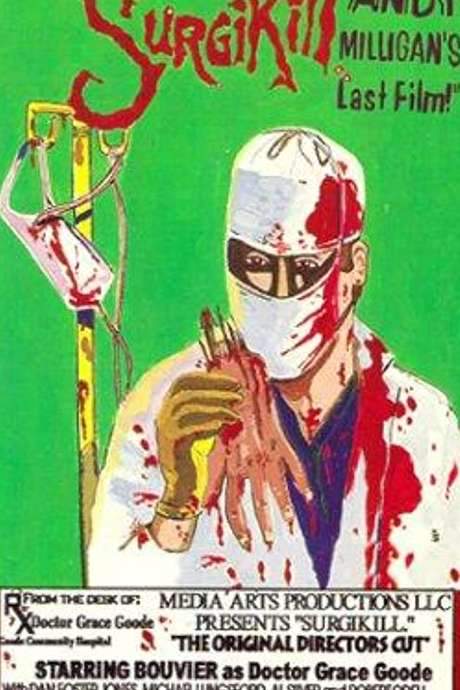
This short film presents itself as a teaser for a 9-hour-long movie, inviting viewers into a tense, globe-spanning mystery that blends medical precision with a creeping, otherworldly terror. The opening voice-over sets a stark premise that foreshadows a chase built not on speed, but on a sinister, inexorable persistence:
> some murders take seconds; some murders take minutes; some murders take hours; this murder... will take years!
From there, the focus centers on Jack Cucchiaio, a forensic pathologist, whose orderly world is pierced by a deranged-looking attacker who strikes with a spoon. Jack Cucchiaio, played by Paul Clemens (cucchiaio means spoon in Italian), finds that this unnamed assailant only appears when Jack is alone, a phenomenon that seeds a growing fear of everyday utensils and even of quiet moments, like stirring coffee with a fork instead of a spoon. The threat is personal, inexplicable, and relentless, pressing Jack into a claustrophobic struggle that makes the ordinary feel precarious and dangerous.
The danger escalates as the attack continues. The mysterious assailant is immortal, an impossible foe who shatters Jack’s attempts at defense. In a desperate moment, Jack tries to stab the attacker with a kitchen knife, only to have the knife inexplicably pulled free and discarded as the spoon returns with renewed force. The danger deepens when Jack notices a strange symbol etched on the attacker’s arm, a clue that hints at a history beyond mere obsession and violence. The encounter is not just a fight for survival; it becomes a quest to understand what is stalking him and why it won’t die.
To uncover the source of this torment, Jack travels to East Asia, where the truth begins to surface. He learns that his attacker is known as the Ginosaji—“silver spoon” in Japanese—a figure described as immortal and unstoppable, doomed to prey on a victim by striking again and again with a spoon. The Ginosaji is more than a conventional villain; it is a relentless force that will follow Jack to the ends of the Earth and will not stop until it achieves its grim purpose. The revelation reframes the chase as a perpetual hunt, a cycle of fear that transcends borders and time.
What unfolds next is a wide, world-spanning pursuit as Jack roams across continents, sometimes fleeing the Ginosaji and other times confronting the seemingly invincible entity. He arms himself with a range of weapons—dynamite, firearms, and even a rocket launcher—in a desperate bid to end the nightmare. Yet every attempt to end the siege proves futile, underscoring the Ginosaji’s uncanny immortality and the sense that this terror could endure indefinitely.
The final sequence delivers a stark, haunting image: a weakened, wounded Jack crawling through a barren desert as the Ginosaji presses in, spoon raised for the final strike. In a moment of ruptured certainty, the spoon breaks. The Ginosaji then opens its jacket to reveal dozens of spoons, amplifying the sense of an overwhelming, inexhaustible threat. The film closes with the title and credits, presented in the punchy, stylized rhythm of a trailer, leaving viewers with a lingering sense of dread and questions that feel as if they could stretch on for years.
The film is anchored by a sparse yet effective sound design and a voice that guides the narrative, carried by Richard Gale as the Narrator. The eerie premise is reinforced through stark visuals, a recurring motif of spoons, and a sense that the story, while focused on one man’s ordeal, hints at a universe where time, myth, and mortality collide in unsettling ways.