Plot Explained Spoilers guaranteed!
Plot Explained

Browse by genre

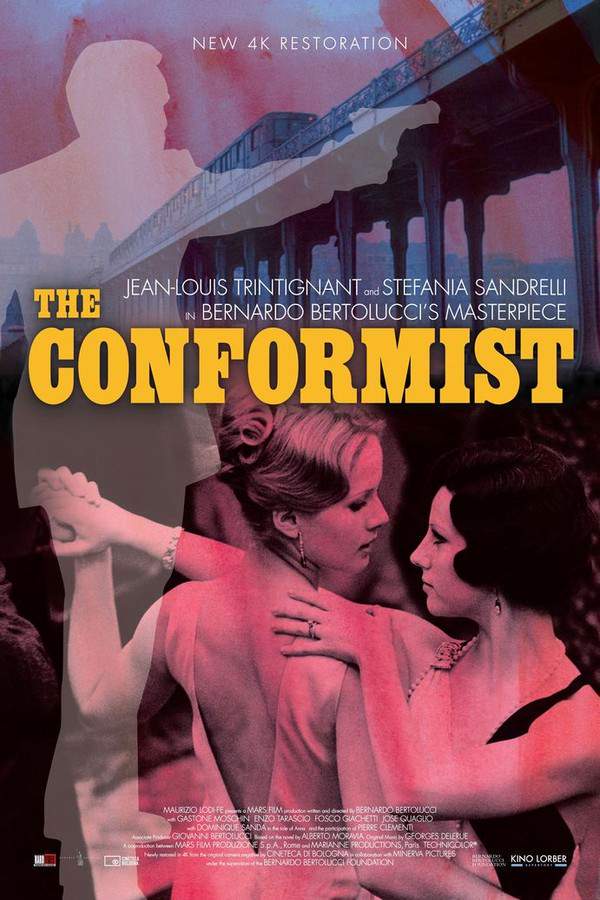
The Conformist (1970) movie poster

Timeline

The Conformist (1970) Timeline Explained – Every Event in Order

Release, runtime and language
1970 · 107 min · Italian
Loading streaming availability…
Directed by
Bernardo Bertolucci
Starring
Jean-Louis Trintignant, Stefania Sandrelli

In 1930s Italy, a man seeks acceptance and stability by joining the Fascist party. His pursuit of conformity is intertwined with a dark past, revealed through unsettling flashbacks. These memories depict a passionate and forbidden romance, a traumatic event involving violence, and the enduring burden of guilt that shapes his present actions and motivations.

On this page (6)
  1. 1 Where to watch
  2. 2 Events in order (14)
  3. 3 Timeline questions answered
  4. 4 Movie threads
  5. 5 Movies like The Conformist
  6. 6 Every angle
Loading streaming availability…

14 events in order · contains spoilers

The Conformist Timeline: Events in Chronological Order

Every key event of The Conformist (1970) in order, scene by scene, with when and where it takes place. Use it to untangle flashbacks, time jumps and parallel storylines, to refresh your memory before the sequel or to find the exact scene you are thinking of.

  1. Final preparations to assassinate Quadri

    In 1938 Paris, Marcello completes the plan to kill his former university professor Luca Quadri. He leaves his wife Giulia in their hotel room and is collected by Special Agent Manganiello in a car to begin the mission. The act is framed as a test of his loyalty to the Fascist cause and his willingness to take a life.

    When
    1938
    Where
    Paris
  2. Flashback: plans for marriage and fascist career

    A series of flashbacks shows Marcello confiding in his blind friend Italo about his hopes to marry and his attempts to join the Fascist secret police. These memories reveal the seeds of his moral compromises and foreshadow the choices that lie ahead. They illuminate how his personal life is entangled with his political ambitions.

    When
    Flashback (earlier years)
  3. Visit to the morphine-addicted mother

    In a decaying Rome villa, Marcello visits his morphine-addicted mother, witnessing the family’s decline. The scene underscores the cost of his world and his evolving emotional distance. It hints at the personal toll of his later public actions.

    When
    Earlier years
    Where
    Rome, family villa
  4. Visit to the father in the insane asylum

    Marcello also visits his father in an insane asylum, illustrating a broken family life beneath the surface of his orderly façade. The encounter deepens the sense of fragility in his world and fuels the tension between private life and public allegiance. It sets a background of familial instability he cannot escape.

    When
    Earlier years
    Where
    Rome
  5. 1917: schoolyard assault and near murder

    In 1917, Marcello is bullied at school until Lino intervenes as a chauffeur who shows him a pistol. Lino sexually assaults him, and Marcello partially responds before grabbing the pistol and firing into the walls and at Lino. He flees, convinced he has committed murder and is left with a haunting, silent guilt.

    When
    1917
    Where
    Schoolyard / nearby streets
  6. Confession for marriage and absolution

    In another flashback, Marcello debates the necessity of confession with Giulia so their Catholic parents will permit their marriage. He goes to confession, admitting sins including the rape and supposed murder of Lino, premarital sex, and a lack of guilt. The priest absolves him after learning he works for the Fascist secret police.

    When
    Pre-marriage
    Where
    Confessional booth
  7. Fascist orders: Raoul assigns Quadri mission

    In Ventimiglia, Fascist officer Raoul orders Marcello to assassinate Quadri, a move that pushes Marcello toward action. He uses his honeymoon as cover to travel to Paris with Giulia, beginning the mission under a veneer of normalcy. The instruction tightens the link between his duty and his personal life.

    When
    1938
    Where
    Ventimiglia
  8. Marcello meets Quadri's wife Anna in Paris

    While visiting Quadri, now an exile in France, Marcello falls in love with Anna, Quadri’s French wife. He pursues a dangerous affair, even as Anna and Quadri are aware of his fascist loyalties. The attraction tests his political convictions against personal desire.

    When
    1938
    Where
    Paris
  9. Anna and Giulia’s bond and the dance hall test

    Anna develops a close attachment to Giulia as both wives dress extravagantly and accompany their husbands to a dance hall. The evening becomes a test of Marcello’s commitment to the Fascists, watched by Manganiello who remains skeptical of his loyalties. Tensions between love, loyalty, and politics intensify.

    When
    1938
    Where
    Paris
  10. Revealing the plan: the Savoy country house

    Marcello secretly returns the gun and informs Manganiello of Quadri’s country-house location in Savoy. The exchange cements the next phase of the assassination plot and marks Marcello’s careful, calculated approach to carrying out the mission. The setup heightens the sense of impending violence.

    When
    1938
    Where
    Savoy countryside
  11. Quadri’s murder and Anna’s death

    On a deserted alpine road, Quadri is fatally stabbed by fascist agents while Anna watches in horror. When the assailants turn on her, Anna flees toward the car for help, only to be shot as Marcello’s betrayal becomes apparent. Manganiello walks away, disgusted by Marcello’s cowardice for not shooting Anna when she fled.

    When
    1938
    Where
    Savoy Alps
  12. 1943: fall of Fascism and domestic life

    By 1943, Mussolini’s resignation and the fall of the Fascist regime leave Marcello living a conventional life with Giulia and their daughter. The external change mirrors a new internal reckoning as the old certainties crumble. The country’s upheaval reframes his personal moral landscape.

    When
    1943
    Where
    Rome
  13. Realization of Lino’s survival and public denouncement

    While walking the streets of Rome amid celebrations, Marcello overhears two men flirting and realizes Lino survived the earlier events. He erupts, denouncing Lino as a Fascist, a homosexual, and the Quadris’ killer, while also denouncing Italo as a Fascist. An anti-Fascist crowd swirls past, taking Italo away in the unrest.

    When
    1943
    Where
    Rome
  14. Final image: memory and indictment

    As the anti-Fascist crowd moves on, Marcello sits beside a small fire, gazing at the young man Lino had been speaking to, now nude on a bed. The scene lingers on memory and complicity, leaving unresolved tensions between his past actions and present life. It closes on the uneasy moral landscape that defines him.

    When
    1943
    Where
    Rome

Last updated: October 09, 2025 at 15:44

Was this helpful?

Timeline questions answered

The Conformist Timeline Explained: Your Questions Answered

When does it happen, and why in that order? The questions people ask about the chronology of The Conformist (1970): time jumps, flashbacks, cause and effect between scenes and the correct order of events, each answered with spoilers.

Q1

Why does Marcello want to join the Fascist secret police?

Marcello seeks membership in the Fascist secret police as a way to achieve the conformity and normalcy he desperately craves. After his traumatic childhood experience, he developed a deep need for control and social acceptance. By joining the regime, he believes he can bury his dark past and become a respectable, conventional man. His marriage to Giulia represents his ultimate pursuit of a normal life, and his work for the secret police is the means to secure that facade.

Foreshadowing: Earlier flashbacks show Marcello discussing with Italo his hopes of marrying and his attempts to join the Fascist secret police, revealing this goal long before the assassination mission.

  • fascist secret police
  • marcello
  • conformity
  • normalcy
  • acceptance
Q2

What happened in the 1917 flashback with Lino?

In 1917, young Marcello was bullied at school until Lino, a family chauffeur, intervened. Lino showed Marcello a pistol and then sexually assaulted him. Marcello partially resisted before grabbing the weapon and firing at the walls and then at Lino. He fled believing he had murdered Lino, leaving him with decades of guilt. This traumatic event shaped his psychological makeup and his desperate need for control and normalcy.

  • 1917 flashback
  • lino
  • assault
  • childhood trauma
  • pistol
Q3

Why does Marcello betray Quadri and Anna?

Marcello betrays Quadri and Anna because he remains loyal to his Fascist handlers despite his personal conflicted feelings. Although he is drawn to Anna and experiences doubt during the mission, he ultimately provides Manganiello with the location of Quadri's country house in Savoy. This leads to Quadri's murder and Anna's death when she discovers Marcello's involvement. His betrayal stems from his inability to break free from the system that gives him identity and purpose.

Foreshadowing: Manganiello remains skeptical of Marcello throughout the Paris scenes, suggesting his true loyalties were always questionable.

  • betrayal
  • quadri
  • anna
  • marcello
  • assassination
  • savoy
Q4

Does Lino die in The Conformist?

No, Lino does not die. In the 1943 sequence, Marcello walks through Rome during celebrations of Mussolini's fall and overhears two men flirting. He recognizes one of them as Lino, revealing that the chauffeur survived the 1917 shooting. This shatters Marcello's understanding of his own past, as he realizes his decades of guilt were based on a misconception, he never killed anyone.

Foreshadowing: The 1917 scene shows Marcello firing at Lino but immediately fleeing, never confirming whether his shots actually struck the man.

  • lino survival
  • 1943
  • death
  • marcello
  • realization
Q5

Why does Marcello go to confession?

Marcello goes to confession to win approval from Giulia's Roman Catholic parents so they can marry. Though he is an atheist, he agrees to confess because he prioritizes achieving a normal, conventional life. In the confessional, he admits to the rape and presumed murder of Lino, premarital sex, and his lack of guilt, shocking the priest. The priest absolves him once he learns Marcello works for the Fascist secret police, suggesting moral compromise is easily overlooked for political loyalty.

  • confession
  • priest
  • giulia
  • marriage
  • sins
  • atheist
Q6

Why is Marcello drawn to Anna?

Marcello is drawn to Anna despite, or perhaps because of, the danger she represents. Anna is Quadri's French wife and the partner of the man he is assigned to kill. His attraction may stem from his psychological need to repeat destructive patterns, pursuing something forbidden and self-destructive. At the same time, Anna is aware of Marcello's Fascist affiliations and engages with him anyway, creating a complex, dangerous liaison that mirrors his own moral contradictions.

Foreshadowing: The summary notes Marcello is drawn to Anna while visiting Quadri, beginning a dangerous affair.

  • anna
  • affair
  • attraction
  • danger
  • quadri
  • pursuit
Q7

What triggers Marcello's breakdown in 1943?

Marcello's breakdown in 1943 is triggered by two simultaneous revelations: first, he discovers Lino has survived their childhood encounter, meaning his lifelong guilt was based on a misconception. Second, the Fascist regime he served his entire identity to is collapsing. During the chaos of celebration, Marcello desperately tries to reinvent himself by denouncing Lino as a Fascist and murderer, and Italo as a Fascist too, attempting to jump to the winning side of history.

  • 1943
  • breakdown
  • marcello
  • lino
  • denouncement
  • collapse
Q8

What does the ending signify?

The ending signifies the ultimate hollowness of Marcello's existence. His entire identity was built on the Fascist regime and his perceived crime. With both revealed as meaningless, Lino survived and Fascism fell, Marcello is left morally adrift. Sitting beside a fire, gazing at a nude young man (echoing his traumatic past), he represents a man whose carefully constructed life has collapsed, leaving only emptiness and complicity.

  • ending
  • significance
  • hollow
  • marcello
  • moral drift
Q9

Why are Quadri and Anna killed?

Quadri and Anna are killed because Fascist officer Raoul orders Marcello to assassinate Quadri, a prominent anti-Fascist intellectual living in exile in France. The regime views Quadri as a threat and wants him eliminated. Marcello carries out the mission by providing Manganiello with the location of Quadri's country house. On an Alpine road in Savoy, fascist agents fatally stab Quadri. Anna is killed when she flees toward the car for help and discovers Marcello's betrayal.

Foreshadowing: In Ventimiglia, Raoul assigns Marcello the mission to eliminate Quadri, framing it as a test of loyalty.

  • quadri
  • anna
  • assassination
  • killing
  • savoy
  • fascist
Q10

Why is normalcy so important to Marcello?

Normalcy is crucial to Marcello because his traumatic childhood left him feeling broken and guilty. The assault by Lino and his belief that he murdered someone created a desperate need to prove he is a respectable, conventional man. Joining the Fascist party, marrying Giulia, and having children represent his attempt to construct a respectable identity and bury his dark past. This pursuit of normalcy ultimately leads him to commit betrayals and murders, which deepens his moral corruption.

Foreshadowing: In confession, Marcello tells the priest he prioritizes a normal life and traditional marriage with children.

  • normalcy
  • conformity
  • marriage
  • respectability
  • guilt
  • childhood
Q11

What is the role of Italo in the story?

Italo serves as Marcello's confidant and mirror throughout the film. As a blind friend from Marcello's past, he represents the connection to Marcello's pre-Fascist life. In 1943, during the chaos of Mussolini's fall, Marcello turns on Italo by denouncing him as a Fascist to the anti-Fascist crowd, who then take Italo away. This final betrayal demonstrates how Marcello will sacrifice anyone to save himself, even his oldest friend.

Foreshadowing: Early flashbacks show Marcello confiding in Italo about his hopes to marry and join the Fascist secret police.

  • italo
  • blind friend
  • denouncement
  • 1943
  • betrayal
Q12

Why does Marcello return the gun to Manganiello?

Marcello returns the gun to Manganiello as part of his calculated plan to distance himself from the physical act of assassination. By providing Manganiello with Quadri's location in Savoy and letting the agents carry out the killing, Marcello attempts to maintain plausible deniability while still ensuring the mission succeeds. This reflects his psychological need to appear normal and uninvolved, even as he orchestrates the murder from behind the scenes.

Foreshadowing: This secret exchange with Manganiello about the Savoy country house sets up the assassination that follows.

  • gun
  • return
  • manganiello
  • savoy
  • plan
  • assassination

Movie threads

More Movies Like The Conformist, by Mood & Story

Curated lists built around what makes The Conformist tick: the same mood, the same kind of story or the same emotional payoff. Each list explains why these movies belong together.

Movies with fractured narratives and psychological unraveling like The Conformist

Stories where traumatic pasts resurface through non-linear narratives to shape a fractured present. Find movies like The Conformist that use flashbacks and non-linear storytelling to delve into themes of repressed memory, trauma, and guilt. These similar psychological dramas often feature complex timelines where the past haunts and dictates the present.

  • unsettling
  • haunted
  • introspective
  • melancholic
  • psychological
  • fragmented
  • Tone: dark, introspective, melancholic
  • Pacing: variable, contemplative
Why these movies?

The story pattern: Films in this thread often unfold through a mosaic of past and present, where key events from a character's history are revealed out of sequence. This structure mirrors the process of memory itself, creating a journey of discovery about the origins of their current psychological distress, moral ambiguity, or motivations.

Why they belong together: These films are grouped by their shared narrative technique and psychological focus. They prioritize internal states over external plot, using time as a flexible tool to build a deeply subjective and often unsettling experience centered on memory, trauma, and identity.

Stories about moral compromise and political conformity like The Conformist

Character studies of individuals losing their morality to gain acceptance within an oppressive ideology. If you liked The Conformist, explore these movies about characters betraying their morals to fit into a fascist or oppressive society. These similar dramatic stories examine the heavy guilt and psychological toll of conformity within corrupt systems.

  • oppressive
  • claustrophobic
  • pessimistic
  • anxious
  • moral ambiguity
  • guilt-ridden
  • Tone: dark, bleak, oppressive
  • Pacing: steady, deliberate
Why these movies?

The story pattern: The narrative typically follows a protagonist's descent into complicity, often beginning with a desire for a normal life. Their journey is marked by escalating moral betrayals, leading to a profound internal conflict and a bleak realization of their own hollow identity, usually culminating in a devastating, irreversible outcome.

Why they belong together: These films share a powerful thematic core: exploring the intersection of personal weakness, political ideology, and moral collapse. They create a claustrophobic, oppressive mood by focusing on the internal guilt and existential dread of someone who has sacrificed their soul for an empty promise of stability.

If you liked this

Movies Like The Conformist

Similar movies to The Conformist: the same genre, themes or kind of story. Each one comes with its own plot summary, timeline and ending explained.

Browse all movie summaries

Every angle

The Conformist (1970) Explained: Plot, Timeline & Characters

Everything about The Conformist in one place: what happens in the plot summary, the timeline in chronological order, the characters and meaning and a spoiler-free summary. What's After the Movie adds the cast, box office and post-credit scenes.

Coming soon on iOS and Android

The Plot Explained Movie Summary App

Plot summaries, endings explained and timelines on your phone. Catch up on any movie in minutes, save your favorites and never miss a twist again.

Be the first to know when we launch. Your email stays private, always.

Learn more about the app