Year: 1968
Runtime: 158 mins
Language: Hindi
Director: Harnam Singh Rawail
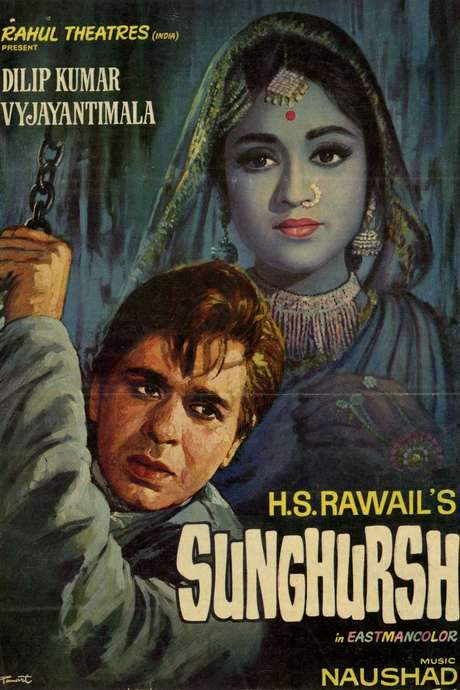
Bhavani Prasad, a vicious gangster who pretends to be a priest, seeks to perpetuate his criminal empire through his lineage. After his son Shankar rebels against the violent way of life, Bhavani murders him and attempts to frame his cousin Naubat Lal. When Naubat Lal reveals the truth, Bhavani eliminates him as well, intensifying the bitter family feud that now threatens his grandson Kundan’s future.
Get a spoiler-free look at Sunghursh (1968) with a clear plot overview that covers the setting, main characters, and story premise—without revealing key twists or the ending. Perfect for deciding if this film is your next watch.
In the timeless city of Banaras, where river‑banks echo with prayers and the scent of incense pervades every alley, a palpable tension clings to the ancient stone. The film immerses you in a world where devotion and danger coexist, the luminous rituals of the Shakta tradition casting shadows that hint at hidden rites. Within this sacred tapestry moves a charismatic figure who commands reverence as a priest while privately steering a far darker enterprise.
Bhavani Prasad is the spine of that enterprise—an imposing presence whose public piety masks an unyielding desire to cement his legacy through blood‑bound succession. His eldest son, Shankar, cannot bear the weight of his father’s ruthless path and chooses exile, taking his wife and children away from the holy precincts. The departure creates a rift that reverberates through generations, leaving the youngest heir, Kundan, at the crossroads of faith and family expectation.
Caught between the solemn chants of the temple and the ominous expectations of his forebear, Kundan is raised under the austere tutelage of his grandfather, taught that honor and duty are inseparable from the lineage he inherits. Yet the boy’s quiet curiosity and innate sense of rightness set him apart, suggesting a potential break from the cycle that has bound his clan for decades. Across the river, the distant cousin Naubat Lal represents another branch of the same tangled family tree, a reminder that old grievances linger beneath the surface of communal life.
The mood is one of brooding intensity, where the flickering oil lamps of the ghats illuminate both devotion and desperation. As the story unfolds, the audience feels the weight of inherited obligation and the pull of personal conscience, inviting a lingering question: can a soul born into darkness ever find its own light?
Last Updated: August 20, 2025 at 17:48
Discover curated groups of movies connected by mood, themes, and story style. Browse collections built around emotion, atmosphere, and narrative focus to easily find films that match what you feel like watching right now.
Epic stories of families trapped in a legacy of violence and betrayal.Movies like Sunghursh that delve into multi-generational crime families and the heavy moral conflicts they endure. If you were captivated by the saga of Bhavani Prasad's violent legacy and his grandson's struggle, you'll find similar epic stories of family, power, and inescapable fate in these films.
This thread follows narratives that span decades or generations, often beginning with the founding of a criminal empire and exploring its corrosive effects on the founder's descendants. The core conflict is typically internal—a battle for the soul of the next generation, pitting loyalty to the family against the desire for a moral life, frequently ending in tragedy.
Movies are grouped here for their shared focus on the inescapable nature of a family's criminal legacy. They share a dark, oppressive tone, a steady, epic pacing that allows the tragedy to unfold, and a heavy emotional weight centered on betrayal and the high cost of breaking a violent cycle.
Stories where characters are crushed by the weight of their violent world.If you appreciated the heavy emotional weight and bleak moral landscape of Sunghursh, this collection features similar films. Explore stories centered on cyclical violence, difficult redemption, and bittersweet endings where characters seek to break free from a destructive path, often with tragic consequences.
The narrative pattern here is defined by a protagonist trapped in a system or tradition of violence. Their central arc is an attempt to break the cycle, which forces them into profound moral conflict, often leading to great personal loss. The ending provides a sense of resolution to the central conflict but is shadowed by tragedy, offering a somber form of catharsis.
These films are united by their exploration of cyclical violence and the heavy toll it takes on the human spirit. They share a dark, brooding tone, a steady pacing that builds grim tension, and a consistent high intensity driven by the high stakes of the characters' moral struggles.
Don't stop at just watching — explore Sunghursh in full detail. From the complete plot summary and scene-by-scene timeline to character breakdowns, thematic analysis, and a deep dive into the ending — every page helps you truly understand what Sunghursh is all about. Plus, discover what's next after the movie.
Read a complete plot summary of Sunghursh, including all key story points, character arcs, and turning points. This in-depth recap is ideal for understanding the narrative structure or reviewing what happened in the movie.
Track the full timeline of Sunghursh with every major event arranged chronologically. Perfect for decoding non-linear storytelling, flashbacks, or parallel narratives with a clear scene-by-scene breakdown.
Discover the characters, locations, and core themes that shape Sunghursh. Get insights into symbolic elements, setting significance, and deeper narrative meaning — ideal for thematic analysis and movie breakdowns.
Visit What's After the Movie to explore more about Sunghursh: box office results, cast and crew info, production details, post-credit scenes, and external links — all in one place for movie fans and researchers.