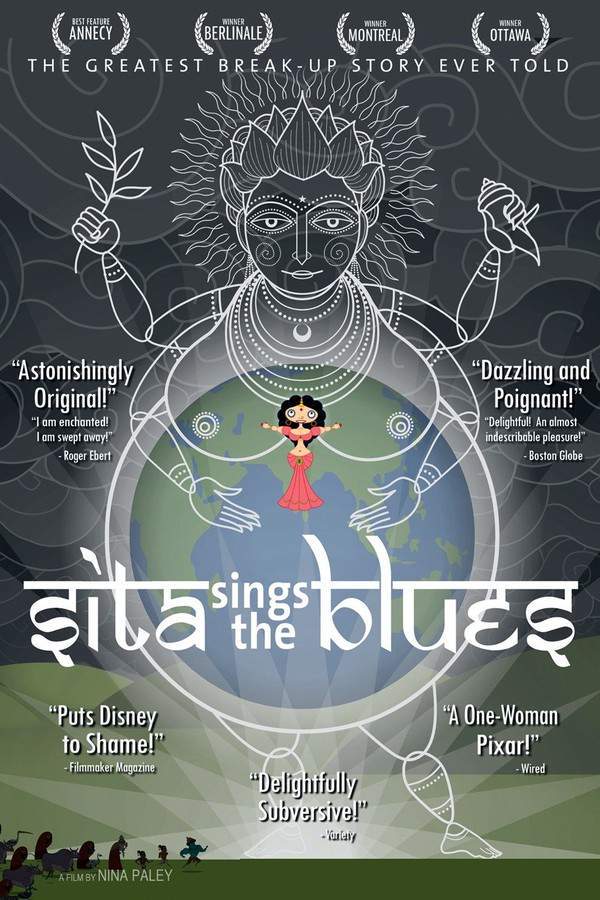
This unique film interweaves the ancient Indian epic of Sita and Rama with the modern-day story of Nina, whose relationship falls apart through email exchanges. The narrative is cleverly presented through wry commentary from three shadow puppets, offering both humorous and poignant observations on timeless tragedy and relatable heartbreak. The film is accompanied by sultry 1920s jazz vocals by Annette Hanshaw, creating a vibrant and unexpected blend of myth, heartache, and comedy.
Find where to stream, rent, or buy Sita Sings the Blues (2009) in the US with current JustWatch availability, up-to-date pricing, and platform listings for subscription, rental, and digital purchase options.
Warning: spoilers below!
Haven’t seen Sita Sings the Blues yet? This summary contains major spoilers. Bookmark the page, watch the movie, and come back for the full breakdown. If you're ready, scroll on and relive the story!
Read the complete plot breakdown of Sita Sings the Blues (2009), including all key story events, major twists, and the ending explained in detail. Discover what really happened, and what it all means.
The film presents a thoughtful adaptation of a timeless legend, focusing significantly on the character of Sita and her experiences, while emphasizing themes of truth, justice, and a woman’s plea for equal rights. The story begins with the exile of Prince Rama from his royal court, a decision imposed by his father’s favored queen, Kaikeyi. After saving the king’s life, Kaikeyi seizes the opportunity to secure the throne for her own son, demanding Rama’s banishment in return for the favor owed to her.
Determined to stay by the side of her beloved husband, Sita chooses to accompany Rama into the perilous forests, which are fraught with demons and malicious spirits. The notorious demon king, Ravana, driven by envy and spurred on by his vengeful sister, sets his sights on Sita’s incomparable beauty. He devises a cunning plan to distract Rama by sending a golden deer near their home, prompting Rama to venture into the woods to hunt it. Seizing the opportunity, Ravana abducts Sita, threatening her with dire consequences unless she yields to him.
Throughout her harrowing ordeal, Sita remains steadfastly loyal to Rama, firmly rejecting Ravana’s advances and holding onto the hope that her husband will rescue her. As time passes, Rama, with assistance from the valiant monkey prince, Hanuman, learns of Sita’s plight, rallying an army of monkeys to aid in her liberation. In a fierce confrontation, Rama vanquishes Ravana and reunites with Sita. However, upon her return, Rama is plagued by doubts about Sita’s fidelity during her captivity. To prove her loyalty, Sita willingly undergoes a trial by fire, where she throws herself into the flames, only to be saved by divine intervention, which supports her claims of purity and devotion.
As Sita and Rama return to the palace, the couple soon learns that they are expecting a child. Yet, doubts still linger in Rama’s heart, compounded by overheard conversations from his subjects questioning his ability to accept an unfaithful partner. In a moment of despair, he instructs his brother, Lakshman, to leave Sita in the forest. Alone, Sita finds solace among hermits, where she gives birth to twin boys who are raised to honor their father.
Years later, Rama hears the boys singing praises of him. Stricken by both joy and sorrow upon finding Sita, he faces her with the weight of their past. In a heartbreaking finale, Sita, hurt by Rama’s doubts, prays for the earth to embrace her, affirming her unwavering loyalty, resulting in her being consumed by the ground, leaving Rama and Lakshman behind in profound sorrow.
Last updated: May 13, 2025 at 20:30
Explore frequently asked questions about Sita Sings the Blues (2009) with spoiler-rich answers covering the full plot summary, major story beats, character motivations, hidden details, and ending meaning. This movie summary FAQ helps explain confusing scenes, plot twists, and narrative decisions in clear, searchable detail.
Kaikeyi, Rama's stepmother, manipulates King Dasharatha into banishing Rama after claiming a favor owed to her. After saving the king's life in battle, Kaikeyi demanded the throne for her own son Bharata and Rama's exile as payment. This politically motivated act forces Rama into the forest and sets the tragic events in motion.
Kaikeyi's demand for 'two boons' early in the film plants the seeds for all subsequent suffering.
Sita voluntarily accompanies Rama into the forest because of her unwavering devotion and love for her husband. She refuses to stay in the palace without him, viewing the banishment as a test of their relationship rather than a punishment. Her decision reflects her core character trait of steadfast loyalty, even when it means facing danger in the demon-filled forests.
Sita's refusal to stay behind establishes her as a character defined by devotion throughout the story.
Ravana schemes to use a magical golden hind (deer) specifically to lure Rama away from their dwelling. Knowing he cannot defeat Rama in direct combat, Ravana exploits Rama's desire to gift Sita the beautiful creature. While Rama pursues the deer, Ravana seizes his opportunity to abduct an unguarded Sita, using his sister Surpanakha's information about their location.
The golden hind appears mysteriously at the edge of their home, drawing Rama's attention away from Sita.
Despite Sita's captivity being forced upon her, Rama harbors doubts about her fidelity during her time in Ravana's lair. These doubts stem from societal expectations and his own insecurities about whether Sita remained chaste while held by the demon king. Even after her rescue, Rama cannot fully trust that she remained loyal, reflecting the tragic irony that Sita's virtue is questioned despite her unwavering devotion.
Rama's initial relief at finding Sita quickly gives way to suspicion in the rescue scene.
Sita undergoes the trial by fire to prove her purity and loyalty to Rama when he publicly doubts her. Rather than defending herself with words, she chooses to literally demonstrate her devotion by walking into flames. The gods protect her, affirming her innocence, but this moment also highlights the tragic necessity for a woman to prove her virtue through supernatural intervention rather than be believed on her word.
Sita's earlier steadfast refusal of Ravana's advances foreshadows her willingness to prove her loyalty through sacrifice.
Rama banishes pregnant Sita after returning to the palace because he overhears his subjects whispering about his honor, questioning whether a true king would accept a wife who lived in another man's house. Rather than defy public opinion, Rama succumbs to social pressure and orders Lakshman to leave Sita in the forest. This decision shows how societal expectations and fear of appearing weak drive his tragic choice, despite Sita having proven her loyalty through the trial by fire.
The whispers Rama overhears echo the doubts he expressed after the rescue, showing his insecurity never fully resolved.
In the tragic finale, Sita prays to the earth (her mother) to take her back after enduring years of injustice and repeated doubt from Rama. Feeling misunderstood and broken by his continued suspicion even after she proved her devotion multiple times, Sita calls upon the earth to embrace her. The earth answers her prayer, swallowing her whole, a death that affirms her purity one final time while condemning the injustice she suffered. Rama and Lakshman's desperate pleas cannot stop this final act of defiance and grief.
Sita's earlier statement about being 'daughter of the earth' foreshadows her return to it.
Hanuman, the monkey prince, becomes Rama's crucial ally in the rescue mission. He uses his supernatural abilities, including flight and superhuman strength, to locate Sita in Ravana's fortress and deliver Rama's message to her. Hanuman also rallies the monkey army to support Rama in the battle against Ravana's forces. His intervention transforms the conflict from a personal rescue into a full-scale war, ultimately leading to Ravana's defeat and Sita's liberation.
Hanuman first appears when Rama and Lakshman enter the forest, offering his assistance early on.
Ravana becomes obsessed with Sita after learning of her incomparable beauty from his sister Surpanakha. Driven by desire and envy, Ravana decides to make Sita his queen rather than simply harm her. He uses deception and trickery to capture her rather than direct force, showing that he values having her willing or at least believes he can win her over. Sita's steadfast refusal throughout her captivity ultimately leads to her being held prisoner until Rama's rescue.
Surpanakha's encounter with Rama and Sita sets Ravana's plan in motion.
Nina's modern-day storyline parallels Sita's ancient tale, showing that the themes of betrayal and heartbreak transcend time. As Nina's relationship dissolves through email exchanges, her experience reflects Sita's suffering, being abandoned despite loyalty. The juxtaposition creates a commentary on how women across centuries have faced similar injustices in love. Nina's story provides emotional resonance for contemporary viewers while reinforcing the timeless nature of Sita's tragedy.
The film opens with Nina reading about Sita, establishing the parallel from the start.
The three shadow puppets serve as a narrator frame that adds humor and critical perspective to the tragic story. Their wry, sometimes sardonic observations break the fourth wall and offer ironic commentary on the characters' actions, like questioning Rama's decisions or mocking the plot's tragic elements. This creative choice prevents the mythology from feeling overly serious while allowing the film to acknowledge the story's inherent sadness with a knowing wink.
The puppets appear in the opening sequence, establishing their role as the film's narrative voice.
Discover curated groups of movies connected by mood, themes, and story style. Browse collections built around emotion, atmosphere, and narrative focus to easily find films that match what you feel like watching right now.
Ancient epics retold with modern sensibilities and unique artistic styles.Discover movies like Sita Sings the Blues that offer unique, artistic reinterpretations of ancient myths. These films blend timeless stories with modern insights, innovative animation styles, or self-aware commentary to create a fresh and engaging experience for viewers.
This thread groups films that deconstruct or recontextualize well-known myths, often using parallel narratives, modern-day analogues, or metatextual commentary. The narrative pattern involves drawing poignant connections between ancient struggles and contemporary issues, creating a dialogue across time.
Movies are grouped here for their shared approach to source material: they are not straightforward adaptations but creative, often personal, explorations of mythology. They connect through their innovative storytelling techniques and their desire to find modern meaning in ancient stories.
Animated stories where music underscores tales of heartbreak and injustice.If you liked the mix of animation, jazz, and heartbreak in Sita Sings the Blues, explore these movies. They are animated musicals that balance whimsical presentation with heavy emotional themes, using their soundtrack to explore loss, love, and longing in a poignant way.
Stories in this thread often follow characters through profound emotional journeys—typically involving lost love or personal injustice—where the musical numbers serve as emotional outlets or narrative commentary. The endings tend towards the bittersweet or sad, leaving a lasting emotional impression.
These films are united by their unique combination of animation and music to tell emotionally weighty stories. The shared vibe is one of artistic expression used to process pain, creating a beautiful yet heartbreaking atmosphere that resonates deeply with viewers.
Don't stop at just watching - explore Sita Sings the Blues in full detail. From the complete plot summary and scene-by-scene timeline to character breakdowns, thematic analysis, and a deep dive into the ending - every page helps you truly understand what Sita Sings the Blues is all about. Plus, discover what's next after the movie.
Track the full timeline of Sita Sings the Blues with every major event arranged chronologically. Perfect for decoding non-linear storytelling, flashbacks, or parallel narratives with a clear scene-by-scene breakdown.
Discover the characters, locations, and core themes that shape Sita Sings the Blues. Get insights into symbolic elements, setting significance, and deeper narrative meaning - ideal for thematic analysis and movie breakdowns.
Discover movies like Sita Sings the Blues that share similar genres, themes, and storytelling elements. Whether you’re drawn to the atmosphere, character arcs, or plot structure, these curated recommendations will help you explore more films you’ll love.
Sita Sings the Blues (2009) Scene-by-Scene Movie Timeline
Sita Sings the Blues (2009) Movie Characters, Themes & Settings
Sita Sings the Blues (2009) Spoiler-Free Summary & Key Flow
Movies Like Sita Sings the Blues – Similar Titles You’ll Enjoy
Chico & Rita (2012) Story Summary & Characters
Bollywood/Hollywood (2003) Ending Explained & Film Insights
Saawariya (2007) Spoiler-Packed Plot Recap
Basmati Blues (2018) Film Overview & Timeline
The King and I (1999) Ending Explained & Film Insights
Sankarabharanam (1980) Full Summary & Key Details
The Burning of Lanka (1917) Story Summary & Characters
Ramayana: The Legend of Prince Rama (1993) Full Summary & Key Details
Samba the Great (1977) Ending Explained & Film Insights
Sangeet (1992) Ending Explained & Film Insights
Sing to the Dawn (2009) Movie Recap & Themes
Jodi (2023) Spoiler-Packed Plot Recap
Kanchana Sita (1978) Detailed Story Recap
Sita Ramam (2022) Full Movie Breakdown
Bajre Da Sitta (2022) Story Summary & Characters