Plot Explained Spoilers guaranteed!
Plot Explained

Browse by genre

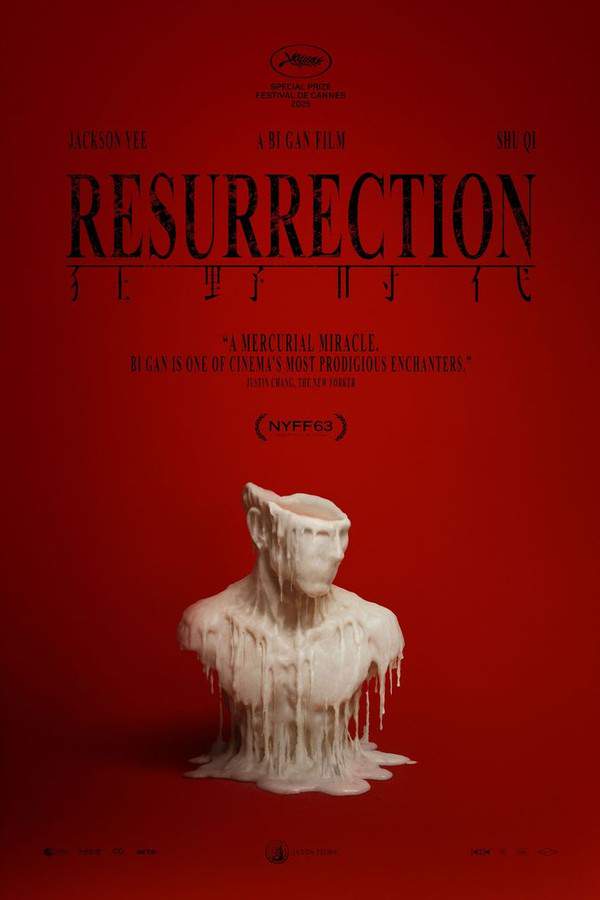
Resurrection (2025) movie poster

Timeline

Resurrection (2025) Timeline Explained – Every Event in Order

Release, runtime and language
2025 · 2 h 40 m · Chinese
Echo score 77
Directed by
Bi Gan
Starring
Jue Huang, Yongzhong Chen, Jackson Yee, Mark Chao, Chloe Maayan, Shu Qi
Budget
$2.7K

In a dystopian future humanity has traded the ability to dream for immortality. An outcast, portrayed by Jackson Yee, roams a hallucinatory realm, confronting nightmarish visions and fleeting beauty as he constructs an intoxicating world of his own making.

On this page (4)
  1. 1 Events in order (15)
  2. 2 Timeline questions answered
  3. 3 Movie threads
  4. 4 Every angle

15 events in order · contains spoilers

Resurrection Timeline: Events in Chronological Order

Every key event of Resurrection (2025) in order, scene by scene, with when and where it takes place. Use it to untangle flashbacks, time jumps and parallel storylines, to refresh your memory before the sequel or to find the exact scene you are thinking of.

  1. Miss Shu grants a gentle death and cinema dreams

    In a world where dreaming is traded for longevity, Miss Shu, an Other One, seeks out a Deliriant who still longs for the dream life. She grants him a gentle death by installing a film projector inside him, allowing him to experience cinematic dreams after death. This act opens the door to memory and imagination through film.

    Where
    Shu's facility (Other One world)
  2. Qiu emerges in the mid-20th century

    The Deliriant resurfaces as Qiu in the mid-20th century, accused of murdering a man by stabbing him with a fountain pen. His presence draws the attention of the Commander, who pursues the mysterious suitcase thought to end the ongoing war.

    When
    Mid-20th century
    Where
    Unknown location
  3. Mirror shop torture and the suitcase reveal

    In a mirror shop, the Commander tortures Qiu to reveal the suitcase's location. Qiu reveals a theremin hidden inside the suitcase and, before escaping, declares that he is the suitcase.

    When
    Mid-20th century
    Where
    Mirror shop
  4. Qiu strikes and escapes

    Using the shop's disorienting layout, Qiu stabs the Commander in one ear and escapes. He continues to insist that he embodies the suitcase, intensifying the pursuit.

    When
    Mid-20th century
    Where
    Mirror shop
  5. The Commander’s chilling counterpoint

    The Commander later wounds himself in the other ear and plays Bach's Come, Sweet Death on the theremin as a grim vigil. He then tracks Qiu to a train, determined to finish the hunt.

    When
    Mid-20th century
    Where
    Mirror shop and train
  6. Confrontation on the train

    On the train, the Commander confronts Qiu and kills him. The confrontation culminates in both of them bursting into flames, marking a fiery end to their pursuit.

    When
    Mid-20th century
    Where
    Train
  7. Thirty years later: Mongrel at the ruined temple

    Thirty years after the earlier events, the Deliriant becomes Mongrel, an art thief stranded in a ruined Buddhist temple. He breaks a fragment from a Buddha statue to release the Spirit of Bitterness, reincarnated into the tooth.

    When
    Thirty years later
    Where
    Ruined Buddhist temple
  8. Spirit and the thief’s past revealed

    The Spirit enters the scene as a trickster, taking form within the tooth. Mongrel reveals a dark memory: he killed his father to spare him a painful death from rabies, and the Spirit’s presence complicates their already tense bond.

    When
    Thirty years later
    Where
    Ruined Buddhist temple
  9. Ritual leads to Enlightenment

    Mongrel and the Spirit conduct a Buddhist ritual that culminates in the Spirit achieving Enlightenment. In the aftermath, the thief himself is transformed and becomes a literal dog.

    When
    Thirty years later
    Where
    Ruined Buddhist temple
  10. Jia rises as a con artist

    Decades later, the Deliriant becomes Jia, a slick con artist who recruits an orphan girl as his sidekick. He shows the girl a banknote with a riddle he believes will bring back her missing father.

    When
    Some decades later
    Where
    Unknown city
  11. Tricks, cards, and a mob boss

    Jia teaches the girl elaborate tricks that supposedly let her recognize cards by smell, and the duo swindle a mob boss to stay ahead. Their schemes rely on misdirection and the girl's keen senses, pushing their partnership to the edge.

    When
    Some decades later
    Where
    City
  12. Jia’s death cuts the thread

    Jia plans to abandon the girl, but he is robbed and stabbed to death before he can return to her. The girl is left to navigate the fallout of their partnership and the riddle’s promise.

    When
    Some decades later
    Where
    City
  13. A final test: the burnt note

    Meanwhile, the mob boss asks the girl to decipher the final message left by his estranged daughter on a burnt piece of paper. The girl uses her sense of smell to interpret the scent and completes the message.

    When
    Some decades later
    Where
    City
  14. New Year’s Eve 1999 arrives in the port city

    In a port city on New Year’s Eve 1999, the Deliriant appears as Apollo, a young hoodlum who falls for Tai Zhaomei, a vampire who claims she has never bitten anyone. They fall in love, and Tai bites Apollo with his consent. They kiss as the sun rises, and Apollo dies from his injuries, while Tai is felled by the sunlight.

    When
    New Year’s Eve 1999
    Where
    Port city
  15. The final dream and the wax theater

    The Deliriant dies after the final dream. Shu dresses him in monster garbs and conducts a funeral rite, attempting to speak to him through cinema once more. The film ends in a wax movie theater, where bright figures melt away as the light fades.

    When
    End of film
    Where
    Wax movie theater

Last updated: December 06, 2025 at 16:32

Was this helpful?

Timeline questions answered

Resurrection Timeline Explained: Your Questions Answered

When does it happen, and why in that order? The questions people ask about the chronology of Resurrection (2025): time jumps, flashbacks, cause and effect between scenes and the correct order of events, each answered with spoilers.

Q1

What is the Deliriant and why does he appear in different time periods?

The Deliriant is a being who has preserved the ability to dream in a world where humanity traded dreams for longer life. He reincarnates through different lifetimes across history, appearing as Qiu in the mid-20th century, Mongrel thirty years later, Jia decades after that, and finally Apollo in 1999. Each incarnation represents a different chapter of the same immortal soul, with the Other Ones (like Miss Shu) hunting Deliriants to preserve a fragile balance in society.

Foreshadowing: The opening scene establishes that Deliriants are rare beings who retain the capacity to dream, making them both precious and dangerous.

  • deliriant
  • reincarnation
  • dream
  • immortality
  • other ones
Q2

Why does Miss Shu install a film projector inside the first Deliriant?

Miss Shu, an Other One, grants the dying Deliriant a merciful end after witnessing his stubborn devotion to the dream life. Rather than letting him simply perish, she installs a film projector inside him so he can experience cinematic visions within his own body and mind after death, a final gift that allows him to continue dreaming through cinema.

Foreshadowing: This act of granting dreams through film foreshadows the film's recurring theme of cinema as a bridge between life and death.

  • miss shu
  • film projector
  • cinema
  • dreams
  • other ones
Q3

What is the significance of the suitcase and theremin in Qiu's storyline?

The suitcase contains a hidden theremin, an electronic musical instrument, making it the object of a larger war between factions in this era. The Commander tortures Qiu to discover the suitcase's location inside a mirror shop. The theremin becomes the instrument of fate when the Commander later plays Bach's "Come, Sweet Death" on it, linking the weaponized memory of the Deliriant's legend to his own identity.

Foreshadowing: The theremin's haunting sound appears both as a weapon and a symbol of the Deliriant's inescapable legend.

  • suitcase
  • theremin
  • commander
  • mirror shop
  • fountain pen
Q4

Why does Qiu say he is the suitcase?

When cornered in the mirror shop, Qiu declares "I am the suitcase" to emphasize that his identity has become inseparable from the object everyone seeks. This cryptic statement signals that the Deliriant's essence has merged with the weaponized memory and legend surrounding him, his existence IS the prize, not merely its container.

Foreshadowing: This declaration foreshadows how the Deliriant's identity becomes consumed by the myths surrounding him.

  • qiu
  • suitcase
  • identity
  • mirror shop
Q5

Why does the Commander stab himself in the ear?

After Qiu stabs him in one ear during the escape, the Commander later wounds himself in the other ear and plays Bach's "Come, Sweet Death" on the theremin as a grim vigil. This act suggests psychological destruction and symbolic surrender, mirroring Qiu's violence against him while embracing death as a form of completion. He then tracks Qiu to the train to finish their confrontation.

Foreshadowing: The self-mutilation reflects the Commander's obsession with matching or completing the Deliriant's legend.

  • commander
  • self-harm
  • theremin
  • come sweet death
  • bach
Q6

What happens to Mongrel at the end of the temple scene?

After performing a Buddhist ritual with the Spirit of Bitterness, Mongrel's fate takes a dark turn, he becomes the embodiment of a real dog. While the Spirit achieves a form of Enlightenment through the rite, Mongrel is transformed into an animal, blurring the line between thief and spirit, dream and waking life.

Foreshadowing: The transformation suggests that the Deliriant's nature can manifest in various forms, animal as well as human.

  • mongrel
  • dog
  • buddhist temple
  • spirit of bitterness
  • transformation
Q7

Why did Mongrel kill his father?

Mongrel reveals a dark memory: he killed his father to spare him an agonizing death from rabies. The Spirit of Bitterness, reincarnated into a Buddha statue's tooth, adopts the father's appearance, adding emotional complexity to their relationship. This act of mercy killing represents the Deliriant's willingness to make desperate choices to prevent suffering.

Foreshadowing: This backstory explains why Mongrel carries such guilt and why the Spirit's presence haunts him.

  • mongrel
  • father
  • rabies
  • killing
  • spirit of bitterness
Q8

What is the riddle on the banknote in Jia's storyline?

The orphan girl carries a banknote with a riddle she believes will summon her father back. Jia teaches her tricks and uses her in scams, but discovers another banknote bearing a profane answer to her riddle. He plans to abandon her but is killed before returning. The riddle represents hope for reunion, while the answer Jia finds suggests a cruel twist to that hope.

Foreshadowing: The bank's note subplot demonstrates how memory and deception intertwine in a world where reality can be manufactured.

  • banknote
  • riddle
  • jia
  • orphan girl
  • father
Q9

What happens to the orphan girl after Jia's death?

After Jia is robbed and killed, the mob boss asks the girl to decipher the final message his estranged daughter left on a burned piece of paper. Using her keen senses, especially smell, she detects the correct answer and completes the task. This arc emphasizes how sensory clues can unlock hidden truths in a world where reality is manufactured.

Foreshadowing: The girl's ability to read through scent highlights how the Deliriant's influence extends to those around him.

  • orphan girl
  • mob boss
  • burnt paper
  • smell
  • message
Q10

Why does Tai bite Apollo if she claims she never bites?

Tai Zhaomei claims she has never bitten anyone, but when she and Apollo are granted a chance to escape together by Mr. Luo, she reveals her vampiric nature and bites Apollo with his full consent. Their tragic kiss beneath the rising sun ends with Apollo dying from his wounds while Tai is overwhelmed by daylight, fulfilling the vampire mythology while subverting the typical redemption arc.

Foreshadowing: The consent-based bite and subsequent death under the sun subvert typical vampire narrative expectations.

  • tai zhaomei
  • apollo
  • vampire
  • bite
  • sunrise
  • death
Q11

What does the final funeral scene with Shu represent?

After Apollo dies, Miss Shu dresses the Deliriant in "monster garbs" and conducts a funeral rite, attempting one last connection through cinema. The film ends in a wax movie theater where bright figures slowly melt away, leaving only memories projected in light. This final tableau represents transcendence through art, the dream finally released, the Deliriant's essence preserved only in projected memory.

Foreshadowing: The wax theater returning to light echoes Miss Shu's original act of granting cinematic dreams.

  • shu
  • funeral
  • monster garbs
  • wax theater
  • cinema
  • melting figures
Q12

What is the overall meaning of the film about dreams and immortality?

The film explores a world where humanity traded dreams for longevity, making the Deliriant, a being who preserved the capacity to dream, a hunted anomaly. Through multiple lifetimes, the Deliriant experiences love, loss, and transformation, with cinema serving as the language to express what life cannot sustain. The ending suggests that while the Deliriant dies, his essence achieves transcendence through art, dreams outlasting the dreamer.

Foreshadowing: Each life cycle demonstrates that dreams persist even as physical forms are lost.

  • dreams
  • immortality
  • cinema
  • transcendence
  • art
  • memory

Movie threads

More Movies Like Resurrection, by Mood & Story

Curated lists built around what makes Resurrection tick: the same mood, the same kind of story or the same emotional payoff. Each list explains why these movies belong together.

Melancholic Sci-Fi Dystopias like Resurrection

Philosophical futures where humanity's progress comes at a profound emotional cost. If you enjoyed the poetic sorrow and philosophical weight of Resurrection, explore more movies like it. This list features dystopian stories where the world-building serves a deeply melancholic and humanistic exploration of loss, memory, and the cost of immortality.

  • dystopian
  • melancholic
  • philosophical
  • atmospheric
  • bittersweet
  • existential
  • Tone: melancholic, philosophical
  • Pacing: variable, atmospheric
Why these movies?

The story pattern: Narratives in this thread often follow isolated characters or outcasts navigating societies built on a foundational sacrifice. The central conflict is internal and philosophical, as characters grapple with the meaning of their existence in a world that has traded soul for survival, leading to journeys of profound introspection.

Why they belong together: These films are grouped by their shared atmosphere of high-concept melancholy, using sci-fi premises to amplify deeply human emotions. They prioritize mood, philosophical inquiry, and a bittersweet tone over traditional plot mechanics, creating a cohesive, emotionally heavy viewing experience.
Hallucinatory Journeys of the Self like Resurrection

Films where reality blurs and characters confront their deepest selves through visions. Fans of Resurrection's hallucinatory exploration of identity and memory will find similar movies here. These films use dreamlike narratives and surreal visuals to delve into the psyche, offering complex, visually arresting stories about the construction of self.

  • hallucinatory
  • dreamlike
  • psychological
  • surreal
  • atmospheric
  • complex
  • Tone: melancholic, hallucinatory
  • Pacing: variable, reflective
Why these movies?

The story pattern: The narrative pattern involves a protagonist navigating a landscape that blends memory, dream, and reality. The journey is internal, often fraught with symbolic obstacles and nightmarish visions, leading to a climax of self-realization or tragic dissolution. The structure is typically complex and requires interpretive engagement from the viewer.

Why they belong together: These films are united by their commitment to a subjective, hallucinatory experience. They share a high level of narrative complexity, a dreamlike atmospheric mood, and a central theme of piecing together a fractured identity or consciousness, making them feel coherent and distinct.

Every angle

Resurrection (2025) Explained: Plot, Ending, Timeline & Characters

Everything about Resurrection in one place: what happens in the plot summary, the timeline in chronological order, the characters and meaning, the ending explained and a spoiler-free summary. What's After the Movie adds the cast, box office and post-credit scenes.

Coming soon on iOS and Android

The Plot Explained Movie Summary App

Plot summaries, endings explained and timelines on your phone. Catch up on any movie in minutes, save your favorites and never miss a twist again.

Be the first to know when we launch. Your email stays private, always.

Learn more about the app