


Plot Explained Spoilers guaranteed!
Plot Explained

Browse by genre

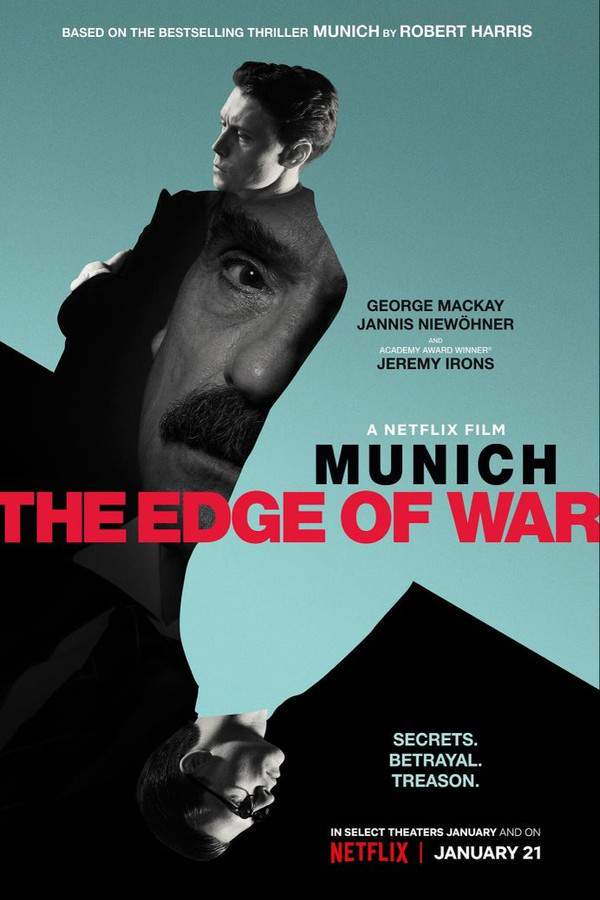
Munich: The Edge of War (2022) movie poster

Ending Explained

Munich: The Edge of War (2022) Ending Explained – Final Scene & Meaning

Release, runtime and language
2022 · 130 min · English
Echo score 54
JustWatch #31,961 6
Directed by
Christian Schwochow
Starring
George MacKay, Jeremy Irons, Sandra Hüller, Alex Jennings, Anjli Mohindra, August Diehl

In the autumn of 1938, with Europe on the brink, British civil servant Hugh Legat and German diplomat Paul von Hartmann are reunited in Munich for a pivotal conference. As old friends, they find themselves navigating a complex and dangerous political landscape, attempting to avert a looming war. Their personal connection is tested as they confront the escalating tensions and the potential for devastating consequences, struggling to reconcile their loyalties and the uncertain fate of the continent.

On this page (8)
  1. 1 Where to watch
  2. 2 What happens at the end
  3. 3 Final events in order
  4. 4 Ending questions answered
  5. 5 The book behind the movie
  6. 6 Movie threads
  7. 7 Movies like Munich: The Edge of War
  8. 8 Every angle

Where to watch

Where to Watch Munich: The Edge of War (2022)

Where can you watch Munich: The Edge of War? Stream, rent or buy it in the US, including on Netflix and Netflix Standard: current JustWatch availability with up-to-date prices.

Streaming availability powered by JustWatch

Ending explained · contains spoilers

What Happens at the End of Munich: The Edge of War?

How Munich: The Edge of War (2022) ends, what the final scene means, which earlier moments set it up and how to read the ending if the film leaves it open. The full ending explained, with every spoiler.

At the end of "Munich: The Edge of War," the true consequences of the characters' choices and the brutal reality of that historical moment become very clear. Paul Von Hartman, who initially believed in Hitler’s promises, undergoes a profound transformation after witnessing the horrors inflicted on Lena, his Jewish girlfriend, and after uncovering evidence proving Hitler’s true intentions. Despite his efforts to prevent the Munich treaty by revealing this information to the British government, he ultimately fails to stop it. The treaty, which was supposed to avert war by ceding the Sudetenland to Germany, only temporarily delays the inevitable. Within a year, Hitler breaks the agreement, invading Poland and igniting World War II.

The film shows how political appeasement, motivated by a desire to avoid conflict, can embolden tyrants rather than tame them. Neville Chamberlain’s strategy of diplomatic negotiation buys time but ultimately enables Hitler’s expansionist ambitions. Meanwhile, Hitler is portrayed as a manipulative leader who conceals his true motives behind propaganda, only to reveal his ruthlessness once he feels secure enough to act.

In the final scenes, Hitler’s discontent and the aftermath of the Munich agreement are palpable. He is furious that Chamberlain received credit for "peace," while he saw it as a betrayal and a temporary victory for his plans of conquest. The film emphasizes that totalitarian regimes thrive on control of perceptions and that their real agendas remain hidden behind layers of deception.

A key message of the story is a reflection on human nature—how often people prefer to turn a blind eye to injustices until they are personally affected. Paul’s moral journey underscores that true resistance often comes too late and that moral courage is difficult to summon when one isn’t directly impacted by oppression. The ending leaves viewers contemplating the tragic cost of political complacency, the importance of foresight, and the dangers of appeasement in the face of evil. Ultimately, it’s a sobering reminder that history can repeat itself when human beings fail to recognize and challenge tyranny early enough. The film closes on the somber realization that the world narrowly escaped disaster, but only through the sacrifice of truth and moral conviction.

Last updated: June 25, 2025 at 08:58

Was this helpful?

The last 4 events

How Munich: The Edge of War Ends: The Final Events in Order

The last events of Munich: The Edge of War (2022) in chronological order, the run-up to the ending explained above. The complete timeline has all 15 events, scene by scene.

Open the full timeline
  1. Betrayal and Espionage

    Hartmann's plans begin to unravel as Franz, an SS officer, ransacks Legat's hotel room, intensifying the atmosphere of paranoia and suspicion. This betrayal highlights the dangers they face from within and the desperate stakes involved in their conspiracy.

    When
    1938
    Where
    Munich
  2. Joan's Key Role

    Joan Menzies, a typist, inadvertently becomes a crucial figure in their plan by safeguarding the important document from Sauer, the SS officer. Her role emphasizes the unexpected ways in which ordinary individuals can impact the course of history during tumultuous times.

    When
    1938
    Where
    Munich
  3. Chamberlain's Ignorance

    Chamberlain returns from Munich, buoyed by public applause as he delivers his famous 'Peace for our time' speech. Unbeknownst to him, the appeasement will only hasten the approach of war, pushing Legat to leave his position and join the RAF.

    When
    1938
    Where
    London
  4. Outbreak of World War II

    Just a year after the Munich Agreement, World War II erupts, nullifying the fragile peace that Chamberlain sought. His resignation follows amidst criticism, and the intelligence gathered proves crucial for Britain's future efforts in the conflict.

    When
    1939
    Where
    Europe

Ending questions answered

Munich: The Edge of War Ending: Your Questions Answered

The questions people ask most about the ending of Munich: The Edge of War (2022): what the final scene means, how the twist works, what happens to each character and how to read the ending. Each answer contains spoilers.

Q1

Why did Paul von Hartmann fail to stop the Munich Agreement?

Paul failed because, despite obtaining concrete evidence of Hitler's true intentions and passing it to the British, Chamberlain had already committed to pursuing appeasement. The British government chose to proceed with the treaty regardless, viewing it as the only viable path to peace at that moment. Paul's intelligence was technically correct, but the political will to act on it was absent.

Foreshadowing: Earlier scenes establish that Chamberlain's government was already committed to negotiation, making Paul's revelation an uphill battle.

  • paul von hartmann
  • munich agreement
  • failure
  • chamberlain
  • hitler evidence
Q2

What happens to Lena in the end?

Lena, Paul's Jewish girlfriend, is shown suffering under Nazi persecution. The exact details of her fate are left somewhat ambiguous in the final scenes, but the film implies she becomes a victim of the regime's violence. Her ordeal is what catalyzes Paul's transformation and determination to expose Hitler.

Foreshadowing: Paul's growing concern for Lena's safety increases throughout the film as Nazi oppression intensifies.

  • lena
  • jewish girlfriend
  • paul von hartmann
  • nazi persecution
  • fate
Q3

Why does Hitler break the Munich Agreement?

Hitler never intended to honor the Munich Agreement, viewing it only as a tactical victory to remove obstacles to his true goal of conquest. Within a year, he invades Poland, demonstrating that the treaty was merely a delay tactic. The film portrays him as a manipulative leader who uses diplomacy as a mask for expansionist ambitions.

Foreshadowing: Hitler's private conversations throughout the film reveal his contempt for the agreement and his long-term plans.

  • hitler
  • munich agreement
  • pacted
  • poland invasion
  • world war 2
Q4

What is the film's message about appeasement in the ending?

The ending delivers a clear message that appeasement emboldens tyrants rather than containing them. Chamberlain's strategy of diplomatic negotiation bought time but ultimately enabled Hitler's expansionist ambitions. The film shows that avoiding conflict in the short term led to a far larger war, arguing that standing firm against evil earlier could have prevented catastrophe.

Foreshadowing: The entire narrative builds toward demonstrating the consequences of choosing peace over principle.

  • appeasement
  • chamberlain
  • munich
  • treaty
  • political message
  • tyranny
Q5

What happens to Paul von Hartmann at the end of the movie?

Paul survives the film but faces the devastating realization that his moral victory came at the cost of historical failure. His efforts to expose Hitler were technically correct but arrived too late to change the course of events. The ending shows him carrying the weight of knowing the truth while watching history unfold toward war.

Foreshadowing: Paul's transformation from naive supporter to resistance figure sets up his doomed moral crusade.

  • paul von hartmann
  • ending fate
  • survives
  • moral victory
  • truth
Q6

What is Chamberlain's fate after the Munich Agreement?

In the ending, Chamberlain is shown receiving public credit for achieving 'peace in our time,' which visibly angers Hitler. However, the film implies this victory is hollow, within a year, the agreement collapses and WWII begins. Chamberlain's legacy becomes one of well-intentioned but catastrophic political misjudgment.

Foreshadowing: Throughout the film, Chamberlain's advisors debate whether appeasement will hold up to scrutiny.

  • chamberlain
  • peace
  • munich
  • prime minister
  • legacy
  • failure
Q7

Why does the film portray WWII as inevitable despite the Munich Agreement?

The film presents WWII as historically inevitable because Hitler's ambitions were never limited to the Sudetenland. His true goal was territorial conquest and racial domination, goals he openly shared with inner circles. The Munich Agreement merely bought time without addressing the underlying ideological and expansionist drive that made war unavoidable.

Foreshadowing: Paul discovers documents revealing Hitler's complete war plans, showing the agreement was always a façade.

  • world war 2
  • inevitable
  • munich
  • hitler conquest
  • historical fate
Q8

What does the ending say about human nature and moral courage?

The ending reflects that people often ignore injustice until they are personally affected, Paul only fully grasped the danger after Lena suffered. The film suggests true moral resistance is difficult when one isn't directly impacted by oppression, and that foresight requires confronting uncomfortable truths rather than seeking comfortable illusions.

Foreshadowing: Paul's journey from indifferent observer to active resister mirrors the moral awakening the film advocates.

  • human nature
  • moral courage
  • appeasement
  • injustice
  • personal impact
  • conscience

Movie threads

More Movies Like Munich: The Edge of War, by Mood & Story

Curated lists built around what makes Munich: The Edge of War tick: the same mood, the same kind of story or the same emotional payoff. Each list explains why these movies belong together.

Historical Espionage Thrillers like Munich: The Edge of War

High-stakes spy missions conducted in the shadow of a ruthless totalitarian regime. Explore movies similar to Munich: The Edge of War that feature tense spy missions set against historical backdrops. If you liked the high-risk political maneuvering within Nazi Germany, you'll find these stories of clandestine operations, fraught alliances, and desperate measures under dictatorship compelling.

  • tense
  • claustrophobic
  • paranoid
  • urgent
  • grim
  • high-stakes
  • Tone: tense, grim, anxious
  • Pacing: fast, urgent
Why these movies?

The story pattern: Narratives in this thread typically follow a lone operative or a small, isolated cell attempting to achieve a critical objective against a powerful, monolithic enemy. The plot is driven by close calls, betrayals, and the constant threat of exposure, often culminating in a finale where success is ambiguous or comes at a great personal cost.

Why they belong together: These films are grouped by their shared setting of a repressive political system and the specific type of tension generated by espionage within it. They deliver a consistent vibe of anxiety, high risk, and grim determination, appealing to viewers who enjoy politically charged thrillers with heavy historical stakes.

Bitterswart Political Dramas like Munich: The Edge of War

Stories where a desperate fight against tragedy yields a painful, Pyrrhic victory. Discover movies like Munich: The Edge of War that explore desperate attempts to change the course of history. These films share a bittersweet tone, where characters' heroic efforts result in a complex mix of limited success and tragic consequence, perfect for viewers who appreciate heavy, morally ambiguous historical stories.

  • bittersweet
  • tragic
  • urgent
  • heavy
  • determined
  • anxious
  • Tone: tense, bittersweet, tragic
  • Pacing: fast, driven
Why these movies?

The story pattern: The narrative arc involves a clear, urgent mission to stop a catastrophic event. The protagonists invest everything, facing immense obstacles, but the resolution is not a clean victory. Instead, it's a compromise—a smaller win that fails to prevent the larger tragedy, leaving characters and viewers with a heavy sense of what was lost versus what was narrowly saved.

Why they belong together: These films are united by their specific emotional payoff: a bittersweet ending following a high-tension, high-stakes plot. They balance the thrill of a political or historical thriller with the profound emotional weight of a drama, creating a memorable experience defined by its melancholic resolution.

If you liked this

Movies Like Munich: The Edge of War

Similar movies to Munich: The Edge of War: the same genre, themes or kind of story. Each one comes with its own plot summary, timeline and ending explained.

Browse all movie summaries

Every angle

Munich: The Edge of War (2022) Explained: Plot, Ending, Timeline & Characters

Everything about Munich: The Edge of War in one place: what happens in the plot summary, the timeline in chronological order, the characters and meaning, the ending explained and a spoiler-free summary. What's After the Movie adds the cast, box office and post-credit scenes.

Coming soon on iOS and Android

The Plot Explained Movie Summary App

Plot summaries, endings explained and timelines on your phone. Catch up on any movie in minutes, save your favorites and never miss a twist again.

Be the first to know when we launch. Your email stays private, always.

Learn more about the app