Year: 2007
Runtime: 124 min
Language: English
Director: Curtis Hanson
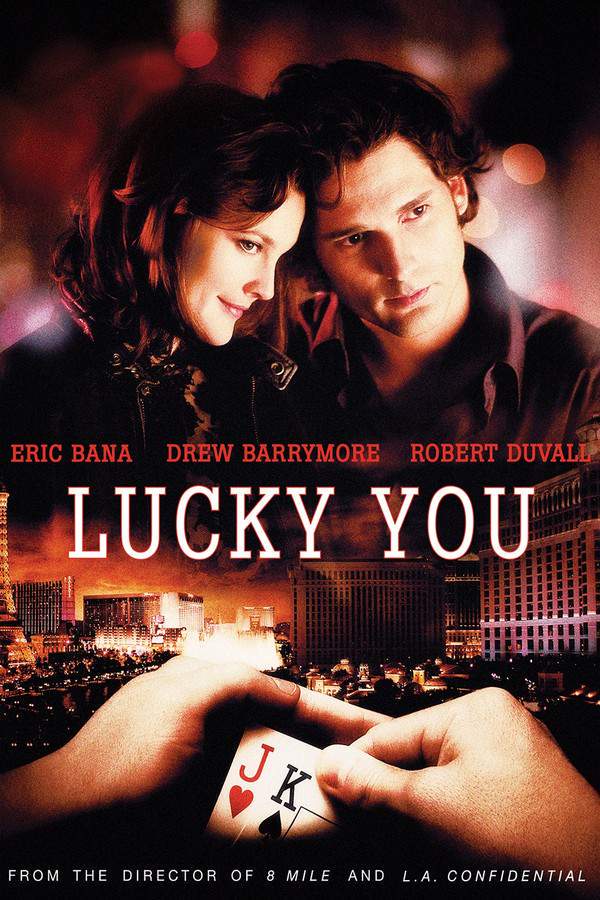
A gifted poker player, Huck Cheever, finds himself caught in a passionate love affair while striving to reach the prestigious world championship in Las Vegas. The intense competition is complicated by the reappearance of his estranged father, a renowned player with a legendary history. As Huck advances toward the final game, he's forced to confront his difficult past and the reasons for his father’s abandonment, adding emotional depth to the high-stakes showdown.
Warning: spoilers below!
Haven’t seen Lucky You yet? This summary contains major spoilers. Bookmark the page, watch the movie, and come back for the full breakdown. If you're ready, scroll on and relive the story!
Read the complete plot breakdown of Lucky You (2007), including all key story events, major twists, and the ending explained in detail. Discover what really happened—and what it all means.
In Las Vegas, 2003, we meet Huck Cheever (Eric Bana), a gifted young poker player grappling with a strained relationship with his estranged father, L.C. Cheever (Robert Duvall), a celebrated two-time World Series of Poker Champion. Huck frequents the vibrant poker rooms of Las Vegas, yearning to secure a spot in the prestigious $10,000 main event No Limit Texas Hold’Em tournament at the World Series of Poker.
Huck possesses an exceptional knack for reading people — understanding negotiations and human behavior — which allows him to excel at the tables. In a bid to fund his poker ambitions, he often visits the pawn shop, sometimes even pawning his mother’s engagement ring.
His skills are showcased one night at the Bellagio poker room, where he crosses paths with aspiring singer Billie Offer (Drew Barrymore), who has just arrived in the city. Their connection sparks interest; however, Billie’s older sister, Suzanne, expresses concerns, cautioning her that Huck embodies a “hustle 10, commitment zero” mentality. Complicating matters, the dynamic between father and son shifts dramatically when L.C. returns from the South of France, leading Huck to confront his father over a pivotal poker matchup.
In a tense heads-up scenario, Huck impulsively goes all-in during play, staking his mother’s engagement ring against L.C.’s significant war memento — his father’s watch. Ultimately, L.C. triumphs, winning yet again. Observing Huck’s playing style, loan shark Roy Durucher (Charles Martin Smith) notes Huck’s potential but criticizes his lack of patience, offering to finance Huck’s main-event entry with a split of the winnings. Huck, however, declines the offer.
Desperate for funds, Huck approaches his friend Jack (Robert Downey Jr.) for a loan, but to no avail. Instead, he runs into Billie again, who is ecstatic after landing a singing gig. To celebrate this achievement, Huck invites her to play poker with the traveler’s checks she brought, eager to demonstrate his prowess at the game. She soon recognizes Huck’s extraordinary ability to discern player tendencies through betting patterns.
When L.C. presents Huck with the redeemed wedding ring after retrieving it from the pawn shop, Huck struggles to maintain his footing, losing everything shortly after. This leads to an enlightening dinner conversation with Billie, where Huck reflects on his complicated relationship with his father and the roots of his poker career. Underneath their budding romance, Huck’s unresolved issues begin to surface, culminating when he steals from Billie’s purse for a quick round of poker, straining their relationship.
After suffering a setback during a “super satellite” game, Huck finds himself cut off from the main event. Yet, with Roy’s backing, Huck is given another chance and an extra $1,200 to repay Billie. They share a moment of connection, leading him to believe there’s still hope for their relationship. However, fate takes a turn when L.C. quickly claims Huck’s stake money during another brief game, leaving Huck with tough choices.
Caught in yet another bind, Huck must confront his challenges head-on. Billie holds the stopwatch for Huck’s golfing marathon, which he must complete in under three hours to win cash that can assist his poker ambitions. Despite putting in a valiant effort, he falls short by two seconds, facing physical consequences as Roy’s thugs send a stern warning about his debt.
In a twist of fate, Huck learns that Billie has returned to Bakersfield, pushing him to make some desperate decisions. He sells the wedding ring to his father, recouping enough to enter the World Series by raising $10,000 in one night of poker. Driven by his need to express his feelings, Huck travels to Bakersfield, professing to Billie that they have a chance at something extraordinary.
With renewed determination, he enters the World Series, where both Huck and L.C. find themselves on the final table’s brink. Billie watches as they face off, witnessing Huck strategically fold a winning hand, ultimately placing third. Shortly thereafter, L.C. is eliminated as well, succumbing to a talented opponent, Jason Keyes (Evan Jones), who epitomizes the spirit of a new generation of poker players.
In the aftermath, L.C. extends an olive branch, challenging Huck to a friendly rematch over casual stakes. It’s a moment of healing for both, restoring their fractured relationship. As the final scene unfolds, Huck and Billie find their way back to each other, suggesting the rekindling of their love amidst a world of highs and lows synonymous with poker itself.
Last Updated: October 27, 2024 at 21:00
Discover curated groups of movies connected by mood, themes, and story style. Browse collections built around emotion, atmosphere, and narrative focus to easily find films that match what you feel like watching right now.
Characters use a high-pressure contest to confront their past and redefine themselves.Discover movies like Lucky You where high-stakes tournaments and professional rivalries are intertwined with a character's quest for redemption. These films feature protagonists seeking to win it all while confronting personal history, offering a blend of tense competition and emotional healing.
The narrative follows a skilled but troubled protagonist entering a high-stakes competitive world. Their pursuit of victory is complicated by the reappearance of a key figure from their past (often a family member or rival), forcing them to reconcile old wounds. The climax of the external competition parallels the resolution of their internal conflict, culminating in both professional and personal triumph.
They share a specific structure where the external plot of a competition is a direct metaphor for the protagonist's internal struggle. The tension of the game creates urgency, while the character-driven moments provide depth, resulting in a satisfying, hopeful arc where winning means more than just a prize.
Estranged fathers and sons navigate a difficult path back to understanding.If you liked the emotional core of Lucky You, explore these films about estranged fathers and sons mending their broken bonds. These dramas focus on the complex journey towards forgiveness and understanding, often using a shared passion or profession as the catalyst for healing.
The narrative centers on a son who has been deeply affected by his father's absence or failures. A shared environment or goal—like a business, a skill, or a crisis—brings them back together. Through conflict and reluctant cooperation, they are forced to see each other's perspectives, leading to a heartfelt reconciliation that acknowledges past pain while building a new future.
They are grouped by their primary focus on the nuanced emotional dynamics of a specific family relationship. The shared mood is one of guarded hope, combining introspective sadness with the possibility of forgiveness, resulting in a emotionally medium-weight but ultimately uplifting experience.
Don't stop at just watching — explore Lucky You in full detail. From the complete plot summary and scene-by-scene timeline to character breakdowns, thematic analysis, and a deep dive into the ending — every page helps you truly understand what Lucky You is all about. Plus, discover what's next after the movie.
Track the full timeline of Lucky You with every major event arranged chronologically. Perfect for decoding non-linear storytelling, flashbacks, or parallel narratives with a clear scene-by-scene breakdown.
Discover the characters, locations, and core themes that shape Lucky You. Get insights into symbolic elements, setting significance, and deeper narrative meaning — ideal for thematic analysis and movie breakdowns.
Get a quick, spoiler-free overview of Lucky You that covers the main plot points and key details without revealing any major twists or spoilers. Perfect for those who want to know what to expect before diving in.
Visit What's After the Movie to explore more about Lucky You: box office results, cast and crew info, production details, post-credit scenes, and external links — all in one place for movie fans and researchers.
Discover movies like Lucky You that share similar genres, themes, and storytelling elements. Whether you’re drawn to the atmosphere, character arcs, or plot structure, these curated recommendations will help you explore more films you’ll love.
Lucky You (2007) Scene-by-Scene Movie Timeline
Lucky You (2007) Movie Characters, Themes & Settings
Lucky You (2007) Spoiler-Free Summary & Key Flow
Movies Like Lucky You – Similar Titles You’ll Enjoy
The Hustler (1961) Film Overview & Timeline
Lucky (2017) Movie Recap & Themes
Lucky Them (2014) Film Overview & Timeline
Deal (2008) Complete Plot Breakdown
Lucky Break (2002) Ending Explained & Film Insights
Lucky Grandma (2019) Movie Recap & Themes
Luckytown (2000) Plot Summary & Ending Explained
Lucky Girl (2001) Full Movie Breakdown
7 Times Lucky (2004) Ending Explained & Film Insights
Lucky Chances (1000) Plot Summary & Ending Explained
Lucky Partners (1940) Film Overview & Timeline
Lucky Night (1939) Full Summary & Key Details
The Casino (1972) Plot Summary & Ending Explained
Mr. Lucky (1943) Story Summary & Characters
You Can’t Buy Luck (1937) Film Overview & Timeline