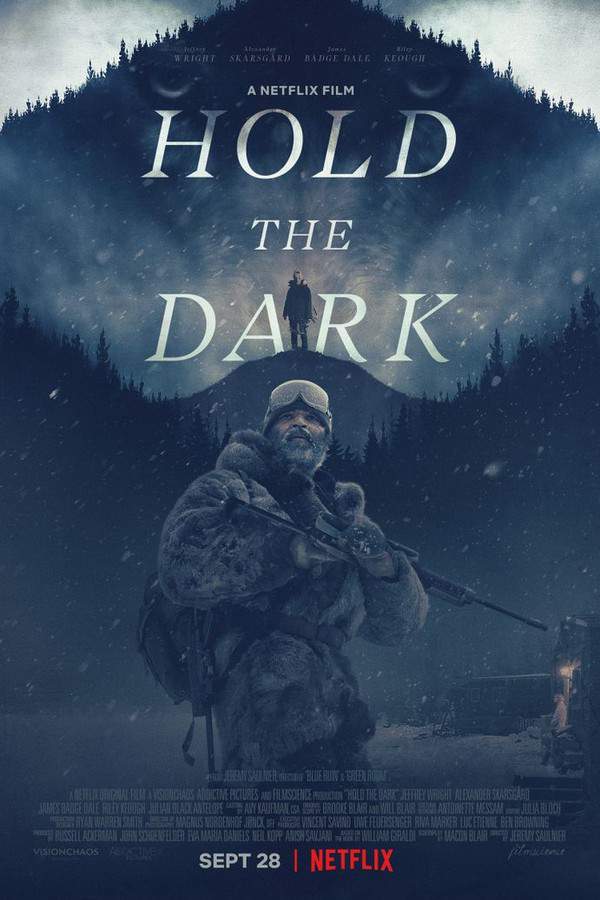
Hold the Dark concludes with a deeply ambiguous and symbolic ending that leaves much open to interpretation. After a tense journey into the Alaskan wilderness, Russell Core, the wolf expert, finds Medora hiding at a hot spring, and they share an intimate moment before Vern, her brother and husband, arrives. Vern shoots Russell with an arrow, but instead of killing him, he and Medora kiss passionately before collapsing together, hinting at their complex and primal bond. The film then shows Vern and Medora carrying their son's coffin back into the wilderness, embodying a willingness to return to their savage roots and the darkness within them. Meanwhile, Russell, wounded but alive, begins to escape but is ultimately surrounded by wolves. However, instead of attacking, the wolves seem to protect him, and he is saved by native women, symbolizing a form of spiritual rescue or connection to something deeper and primal. The story closes with Russell in a hospital, reuniting with his estranged daughter, signifying a tentative step back into the human world and hope for redemption.
The most critical revelation of the ending is that Medora and Vern are actually twin siblings—brother and sister—though this is never explicitly confirmed in the film itself, only hinted at through subtle clues. This incestuous relationship is portrayed as a core drive behind many of the characters’ actions, especially Medora’s act of killing her own child, which echoes the wolves’ act of eating their own pups to survive. It emphasizes the film's central theme that the line between humanity and ferality is blurred, with the darkness within the characters reflecting the wild instincts of nature. Their shared history, hinted at through past trauma and native warnings, suggests that the “Dark” that haunts the story is a metaphor for the primal, animalistic forces that lurk beneath the surface of civilization.
Ultimately, Russell’s journey represents a struggle to confront and hold back this darkness. His connection with others—particularly his reuniting with his daughter—and his survival symbolize the fragile line between the human and the animalistic. The film’s ending invites viewers to consider that the darkness is not just in the wilderness or in the characters’ pasts, but also within all of us, and that it is only through human connection, understanding, and mercy that we can hope to resist succumbing to our own primal instincts. In this way, Hold the Dark is as much a meditation on the animalistic parts of human nature as it is a story of hope and reconciliation in the face of inevitable darkness.