Plot Explained Spoilers guaranteed!
Plot Explained

Browse by genre

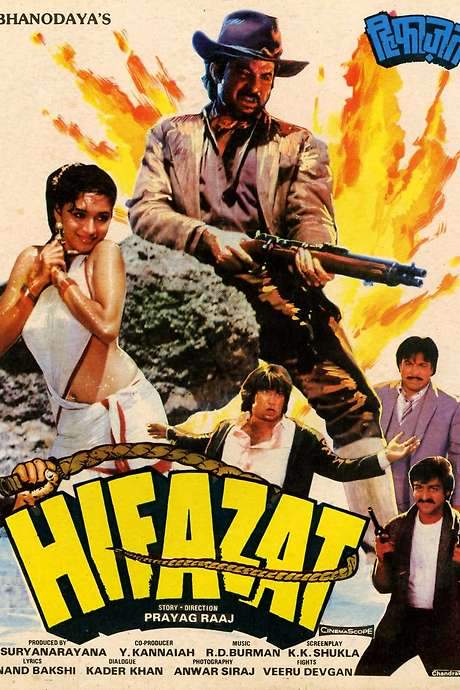
Hifazat (1987) movie poster

Plot Summary

Hifazat (1987) Plot Summary Explained

Release, runtime and language
1987 · 138 mins · Hindi
Loading streaming availability…
Directed by
Prayag Raj
Starring
Anil Kapoor, Madhuri Dixit, Gulshan Grover, Shakti Kapoor, Ashok Kumar, Pran Sikand

Satya Prakash is compelled by his first wife Laxmi to take a second wife, Rukmini, so he can produce an heir. Both women bear sons, and as the brothers grow they become locked in a bitter battle for dominance over their father's estate, exposing deep family tensions and ruthless ambition.

On this page (5)
  1. 1 Where to watch
  2. 2 What happens: full plot
  3. 3 Plot questions answered
  4. 4 Movie threads
  5. 5 Every angle
Loading streaming availability…

Full plot summary · contains spoilers

What Happens in Hifazat: Full Plot Summary

The whole story of Hifazat (1987) explained, from the opening scene to the final frame: every key event, every twist and what it all adds up to. Read it as a quick recap before the sequel, to check a scene you missed, or to finally understand what really happened.

After Laxmi endures three stillbirths, her husband Satyaprakash and his mother fear there will be no heir to carry the family name. To safeguard the lineage, they push for a second marriage, and Laxmi reluctantly agrees to accept a new wife, Rukmani, into their home. This arrangement, born of pressure and tradition, sets off a complex chain of consequences that reshape the family’s future.

With Rukmani in the house, Laxmi is soon blessed with a pregnancy, and she gives birth to a son, Raj Kumar. Not long after, Rukmani also has a son, Lakhan, and the household briefly seems to gain a sense of balance and continuity. Yet the joys are overshadowed by tragedy when Raj Kumar is abducted and vanishes from their lives, leaving a void and a growing ache that tests the family’s stability.

The situation darkens further when Satyaprakash is arrested for the murder of a contractor and is sentenced to prison. In the absence of the father, Rukmani and her brother Buddhiram take charge of running the household, and their leadership brings harshness and abuse toward Laxmi, who bears the weight of the family’s misfortunes with quiet strength.

Years pass, and a young man appears, claiming to be the missing son of Laxmi and Satyaprakash. This unexpected arrival stirs a flicker of hope and a sense of renewed purpose in the frail matriarch, offering a chance to restore dignity to a family battered by hardship. Yet the fragile hope is short-lived. When Satyaprakash is released from prison, he recognizes the young man as a former fellow inmate, and, with the bluntness of hard-won truth, asks him to leave the house. He cannot foresee the deadly consequence of that decision: Buddhiram seizes the moment the young man steps outside the door to act, and in a ruthless turn, violence erupts, threatening both the life of Laxmi and the fragile resolve the family has managed to muster.

What unfolds is a stark portrait of devotion, betrayal, and the heavy costs of safeguarding a family name. The narrative tracks how love and obligation collide with power and control, forcing Laxmi to confront painful choices and exposing the precarious balance that sustains or shatters a lineage. In its measured, somber tone, the story examines the resilience required to endure grievous loss while navigating a web of family obligations, secrecy, and the consequences of actions taken in the name of honor.
Last updated: February 18, 2026 at 23:44

Was this helpful?

Plot questions answered

Hifazat Plot Explained: Your Questions Answered

The questions people ask most about Hifazat (1987): what happens in the confusing scenes, why the characters do what they do, the twists, hidden details and what the ending means. Each answer contains spoilers.

Q1

Why did Laxmi agree to let Satyaprakash marry a second wife?

Laxmi agreed to the second marriage because she had suffered three stillbirths, and the family feared there would be no heir to carry the family name. Under pressure from her husband and her mother-in-law, and driven by the traditional need to preserve the lineage, Laxmi reluctantly consented to Rukmani entering the household.

  • second wife
  • arranged marriage
  • family heir
  • tradition
  • laxmi consent
Q2

What happened to Raj Kumar after he was abducted?

After being abducted as an infant, Raj Kumar disappears from the family completely. The summary does not reveal who took him or where he went, leaving his fate unknown until years later when a young man arrives claiming to be the missing son.

  • raj kumar
  • abduction
  • missing son
  • disappearance
Q3

Why was Satyaprakash arrested and imprisoned for murder?

Satyaprakash was arrested for the murder of a contractor and sentenced to prison. The summary does not provide details about the contractor or the circumstances of the killing, only that he was convicted of the crime.

  • satyaprakash
  • prison
  • murder conviction
  • contractor
Q4

Why did Rukmani and her brother Buddhiram mistreat Laxmi during Satyaprakash's imprisonment?

When Satyaprakash went to prison, Rukmani and her brother Buddhiram took control of the household. With the father absent, they seized power and subjected Laxmi to abuse, exploiting their new authority to mistreat her while she bore the weight of the family's misfortunes.

  • rukmani
  • buddhiram
  • abuse
  • power grab
  • household control
Q5

Who was the young man who arrived claiming to be Raj Kumar?

The young man claimed to be the missing Raj Kumar, Satyaprakash and Laxmi's son. However, when Satyaprakash was released from prison, he recognized the young man as a former fellow inmate, suggesting the claim was false or at least questionable.

  • imposter
  • raj kumar
  • prison inmate
  • identity claim
Q6

Why did Satyaprakash ask the young man to leave the house?

After recognizing the young man as a former prison inmate, Satyaprakash asked him to leave. He believed the man was not truly his son but an outsider who may have been trying to take advantage of the family. This decision directly led to the tragic violence that followed.

  • satyaprakash
  • rejection
  • fake son
  • recognition
Q7

What triggered Buddhiram to kill the young man and Laxmi?

When Satyaprakash asked the young man to leave, Buddhiram seized the moment and murdered both the young man and Laxmi. Buddhiram used the confusion of the departure to carry out the killing, which marked a violent, irreversible turn in the family's tragedy.

  • buddhiram
  • murder
  • violence
  • death
  • tragedy
Q8

What caused the rivalry between Lakhan and Raj Kumar?

As the sons of Satyaprakash grew up, they became locked in a bitter battle for dominance over their father's estate. The rivalry between Lakhan (Rukmani's son) and Raj Kumar (Laxmi's son) was driven by deep family tensions and ruthless ambition, with both boys competing for control of the inheritance.

  • lakhan
  • raj kumar
  • rivalry
  • estate
  • brothers conflict
Q9

Why did the family favor having a male heir so strongly?

The family was desperate for a male heir because of deep-rooted tradition and the need to preserve the family lineage. Laxmi's three stillbirths created fear that the family name would die out, which is why they pushed for Satyaprakash to marry again and produce an heir.

  • male heir
  • family name
  • lineage
  • tradition
  • ancestors
Q10

Why did Laxmi endure the abuse from Rukmani and Buddhiram?

Laxmi bore the weight of the family's misfortunes with quiet strength, enduring the mistreatment while trying to preserve her dignity. Without her husband present and with limited options, she remained in the household despite the oppression, driven by her role as mother and wife.

  • laxmi
  • patience
  • suffering
  • endurance
  • dignity
Q11

What happened to Lakhan after the final tragedy?

The summary focuses on the deaths of Laxmi and the young man, and does not provide information about Lakhan's ultimate fate. The narrative ends with the violent turn that destroyed any remaining hope of reconciliation within the family.

  • lakhan
  • outcome
  • future
  • brother
Q12

Why does the film end with such a bleak outcome?

The story unfolds with a fatalistic pace where each event compounds the characters' misery, leading to a bleak ending that seals the family's doom. The narrative explores themes of spousal abuse, corruption of family bonds by greed, and how actions taken in the name of honor lead to irreversible tragedy.

  • ending
  • tragedy
  • bleak
  • fate
  • family breakdown

Movie threads

More Movies Like Hifazat, by Mood & Story

Curated lists built around what makes Hifazat tick: the same mood, the same kind of story or the same emotional payoff. Each list explains why these movies belong together.

Movies about family inheritance battles like Hifazat

Stories where inheritance tears families apart through greed and rivalry. For viewers who enjoyed the bitter family conflict over an estate in Hifazat, this list features similar movies where inheritance disputes lead to betrayal, rivalry, and the collapse of a dynasty.

  • dysfunctional
  • greedy
  • tense
  • tragic
  • betrayal
  • rivalry
  • Tone: bleak, tense
  • Pacing: steady, fatalistic
Why these movies?

The story pattern: These stories typically follow a linear path where a patriarch's death or a promised inheritance ignites long-simmering resentments, leading to escalating betrayals, moral compromises, and often a tragic conclusion that leaves the family fractured beyond repair.

Why they belong together: Movies are grouped here by their central plot engine: the fight for an estate or inheritance. They share a focus on greed, the corruption of family loyalty, and a bleak outlook on human nature when faced with wealth and power.

Bleak and heavy family dramas like Hifazat

A steady, oppressive march towards an inescapably tragic conclusion. If you were captivated by the heavy, oppressive tragedy and bleak ending of Hifazat, explore these movies that share a similar feeling of inevitable doom and deep family dysfunction.

  • oppressive
  • tragic
  • melancholic
  • desperate
  • dyfunctional
  • cold
  • Tone: bleak, melancholic, tragic
  • Pacing: steady, slow burn
Why these movies?

The story pattern: The narrative pattern is one of linear decline, where each event compounds the characters' misery. There are no real surprises, only the brutal inevitability of a pre-ordained tragic fate, focusing on the erosion of hope and the crushing weight of circumstance.

Why they belong together: This thread groups films based on their overwhelming bleak tone, heavy emotional weight, and a steady pacing that feels like a march toward tragedy. The shared experience is one of witnessing an unfixable situation spiral into despair.

Every angle

Hifazat (1987) Explained: Plot, Timeline & Characters

Everything about Hifazat in one place: what happens in the plot summary, the timeline in chronological order, the characters and meaning and a spoiler-free summary. What's After the Movie adds the cast, box office and post-credit scenes.

Coming soon on iOS and Android

The Plot Explained Movie Summary App

Plot summaries, endings explained and timelines on your phone. Catch up on any movie in minutes, save your favorites and never miss a twist again.

Be the first to know when we launch. Your email stays private, always.

Learn more about the app