Plot Explained Spoilers guaranteed!
Plot Explained

Browse by genre

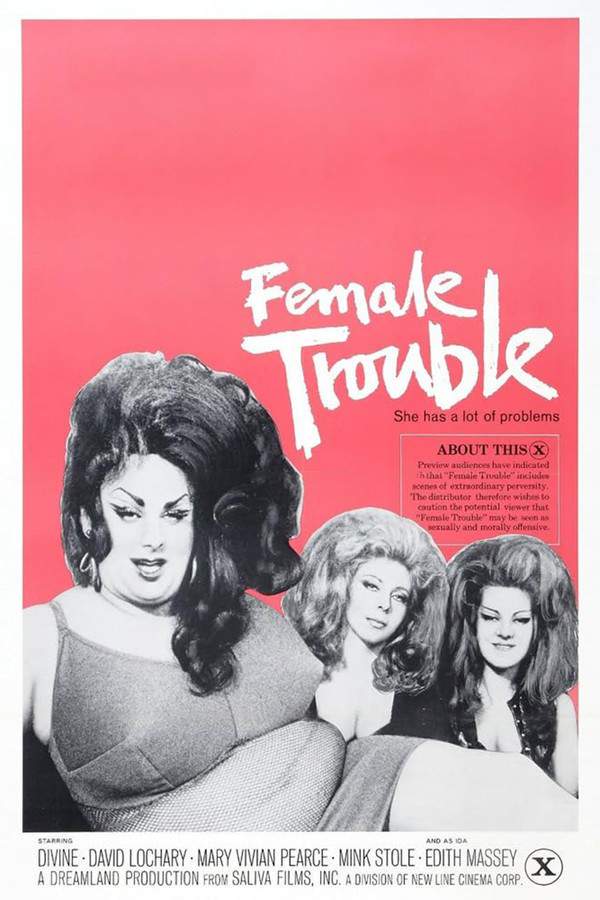
Female Trouble (re-release) (2002) movie poster

Plot Summary

Female Trouble (re-release) (2002) Plot Summary Explained

Release, runtime and language
2002 · 89 min · English

A plus-sized woman named Divine embarks on a journey of crime and chaos, unleashing her rebellious daughter upon an unsuspecting world. The resulting chain of events escalates into increasingly outrageous and unsettling situations, testing the limits of decency and pushing the boundaries of outrageousness. The film is a darkly comedic and provocative exploration of societal norms and family dysfunction.

On this page (5)
  1. 1 Where to watch
  2. 2 What happens: full plot
  3. 3 Plot questions answered
  4. 4 Movie threads
  5. 5 Every angle

Where to watch

Where to Watch Female Trouble (re-release) (2002)

Where can you watch Female Trouble (re-release)? Stream, rent or buy it in the US, including on Fandango At Home, Google Play Movies and YouTube: current JustWatch availability with up-to-date prices.

Streaming availability powered by JustWatch

Full plot summary · contains spoilers

What Happens in Female Trouble (re-release): Full Plot Summary

The whole story of Female Trouble (re-release) (2002) explained, from the opening scene to the final frame: every key event, every twist and what it all adds up to. Read it as a quick recap before the sequel, to check a scene you missed, or to finally understand what really happened.

In the stark winter of 1960, the streets of Baltimore became the setting for Dawn Davenport's descent into a life of turmoil. When her parents denied her the cha-cha heels she desperately wanted for Christmas, her frustration erupted. In a dramatic outburst, she overturned the family Christmas tree onto her mother and stormed out of the house clad in little more than her rebellious spirit. This impulsive decision led Dawn to hitch a ride with Earl Peterson, a man of questionable character, who transported her to a desolate place where they shared a filthy mattress. The aftermath of this encounter left Dawn pregnant, with Earl denying any responsibility as a father. Eventually, she gave birth to a daughter, Taffy, whom she subjected to both physical and emotional torment.

Surviving the harsh realities of life, Dawn took on a series of dead-end jobs, including waitressing at a diner and dancing at a sleazy club, aided by her former high school companions, Concetta and Chicklette. This trio engaged in robberies and street prostitution, navigating the darker sides of survival. In her quest for solace, Dawn often visited the Lipstick Beauty Salon, where she eventually wed her hair stylist and next-door neighbor, Gater Nelson.

At the salon, the owners, Donald and Donna Dasher, devised a bizarre artistic venture that blurred the lines between criminality and beauty. They lured Dawn into their scheme with promises of fame, photographing her transgressions to feed her vanity. As their manipulations deepened, Dawn married Gater, but their relationship crumbled when Gater's aunt, Ida Nelson, unleashed vengeful retribution, disfiguring Dawn with acid. The Dashers capitalized on her new appearance, transforming her into a grotesque model while providing her a lavish life steeped in dependency. In a twisted act of revenge, they captured Ida and presented her imprisoned in a birdcage as a grotesque gift for Dawn, culminating in a horrific demand for Dawn to sever her own hand as a form of vengeance for her disfigurement.

As Taffy's discontent grew, she became acutely aware of her mother's questionable lifestyle and Dawn's insidious attempts to convince her of her own inferiority. When Taffy confronted Dawn about her father, she sought the truth, leading her to a heartbreaking discovery of a man reduced to a drunken wreck living in squalor. In a fit of outrage, she took matters into her own hands, ending his life with a swift strike from a chef's knife after he made an unwanted advance. Upon returning home, Taffy fabricated a story about failing to find her father and announced her intention to join the Hare Krishna movement, a revelation that ignited Dawn's fury and threats.

Amidst the chaos, Dawn underwent a transformation fuelled by the Dashers, donning garish hair, makeup, and flamboyant outfits. Her new persona took to the stage in a nightclub performance that can only be described as bizarre: imagine trampolining, destroying phone directories, and dancing among dead fish, culminating in an explosive onstage meltdown with a gun, leaving a trail of destruction. When the authorities responded to the scene, the chaos escalated, adding to the body count while allowing the Dashers to escape unscathed, presenting themselves as model citizens.

Dawn's evasion of justice soon led her to a dense forest where authorities apprehended her, resulting in a trial for multiple murders. Throughout the proceedings, the Dashers feigned innocence, shifting the blame entirely onto Dawn, aided by bribing Ida to provide false testimony. Despite her lawyer's fervent argument for a verdict of not guilty by reason of insanity, the jury found her guilty, sentencing her to death in the electric chair.

As the fateful day loomed closer, Dawn exchanged a heartfelt farewell with Earnestine, her fellow inmate and lover, as she was led to her execution by a priest and two guards. In a poignant final act of defiance, she delivered a mock acceptance speech as if claiming an award, her words lingering hauntingly before the deadly current took her life.

Last updated: November 21, 2024 at 10:27

Was this helpful?

Plot questions answered

Female Trouble (re-release) Plot Explained: Your Questions Answered

The questions people ask most about Female Trouble (re-release) (2002): what happens in the confusing scenes, why the characters do what they do, the twists, hidden details and what the ending means. Each answer contains spoilers.

Q1

Why does Dawn Davenport flip out over cha-cha heels?

Dawn's meltdown over the cha-cha heels represents her deep-seated entitlement and volatile temperament. The shoes symbolize her desire to stand out and be noticed, she's a rebellious teenager who feels constrained by her conservative parents. This impulsive outburst sets the trajectory for her entire downward spiral, showing that her problems stem from her own destructive personality rather than just bad luck.

Foreshadowing: The cha-cha heels foreshadow Dawn's later obsession with fame and attention from the Dashers.

  • Dawn Davenport
  • cha-cha heels
  • rebellion
  • teenage turmoil
Q2

How does Dawn end up pregnant after hitching a ride?

After storming out of her house, Dawn hitches a ride with Earl Peterson, a stranger who takes her to a secluded area. They have sex on a filthy mattress, resulting in Dawn becoming pregnant. Earl denies any responsibility for the child and abandons her, leaving Dawn to face single motherhood alone.

  • Earl Peterson
  • pregnancy
  • hitchhiking
  • Taffy
Q3

Why does Dawn abuse her daughter Taffy?

Dawn's abuse of Taffy stems from her own unresolved trauma and inability to process her failures. Rather than acknowledging her own mistakes, Dawn channels her frustrations outward, taking out her self-loathing on the one person she has power over. Taffy becomes a target for Dawn's bottled-up anger about her ruined life.

Foreshadowing: Early scenes of Dawn's tantrums over minor disappointments establish her pattern of lashing out at others when frustrated.

  • Dawn
  • Taffy
  • abuse
  • mother-daughter conflict
Q4

Who are Donald and Donna Dasher and what do they want from Dawn?

The Dashers own the Lipstick Beauty Salon where Dawn gets her hair done. They lure her into a bizarre "artistic" scheme by flattering her vanity and photographing her criminal activities. Their goal is to exploit Dawn for financial gain, they profit from her grotesque appearance after the acid attack and manipulate her into dependency while they escape accountability.

Foreshadowing: The Dashers' interest in Dawn intensifies after she marries Gater, hinting at their ulterior motives.

  • Donald Dasher
  • Donna Dasher
  • exploitation
  • manipulation
  • art scheme
Q5

Why does Ida Nelson throw acid on Dawn?

Ida Nelson is Gater Nelson's aunt, and she attacks Dawn with acid out of revenge for reasons the film implies stem from jealousy or family loyalty. The exact motivation isn't fully detailed, but it's clearly a vengeful act meant to destroy Dawn's beauty and life. The Dashers then exploit Dawn's disfigurement by making her their dependent model.

  • Ida Nelson
  • acid attack
  • Gater
  • disfigurement
  • revenge
Q6

What happens to Ida after she disfigures Dawn?

The Dashers capture Ida and imprison her in a birdcage as a twisted "gift" for Dawn. They present the caged Ida to Dawn as an act of revenge on her behalf. The Dashers then demand that Dawn cut off her own hand as a form of symbolic self-mutilation matching her disfigurement, demonstrating the extreme manipulation they exercise over her.

  • Ida Nelson
  • birdcage
  • captivity
  • revenge
  • Dashers
Q7

Why does Taffy kill her biological father?

Taffy tracks down her father after confronting Dawn about him, only to find him living in squalor as a drunken wreck. When he makes an unwanted sexual advance toward her, Taffy reacts violently in self-defense, killing him with a chef's knife. This tragic act demonstrates the generational cycle of dysfunction and violence running through the family.

Foreshadowing: Taffy's growing discontent and curiosity about her father set this tragic chain of events in motion.

  • Taffy
  • father
  • murder
  • self-defense
  • generational trauma
Q8

What happens during Dawn's bizarre nightclub performance?

Under the Dashers' influence, Dawn transforms into a flamboyant performer whose act includes trampolining, destroying phone directories, and dancing among dead fish. The performance escalates into an explosive meltdown where she fires a gun on stage, killing people and causing massive destruction before authorities arrive.

Foreshadowing: The Dashers' earlier manipulation of Dawn's vanity foreshadows this extreme public spectacle.

  • nightclub performance
  • chaos
  • gun
  • Dashers
  • transformation
Q9

Why don't the Dashers get punished for their crimes?

The Dashers manipulate the legal system by bribery and deception. During Dawn's trial, they feign innocence and shift all blame onto her. They also bribe Ida Nelson to provide false testimony against Dawn, ensuring the jury convicts her while the Dashers escape consequences and present themselves as model citizens.

  • Dashers
  • trial
  • bribery
  • false testimony
  • escape justice
Q10

Why is Dawn executed despite the insanity defense?

Dawn's lawyer argues she is not guilty by reason of insanity, but the jury convicts her anyway. The Dashers' false testimony, combined with the overwhelming evidence of multiple murders during her nightclub rampage, seals her fate. The film depicts a justice system that fails to recognize Dawn's manipulation by the Dashers, executing her rather than considering her psychological state.

  • execution
  • insanity defense
  • trial
  • death sentence
  • electric chair
Q11

Who is Earnestine and what is her relationship to Dawn?

Earnestine is Dawn's fellow inmate and lover whom she meets while awaiting execution. Their relationship provides a moment of genuine human connection in Dawn's otherwise chaotic life. In a poignant scene, the two exchange heartfelt farewells before Dawn is led to the electric chair, showing a vulnerable side of Dawn that contrasts with her usual aggression.

  • Earnestine
  • cellmate
  • lover
  • execution
  • farewell
Q12

What does Dawn say in her final moments?

As Dawn is led to the electric chair, she delivers a mock acceptance speech as if she's receiving an award rather than facing death. This defiant final act demonstrates her characteristic showmanship and refusal to be subdued, even in the face of execution. Her haunting words linger before the deadly current ends her life.

  • final speech
  • acceptance speech
  • electric chair
  • defiance
  • execution

Movie threads

More Movies Like Female Trouble (re-release), by Mood & Story

Curated lists built around what makes Female Trouble (re-release) tick: the same mood, the same kind of story or the same emotional payoff. Each list explains why these movies belong together.

Transgressive Satire movies like Female Trouble (re-release)

Movies that gleefully shred societal norms with dark humor and grotesque rebellion. If you enjoyed the outrageous social critique of Female Trouble (re-release), explore more movies that use dark comedy and transgressive themes to challenge societal norms. These films share a rebellious spirit, a chaotic energy, and a fearless approach to satire, perfect for viewers who like their humor with a heavy dose of anarchy.

  • satirical
  • transgressive
  • outrageous
  • grotesque
  • rebellious
  • chaotic
  • Tone: dark, satirical, transgressive
  • Pacing: fast, chaotic
Why these movies?

The story pattern: Narratives in this thread often follow characters who spiral into extremes of behavior, rejecting or being rejected by mainstream society. The plots escalate chaotically, using shocking events not just for shock value, but as a pointed critique of specific institutions or cultural values, often culminating in a bleak or absurd conclusion.

Why they belong together: Films are grouped here based on their shared commitment to pushing boundaries, their use of dark comedy as a weapon for social commentary, and their overall vibe of deliberate, gleeful bad taste. They create a cohesive experience of rebellion and critique through chaotic energy and grotesque aesthetics.

Bleak Crime Spiral stories similar to Female Trouble (re-release)

Descents into crime driven by personal dysfunction and a rejection of morality. For viewers who liked the chaotic crime spree and moral collapse in Female Trouble (re-release), this section features other movies about characters spiraling into crime and violence. These stories share a heavy emotional weight, fast pacing, and a bleak outlook, exploring the destructive consequences of a life lived outside the law and social norms.

  • bleak
  • chaotic
  • nihilistic
  • violent
  • unsettling
  • angry
  • Tone: dark, bleak, nihilistic
  • Pacing: fast, escalating
Why these movies?

The story pattern: The narrative pattern is one of escalation: a single transgression or a moment of rebellion snowballs into a life of increasingly severe crimes. The structure is often linear but propelled by a sense of fatalism, where the protagonist's actions lead them deeper into a world of violence and exploitation, stripping away their humanity.

Why they belong together: These films are connected by their core narrative arc of a character's self-destructive dive into criminality. They share a high-intensity, fast-paced viewing experience, a dark tone, and a heavy emotional weight that comes from witnessing a complete moral and psychological unraveling, culminating in a hopeless ending.

Every angle

Female Trouble (re-release) (2002) Explained: Plot, Timeline & Characters

Everything about Female Trouble (re-release) in one place: what happens in the plot summary, the timeline in chronological order, the characters and meaning and a spoiler-free summary. What's After the Movie adds the cast, box office and post-credit scenes.

Coming soon on iOS and Android

The Plot Explained Movie Summary App

Plot summaries, endings explained and timelines on your phone. Catch up on any movie in minutes, save your favorites and never miss a twist again.

Be the first to know when we launch. Your email stays private, always.

Learn more about the app