Plot Explained Spoilers guaranteed!
Plot Explained

Browse by genre

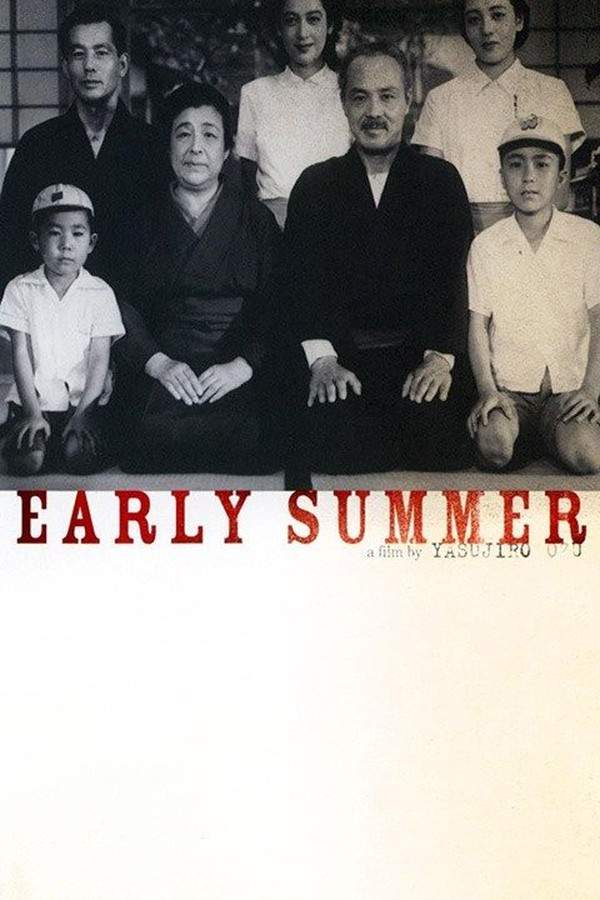
Early Summer (1972) movie poster

Timeline

Early Summer (1972) Timeline Explained – Every Event in Order

Release, runtime and language
1972 · 125 min · Japanese
Directed by
Yasujiro Ozu
Starring
Chieko Higashiyama, Chishû Ryû, Haruko Sugimura, Kuniko Miyake, Setsuko Hara, Chikage Awashima

In postwar Tokyo, Noriko, a 28-year-old woman, finds herself at a pivotal moment, balancing her desire for independence with the expectations of her family and society. Faced with pressure to marry, she grapples with two very different possibilities: the stability offered by a match with Takako, and the resurfacing of a childhood connection with Kenkichi, whose return stirs up buried feelings and complicates her choices.

On this page (4)
  1. 1 Events in order (10)
  2. 2 Timeline questions answered
  3. 3 Movie threads
  4. 4 Every angle

10 events in order · contains spoilers

Early Summer Timeline: Events in Chronological Order

Every key event of Early Summer (1972) in order, scene by scene, with when and where it takes place. Use it to untangle flashbacks, time jumps and parallel storylines, to refresh your memory before the sequel or to find the exact scene you are thinking of.

  1. Noriko's Family Dynamics

    Noriko, a 28-year-old secretary, lives with her extended family in Kamakura, Kanagawa. The arrival of an elderly uncle disrupts the family's equilibrium and brings societal expectations of marriage to the forefront for Noriko.

    Where
    Kamakura, Kanagawa
  2. Proposal from Boss

    At her workplace, Noriko's boss, Satake, proposes a match for her with a 40-year-old businessman and golfer, Mr. Manabe. This suggestion highlights the pressure on Noriko to settle down amidst her divided friend group.

  3. Friendship Dynamics

    Noriko's social circle is defined by two distinct groups: the married and the single. Aya Tamura emerges as her closest friend within the single group, providing companionship and light-hearted banter amid mounting familial and societal pressures.

  4. Childhood Friend Reunion

    Kenkichi Yabe, Noriko's childhood friend and a widowed doctor, reconnects with her, bringing along a sheaf of wheat as a heartfelt gift. This sheaf symbolizes connection, being a cherished token from her deceased brother, which Yabe was entrusted to pass on.

  5. Assignment to Akita

    Circumstances lead Yabe to be assigned to Akita, a rural area often teased by Noriko and Aya. Despite their light-hearted mockery, this assignment portends a significant shift in Noriko's life as familial pressures surrounding marriage intensify.

    Where
    Akita
  6. Marriage Proposal from Yabe's Mother

    Yabe's mother, Tami, unexpectedly proposes that Noriko marry her son and move with them to Akita. Faced with this impulsive suggestion, Noriko chooses to accept, leading to a wave of quiet devastation among her family.

  7. Family Devastation

    Noriko's decision to pursue marriage with Yabe creates an atmosphere of silent despair among her parents and brother. They worry that this choice may not be the best for her future, prompting her to reflect on her decision.

  8. Acceptance of Noriko's Choice

    Despite their initial disappointment and concerns, Noriko's family gradually begins to accept her decision to marry Yabe. The acceptance becomes evident during a moving family photograph session, symbolizing unity in the face of change.

  9. Plans for the Future

    As Noriko prepares for her new life, her parents make plans to move to the countryside alongside her elderly uncle. Their change in residence illustrates the family's adaptation to a new phase in their lives following Noriko's decision.

  10. Final Reflection of Change

    The film reaches a poignant climax as Noriko's parents witness a bride in traditional attire walking down a serene country road. This symbolic moment, along with a ripening barley field, beautifully captures the family's evolving relationships and the bittersweet nature of life's transitions.

Last updated: November 16, 2024 at 17:18

Was this helpful?

Timeline questions answered

Early Summer Timeline Explained: Your Questions Answered

When does it happen, and why in that order? The questions people ask about the chronology of Early Summer (1972): time jumps, flashbacks, cause and effect between scenes and the correct order of events, each answered with spoilers.

Q1

Why does Noriko choose Kenkichi over Manabe?

Noriko chooses Kenkichi because their connection runs deeper than a practical match. The sheaf of wheat he brings carries profound emotional weight, it was entrusted to him by her deceased brother who died in World War II, making it a tangible link to her past and family. This symbolic gift reveals Kenkichi's genuine understanding of Noriko's history and emotional needs, which the practical businessman Manabe cannot offer.

Foreshadowing: Earlier, the film establishes that Noriko values authentic connections, as seen in her close friendship with Aya among the single friends.

  • Noriko
  • Kenkichi
  • Manabe
  • marriage choice
  • sheaf of wheat
Q2

What does the sheaf of wheat represent in the film?

The sheaf of wheat is a sacred token from Noriko's brother who died in World War II, entrusted to Kenkichi to pass on to her. This gift symbolizes the continuity of family bonds across time and loss, and it serves as the emotional catalyst that draws Noriko toward Kenkichi. It represents not just memory, but also a promise fulfilled between two families connected by tragedy.

  • sheaf of wheat
  • brother
  • World War II
  • token
  • family bond
Q3

Why does Noriko's family react with devastation to her marriage decision?

Noriko's family feels devastated because she is choosing to leave Tokyo and move to rural Akita with a man they barely know. Her parents and brother fear this choice may not bring her happiness, especially since Kenkichi is a widower with a young daughter and his mother made an impulsive proposal. They worry she is sacrificing stability for an uncertain future far from family.

Foreshadowing: The family's concern is foreshadowed when they collectively pushed for the Manabe match, viewing it as the safer, more respectable option for a woman of Noriko's age.

  • family reaction
  • Akita
  • marriage
  • parents
  • concern
Q4

Why is Akita initially treated as something negative in the film?

Akita is portrayed negatively because it represents rural, remote living far from Tokyo, a significant downgrade in social status and lifestyle for a young woman from an established family. Noriko and Aya tease Akita for its rural accent, emphasizing how foreign and undesirable it seems to city-dwelling Noriko. This makes her eventual acceptance to move there more striking and demonstrates the depth of her feelings for Kenkichi.

Foreshadowing: The teasing of Akita early on establishes the cultural divide that Noriko must ultimately cross.

  • Akita
  • rural
  • Tokyo
  • move
  • marriage
Q5

What does the final scene with the bride signify?

The final scene shows Noriko's parents watching a bride walk down a country road while barley ripens in the background. This visual metaphor represents the cycle of life, Noriko has become like that bride, leaving her family to start a new life. The barley field symbolizes harvest and maturity, while the serene country setting reflects their acceptance of change. The bittersweet imagery captures how departure and new beginnings coexist with loss.

Foreshadowing: This imagery echoes the earlier sheaf of wheat, continuing the film's meditation on continuity and transition.

  • final scene
  • bride
  • barley
  • symbolism
  • ending
Q6

How does Noriko's family come to accept her marriage choice?

The family accepts Noriko's decision through a gradual process that culminates in a family photograph session, which becomes a symbolic moment of unity. Her parents find solace in hoping that Noriko and Kenkichi may eventually return to Tokyo, allowing for future reunions. Their acceptance reflects the Japanese value of supporting family even when personal desires conflict with collective wishes.

  • family acceptance
  • photograph
  • forgiveness
  • support
Q7

What is Noriko's main conflict in the film?

Noriko's main conflict is balancing her personal desire for independence and happiness against the expectations of her family and postwar Japanese society. At 28, she faces intense pressure to marry appropriately, but her choice of Kenkichi, driven by emotional connection rather than practical stability, represents her assertion of personal agency. The film explores whether choosing love over social convention can coexist with family harmony.

  • independence
  • society
  • marriage pressure
  • personal choice
  • Noriko
Q8

Why does Noriko reject the match with Mr. Manabe?

Noriko rejects Mr. Manabe because the proposal represents a practical arrangement rather than a meaningful connection. Her boss Satake arranges the match considering Manabe's status as a 40-year-old businessman and golfer, treating it as a suitable option for Noriko's age. However, Noriko finds this transactional approach hollow compared to the emotional depth she shares with Kenkichi, whose gift of the wheat sheaf speaks to her heart rather than her social standing.

  • Manabe
  • rejected
  • proposal
  • practical match
  • marriage

Movie threads

More Movies Like Early Summer, by Mood & Story

Curated lists built around what makes Early Summer tick: the same mood, the same kind of story or the same emotional payoff. Each list explains why these movies belong together.

Movies about societal pressure like Early Summer

Stories where personal desires clash with the weight of family and tradition. If you liked the gentle conflict between personal freedom and family duty in Early Summer, you'll find similar themes here. This collection features movies about characters navigating societal expectations, marriage pressure, and generational differences, often with a reflective and melancholic tone.

  • reflective
  • melancholic
  • subtle
  • family drama
  • quiet
  • thoughtful
  • Tone: melancholic, reflective
  • Pacing: slow, deliberate
Why these movies?

The story pattern: The narrative typically follows a protagonist, often a woman, at a crossroads. They are presented with a choice that represents the 'correct' path according to tradition versus a riskier path of personal fulfillment. The story focuses on their introspection, the subtle pressures from those around them, and the eventual, often bittersweet, resolution of their dilemma.

Why they belong together: Movies are grouped here because they share a central theme of societal constraint and a quiet, character-driven approach to drama. They prioritize emotional authenticity and subtlety over melodrama, creating a deeply reflective and often poignant viewing experience.

Movies with bittersweet endings like Early Summer

Endings that are both a fulfillment and a loss, capturing the complexity of growing up. Fans of the poignant, realistic ending of Early Summer will appreciate this selection. These are movies that conclude on a bittersweet note, where a character's decisive choice leads to personal growth but also entails a sense of loss or separation, much like Noriko's journey.

  • bittersweet
  • poignant
  • nostalgic
  • melancholic
  • life transition
  • emotional
  • Tone: bittersweet, poignant
  • Pacing: slow to steady, character-focused
Why these movies?

The story pattern: The narrative arc leads to a climax that is a decision rather than an event. The protagonist chooses a path that secures their future or identity, but it inexorably severs a past connection—be it with family, a loved one, or a former way of life. The focus is on the emotional weight and acceptance of this necessary change.

Why they belong together: These movies are united by their emotional conclusion, which perfectly balances hope and regret. They offer a mature, nuanced perspective on life transitions, making them deeply moving and memorable without resorting to tragedy or unadulterated joy.

Every angle

Early Summer (1972) Explained: Plot, Timeline & Characters

Everything about Early Summer in one place: what happens in the plot summary, the timeline in chronological order, the characters and meaning and a spoiler-free summary. What's After the Movie adds the cast, box office and post-credit scenes.

Coming soon on iOS and Android

The Plot Explained Movie Summary App

Plot summaries, endings explained and timelines on your phone. Catch up on any movie in minutes, save your favorites and never miss a twist again.

Be the first to know when we launch. Your email stays private, always.

Learn more about the app