Plot Explained Spoilers guaranteed!
Plot Explained

Browse by genre

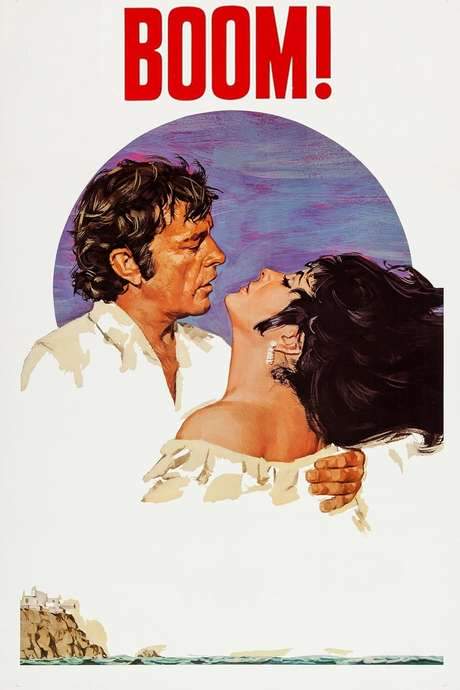
Boom! (1968) movie poster

Plot Summary

Boom! (1968) Plot Summary Explained

Release, runtime and language
1968 · 113 mins · English
Directed by
Joseph Losey
Starring
Elizabeth Taylor, Richard Burton, Romolo Valli, Michael Dunn, Noël Coward, Veronica Wells

The film follows a wealthy woman who, despite her material abundance, feels an inner emptiness, and a penniless poet who can only offer the ability to satisfy her desires. As they become entangled, they devour life’s pleasures together, each confronting the void the other represents.

On this page (5)
  1. 1 What happens: full plot
  2. 2 Plot questions answered
  3. 3 Movie threads
  4. 4 Movies like Boom!
  5. 5 Every angle

Full plot summary · contains spoilers

What Happens in Boom!: Full Plot Summary

The whole story of Boom! (1968) explained, from the opening scene to the final frame: every key event, every twist and what it all adds up to. Read it as a quick recap before the sequel, to check a scene you missed, or to finally understand what really happened.

On a secluded Italian island, Flora 'Sissy' Goforth Elizabeth Taylor is a terminally ill woman living in a sprawling mansion with a coterie of servants who endure her sharp tongue and controlling moods. Into her life arrives Christopher Flanders Richard Burton, nicknamed "L'Angelo della morte" — the Angel of Death — a mysterious man who claims they may have met before, though Flora pretends she cannot recall. Flora is described as suffering from neuritis and a nest of other "-itis" afflictions, while her villas are wired for sound so she can dictate her memoirs at any moment and shape her legacy.

Her days are shadowed by Miss Black Joanna Shimkus, Flora’s secretary whom she calls "Blackie," as well as by the looming presence of a gas-lit world where power, desire, and death blur together. After a dramatic dog attack on Christopher as he climbs the cliff to Flora’s estate, she assigns him a villa to recuperate and outfits him with a samurai robe and sword to replace his shredded clothes, a stark image of control and ritual in a fragile life. The tension deepens when she invites The Witch of Capri Noël Coward to dinner on her terrace; the Witch warns Flora of Christopher’s ominous nickname and his history of visiting the dying, a claim Flora both resists and fears.

Christopher flagrantly seduces Miss Black, whose husband died the year before, adding a dangerous undercurrent to the already volatile dynamics inside the mansion. The relationship between Flora and Christopher becomes the film’s backbone, propelled by dialogue rich in allegory and Symbolism. Flora muses that the present moment can become an instant memory, while Christopher speaks of the crashing waves on the cliffs as the sign of “the shock of each moment of still being alive”—the titular Boom! The movie thus explores a delicate balance of respect and contempt for those who refuse to acknowledge their mortality, showing how fading erotic energy can be redirected into the denial itself.

Flora alternates between tenderness and bombast as she grows emotionally entangled with Christopher, yet she remains terrified by what he represents. Her health declines as night falls, and the isolation of the island amplifies her vulnerability. In a chilling turn, Christopher recounts a story of aiding an old man who chose to end his suffering, a tale that culminates in a powerful gesture: he removes Flora’s enormous diamond ring—a symbol of taking life and of freeing her from earthly concerns—and tosses it off the cliff.

As Flora dies, the sea answers with a relentless roar, and Christopher’s last murmur resonates with the film’s signature act of inevitability.

> Boom!
Last updated: October 05, 2025 at 11:16

Was this helpful?

Plot questions answered

Boom! Plot Explained: Your Questions Answered

The questions people ask most about Boom! (1968): what happens in the confusing scenes, why the characters do what they do, the twists, hidden details and what the ending means. Each answer contains spoilers.

Q1

Why is Christopher called the Angel of Death?

Christopher is nicknamed "L'Angelo della morte" (the Angel of Death) because he has a history of visiting terminally ill people shortly before they die. The Witch of Capri reveals that Christopher has been with many dying people before Flora, suggesting he either causes or preys upon those near death. This ominous reputation precedes him to the island.

Foreshadowing: The dog attack as Christopher climbs the cliff foreshadows his lethal nature and the dangerous power dynamics that will define his relationship with Flora.

  • christopher
  • angel of death
  • witch of capri
  • nickname
  • death omen
Q2

Why does Flora give Christopher a samurai robe and sword?

After Christopher's clothes are shredded by the guard dogs during his arrival, Flora outfits him with a samurai robe and sword as a symbolic gesture. The attire represents control, ritual, and honor, tying Christopher to death and tradition. It also reflects Flora's need to shape her environment and legacy, even as she inserts this mysterious man into her private world.

Foreshadowing: The samurai sword foreshadows Christopher's later role as someone who can "take" life, connecting to the mercy killing story he recounts.

  • flora
  • christopher
  • samurai robe
  • sword
  • symbolism
  • control
Q3

What is the meaning of Christopher's mercy killing story?

While Flora lies dying, Christopher tells her about an old man he helped who wanted to end his suffering. The story presents a brutal calculus of mercy, he frames assisted death as a form of relief rather than murder. By sharing this, Christopher prepares Flora (and the audience) for his own role in her eventual death, blurring the line between compassion and predation.

Foreshadowing: This story directly foreshadows Christopher's actions with Flora, taking her ring and effectively "claiming" her life.

  • christopher
  • mercy killing
  • old man
  • story
  • end suffering
Q4

Why does Christopher take Flora's diamond ring?

Christopher removes Flora's enormous diamond ring at the climax, symbolically claiming the right to end her earthly concerns. The ring represents wealth, power, and attachment to material life, taking it marks the transfer of control from Flora to Christopher. He then throws it off the cliff, signaling release from earthly attachments and completing the cycle of death he represents.

Foreshadowing: The ring was established earlier as Flora's most prized possession, making its removal a powerful symbolic moment of surrender.

  • flora
  • christopher
  • diamond ring
  • cliff
  • symbolism
  • death
Q5

Why does Miss Black quit her secretarial job?

Miss Black, Flora's secretary nicknamed "Blackie," quits after becoming entangled with Christopher. The affair creates tension within Flora's household and represents a betrayal of the controlled environment Flora has built around her memoirs and legacy. By quitting, Miss Black severs the link to Flora's dictation world, showing how the dynamics inside the mansion are unraveling as death approaches.

Foreshadowing: Miss Black's departure mirrors the broader collapse of Flora's control as Christopher's influence grows.

  • miss black
  • blackie
  • quit
  • secretary
  • job
  • affair
  • christopher
Q6

What does "Boom!" mean in the movie?

"Boom!" refers to the shock of each moment of still being alive, as Christopher explains when describing the crashing waves on the cliffs. The phrase represents the sudden impact of existence against mortality, the moment when one realizes they are still alive despite death's constant proximity. The title encapsulates the film's meditation on time, life, and the inevitable end thatFlora confronts throughout the film.

Foreshadowing: Christopher's quote about the waves echoing "Boom" establishes the film's central motif before Flora's death.

  • boom
  • title
  • meaning
  • waves
  • shock
  • alive
  • mortality
Q7

Why does Flora invite the Witch of Capri to dinner?

Flora invites The Witch of Capri to her terrace seeking guidance from superstition and spectacle. The Witch provides crucial information about Christopher's ominous nickname and his pattern of visiting the dying, giving Flora a troubling frame for understanding his presence. Flora processes this with curiosity and denial, testing her own beliefs about fate and portents around death.

Foreshadowing: The Witch's warning establishes Christopher as a death omen, which the audience carries through the rest of the film.

  • witch of capri
  • flora
  • dinner
  • terrace
  • warning
  • fate
Q8

Why does Flora feel empty despite being wealthy?

Flora is a terminally ill woman with material abundance but suffers from an inner emptiness that wealth cannot fill. Her villas are wired for sound so she can constantly shape her legacy through dictating memoirs, revealing her desperate need to be remembered. The film explores how material success cannot combat existential void, especially when facing mortality.

Foreshadowing: Flora's obsession with legacy and control sets up her attraction to Christopher, who represents both the end of that control and the possibility of meaning.

  • flora
  • emptiness
  • wealth
  • legacy
  • memoirs
  • terminal illness
Q9

Why does Christopher flirt with Miss Black?

Christopher openly seduces Miss Black, whose husband died the previous year, adding a dangerous undercurrent to the mansion's dynamics. This affair exposes the vulnerable emotional states within Flora's household, Miss Black's grief makes her susceptible to Christopher's attention, while Flora watches with fascination and fear. The relationship represents another layer of desire and death intertwining.

Foreshadowing: The affair foreshadows the unraveling of Flora's controlled world and accelerates Miss Black's departure from the household.

  • christopher
  • miss black
  • flirt
  • seduce
  • husband died
  • affair
Q10

Does Christopher kill Flora, or does she die naturally?

Flora is described as terminally ill with neuritis and various "-itis" afflictions. While Christopher represents death metaphorically and tells stories of mercy killing, the film leaves ambiguous whether he physically causes her death or simply witnesses her natural passing. The focus remains on the symbolic transfer of her ring and the psychological death she experiences as she surrenders control.

Foreshadowing: Christopher's earlier mercy killing story and his taking of the ring suggest he at least facilitates her death, if not causes it outright.

  • flora
  • christopher
  • death
  • kill
  • mercy killing
  • natural
  • ambiguous
Q11

What happens to Flora's ring after she dies?

After Flora dies, Christopher throws her enormous diamond ring off the cliff into the sea. This act symbolizes release from earthly concerns, the ring represented wealth, power, and attachment to the material world. Its discarding completes the cycle of death and frees both Flora (symbolically) and Christopher from earthly attachments, echoing the film's themes of mortality and letting go.

Foreshadowing: Christopher's taking of the ring earlier foreshadows this final act of release.

  • ring
  • cliff
  • sea
  • throw
  • flora
  • christopher
  • release
  • symbolism
Q12

Why is the Italian island setting significant?

The isolated Italian island creates a hermetic, dreamlike environment where the normal rules of life suspended. Flora lives in a sprawling mansion with servants, cut off from the outside world, a space where power, desire, and death blur together. The island's isolation amplifies Flora's vulnerability and the surreal, symbolic quality of the narrative.

Foreshadowing: The isolated setting prepares the audience for the claustrophobic, intense dynamics between the small cast of characters.

  • italian island
  • setting
  • isolated
  • mansion
  • surreal
  • atmosphere

Movie threads

More Movies Like Boom!, by Mood & Story

Curated lists built around what makes Boom! tick: the same mood, the same kind of story or the same emotional payoff. Each list explains why these movies belong together.

Movies about confronting mortality like Boom!

Stories where mortality is confronted through intense, symbolic conversations. If you enjoyed the philosophical exploration of death in Boom!, you might like these other movies. This list features similar stories where characters grapple with mortality, legacy, and the meaning of life, often through dense, symbolic conversations in isolated settings.

  • melancholic
  • philosophical
  • oppressive
  • reflective
  • atmospheric
  • symbolic
  • Tone: melancholic, reflective
  • Pacing: slow, contemplative
Why these movies?

The story pattern: Narratives in this thread typically center on a protagonist facing a terminal illness or existential void. A visitor, often representing an abstract force like death or desire, enters their isolated world, leading to a series of intense dialogues that explore profound themes. The plot is secondary to the philosophical and emotional unpacking of mortality.

Why they belong together: These films are grouped together because they share a core preoccupation with mortality, using slow-paced, dialogue-heavy structures to create a melancholic and reflective mood. They prioritize atmospheric tension and thematic depth over complex plotting, resulting in a heavy emotional weight and often a somber conclusion.

Movies about wealth and emptiness like Boom!

Character studies of the affluent grappling with profound inner voids. For viewers who appreciated the themes of wealth and existential void in Boom!, this list contains movies with a similar vibe. Discover other stories that delve into the lives of the affluent, exploring the melancholic tension between material comfort and profound inner emptiness.

  • melancholic
  • oppressive
  • atmospheric
  • reflective
  • dreamlike
  • tense
  • Tone: melancholic, oppressive
  • Pacing: slow, atmospheric
Why these movies?

The story pattern: The typical narrative involves a wealthy protagonist in a luxurious but confining setting (like a mansion) who, despite having everything, feels a deep sense of purposelessness. Their encounter with an outsider—who may represent passion, danger, or authenticity—triggers a slow-burn confrontation with their inner void, exploring power dynamics and the true cost of a life without meaning.

Why they belong together: These movies are connected by their central theme of existential despair within wealth, a melancholic and oppressive tone, and a deliberately slow pacing that allows the atmosphere of emptiness to fully permeate. They share a heavy emotional weight and often feature complex character dynamics centered on power and desire.

If you liked this

Movies Like Boom!

Similar movies to Boom!: the same genre, themes or kind of story. Each one comes with its own plot summary, timeline and ending explained.

Browse all movie summaries

Every angle

Boom! (1968) Explained: Plot, Timeline & Characters

Everything about Boom! in one place: what happens in the plot summary, the timeline in chronological order, the characters and meaning and a spoiler-free summary. What's After the Movie adds the cast, box office and post-credit scenes.

Coming soon on iOS and Android

The Plot Explained Movie Summary App

Plot summaries, endings explained and timelines on your phone. Catch up on any movie in minutes, save your favorites and never miss a twist again.

Be the first to know when we launch. Your email stays private, always.

Learn more about the app