Plot Explained Spoilers guaranteed!
Plot Explained

Browse by genre

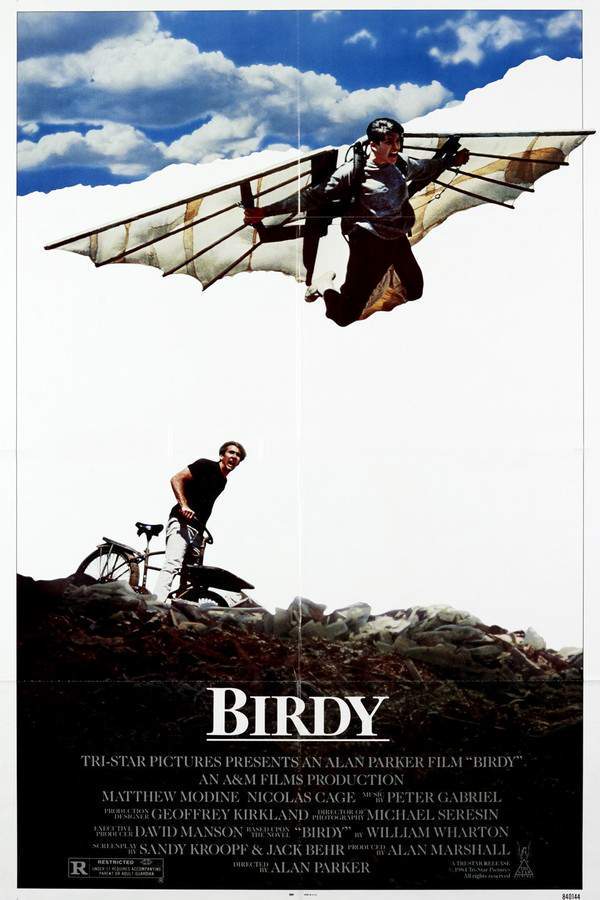
Birdy (1984) movie poster

Plot Summary

Birdy (1984) Plot Summary Explained

Release, runtime and language
1984 · 120 min · English
JustWatch #1,826 17
Directed by
Alan Parker
Starring
Nicolas Cage, Matthew Modine, Nancy Fish, Sandy Baron, Karen Young, John Harkins

Haunted by his experiences in Vietnam, a veteran struggles to readjust to civilian life, withdrawing into a fantasy where he exists as a bird. Confined to a mental hospital and increasingly disconnected from reality, doctors attempt to help him confront his trauma. His childhood friend and fellow veteran, Al, offers a lifeline, visiting regularly in an effort to reconnect him with the world and guide him toward healing.

On this page (6)
  1. 1 Where to watch
  2. 2 What happens: full plot
  3. 3 Plot questions answered
  4. 4 Movie threads
  5. 5 Movies like Birdy
  6. 6 Every angle

Where to watch

Where to Watch Birdy (1984)

Where can you watch Birdy? Stream, rent or buy it in the US, including on Amazon Prime Video, Fawesome and Amazon Video: current JustWatch availability with up-to-date prices.

Streaming availability powered by JustWatch

Full plot summary · contains spoilers

What Happens in Birdy: Full Plot Summary

The whole story of Birdy (1984) explained, from the opening scene to the final frame: every key event, every twist and what it all adds up to. Read it as a quick recap before the sequel, to check a scene you missed, or to finally understand what really happened.

A young man known as Birdy (played by Matthew Modine) is found sitting on the floor of his desolate psychiatric hospital room, appearing almost in a comatose state. Meanwhile, in a different sector of the hospital, U.S. Army Sergeant Alfonso 'Al' Columbato (portrayed by Nicolas Cage), whose heavily bandaged face suggests a painful past, is being wheeled into his dormitory-style room. As the orderlies help him to his bed, a doctor discusses Al's facial injuries, the schedule for removing the bandages, and the prospects for his forthcoming reconstructive surgery. It appears that Al will soon be leaving the hospital.

While on a train, Al is trying to find a seat when he notices a woman and her teenage daughter. He feels awkward under the girl's gaze, as she cannot help but stare at his disfigured face. In an attempt to ease her discomfort, Al jokingly says "boo," prompting a smile from her. Her mother quickly admonishes her not to stare. As he contemplates memories of Birdy, who was always seen as eccentric by others, he enters a vivid flashback of their high school days in South Philadelphia.

In a nearby field surrounded by homes, Al participates in a pick-up game of softball. When he hits a ball that lands in Birdy’s backyard, he swears as he realizes the woman who lives there, Birdy’s mother (played by Dolores Sage), is likely to keep the ball. Birdy's father (played by George Buck) tells her to return the ball, but she refuses, leaving the children without something to play with. While walking away, Al spots Birdy sitting silently in a tree, and they exchange nothing but a knowing glance.

Al's romantic interests lead him to make out with a girl under some bleachers, which is suddenly interrupted by his younger brother Mario Columbato (James Santini). After some coaxing, Al reluctantly follows Mario to Birdy’s house, where he finds Birdy on the porch, sitting among some cooing pigeons. Al cleverly nicknames him “bird boy,” but Birdy remains silent. When Al asks for a knife to remove a splinter, Birdy hands him a pocket knife, but when Al tries to keep it, Birdy quickly runs off. Their struggle reveals Birdy’s innocence as he insists he rightfully obtained the knife from someone else, not having stolen it.

Birdy’s unique ability to interact with pigeons captivates Al, who eventually offers to assist Birdy in catching them. Their adventures lead them atop a railway overpass, where Birdy embodies a carefree spirit, easily capturing pigeons while Al grapples with his own insecurities. In one thrilling moment, Birdy leaps from a height, claiming that he “flew” and found it beautiful, solidifying the bond they share.

As the story transitions back to the present, Al finds himself pondering Birdy through a window. Birdy remains lost in thought while Major Weiss (played by John Harkins), Birdy’s doctor, questions Al about his friend's condition. Al expresses worry over Birdy’s mental state, as he has not spoken since his return from Vietnam, where he was reported Missing In Action for an entire month. The Major suggests the visit might benefit both Al and Birdy.

Accompanied by orderly Renaldi (played by Bruno Kirby), Al is taken to meet Birdy. Upon entering, Al jokes in an attempt to connect, but Birdy remains unresponsive. Their history is vividly recalled through a series of flashbacks that illustrate Birdy’s deep connection to birds and his struggles with reality. Al tries to spark a conversation about their childhood, but Birdy does not respond, leading Al to feel a mix of frustration and sorrow.

Their intertwined past reveals a tapestry of shared experiences, optimism, and the heartbreak that comes from childhood innocence being stripped away by the harsh realities of life and war. Moments of joy turn into haunting memories of loss, love, and the disillusionment that accompanies the transition to adulthood. The depth of their friendship is put to the test as Al wrestles with his own demons while trying to reach Birdy, revealing the profound impact of trauma and the search for identity amid chaos.

In a turning point, Al expresses to Birdy that he’s also dealing with his own emotional turmoil, prompting a moment of vulnerability from Birdy, who unexpectedly utters his friend’s name. This becomes a crucial turning point, showing that hope still exists within Birdy, despite the silence that has enveloped him. Al recognizes this as a breakthrough, even as the pressures of their surroundings threaten to pull them apart once more.

The narrative masterfully weaves between unfolding timelines, illustrating the complexities of friendship against the backdrop of mental illness and the lingering shadows cast by wartime experiences. Al’s determination to help Birdy not only signifies his loyalty but also the necessity of connection in healing.
Last updated: October 25, 2024 at 10:09

Was this helpful?

Plot questions answered

Birdy Plot Explained: Your Questions Answered

The questions people ask most about Birdy (1984): what happens in the confusing scenes, why the characters do what they do, the twists, hidden details and what the ending means. Each answer contains spoilers.

Q1

Why did Birdy stop speaking after returning from Vietnam?

Birdy stopped speaking after being reported Missing In Action for an entire month in Vietnam. The trauma of whatever experiences he endured during that time caused him to withdraw completely into himself, retreating into a fantasy where he exists as a bird. This complete disconnect from reality manifested as catatonic-like silence in the psychiatric hospital.

Foreshadowing: Earlier flashbacks show Birdy already preferring solitude and silence, sitting in trees watching the world below rather than participating in it.

  • birdy vietnam trauma
  • ptsd
  • mental breakdown
  • shell shock
Q2

What is Birdy's fantasy about being a bird?

Birdy has retreated into a fantasy where he believes he is a bird. This manifests as his complete identification with birds, he sits silently among pigeons, claims to have 'flown' when jumping from heights, and has stopped engaging with human reality entirely. The fantasy appears to be a coping mechanism to escape the traumatic memories of Vietnam.

Foreshadowing: Throughout their childhood, Birdy demonstrates an unusual deep connection with pigeons and a preference for heights, suggesting this fantasy was always latent within him.

  • bird fantasy
  • escape
  • coping mechanism
  • dissociative fantasy
Q3

How did Al and Birdy become childhood friends?

Al and Birdy became friends growing up in South Philadelphia. Their bond formed through shared adventures catching pigeons together, with Birdy demonstrating his unique ability to interact with the birds. Despite coming from different worlds, Al was more social and interested in romance while Birdy was eccentric and withdrawn, they shared a deep understanding that transcended words.

Foreshadowing: The film opens with their present-day reconnecting, then immediately flashes back to show the foundation of their friendship in childhood games and silent exchanges.

  • childhood friends
  • south philadelphia
  • al columbato
  • pigeon catching
Q4

What caused Birdy's mental breakdown?

Birdy's breakdown was triggered by his experiences during the Vietnam War, specifically his month as Missing In Action. The exact events are never shown, but the psychological trauma of that period caused him to completely withdraw from reality. His doctors note he hasn't spoken since returning from Vietnam, and he exists in a catatonic state punctuated by his bird fantasy.

Foreshadowing: The contrast between the energetic, free-spirited boy who claimed to 'fly' and the silent, unresponsive patient in the hospital illustrates the devastating impact of war.

  • trauma
  • vietnam war
  • mia
  • psychological damage
  • mental illness
Q5

Why does Birdy have such a connection with pigeons?

Birdy has always had a unique ability to communicate with and handle pigeons. From childhood, he would sit among them on his porch, and they would coo around him without fear. This connection deepens in his fantasy state, where he uses pigeons as his primary link to the world, preferring their company over human interaction.

Foreshadowing: Early flashbacks show Birdy effortlessly catching pigeons while Al struggled, demonstrating an almost supernatural bond with the birds that predates his trauma.

  • pigeons
  • birds
  • animal connection
  • symbolism
  • nature
Q6

What happens at the end when Birdy finally speaks?

At the film's pivotal moment, Al admits to Birdy that he too is struggling with his own emotional turmoil. This moment of vulnerability from Al, the first time he's shared his own pain, breaks through Birdy's silence. In response, Birdy unexpectedly speaks Al's name, marking his first word since returning from Vietnam. This breakthrough represents hope that connection and friendship can begin the healing process.

Foreshadowing: Throughout the film, Al's consistent visits and attempts to reach Birdy, along with references to their shared childhood, build toward this moment of human connection breaking through trauma.

  • breakthrough
  • speaking
  • recovery
  • hope
  • emotional connection
Q7

Why does the movie jump between past and present?

The film uses a nonlinear structure, constantly shifting between the present-day hospital scenes and vivid flashbacks of the characters' youth. This storytelling technique directly serves the narrative purpose: contrasting the energetic, innocent friendship of their childhood with the traumatic, broken men they became after Vietnam. The jumps highlight how war destroyed their innocence and illustrate the depth of their bond that Al is trying to resurrect.

Foreshadowing: The opening immediately establishes this pattern, showing Birdy in the hospital before jumping back to show the carefree days when he and Al caught pigeons together.

  • nonlinear narrative
  • flashbacks
  • structure
  • war trauma
  • coming of age
Q8

What does Birdy's 'flight' mean when he jumps from the overpass?

When they were teenagers, Birdy leapt from a railway overpass and claimed he 'flew,' finding it beautiful. This moment represents the peak of his innocent, carefree spirit and the height of his connection with Al. It also foreshadows his later retreat into fantasy, as flight becomes the central metaphor for his desire to escape the burdens of reality.

Foreshadowing: This childhood moment of claiming to fly directly parallels his later fantasy of being a bird, showing how that innocence has now become a complete escape mechanism.

  • flight
  • freedom
  • innocence
  • symbolism
  • youth
Q9

Why does Al keep visiting Birdy in the hospital?

Al continues visiting Birdy because he is his childhood best friend and feels a deep responsibility to help him. Despite his own injuries, his face is bandaged from reconstructive surgery, Al makes repeated efforts to reach Birdy, attempting jokes, sharing memories, and ultimately opening up about his own struggles. His determination stems from both loyalty and from recognizing that helping Birdy might also help himself process his own trauma.

Foreshadowing: From their first meeting in the hospital, Al immediately tries to connect with humor, showing his commitment to reaching his friend even before major breakthroughs occur.

  • loyalty
  • friendship
  • veterans
  • support
  • connection
Q10

What does the ending imply about recovery?

The ending is bittersweet, Birdy's breakthrough of speaking Al's name offers a glimmer of hope, but the film makes clear this is only the beginning of a long, uncertain recovery path. Both men remain scarred by their war experiences, and the small victory of one spoken word cannot undo the immense suffering they've endured. The hope lies not in a cure but in the possibility that human connection can begin the healing process.

Foreshadowing: The entire film builds toward this moment while consistently reminding viewers of the overwhelming weight of their trauma, ensuring the ending feels earned but not falsely optimistic.

  • recovery
  • hope
  • healing
  • trauma therapy
  • friendship

Movie threads

More Movies Like Birdy, by Mood & Story

Curated lists built around what makes Birdy tick: the same mood, the same kind of story or the same emotional payoff. Each list explains why these movies belong together.

Movies about psychological trauma and recovery like Birdy

Stories about characters struggling to piece their minds back together after extreme trauma. If you were moved by Birdy's deep dive into trauma and healing, this section features similar movies about characters grappling with severe psychological wounds. These films often use memory and friendship as tools for recovery, offering stories where the journey toward mental wellness is the central, emotionally heavy focus.

  • traumatic
  • vulnerable
  • contemplative
  • haunting
  • isolated
  • hopeful
  • Tone: melancholic, reflective
  • Pacing: variable, contemplative
Why these movies?

The story pattern: Films in this thread typically follow a character who has endured a profound psychological shock, leading to a withdrawn or fractured state. The narrative often employs flashbacks to contrast their traumatic present with a more innocent past, using the support of a steadfast friend or caregiver as a catalyst for a difficult and uncertain healing process.

Why they belong together: These movies are grouped together because they share a deep focus on the internal landscape of trauma. They prioritize emotional weight over action, often featuring melancholic tones, complex non-linear structures, and a central theme of reclaiming one's mind and spirit from the grip of severe psychological injury.

Movies about lifeline friendships in crisis like Birdy

Powerful stories where a deep bond is the only thing pulling someone back from the edge. For viewers who appreciated the central friendship in Birdy, this section collects movies where a deep, longstanding bond is the key to overcoming trauma. These films explore how friendship can provide a lifeline during the darkest times, featuring similar dynamics of loyalty, shared memory, and unwavering support.

  • nostalgic
  • vulnerable
  • heartfelt
  • solemn
  • devoted
  • emotional
  • Tone: bittersweet, hopeful
  • Pacing: steady, character-driven
Why these movies?

The story pattern: The narrative pattern revolves around one friend who is deeply lost—whether to trauma, addiction, or despair—and another who refuses to let go. The story often flashes back to their shared, happier past to underscore the strength of their bond, making the present-day effort to reconnect a powerful emotional journey through memory and commitment.

Why they belong together: These films are connected by their central exploration of platonic love and loyalty under duress. They share a bittersweet tone, balancing the pain of one character's struggle with the quiet hope provided by their friend's dedication. The emotional core is the transformative power of human connection in the face of isolation.

If you liked this

Movies Like Birdy

Similar movies to Birdy: the same genre, themes or kind of story. Each one comes with its own plot summary, timeline and ending explained.

Browse all movie summaries

Every angle

Birdy (1984) Explained: Plot, Timeline & Characters

Everything about Birdy in one place: what happens in the plot summary, the timeline in chronological order, the characters and meaning and a spoiler-free summary. What's After the Movie adds the cast, box office and post-credit scenes.

Coming soon on iOS and Android

The Plot Explained Movie Summary App

Plot summaries, endings explained and timelines on your phone. Catch up on any movie in minutes, save your favorites and never miss a twist again.

Be the first to know when we launch. Your email stays private, always.

Learn more about the app