Plot Explained Spoilers guaranteed!
Plot Explained

Browse by genre

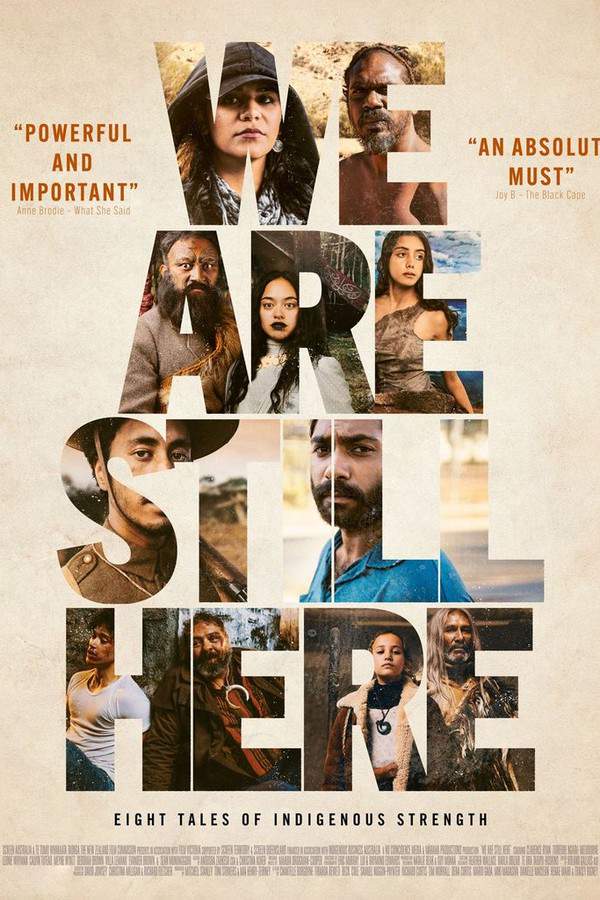
We Are Still Here (2022) movie poster

Timeline

We Are Still Here (2022) Timeline Explained – Every Event in Order

Release, runtime and language
2022 · 90 mins · Māori
Loading streaming availability…
Directed by
Beck Cole, Danielle MacLean
Starring
Calvin Tuteao, Sean Mununggurr, Barry Te Hira, Robert Taylor, Meyne Wyatt, Lisa Flanagan
Budget
$4M

Spanning a thousand years and multiple generations, this collection explores the interwoven histories of Indigenous peoples in Australia, New Zealand, and the South Pacific. From ancient times through the 19th century, to the present day and a dystopian future, the stories reflect resilience, grief, love, and dispossession. They offer diverse perspectives on enduring struggles against patriarchy, colonialism, and racism, bearing witness to a rich cultural heritage.

On this page (6)
  1. 1 Where to watch
  2. 2 Events in order (13)
  3. 3 Timeline questions answered
  4. 4 Movie threads
  5. 5 Movies like We Are Still Here
  6. 6 Every angle
Loading streaming availability…

13 events in order · contains spoilers

We Are Still Here Timeline: Events in Chronological Order

Every key event of We Are Still Here (2022) in order, scene by scene, with when and where it takes place. Use it to untangle flashbacks, time jumps and parallel storylines, to refresh your memory before the sequel or to find the exact scene you are thinking of.

  1. Fisherwomen Attacked at Sea

    Two Indigenous fisherwomen are attacked by British colonial slave-trader ships while they are out fishing. The assault marks a violent encounter with European colonisers arriving on their shores. Their ordeal becomes the starting point for a collision between two very different worlds.

    When
    Late 18th century
    Where
    At sea off the Australian coast
  2. A Tug-of-War Between Worlds

    Caught between tradition and modernity, the two fisherwomen experience a surreal, psychedelic struggle. They are forced to confront the disruptive forces of colonisation threatening their way of life. Their fight becomes a symbolic battle to hold on to their heritage.

  3. An Indigenous Guide's Fateful Choice

    An Indigenous man agrees to help a white settler search for his missing family. Trusting the stranger's goodwill, he guides him across the land his own people have known for generations. The decision will prove to be a fateful mistake.

    When
    19th century
    Where
    Colonial Australia
  4. Betrayal and Massacre

    After helping the settler, the man returns to discover that his own family has been killed. The massacre was carried out by colonisers led by the very settler he had helped. The betrayal exposes the brutal violence Indigenous communities endured during settlement.

  5. Joining the Resistance

    A young Māori woman tries to persuade her father to join the resistance against the British occupation. He is torn apart by fear for the safety of his family and community. Ultimately, she convinces him to stand up and fight alongside his people.

    When
    19th century
    Where
    New Zealand
  6. Enemies Find Common Ground

    During World War I, a Samoan slave-soldier fighting for the British and a Turkish soldier of the Ottoman army face each other from opposite sides of the battlefield. Despite language barriers and cultural differences, the two men discover they share more than divides them. An unlikely friendship forms amid the brutality of war.

    When
    World War I
    Where
    Gallipoli
  7. A Racist Attack on an Activist's Mother

    In the present day, state security officers carry out a racist assault on the mother of a young activist. The attack leaves her daughter, a graffiti artist, outraged and seeking justice. She begins plotting a dramatic response to the injustice her family has suffered.

    When
    Present day
    Where
    Melbourne, Australia
  8. Plotting to Burn Cooks' Cottage

    The young graffiti artist is joined by a new friend as they plan to burn down Cooks' Cottage. The building celebrates the legacy of Captain Cook, a symbol of the colonisation of Australia. Destroying it would be their defiant act against settler colonialism.

    Where
    Melbourne, Australia
  9. Caught in the Riots

    A young man, still reeling from the loss of his mother, searches for his family amid violent street riots. In the chaos he witnesses police brutality firsthand. The experience deepens his grief while exposing the systemic injustice surrounding him.

    When
    Present day
  10. Buying a Six-Pack of Beer

    An Indigenous man living in the Northern Territory, where it is illegal for Aboriginal people to purchase alcohol, attempts to buy a six-pack of beer. His simple errand immediately draws the attention of white police officers. He becomes a target for merely seeking the same freedoms others take for granted.

    When
    Present day
    Where
    Northern Territory, Australia
  11. The Great War Between North and South

    Thousands of years in the future, a devastating war between the global north, led by the United States, and the global south, led by China, has ravaged the planet. The conflict wipes out 80% of the human population. In the ashes of the world, a Nazi-like regime rises to power.

    When
    Thousands of years in the future
    Where
    Earth
  12. Indigenous Peoples Deported Off-World

    Under the new regime, Aboriginal and other Indigenous peoples are deported to off-world colonies as slave labour. The colonisation that began centuries earlier has escalated into brutal interplanetary segregation. The regime echoes the darkest chapters of Earth's colonial history.

    Where
    Off-world colonies
  13. A Desperate Search for Medicine

    A young girl ventures through the dystopian world in search of medicine for her ailing father. Her quest takes her through a regime-controlled future shaped by centuries of colonial oppression. Her struggle shows that Indigenous people endure, still fighting for survival and dignity even thousands of years on.

Last updated: October 28, 2026 at 07:15

Was this helpful?

Timeline questions answered

We Are Still Here Timeline Explained: Your Questions Answered

When does it happen, and why in that order? The questions people ask about the chronology of We Are Still Here (2022): time jumps, flashbacks, cause and effect between scenes and the correct order of events, each answered with spoilers.

Q1

Why did the Indigenous guide help the white settler?

He agrees to guide a white settler searching for his missing family because he trusts the stranger's stated goodwill. The choice becomes fatal when he returns and finds that his own family has been killed by colonisers led by the settler he helped, exposing the betrayal hidden behind the request.

Foreshadowing: The guide's initial trust in the settler's family story sets up the later revelation that the same man leads the massacre.

  • indigenous guide
  • white settler
  • missing family
  • colonial betrayal
  • massacre
Q2

Are the anthology's stories separate or connected?

We Are Still Here is an anthology of ten linked short films, not one continuous plot. The stories move across historical, contemporary, and dystopian settings to examine settler colonialism from different Indigenous perspectives. Their connection is thematic: each strand shows how dispossession, racism, and resistance persist even as the setting and form of oppression change.

  • linked short films
  • anthology structure
  • settler colonialism
  • indigenous perspectives
  • time jumps
Q3

Why does the activist want to burn down Cooks' Cottage?

She wants to burn down Cooks' Cottage because a racist assault on her mother by state security has driven her to seek justice. The building is chosen because it celebrates Captain Cook's legacy, a symbol of colonisation and Indigenous dispossession, and a friend helps her turn her reaction into a planned protest.

Foreshadowing: The assault on her mother gives the later target a personal motive beyond the building's symbolic meaning.

  • activist
  • graffiti artist
  • cook's cottage
  • captain cook
  • state security
  • colonial protest
Q4

Why does the young girl search for medicine for her father?

She sets out to find medicine for her ailing father in a future controlled by a regime that has deported Indigenous communities to off-world slave colonies. Her journey brings the dystopian storyline down to a personal level, showing an Indigenous child still trying to protect her father and survive within a system built on colonial enslavement.

  • young girl
  • medicine
  • ailing father
  • dystopian future
  • off-world colony
  • survival
Q5

Why are Indigenous people deported to off-world colonies in the future?

After a global war wipes out 80% of humanity, a Nazi-like regime rises and deports Aboriginal and other Indigenous people to off-world colonies as slave labour. The future storyline is a deliberate extension of the anthology's earlier stories: colonial power changes form, but massacre, forced removal, and labour exploitation remain. We Are Still Here uses that parallel to ask whether settler colonialism ever truly ends.

Foreshadowing: The earlier depictions of massacre, dispossession, and racialised state violence prepare the pattern that the future regime repeats on an interplanetary scale.

  • dystopian future
  • off-world colonies
  • slave labour
  • nazi-like regime
  • indigenous deportation
Q6

Why is the Northern Territory man targeted for buying beer?

In the Northern Territory, Aboriginal people are legally barred from buying alcohol, so his attempt to buy a six-pack places him in conflict with a racially discriminatory law. White police officers target him during the purchase, turning an ordinary errand into a confrontation over the freedoms other Australians are allowed to take for granted. The episode shows how discriminatory rules become real through policing.

  • northern territory
  • alcohol purchase
  • six-pack
  • aboriginal people
  • white police
  • discriminatory law
Q7

Why does the Māori father finally join the resistance?

His daughter ultimately convinces him that he must defend his community against British occupation, despite his fear that involvement could endanger his family. His decision changes him from someone focused on keeping the community safe by avoiding the fight to an active participant in the resistance. The turning point is about accepting that safety cannot be guaranteed while the occupation continues.

Foreshadowing: His fear for his family's safety is established before his daughter changes his mind.

  • māori resistance
  • father and daughter
  • british occupation
  • new zealand
  • family safety
Q8

Why does the grieving young man witness police brutality during the riots?

He is still grieving his mother's death when he goes out to search for his family, and the violent riots place him directly in the streets where police are brutal. The confrontation turns his private loss into a firsthand encounter with the systemic violence faced by his community.

  • street riots
  • police brutality
  • grief
  • family search
  • systemic violence
Q9

How do the Samoan and Turkish soldiers become friends at Gallipoli?

A Samoan slave-soldier fighting for Britain and a Turkish Ottoman soldier begin as enemies at Gallipoli. Their battlefield encounter breaks through language and cultural barriers, allowing them to recognise a shared humanity despite the colonial and military systems that have placed them on opposite sides.

  • samoan soldier
  • turkish soldier
  • gallipoli
  • world war i
  • slave soldier
  • unexpected friendship
Q10

What happens to the two fisherwomen after the British slave-trader ships attack them?

The attack by British colonial slave-trader ships shatters their fishing trip and traps them in a surreal, psychedelic struggle between tradition and modernity. The sequence makes their ordeal symbolic: they are fighting to preserve their cultural identity against a violent, colonising disruption.

Foreshadowing: Their ordinary fishing trip establishes the traditional way of life that the slave-trader ships violently interrupt.

  • indigenous fisherwomen
  • british slave traders
  • psychedelic struggle
  • tradition and modernity
  • colonial violence

Movie threads

More Movies Like We Are Still Here, by Mood & Story

Curated lists built around what makes We Are Still Here tick: the same mood, the same kind of story or the same emotional payoff. Each list explains why these movies belong together.

Colonial Survival and Resistance Movies Like We Are Still Here

Collective histories turn oppression into endurance, resistance, and cultural continuity. If you enjoyed We Are Still Here, explore similar historical dramas about Indigenous resistance, cultural survival, and the lasting scars of colonialism. These dark, intense stories connect personal grief with community resilience while confronting dispossession, racism, forced migration, and cultural erasure.

  • sobering
  • oppressive
  • haunting
  • resilient
  • bittersweet
  • cultural survival
  • Tone: somber, oppressive, bittersweet
  • Pacing: variable, reflective to urgent
Why these movies?

The story pattern: Characters confront the loss of land, autonomy, family, or tradition, and their stories expand outward into communal consequences. Earlier suffering reverberates in later lives, while acts of memory, solidarity, and defiance preserve identity and create cautious hope without erasing the violence.

Why they belong together: These films share a somber view of power and belonging, but group them by their emphasis on collective endurance. Their histories of invasion, racism, and dispossession are paired with cultural memory, family bonds, and resistance, keeping the emotional register painful rather than purely triumphant.

Movies Like We Are Still Here: Stories Across Time and Trauma

Linked narratives travel across generations, turning inherited trauma into collective survival. Find movies like We Are Still Here with linked stories spanning past, present, and dystopian future. These complex, variable-paced anthologies mirror grief and oppression across generations, then connect personal loss to friendship, resistance, and collective endurance without offering simple triumph.

  • haunting
  • surreal
  • urgent
  • intergenerational
  • grief-driven
  • resilient
  • Tone: haunting, somber, bittersweet
  • Pacing: variable, reflective to urgent
Why these movies?

The story pattern: An anthology begins with distinct episodes of loss, danger, and separation, then reveals echoes among them. Time jumps and recurring motifs let earlier suffering shape later conflicts, while the final movement broadens personal trauma into a shared struggle. Hope arrives through cooperation, cultural continuity, or survival rather than a neat resolution.

Why they belong together: The defining link is structural and emotional: fragmented timelines make the past feel inseparable from the present and future. Quiet, character-centered passages alternate with urgent journeys and confrontations, while the anthology format lets grief, romance, violence, and resistance accumulate into a larger historical pattern.

If you liked this

Movies Like We Are Still Here

Similar movies to We Are Still Here: the same genre, themes or kind of story. Each one comes with its own plot summary, timeline and ending explained.

Browse all movie summaries

Every angle

We Are Still Here (2022) Explained: Plot, Timeline & Characters

Everything about We Are Still Here in one place: what happens in the plot summary, the timeline in chronological order, the characters and meaning and a spoiler-free summary. What's After the Movie adds the cast, box office and post-credit scenes.

Coming soon on iOS and Android

The Plot Explained Movie Summary App

Plot summaries, endings explained and timelines on your phone. Catch up on any movie in minutes, save your favorites and never miss a twist again.

Be the first to know when we launch. Your email stays private, always.

Learn more about the app