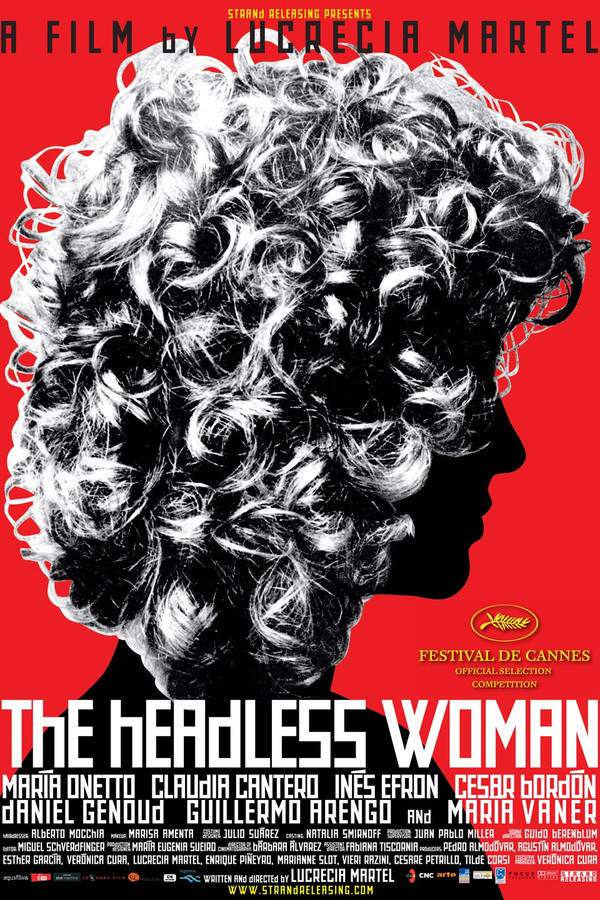
Verónica, known to friends as Vero, is an Argentine bourgeois woman whose sense of safety and routine begins to loosen the moment she suspects she may have struck something—or someone—with her car. The moment unfolds as she is distracted by a cellphone ping, and when she glances down to answer, the vehicle clips something along the road. A brief, non-point-of-view shot follows her as she drives away, and the camera reveals a dog lying still on the ground behind her. The scene is understated, but it plants a seed of unease that threads through the rest of the film.
At first glance, Verónica appears emotionally detached, her reaction more evasive than alarmed. Yet the audience can sense that the incident unsettles her more deeply than she lets on. She moves with a loose, almost clumsy shuffle through her daily life, an outward polish that doesn’t quite hide the tremor beneath. When she confides in her husband Marcos that she may have run over someone, she pushes to return to the scene, seeking something that could confirm or contradict her memory. They stop at the roadside, where a figure is visible from a distance. Marcos insists it is simply a dog, while Verónica remains uncertain, unsettled by what she saw and what remains unseen.
The unease intensifies as the plot quietly expands its scope. The body of a dark-skinned servant’s child is recovered from a canal right above the spot of the accident, a discovery that deepens the mystery and compounds Verónica’s private guilt. Her niece Candita, who harbors a crush on Verónica, asks in a direct, almost blunt way about “that boy who was murdered.” Verónica responds with a guarded inference, insisting that the boy was drowned, not murdered, and she refuses to let the memory take the foreground. The tension between what is spoken and what is suspected grows, and the lines between memory, rumor, and fact begin to blur.
In a bid to jog her memory, Verónica pursues fragments of the past that should be anchored in concrete places. She revisits a hospital where she had X-rays and a hotel where she had a post-accident tryst with her lover, Juan Manuel. Yet the records she seeks do not exist in the ordinary sense. The hospital files have been scrubbed by her brother, who works there, while the hotel records seem to have been erased or hidden by Juan Manuel himself. The absence of evidence, rather than evidence itself, becomes the new clue and the new constraint on Verónica’s sense of what happened, who she is, and how she should feel about the events she cannot fully reconstruct.
The film culminates in a scene that mirrors its themes of social ritual and the fragility of memory. Verónica attends a bourgeois party held in a hotel, moving through the space with a faint, dazed smile. The busy frame around her—people entering and exiting, the social choreography of the room—continues as a backdrop to her internal disarray. She appears poised on the surface, yet the camera lingers on her half-formed reactions, a portrait of someone trying to sustain appearances while a private truth trembles beneath them.
Throughout, the storytelling leans on a restrained realism that foregrounds mood over explicit explanation. The pacing leaves room for interpretation, inviting viewers to consider how Verónica’s social status, personal history, and the pressures of decorum shape her response to the incident. The film uses everyday spaces—the car, the road, the canal, the hospital, the hotel, and the hotel’s party space—to trace the ripple effects of guilt, memory, and the desire to control a narrative that refuses to settle.
Key moments echo softly yet persistently: the initial hit-and-ghost, the uncertain glance back at the roadside, the disturbing discovery above the spot, Candita’s probing question, the erasure of records, and the final, carefully calibrated performance at the party. The result is a quietly haunting study of a woman whose life seems orderly on the surface but is slowly rearranged by the possibility that she may have altered someone’s fate—and by the even more unsettling realization that memory itself may be a mutable, unreliable witness. The film invites a patient, attentive viewing, rewarding those who read between the lines of what Verónica says, what she avoids saying, and what the world around her hints at without ever fully exposing.