Plot Explained Spoilers guaranteed!
Plot Explained

Browse by genre

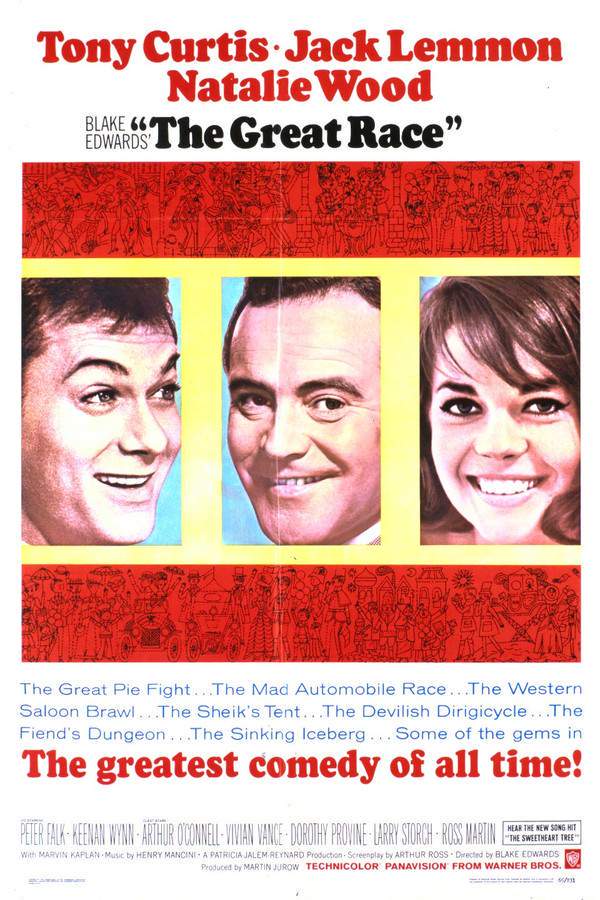
The Great Race (1965) movie poster

Plot Summary

The Great Race (1965) Plot Summary Explained

Release, runtime and language
1965 · 160 min · English
Directed by
Blake Edwards
Starring
Peter Falk, Tony Curtis, Jack Lemmon, Natalie Wood, Arthur O'Connell, Dorothy Provine

A group of celebrated drivers compete in a perilous race across the globe, traveling from New York to Paris. The contest pits the charismatic and daring Leslie, portrayed by Tony Curtis, against the calculating and determined Professor Fate, played by Jack Lemmon. Their rivalry extends beyond speed, encompassing clever tactics and a clash of personalities as they vie for victory in this high-stakes adventure.

On this page (6)
  1. 1 Where to watch
  2. 2 What happens: full plot
  3. 3 Plot questions answered
  4. 4 Movie threads
  5. 5 Movies like The Great Race
  6. 6 Every angle

Where to watch

Where to Watch The Great Race (1965)

Where can you watch The Great Race? Stream, rent or buy it in the US, including on Kanopy, Plex and Tubi TV: current JustWatch availability with up-to-date prices.

Streaming availability powered by JustWatch

Full plot summary · contains spoilers

What Happens in The Great Race: Full Plot Summary

The whole story of The Great Race (1965) explained, from the opening scene to the final frame: every key event, every twist and what it all adds up to. Read it as a quick recap before the sequel, to check a scene you missed, or to finally understand what really happened.

Tony Curtis and Jack Lemmon team up once more in this grand comedy directed by Blake Edwards, presenting a delightful tribute to iconic silent film legends like Charlie Chaplin and Buster Keaton. The Great Race merges classic slapstick humor with exhilarating adventure, transporting viewers back to the early automobile era when innovative designers passionately crafted what were fondly referred to as 'motor cars.'

The storyline revolves around a captivating global motor car race featuring Tony Curtis, who embodies the virtues of good manners and impeccable style, always dressed in striking white. He portrays a gentleman adventurer with an unwavering passion for automobiles, participating in the race with his elegant white roadster. His character is the epitome of chivalry, as he graciously stops to assist a lady, even in the heat of competition.

In stark contrast, Jack Lemmon takes on the role of the scheming antagonist, clad in black and accompanied by a clumsy sidekick reminiscent of Lex Luthor from Superman. His vehicle is a fantastical creation straight from the mind of a mad scientist, a bizarre contraption that is only vaguely recognizable as an automobile. It is laden with excessive gadgets, all designed for a singular purpose—eliminating the competition in outrageous ways.

Further enriching the narrative, Keenan Wynn portrays a multifaceted character who serves as Curtis' aide, assistant, and navigator, showcasing both caricature-like charm and anachronistic qualities. He embodies the traits of a staunchly misogynistic 18th-century English butler, whose unwavering loyalty to his role frequently clashes with his distrust of women.

Just in time, the mesmerizing Natalie Wood graces the screen as a dazzling suffragette, adorned in exquisite Victorian fashion, complete with a parasol. She plays a groundbreaking female reporter striving to make her mark in a male-dominated newspaper landscape, constantly challenging the authority of her editor. Faced with the nagging pressure from his assertive wife, sympathetic to Wood’s cause, the editor finds his grip on control slipping as he struggles to prevent her from covering the race. Displaying true ingenuity, she enters the contest incognito, riding in a motor car funded by the paper itself.

The Great Race unfolds as a whimsical escapade, skillfully crafted by both a visionary director and a talented ensemble cast. This film not only celebrates the essence of storytelling but also rejuvenates the genre in a way that’s often overlooked in a time dominated by fleeting attention spans and studio demands for brevity. It’s a cinematic gem to share with the younger generation, filled with enough action and slapstick to engage even the most restless of viewers.

Last updated: November 04, 2024 at 00:12

Was this helpful?

Plot questions answered

The Great Race Plot Explained: Your Questions Answered

The questions people ask most about The Great Race (1965): what happens in the confusing scenes, why the characters do what they do, the twists, hidden details and what the ending means. Each answer contains spoilers.
Q1

Why does Leslie stop to help a lady during the race?

Leslie stops to help a lady in distress because his character embodies old-fashioned chivalry and good manners. Despite being in the middle of a high-stakes competitive race, his gentlemanly nature compels him to assist anyone in need, even at the cost of his own position in the competition. This act reinforces his virtuous character as the hero dressed in white, contrasting sharply with Professor Fate's ruthless tactics.
Foreshadowing: Earlier scenes establish Leslie's character as a chivalrous gentleman adventurer who values honor over winning.

  • leslie
  • chivalry
  • race
  • lady in distress
  • white suit hero
Q2

What motivates Professor Fate to sabotage other racers?

Professor Fate is motivated by his desire to win the race at any cost. His character represents the villainous opposite of Leslie, he wears black and drives a bizarre vehicle laden with gadgets specifically designed to eliminate his competition through underhanded tactics. His scheming nature drives much of the film's comedic conflict, as he attempts ridiculous schemes to take out Leslie and other rivals.

Foreshadowing: His introduction immediately establishes him as the cunning antagonist cloaked in black with a vehicle full of questionable modifications.

  • professor fate
  • sabotage
  • villain
  • motivation
  • gadgets car
Q3

Why does the suffragette enter the race in disguise?

Natalie Wood's character enters the race incognito because she faces gender discrimination in the male-dominated newspaper industry. Her editor refuses to let her cover the race despite her abilities, and even his wife's pressure cannot change his mind. Determined to prove herself, she secretly enters the race driving a car funded by the newspaper itself, using her disguise to bypass the barriers placed against women in competitive sports.

Foreshadowing: The film establishes early on that she is a pioneering female reporter fighting against male authority in journalism.

  • suffragette
  • natalie wood
  • disguise
  • female reporter
  • race incognito
  • women empowerment
Q4

What causes the rivalry between Leslie and Professor Fate?

The rivalry stems from their opposite personalities and approaches to competition. Leslie represents honor, chivalry, and good sportsmanship, always dressed in pristine white, while Professor Fate embodies cunning, trickery, and ruthless ambition, dressed in black. Their conflict goes beyond mere racing, they clash as representatives of good versus evil, with their contrasting approaches to victory creating ongoing comedic confrontations throughout the film.

Foreshadowing: Their introductions deliberately set up the classic good-versus-evil dynamic through their opposing color schemes and character traits.

  • leslie
  • professor fate
  • rivalry
  • hero villain
  • dark vs light
Q5

How does Professor Fate's car differ from other vehicles in the race?

Professor Fate's vehicle is a fantastical creation resembling something from a mad scientist's imagination, barely recognizable as an automobile. Unlike the other racers' more conventional cars, his is laden with excessive gadgets and weapons designed specifically for eliminating competition. This bizarre contraption embodies his scheming nature and provides the film with its signature slapstick humor through his outrageous assassination attempts.

Foreshadowing: His introduction explicitly describes the car as a bizarre contraption loaded with weaponry and gadgets.

  • professor fate car
  • gadgets
  • weaponized vehicle
  • mad scientist car
Q6

What happens to Professor Fate's scheme at the end of the race?

Professor Fate's schemes ultimately fail despite his relentless attempts to sabotage Leslie and win through trickery. The film follows the classic good-versus-evil structure where the virtuous hero prevails. His elaborate gadgets and underhanded tactics backfire throughout the race, and his defeat reflects the film's theme that honor and chivalry triumph over deception and ruthlessness.

Foreshadowing: The narrative structure establishes early on that this is a heroic tale where the good character in white will overcome the villain in black.

  • professor fate defeat
  • ending
  • villain loses
  • race results
Q7

Why does the aide have misogynistic character traits?

Keenan Wynn's character serves as Leslie's aide, navigator, and assistant, providing comic relief throughout the film. His character is deliberately written as a caricature of an anachronistic 18th-century English butler, complete with misogynistic tendencies that clash with his loyalty to Curtis. This character trait creates occasional conflict and humor, particularly when interacting with the female reporter, reflecting dated social attitudes for comedic effect.

Foreshadowing: His introduction explicitly describes him as embodying traits of a staunchly misogynistic 18th-century English butler.

  • keenan wynn
  • aide
  • navigator
  • butler character
  • comic relief
Q8

Why does the editor's wife support the female reporter's ambitions?

The editor's wife supports Natalie Wood's character because she sympathizes with the suffragette's cause in challenging societal norms. Despite her husband's resistance to allow a woman to cover the race, his wife advocates for the reporter, recognizing her talent and determination. This support reflects the film's broader theme of women's empowerment during an era when women were fighting for greater rights and recognition.

Foreshadowing: The narrative establishes that the editor faces pressure from his assertive wife who supports the female reporter's cause.

  • editor wife
  • suffragette support
  • gender discrimination
  • newspaper
Q9

What makes The Great Race unique in its comedy style?

The Great Race stands out for its homage to silent film legends like Charlie Chaplin and Buster Keaton, incorporating broad slapstick humor, pie fights, and physical comedy into a high-stakes adventure narrative. The film blends classic silent-era comedy with early automobile era aesthetics, creating a whimsical tone that appeals to both adults and families. This combination of vintage humor with modern action elements gives the film its distinctive character.

Foreshadowing: The opening description explicitly frames the film as a tribute to silent film legends.

  • slapstick comedy
  • silent film tribute
  • charlie chaplin
  • buster keaton
  • pie fight
Q10

Why does Leslie wear white throughout the race?

Leslie's distinctive white attire visually reinforces his role as the heroic protagonist. The film uses clear visual symbolism with Leslie in pristine white representing goodness, honor, and sportsmanship, while Professor Fate in black embodies villainy and deception. This color-coded character design follows classic storytelling traditions, making the moral conflict immediately clear to audiences.

Foreshadowing: His introduction specifically mentions he is always dressed in striking white as part of his gentleman adventurer persona.

  • leslie white suit
  • hero visual symbolism
  • white vs black characters
Q11

How does Natalie Wood's character prove herself in the male-dominated world?

Natalie Wood's character proves herself by entering the race incognito and successfully competing against male racers despite the numerous obstacles placed before her. By taking direct action rather than waiting for permission, she demonstrates her competence and determination to prove that women can succeed in traditionally male fields. Her bold move to enter the race in disguise becomes the ultimate challenge to the sexist attitudes of her era.

Foreshadowing: Earlier scenes establish her struggle to gain recognition in the male-dominated newspaper industry.

  • natalie wood character
  • women prove themselves
  • race competition
  • female empowerment

Movie threads

More Movies Like The Great Race, by Mood & Story

Curated lists built around what makes The Great Race tick: the same mood, the same kind of story or the same emotional payoff. Each list explains why these movies belong together.

Whimsical Rivalry Adventures like The Great Race

High-stakes competitions where charming opponents clash in a playful, globe-trotting spirit. If you enjoyed the charming clash between hero and villain in The Great Race, you'll love these movies. This list features playful, high-stakes adventures where charismatic rivals engage in globe-trotting competitions, filled with humor and exhilarating action in a lighthearted spirit.

  • playful
  • adventurous
  • slapstick
  • charming
  • exhilarating
  • nostalgic
  • Tone: whimsical, playful
  • Pacing: fast, action-driven
Why these movies?

The story pattern: Stories typically follow a clear good-versus-evil structure, with a noble hero and a comically determined antagonist engaging in a series of escalating challenges. The narrative is linear and driven by the central competition, ensuring a fast pace and a satisfying, happy conclusion where good triumphs.

Why they belong together: These films are grouped by their shared tone of whimsical fun, a straightforward good-versus-evil plot, fast pacing driven by competition, and a light emotional weight that prioritizes adventure and humor over tension or drama.

Classic-Style Slapstick Spectacles like The Great Race

Large-scale comedies that blend ambitious plots with timeless, physical humor and grandiose gags. Fans of the epic pie fight and grandiose gags in The Great Race will appreciate these movies. This collection features comedies with large-scale plots that are vehicles for spectacular, classic-inspired slapstick humor, creating a nostalgic and wildly entertaining vibe.

  • slapstick
  • nostalgic
  • charming
  • playful
  • grandiose
  • physical comedy
  • Tone: whimsical, nostalgic
  • Pacing: fast, gag-driven
Why these movies?

The story pattern: The narrative often involves a simple, ambitious premise—like a globe-trotting race or a massive heist—that provides a framework for a series of escalating comedic sequences. Character arcs are secondary to the delivery of grandiose physical gags, paying homage to the structure of silent-era comedies on a modern scale.

Why they belong together: These movies share a very high humor score, a whimsical or light tone, and a focus on visual, physical comedy over witty dialogue. They are united by their grandiose approach to slapstick, often featuring large casts and elaborate stunts within a straightforward adventure plot.

If you liked this

Movies Like The Great Race

Similar movies to The Great Race: the same genre, themes or kind of story. Each one comes with its own plot summary, timeline and ending explained.

Browse all movie summaries

Every angle

The Great Race (1965) Explained: Plot, Timeline & Characters

Everything about The Great Race in one place: what happens in the plot summary, the timeline in chronological order, the characters and meaning and a spoiler-free summary. What's After the Movie adds the cast, box office and post-credit scenes.

Coming soon on iOS and Android

The Plot Explained Movie Summary App

Plot summaries, endings explained and timelines on your phone. Catch up on any movie in minutes, save your favorites and never miss a twist again.

Be the first to know when we launch. Your email stays private, always.

Learn more about the app