Plot Explained Spoilers guaranteed!
Plot Explained

Browse by genre

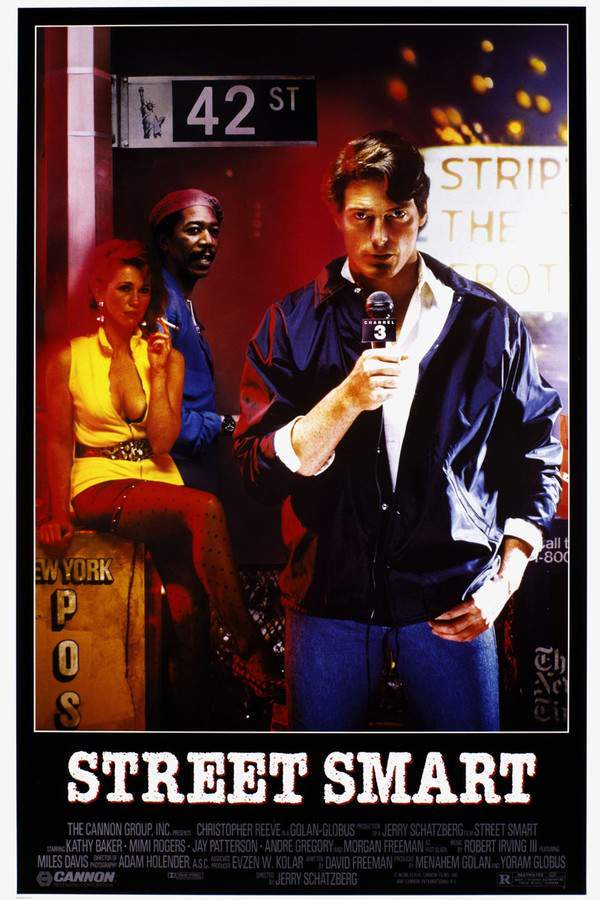
Street Smart (1987) movie poster

Plot Summary

Street Smart (1987) Plot Summary Explained

Release, runtime and language
1987 · 97 min · English
JustWatch #8,120 2
Directed by
Jerry Schatzberg
Starring
Morgan Freeman, Andre Gregory, Christopher Reeve, Mimi Rogers, Erik King, Kathy Baker

A struggling reporter crafts a sensational exposé on street prostitution, hoping to boost his career. The fabricated story proves successful, but the consequences are far-reaching and dangerous. He becomes deeply involved with the ruthless pimp who inspired his article, a complex and dangerous relationship that puts his life at risk as he attempts to conceal the truth behind his story.

On this page (7)
  1. 1 Where to watch
  2. 2 What happens: full plot
  3. 3 Plot questions answered
  4. 4 Movie threads
  5. 5 Movies like Street Smart
  6. 6 Categories
  7. 7 Every angle

Where to watch

Where to Watch Street Smart (1987)

Where can you watch Street Smart? Stream, rent or buy it in the US, including on fuboTV, MGM Plus and Philo: current JustWatch availability with up-to-date prices.

Streaming availability powered by JustWatch

Full plot summary · contains spoilers

What Happens in Street Smart: Full Plot Summary

The whole story of Street Smart (1987) explained, from the opening scene to the final frame: every key event, every twist and what it all adds up to. Read it as a quick recap before the sequel, to check a scene you missed, or to finally understand what really happened.

Jonathan Fisher, Christopher Reeve, a struggling magazine reporter in New York City, is locked in a battle with his editor, Ted Avery Andre Gregory, over how to salvage his career with a story that could catapult him into the public eye. Frustration gnaws at him as he clumsily tries to pitch a profile about a real-life street pimp, an idea Ted finds intriguing but insists must be completed under a tight, almost impossible deadline. To chase the story, Jonathan uses a risky tactic: he pays for time with a prostitute, an upbeat former beautician nicknamed Punchy Mimi Rogers, hoping to uncover material that will feel authentic and urgent. Yet Punchy’s fierce loyalty to her pimp, Leo “Fast Black” Smalls, Jr., runs deep, and she remains guarded, fearful of crossing the life she’s made on the street.

Across town, Smalls erupts in violence, beating a patron who assaults one of his girls. The incident ends with the patron collapsing from a fatal heart attack, and Smalls is indicted for second-degree murder. The legal danger hanging over him throws his world into sharper relief and pulls the reader toward the question of who really controls the narrative in a city where danger and desire mingle on every corner. As Jonathan watches the case unfold, he finds that the story has begun to shape real consequences far beyond the newsroom. Yet his attempts to help Punchy only deepen the bond between them, and a fragile romance forms between the two as they navigate the perils of fame and coercion.

When Alison, Jonathan’s girlfriend, tries to support him in breaking the story, things go disastrously wrong, and Jonathan improvises a different tale: Tyrone, a composite figure who seems to crystallize the essence of Smalls without naming him outright. The response is electrifying. Ted and the magazine crowd lap it up, and Jonathan soars into the spotlight, becoming a television fixture as the host of a new segment titled Street Smart, which spotlights people who “use their street smarts” to survive on the chaotic streets of New York. The triumph tastes sweet, but it also funnels him into a pressure cooker: Ted is eager to meet Tyrone in the flesh and to publish more lurid stories about him, while Leonard Pike, an Assistant District Attorney, hovers with the blunt certainty that the public’s fascination with Tyrone is feeding Smalls’ celebrity and complicating the ongoing prosecution.

Pike’s insistence that Tyrone and Smalls are the same person becomes a thorny ethical and legal battle. The prosecutor’s team believes the sensational parallels between the story and Smalls’ actual life are so strong that the magazine’s notes—Jonathan’s carefully kept record of his interview—could become the key to Smalls’ exoneration. Smalls’ lawyer subpoenas those notes, aiming to force a confession from the magazine and its writers by implying cooperation with the defense. Jonathan insists that Tyrone and Smalls are not the same man, but the weight of evidence—photos of Jonathan and Smalls together at their first public meeting—creates a credibility problem he cannot easily escape. Pike’s subpoena and the magazine’s resistance to turn over non-existent notes push Jonathan into a legal bind that could ruin him as both journalist and man.

Meanwhile, Smalls, Punchy, and Smalls’ lieutenant Reggie begin to orbit Jonathan’s life in more intimate ways. They attend a magazine fundraiser at Ted’s home, not merely as subjects of a story but as participants in a dangerous, evolving alliance. Jonathan and Punchy grow closer, complicating Jonathan’s relationship with Alison and complicating his sense of what is true versus what is marketable. As the legal drama intensifies, Smalls presses for a decisive alibi and asks Jonathan to craft a set of notes that would anchor his whereabouts to the murder. Jonathan refuses at first, but the mounting scrutiny and the threat of a contempt ruling push him to a desperate calculus.

Punchy, torn between loyalty and fear, struggles under Smalls’ capricious authority. When she attempts to walk away from the life Smalls controls, he responds with a brutal threat, leaving her with a harrowing choice that tests her will to survive. The confrontation ends with Punchy’s murder at the hands of a man who can’t tolerate her stepping out of the role he assigns her. News of Punchy’s death reaches Pike, who informs Jonathan in jail that he knows about the ruse Smalls is pressuring him to carry out. The weight of the truth—again, not just about a man but about a city’s appetite for sensational narratives—frays Jonathan’s resolve.

Driven to the edge, Jonathan revisits the plan to provide the notes. He accepts the risk, meets Smalls, and agrees to furnish the alibi that could clear the pimp of the murder charge, while keeping his own name intact. Smalls is eventually found not guilty, a result that infuriates Pike and cements the uneasy moral economy that dominates the case: the story has become a weapon in a larger game. In a bid to protect his own skin, Pike hints that he will pursue Jonathan for fabricating evidence, and his cryptic response—“satisfaction”—lingers as a chilling reminder that the pursuit of truth can bite back in unexpected ways.

Jonathan’s personal life also fractures under the strain. Alison survives a stabbing carried out by Reggie, a blow that leaves her hospitalized and further entwines the fates of everyone in this high-stakes web. To retaliate against Reggie and expose the corruption of loyalties, Jonathan records Reggie accepting money from Darlene, a payoff arranged by Jonathan himself to trap the lieutenant in a skimming scheme. Darlene, played by Anna Maria Horsford, becomes a pivotal though doomed conduit in the narrative, her fate sealed as a consequence of the struggle between the pimp’s brutal code and the magazine’s push for a sensational story.

With the legal and personal pressures closing in, Jonathan’s world shifts again. He openly states that he will produce the notes and is released, but the moral cost of his decisions remains high. Smalls faces a jury and a city that has learned to see him as a symbol of street power, while Jonathan, now a public figure with a controversial, celebrated story, must live with the consequences of having manufactured both the myth and the reality. The climax arrives as Reggie, terrified and cornered, accumulates fear and misreads his own survival instincts. He flees, trips, and in a final, deadly moment, shoots Smalls—an act that ends the pimp’s life and redefines the “Street Smart” broadcasts that brought Jonathan his moment in the spotlight. In the aftermath, Jonathan returns to his newsroom, reporting on Smalls’ execution, the city’s appetite for complex truths, and the uneasy alliance between journalism and the sensational, bravely navigating the gray zones where fame, violence, and truth collide.
Last updated: November 22, 2025 at 15:58

Was this helpful?

Plot questions answered

Street Smart Plot Explained: Your Questions Answered

The questions people ask most about Street Smart (1987): what happens in the confusing scenes, why the characters do what they do, the twists, hidden details and what the ending means. Each answer contains spoilers.

Q1

Why did Jonathan create the fictional character Tyrone?

Jonathan invented Tyrone after his girlfriend Alison's attempt to help his story backfired. Facing a tight deadline and unable to get real information from Punchy, he created Tyrone as a composite pimp figure that captured the essence of Leo Smalls without naming him. The fictional character was so compelling that it became a sensation, launching Jonathan's TV career, but it also drew the attention of prosecutors who believed Tyrone was actually Smalls.

Foreshadowing: Earlier in the film, Jonathan struggles to get Punchy to open up about Smalls, establishing his desperation for a marketable story.

  • tyrone character
  • fictional pimp
  • journalistic fabrication
  • story invention
Q2

Why was Punchy killed?

Punchy was killed because she tried to leave Leo Smalls' control. After being threatened by Smalls with having her eye cut out, she cooperated with Assistant District Attorney Pike by revealing Smalls' plan to have Jonathan fabricate notes for an alibi. Her betrayal made her a liability, and Smalls had her murdered as punishment for stepping out of the role he assigned her.

Foreshadowing: Smalls' earlier threat to cut out her eye foreshadows the brutal control he exerts over his women.

  • punchy death
  • leo smalls
  • murdered
  • betrayal
  • pimp violence
Q3

How did Smalls die?

Smalls was shot and killed by his own lieutenant, Reggie, during a chase through the streets of New York. Reggie, terrified after being set up by Jonathan and fearing Smalls' retribution, shot Smalls in self-defense as the pimp pursued him. Jonathan then covered Smalls' execution for his Street Smart television segment.

Foreshadowing: Jonathan's earlier tape of Reggie accepting money from Darlene created the tension that led to the confrontation.

  • leo smalls death
  • reggie
  • shot
  • final confrontation
  • street execution
Q4

Why did Jonathan agree to fabricate notes for Smalls?

Jonathan agreed to create false notes that would provide Smalls with an alibi because he was facing legal consequences. He had been held in contempt of court for refusing to turn over materials, and a judge had seen photos proving Jonathan had met with Smalls, undermining his claim that Tyrone was fictional. With the threat of a prolonged jail sentence and mounting pressure, Jonathan complied to secure his own release.

Foreshadowing: The prosecutor's earlier subpoena of Jonathan's notes created the legal trap he eventually fell into.

  • fake notes
  • alibi
  • legal pressure
  • contempt of court
  • fabricated evidence
Q5

What happened to Alison at the end of Street Smart?

Alison was stabbed by Reggie, Smalls' lieutenant, as part of the escalating violence surrounding Jonathan's deception. She survived the stabbing but was hospitalized, and the attack further entangled everyone in the dangerous web of consequences stemming from Jonathan's fabricated story.

Foreshadowing: The tension between Jonathan and Smalls' camp escalates throughout the film, turning personal relationships into targets.

  • alison stabbing
  • reggie attack
  • hospitalized
  • violence
Q6

Why did the Tyrone story become so successful?

The Tyrone story succeeded because it was a sensationalized, composite portrait of street life that was both compelling and marketable. It tapped into the public's fascination with the criminal underworld while maintaining plausible deniability. Ted, Jonathan's editor, pushed for more lurid content, and the story's success launched Jonathan's television segment called Street Smart, where he hosted segments about people who survive on the streets.

Foreshadowing: Ted's insistence on a tight deadline and sensational content established the pressure that drove Jonathan toward invention.

  • tyrone success
  • tv segment
  • street smart
  • media sensation
  • sensational story
Q7

Why was District Attorney Pike convinced Tyrone and Smalls were the same person?

Pike was convinced Tyrone and Smalls were the same person because the fictional story paralleled Smalls' actual life too closely. He believed the magazine's notes, which Jonathan had from his real interviews with Smalls, could help exonerate Smalls of murder. The prosecutor subpoenaed the notes hoping to prove the connection and use Jonathan's fabricated material against Smalls' defense.

Foreshadowing: The earlier parallel between the fictional Tyrone's activities and Smalls' real violence created the legal ambiguity Pike exploited.

  • pike
  • prosecutor
  • tyrant connection
  • subpoena
  • legal battle
Q8

Why did Punchy go to the district attorney?

Punchy went to District Attorney Pike after Smalls threatened to blind her for considering leaving his control. She told Pike that Smalls was pressuring Jonathan to fabricate notes for an alibi, hoping to use the legal system as protection. Her cooperation was an act of desperation to escape Smalls' brutal control, but it ultimately led to her murder.

Foreshadowing: Smalls' earlier threat to cut out her eye demonstrated his absolute control over her.

  • punchy cooperation
  • pike
  • witness
  • betrayal
  • escape attempt
Q9

What happened to Reggie at the end of Street Smart?

Reggie was arrested in handcuffs after shooting Smalls. He fled the confrontation out of fear for his life, but in the chaos of the chase, he shot and killed Smalls in what was ruled self-defense. Jonathan had previously set up Reggie by taping him accepting money from Darlene, creating the tension that led to the fatal confrontation.

Foreshadowing: Jonathan's earlier recording scheme to expose Reggie's skimming created the conflict that precipitated the final chase.

  • reggie arrest
  • handcuffs
  • self-defense
  • charged
  • flee
Q10

Why did Smalls threaten to cut out Punchy's eye?

Smalls threatened to cut out Punchy's eye as a brutal demonstration of his absolute control over her when she considered leaving his operation. The threat was meant to terrorize her into submission and obedience. When forced to choose which eye to keep, Punchy chose her left eye, and Smalls released her, though this moment of defiance ultimately led to her death when she sought help from Pike.

Foreshadowing: This scene establishes the dehumanizing violence of Smalls' control over his women.

  • eye threat
  • brutal control
  • intimidation
  • punishment
  • dominance
Q11

Why did Jonathan get his own TV segment called Street Smart?

Jonathan got the Street Smart TV segment because his Tyrone article became a major success. The magazine's editors loved the sensational story, and television producers saw potential in Jonathan's ability to capture the gritty reality of street life. The segment featured people who used their street smarts to survive in New York, and it turned Jonathan into a public figure, but also deepened his entanglement with Smalls' world.

Foreshadowing: The success of the fictional Tyrone piece was driven by Ted's demand for sensational, attention-grabbing content.

  • street smart tv show
  • television career
  • media fame
  • jonathan fisher
Q12

How did the photos of Jonathan and Smalls affect his case?

The photos taken at Jonathan's first meeting with Smalls undermined his claim that Tyrone was entirely fictional. When a judge saw these photos, it proved Jonathan had met with the real pimp, making his denials about the Tyrone-Smalls connection seem like lies. This evidence kept Jonathan trapped in the legal battle and contributed to him being held in contempt of court.

Foreshadowing: Jonathan's initial meeting with Smalls was meant to gather research, but it created lasting evidence against him.

  • photos evidence
  • court case
  • undermining claim
  • meeting proof
  • contempt
Q13

What led to Smalls being indicted for second-degree murder?

Smalls was indicted for second-degree murder after he beat up a patron who assaulted one of his prostitutes. The patron collapsed and died from a heart attack as a result of the attack. While Smalls didn't intend to kill him, the violent assault triggered the fatal cardiac event, leading to the murder charge that later became central to the legal battle.

Foreshadowing: This early act of violence establishes Smalls' dangerous temper and sets the murder trial in motion.

  • murder indictment
  • second-degree murder
  • patron death
  • heart attack
  • assault

Movie threads

More Movies Like Street Smart, by Mood & Story

Curated lists built around what makes Street Smart tick: the same mood, the same kind of story or the same emotional payoff. Each list explains why these movies belong together.

Unethical Journalism Thrillers like Street Smart

Stories where media ambition leads to dangerous lies and heavy consequences. For viewers who liked the tense, morally complex world of Street Smart, this list features movies about journalists facing the consequences of their lies. Discover similar gritty thrillers and dramas where media manipulation leads to danger, exploring themes of corruption, urban survival, and the heavy price of ambition.

  • morally ambiguous
  • tense
  • anxious
  • cynical
  • gritty
  • urban decay
  • Tone: dark, cynical, tense
  • Pacing: steady, escalating
Why these movies?

The story pattern: These stories typically follow a protagonist who achieves career success through a lie, which then forces them deeper into a corrupt world. The narrative is driven by the escalating consequences of their fabrication, creating a claustrophobic atmosphere of fear, guilt, and external threats that often climaxes in a violent or emotionally devastating confrontation.

Why they belong together: Movies in this thread share a focus on the dark side of media, the tension between ambition and ethics, and the inescapable fallout of a single deceitful act. They are united by a gritty, cynical tone, steady pacing that builds dread, and a heavy emotional weight stemming from the protagonist's moral collapse.

Gritty Urban Crime Thrillers like Street Smart

Thrillers set in the decaying city where a lie pulls the protagonist into crime. If you liked the tense atmosphere and urban decay of Street Smart, explore more movies set in gritty city underworlds. These stories feature morally ambiguous characters, high-stakes crime, and a steady build of tension as protagonists get in over their heads with dangerous figures, leading to bittersweet or bleak outcomes.

  • gritty
  • tense
  • urban decay
  • claustrophobic
  • anxious
  • morally ambiguous
  • Tone: dark, gritty, tense
  • Pacing: steady, relentless
Why these movies?

The story pattern: The narrative pattern involves an ordinary person making a fateful decision that connects them to the criminal world. The setting—a decaying, tense urban environment—becomes a character itself, reflecting the protagonist's internal crisis. The story unfolds as a steady descent, focusing on the complex, often abusive relationship with a criminal mentor or antagonist and the inevitable violent climax.

Why they belong together: These movies are grouped by their immersive, oppressive urban settings and the core theme of a character's irreversible descent into a world of crime. They share a dark, gritty tone, high intensity fueled by constant threat, and a heavy emotional weight derived from the consequences of crossing a moral line.

If you liked this

Movies Like Street Smart

Similar movies to Street Smart: the same genre, themes or kind of story. Each one comes with its own plot summary, timeline and ending explained.

Browse all movie summaries

Categories

Movie Lists Featuring Street Smart

Street Smart appears in these hand-built movie categories. Each one groups movies by a specific mood, theme or story type, with their plot summaries and endings explained.

View all movie categories

Every angle

Street Smart (1987) Explained: Plot, Timeline & Characters

Everything about Street Smart in one place: what happens in the plot summary, the timeline in chronological order, the characters and meaning and a spoiler-free summary. What's After the Movie adds the cast, box office and post-credit scenes.

Coming soon on iOS and Android

The Plot Explained Movie Summary App

Plot summaries, endings explained and timelines on your phone. Catch up on any movie in minutes, save your favorites and never miss a twist again.

Be the first to know when we launch. Your email stays private, always.

Learn more about the app