Plot Explained Spoilers guaranteed!
Plot Explained

Browse by genre

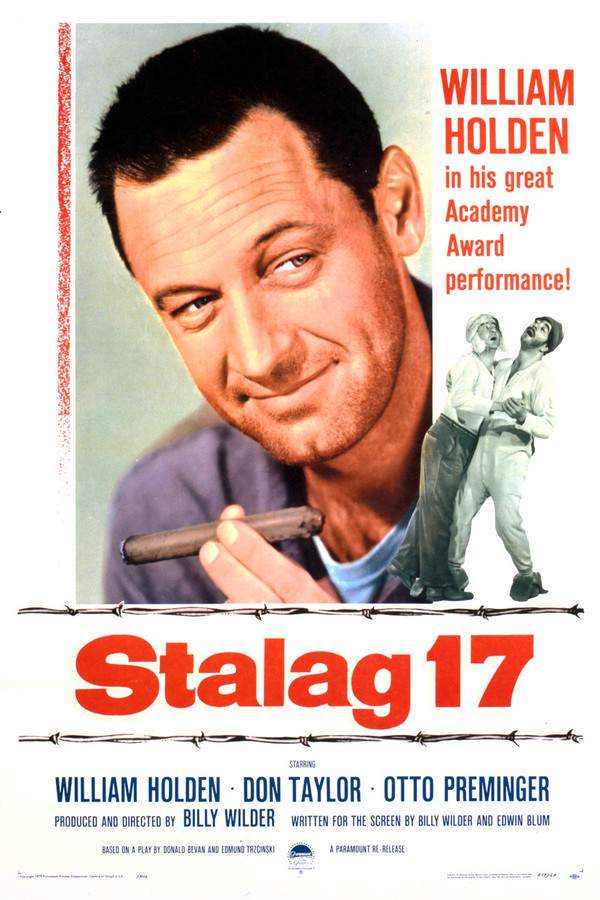
Stalag 17 (1953) movie poster

Plot Summary

Stalag 17 (1953) Plot Summary Explained

Release, runtime and language
1953 · 120 min · English
Loading streaming availability…
Directed by
Billy Wilder
Starring
William Holden, Sig Ruman, Neville Brand, Don Taylor, Robert Strauss, Peter Graves

During World War II, inside a German prisoner-of-war camp in 1944, two American airmen are caught trying to escape, leading to their execution. Suspicion falls on the remaining prisoners as accusations arise regarding someone trading with the enemy. Sergeant Sefton finds himself under scrutiny due to his reputation for bartering. Determined to clear his name and expose the true traitor, he initiates a dangerous investigation to uncover the identity of the man among them who is aiding the German captors.

On this page (6)
  1. 1 Where to watch
  2. 2 What happens: full plot
  3. 3 Plot questions answered
  4. 4 Movie threads
  5. 5 Movies like Stalag 17
  6. 6 Every angle
Loading streaming availability…

Full plot summary · contains spoilers

What Happens in Stalag 17: Full Plot Summary

The whole story of Stalag 17 (1953) explained, from the opening scene to the final frame: every key event, every twist and what it all adds up to. Read it as a quick recap before the sequel, to check a scene you missed, or to finally understand what really happened.

In the stark surroundings of Stalag 17's Compound 4, 630 American airmen, all sergeants, find themselves enduring the strict oversight of Oberst von Scherbach, their no-nonsense camp commander. As Christmas draws near in December 1944, the inmates of this derelict barracks, led by the resourceful leader Hoffy Hoffman and security officer Frank Price, concoct an intricate plan to facilitate the escape of their fellow prisoners, Manfredi and Johnson. Unfortunately, this bold endeavor comes to a tragic end, resulting in the untimely deaths of both men.

With morale plummeting, suspicion begins to swirl around J. J. Sefton, a wily and enterprising skeptic known for his shrewdness. Sefton, played by William Holden, has forged assets by trading with the German guards for luxuries, establishing a series of odd ventures that inject a sense of normalcy into their confined existence—these include activities like rat racing and bootlegged liquor, alongside a makeshift telescope to spy on Russian women from a nearby compound. His close ally, Clarence "Cookie" Cook, serves as both confidant and narrator, revealing their escapades marked by a blend of admiration and anxiety.

The men of Barracks 4 attempt to manage the monotony of life through comedic relief provided by the barracks jokers Animal Kuzawa and Harry Shapiro, while clandestinely tuning into a hidden radio. Their seemingly jovial guard, Feldwebel Schulz, secretly utilizes a hollow black queen chess piece for smuggling coded messages, manipulating the cord of an overhead light bulb as part of an obscured communication system.

As the holidays approach, a new face emerges within Barracks 4: Lieutenant Dunbar, accompanied by Sgt. Bagradian, who brings thrilling tales of heroism, including an account of a time bomb he devised that obliterated a munitions train. Sefton, ever the skeptic, harbors doubts about this newcomer, speculating that his privileged background has contributed to his success at officer school—an assertion that ignites tension between the two.

With Christmas nearing, Schulz announces the impending visit of an inspector from the Geneva Convention, prompting Sefton to curry favor with the guards to be among the Russian women during the festivities. However, when their coveted radio is seized by Schulz, doubt resurfaces about Sefton's innocence, leading to a violent confrontation where he is brutally beaten by his fellow prisoners. This escalates with von Scherbach's alarming arrest of Dunbar on charges of sabotage, intensifying the already fragile trust among the inmates.

The following day, a seasoned inspector arrives at the camp bearing Red Cross parcels filled with surprising items: 2,000 ping-pong balls, which the prisoners cleverly repurpose into makeshift smoke bombs. The inspector soon learns of Dunbar's drastic removal and proceeds to caution von Scherbach—warning that without substantial evidence, convicting Dunbar could result in severe diplomatic repercussions. Meanwhile, von Scherbach covertly instructs Schulz to deliver the black queen to their informant. In a twist, Price covertly retrieves the queen during the Christmas gathering, intercepting the hidden message and resetting the signal, leading Sefton to grow suspicious of Price's clandestine dealings.

As darkness envelops the camp, Bagradian is pressured into divulging the secret behind Dunbar's time bomb—a simple yet lethal lit cigarette stored within a matchbook. The evening takes a chaotic turn when an air raid siren incites panic, compelling the prisoners to vacate their barracks. Sefton, always alert, witnesses Price in a secretive discussion with Schulz, demonstrating the time bomb as evidence against Dunbar—convincing Sefton that Price has aligned himself with the enemy.

On Christmas Day, the SS arrives at the camp to escort Dunbar to Berlin, prompting Hoffy to assign Price the task of monitoring Sefton, who remains suspected of disloyalty. As Hoffy secretly rallies the men of Barracks 4 to plot a daring rescue for Dunbar, a riot erupts, and a smoke bomb ignites, creating the perfect cover for the escape. Amidst the turmoil, Dunbar is hidden away in the water tower until it is safe to move.

As von Scherbach threatens to obliterate the camp, the chilling truth dawns on the prisoners: one of their own must assist in Dunbar's escape. Price steps forward, but Sefton is left in shock when he uncovers Price's betrayal—his true identity as a German spy. As Price attempts a getaway, he is seized by the prisoners, who seek justice.

Sefton seizes the moment to redeem himself, embarking on a mission to rescue Dunbar. He retrieves the Lieutenant just as the prisoners seek retribution on Price, forcing him out of the barracks with cans clanging at his feet. As Price stumbles beneath the weight of his punishment, he inadvertently draws the gaze of the guards, whose gunfire ultimately claims his life.

In the aftermath, as Sefton and Dunbar manage to slip through the pandemonium and away from the camp, the remaining prisoners retreat to their quarters. Cookie takes a moment to whistle "When Johnny Comes Marching Home," a haunting reminder of the grim realities faced by those imprisoned within the confines of barbed wire.
Last updated: November 21, 2024 at 09:29

Was this helpful?

Plot questions answered

Stalag 17 Plot Explained: Your Questions Answered

The questions people ask most about Stalag 17 (1953): what happens in the confusing scenes, why the characters do what they do, the twists, hidden details and what the ending means. Each answer contains spoilers.

Q1

Why was Sefton suspected of being a traitor?

Sefton was suspected because he was known for trading with the German guards, exchanging goods and services for luxuries like alcohol, food, and privileges. After Manfredi and Johnson's failed escape attempt ended in their execution, the prisoners grew desperate and paranoid, looking for someone to blame. Sefton's reputation as a shrewd operator who profited from his dealings with the enemy made him an easy target for suspicion, especially when the radio was seized and his loyalty came into question.

  • sefton suspicion
  • prisoner trading
  • bartering with guards
  • camp suspicion
Q2

Who is the real informant in Barracks 4?

Frank Price, the security officer whom the prisoners trusted to help organize the escape, is the real German informant. Price had been secretly meeting with Feldwebel Schulz and passing information to the German captors. He used the black queen chess piece to hide coded messages and helped frame Lieutenant Dunbar for sabotage. His betrayal was revealed when Sefton witnessed him demonstrating the time bomb to Schulz as evidence against Dunbar.

  • frank price traitor
  • german spy
  • price betrayal
  • barracks 4 informant
Q3

How did the prisoners use the ping-pong balls as smoke bombs?

When the Red Cross inspector delivered parcels containing 2,000 ping-pong balls, the prisoners cleverly repurposed them as smoke bombs for their escape plan. They likely filled or modified the balls to produce smoke when ignited, creating a diversion during the Christmas Day rescue of Lieutenant Dunbar. The smoke provided cover for the prisoners to hide Dunbar in the water tower and execute their escape attempt amid the chaos of the air raid siren.

  • ping-pong balls smoke bomb
  • red cross parcels
  • escape plan
  • christmas escape
Q4

Why was Lieutenant Dunbar arrested?

Lieutenant Dunbar was arrested on charges of sabotage, apparently framed by the German informant Frank Price. When Bagradian was pressured by the Germans, he revealed that Dunbar's time bomb technique involved placing a lit cigarette inside a matchbook. Price used this information to plant evidence and convince the Germans that Dunbar was a saboteur. The timing of Dunbar's arrest coincided with the inspector's visit, creating diplomatic tension as the inspector warned von Scherbach about convicting Dunbar without substantial evidence.

  • dunbar arrest
  • sabotage charges
  • time bomb
  • frame dunbar
Q5

What was the black queen chess piece used for?

The black queen chess piece was hollow and used by Feldwebel Schulz as a secret communication device to exchange coded messages with the German informant inside the camp. Schulz smuggled the queen into the barracks, using the cord of an overhead light bulb as part of the concealed messaging system. When Price was exposed, the prisoners discovered he had been using this device to pass information to the Germans, including details about escape attempts and prisoner activities.

  • black queen chess piece
  • coded messages
  • schulz communication
  • hidden messages
Q6

How does Sefton prove his innocence?

Sefton doesn't formally prove his innocence through words, he proves it through action. After being beaten by his fellow prisoners and under suspicion, he continues investigating and ultimately discovers that Frank Price is the real traitor. Sefton witnesses Price meeting secretly with Schulz and demonstrating the time bomb as evidence against Dunbar. This leads Sefton to save Dunbar from being taken to Berlin, demonstrating his loyalty and redeeming himself in the eyes of the other prisoners.

  • sefton innocence
  • prove loyalty
  • save dunbar
  • redeem character
Q7

What happens to Price after being exposed as a spy?

After being exposed as a German spy, Price attempts to flee the barracks but is seized by the angry prisoners who beat him with cans. As he's forced out of the building, the noise draws the attention of the guards. Price is shot and killed by German gunfire while trying to escape. His death serves as both punishment for his betrayal and a tragic end for a man who lived among the prisoners for months.

  • price death
  • spy punished
  • prisoner justice
  • frank price killed
Q8

How do the prisoners rescue Dunbar on Christmas Day?

On Christmas Day, when the SS arrives to take Dunbar to Berlin, Hoffy organizes a daring rescue. The plan involves creating a distraction using smoke bombs made from the ping-pong balls. During the chaos of the air raid siren and the ensuing riot, the prisoners hide Dunbar in the water tower. Sefton later locates Dunbar and helps him escape from the camp as the other prisoners create diversionary chaos with the smoke bombs.

  • dunbar rescue
  • christmas escape
  • smoke bomb diversion
  • water tower hiding
Q9

Why were Manfredi and Johnson executed?

Manfredi and Johnson were executed because their escape attempt from Stalag 17 was discovered by the German guards. Led by Hoffy and Frank Price, the elaborate escape plan ended in tragedy when both men were caught during their attempt. Their execution shattered the morale of the prisoners and directly led to the suspicion that planted the seed of distrust in Barracks 4, eventually culminating in the hunt for an informant.

  • manfredi execution
  • johnson killed
  • escape attempt
  • failed escape
Q10

Why did Sefton doubt Dunbar from his arrival?

Sefton doubted Dunbar from the start because he was skeptical of the Lieutenant's privileged background. Sefton believed Dunbar's success at officer school and his heroic tales of destroying a munitions train were products of his comfortable upbringing rather than genuine skill or courage. This initial distrust made Sefton less inclined to believe Dunbar was genuinely one of them, though he ultimately proved loyal.

  • sefton distrust
  • dunbar background
  • privileged officer
  • skepticism
Q11

What does the ending mean for the remaining prisoners?

The ending is bittersweet, the prisoners successfully expose and punish the traitor, and Sefton and Dunbar escape to freedom. However, the majority remain trapped in Stalag 17, their fates still uncertain. Cookie's haunting whistle of 'When Johnny Comes Marching Home' underscores the grim reality that while two men escaped, hundreds more still face imprisonment, hardship, and the constant threat of execution or transfer. The victory is tempered by the ongoing war and their continued captivity.

  • ending meaning
  • bittersweet conclusion
  • remaining prisoners
  • captivity theme

Movie threads

More Movies Like Stalag 17, by Mood & Story

Curated lists built around what makes Stalag 17 tick: the same mood, the same kind of story or the same emotional payoff. Each list explains why these movies belong together.

Claustrophobic Thrillers of Paranoia like Stalag 17

Tense stories where a close-knit group turns on itself from within. If you liked the tense atmosphere of suspicion in Stalag 17, you'll enjoy these movies. This thread gathers stories set in confined spaces where a community is fractured by a traitor or hidden enemy, creating a gripping mood of claustrophobic paranoia and investigation, similar to prisoner of war dramas and other tense thrillers.

  • claustrophobic
  • suspenseful
  • paranoid
  • tense
  • investigation
  • betrayal
  • Tone: tense, paranoid
  • Pacing: steady, investigative
Why these movies?

The story pattern: The narrative follows a group under pressure in a closed setting, where a security breach or act of betrayal forces an internal investigation. A central figure, often an outsider or misunderstood character, takes it upon themselves to uncover the truth, leading to a tense unraveling of alliances and a final, often costly, confrontation with the mole.

Why they belong together: Movies are grouped here for their shared focus on a contained setting, the emotional torment of collective suspicion, and the procedural unraveling of a mystery from within. They deliver a specific kind of tension that comes from danger being inside the walls, not just outside.

War Dramas with Dark Comedy like Stalag 17

Stories where laughter is a weapon against despair. For viewers who enjoyed the mix of grim war reality and defiant humor in Stalag 17. This collection features movies that blend serious themes of survival and conflict with sharp, dark comedy, showcasing how characters use wit as a coping mechanism in dire situations, similar to other bittersweet war stories.

  • grim
  • defiant
  • witty
  • bittersweet
  • tense
  • satirical
  • Tone: grim, witty, bittersweet
  • Pacing: steady
Why these movies?

The story pattern: The narrative unfolds in a high-pressure environment where characters use sarcasm, clever schemes, and gallows humor to maintain their sanity and camaraderie. The humor provides relief from the central tension but never fully dispels the underlying threat, resulting in a tonally complex journey that ends on a note of hard-won, bittersweet resilience.

Why they belong together: These films are grouped for their unique tonal blend of serious subject matter with comedic elements. They share a specific vibe where humor is born from desperation, creating a more complex and human portrayal of characters enduring extreme circumstances.

If you liked this

Movies Like Stalag 17

Similar movies to Stalag 17: the same genre, themes or kind of story. Each one comes with its own plot summary, timeline and ending explained.

Browse all movie summaries

Every angle

Stalag 17 (1953) Explained: Plot, Timeline & Characters

Everything about Stalag 17 in one place: what happens in the plot summary, the timeline in chronological order, the characters and meaning and a spoiler-free summary. What's After the Movie adds the cast, box office and post-credit scenes.

Coming soon on iOS and Android

The Plot Explained Movie Summary App

Plot summaries, endings explained and timelines on your phone. Catch up on any movie in minutes, save your favorites and never miss a twist again.

Be the first to know when we launch. Your email stays private, always.

Learn more about the app