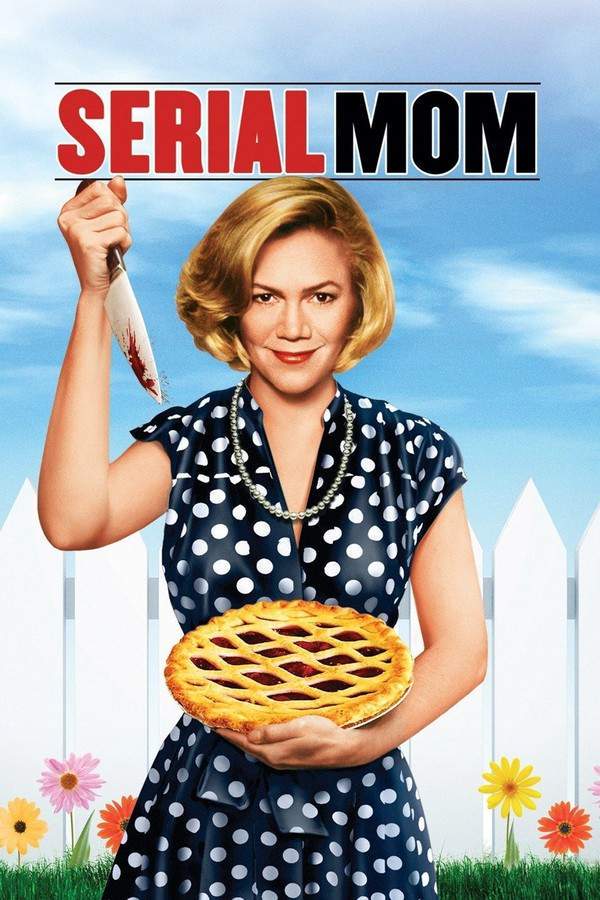
Beverly Sutphin appears to be an unassuming, quiet member of an upper‑middle‑class family living in Towson, Maryland, sharing a home with her dentist husband, Eugene, and their teenage children, Misty and Chip. Beneath the veneer of normalcy, she leads a chilling secret life as a serial killer who targets people for the smallest perceived slights. The film follows a chilling contrast between a homestyle exterior and a ruthless, calculating inner world.
One morning, two detectives, Pike and Gracey, question the Sutphins about a vulgar telephone harassment case aimed at their neighbor, Dottie Hinkle. The detectives’ visit eventually reveals Beverly as the culprit, a murderous streak that began after Dottie took a coveted parking space. The truth is laid bare with unsettling casualness, highlighting Beverly’s knack for turning everyday grievances into deadly conclusions.
Later that day, Beverly’s violence erupts again when she drives over Chip’s math teacher, Mr. Stubbins, with her car after he condemns Chip’s fascination with horror films during a PTA meeting. The attack is swift and shocking, underscoring how ordinary settings become scenes of murder in Beverly’s world. In another domestic ripple, Misty is left crestfallen when her crush, Carl, stands her up. Beverly spots Carl at a swap meet with another girl and responds with cold premeditation, fatally stabbing him with a fire poker.
At home, Eugene uncovers disturbing serial‑killer memorabilia beneath the couple’s mattress, including audio recordings from Ted Bundy in the week of his execution. The discovery frames the dinner table as a stage for dread, especially when Chip shares Scotty’s suspicions about Beverly. Beverly’s departure from the table signals a deeper fracture in the family’s sense of safety, and the Skeletal trail of Beverly’s so‑called benevolence grows more tangled as they fear she may target Scotty next. Instead, she turns her attention to Ralph and Betty Sterner, a couple who had asked Eugene to treat a toothache—an event that becomes another brutal confrontation. Betty is stabbed with scissors, and Ralph is crushed by an air conditioner, a cruel reminder that Beverly’s violence has no boundaries.
As the family and police converge on Scotty’s house, they find him exposed to a lurid voyeurism—masturbating to a porn film—an image that compounds the sense of moral panic surrounding Beverly. The investigation shifts to a broader public arena when police pursue Beverly to a church, where she is named the prime suspect. The service erupts into chaos when Beverly sneezes, allowing her to slip away in the commotion. She hides at the video store where Chip works, and a confrontational moment with Mrs. Jenson—who accuses him of not rewinding tapes—adds a sharp, petty note to the mounting tension.
Beverly follows Mrs. Jenson home and murders her with a leg of lamb while she watches a movie, an act witnessed by Scotty nearby. Beverly’s pursuit then leads to a heavy metal bar, where she sets Scotty on fire during a raucous concert. The Sutphins arrive just as Beverly is taken into custody, ending this violent chapter with another gnawing question about a family’s complicity in tragedy.
The trial that follows becomes a media circus, with Beverly’s defense—or lack thereof—dominated by her own manipulative prowess. Her attempt to defend herself shakes the courtroom as she systematically discredits witnesses by exposing their vices or by sowing doubt about their testimonies. The only witness who actually saw her commit a crime, Luann Hodges, is intoxicated and thus unreliable. The proceedings are further unsettled by the bizarre taunt of a television‑movie angle, as Suzanne Somers appears in the courtroom, cast as Beverly in a TV film, injecting a surreal meta‑dimension into a high‑stakes case.
Beverly is ultimately acquitted of all charges. Her contempt for juror #8—specifically for wearing white shoes after Labor Day—becomes a strange, chilling emblem of her worldview. She targets the juror at a payphone alcove, fatally striking her with the receiver, while Somers’s attempt at a posed photograph triggers an explosive outburst. The juror’s body is subsequently discovered, and Beverly’s knowing, quiet acknowledgment to Somers seals the opaque victory she secures.
A postscript reveals that Beverly Sutphin refused to cooperate with the making of this film, leaving a lingering sense of media‑fueled myth and a community upheaved by its own complicity and fear.
-Weddings 3-217Q5-3vv857qg.jpg)








 Weddings-wUgJ8s7K_G2Obg.jpg)