Plot Explained Spoilers guaranteed!
Plot Explained

Browse by genre

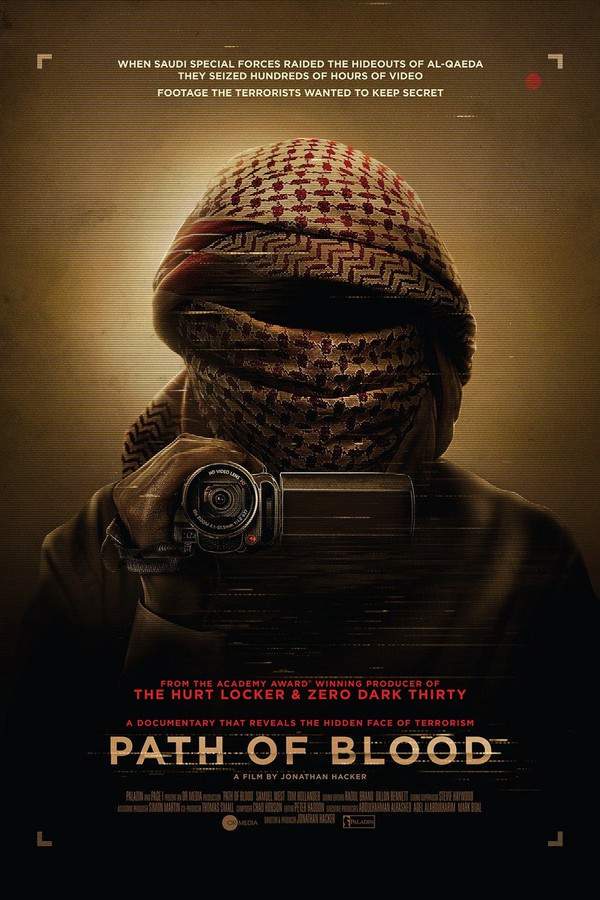
Path of Blood (2018) movie poster

Plot Summary

Path of Blood (2018) Plot Summary Explained

Release, runtime and language
2018 · 92 min · English
Echo score 75
Loading streaming availability…
Directed by
Jonathan Hacker
Starring
Tom Hollander, Paul Marshall Johnson Jr., Samuel West

This documentary offers a disturbing look into the mindset of young people drawn into extremist ideologies. Through exclusive footage from Saudi security services, the film portrays the descent into violence of those brainwashed by idealism and a thirst for adventure. The subjects plot to overthrow the Saudi government, and the documentary reveals the brutal tactics employed when their plans fall apart. It's a powerful and often shocking cinematic experience that explores the complexities of Islamist terrorism and attempts to humanize the individuals involved.

On this page (6)
  1. 1 Where to watch
  2. 2 What happens: full plot
  3. 3 Plot questions answered
  4. 4 Movie threads
  5. 5 Movies like Path of Blood
  6. 6 Every angle
Loading streaming availability…

Full plot summary · contains spoilers

What Happens in Path of Blood: Full Plot Summary

The whole story of Path of Blood (2018) explained, from the opening scene to the final frame: every key event, every twist and what it all adds up to. Read it as a quick recap before the sequel, to check a scene you missed, or to finally understand what really happened.

The story begins in 2001, amidst the devastation and rubble of Tora Bora. It is here that Osama bin Laden issues a critical directive to his most senior lieutenants, commanding them to return to their ancestral homeland of Saudi Arabia. Their objective is clear and ambitious: to spark a violent revolution and seize control of the Land of the Two Holy Mosques. By conquering this strategic territory, Al Qaeda aimed to establish a vast, worldwide Muslim empire capable of confronting the West in a global conflict and emerging victorious.

The campaign officially ignited with the May 2003 Riyadh compound bombings, a series of attacks that caught Saudi society completely off guard. However, the government's reaction was swift and decisive. The stoic security chief, Prince Muhammad bin Nayef, took command of the situation, relentlessly deploying the full firepower and resources of the Saudi state to track, locate, and eliminate the terrorists. As the conflict escalated, Al Qaeda revealed they had many more plans in reserve, forcing both the militants and the government to ratchet up the level of violence in a brutal cycle of warfare.

Throughout this long and bloody struggle, intelligence services managed to capture hundreds of tapes recorded by Al Qaeda’s own foot soldiers. This film utilizes that raw material, alongside rare CSI footage captured by police to document the aftermath of the carnage, to provide a startling account of the conflict. Narrated by Samuel West, the documentary chronicles the daring—and ultimately suicidal—mission of AQAP (Al Qaeda in the Arabian Peninsula) as they attempted to topple the House of Saud and dismantle the authority of the MOI (Ministry of Interior).

Last updated: October 11, 2026 at 16:42

Was this helpful?

Plot questions answered

Path of Blood Plot Explained: Your Questions Answered

The questions people ask most about Path of Blood (2018): what happens in the confusing scenes, why the characters do what they do, the twists, hidden details and what the ending means. Each answer contains spoilers.

Q1

Why did Osama bin Laden order his lieutenants back to Saudi Arabia after Tora Bora?

In 2001, Osama bin Laden gathered his senior lieutenants in the rubble of Tora Bora and issued a directive for them to return to his ancestral homeland. Their objective was to ignite a violent revolution that would overthrow the House of Saud and capture the Land of the Two Holy Mosques. From that strategic base, Al Qaeda intended to build a worldwide Muslim empire capable of confronting and defeating the West. This single order set the entire campaign that Path of Blood chronicles in motion.

Foreshadowing: The directive issued at Tora Bora is the origin point for every attack the documentary later examines, including the 2003 Riyadh bombings.

  • bin laden
  • tora bora
  • directive
  • revolution
  • house of saud
  • al qaeda leadership
Q2

What was Al Qaeda's ultimate objective in Saudi Arabia and why did the mission fail?

Al Qaeda aimed to conquer Saudi Arabia as a strategic launchpad for a global Muslim empire that would take on the West. Their mission collapsed because the relentless pressure of the Saudi security apparatus, led by Prince Muhammad bin Nayef, systematically tracked and eliminated the militants, dismantling their clandestine networks. Path of Blood frames this as the moment when ideological ambition far outpaced operational capability, turning what was meant to be a revolution into a grinding, fatal defeat.

Foreshadowing: The grand ambition stated at Tora Bora is set up to be in direct contrast with the attritional warfare the film eventually reveals.

  • al qaeda
  • objective
  • worldwide muslim empire
  • revolution
  • mission failure
Q3

How did Prince Muhammad bin Nayef become central to the Saudi counterterrorism campaign?

After the May 2003 Riyadh compound bombings, Prince Muhammad bin Nayef took command of the response as the security chief of the Ministry of Interior. He relentlessly focused the full resources of the Saudi state on hunting the terrorists, becoming the driving force behind the entire counterterrorism operation. His stoic, methodical leadership is portrayed in Path of Blood as the central reason the militants' revolution never gained lasting traction inside the kingdom.

Foreshadowing: His initial deployment of state resources sets the tone for the escalatory violence the rest of the film documents.

  • prince muhammad bin nayef
  • counterterrorism
  • ministry of interior
  • security chief
Q4

Why were the 2003 Riyadh compound bombings such a shock to Saudi society?

The May 2003 Riyadh compound bombings were Al Qaeda's opening coordinated attacks on Saudi soil and caught the kingdom completely off guard. Residential compounds filled with foreign workers were never expected to become frontline targets of a domestic insurgency. The shock forced Saudi society to confront the reality that returning militants had spent years building a clandestine network capable of striking deep inside the country, a revelation that reshaped every major security decision that followed in Path of Blood.

Foreshadowing: Al Qaeda's quiet infiltration between 2001 and 2003 had been building toward exactly this kind of high-profile urban strike.

  • riyadh bombings
  • 2003
  • residential compounds
  • surprise attack
  • infiltration
Q5

Why did the conflict escalate into a brutal cycle of violence?

As Saudi security forces closed in on Al Qaeda operatives, the militants responded with new attacks to prove they still had capacity and resolve. Each wave of bombings forced the state to escalate its response in turn, deploying harsher tactics and more resources. Path of Blood shows how this ratcheting dynamic turned what began as a bid for revolution into a grinding attritional war that consumed the kingdom for years.

Foreshadowing: Al Qaeda's claim that they had 'many more plans in reserve' foreshadows the retaliatory attacks the militants unleash once they come under pressure.

  • escalation
  • cycle of violence
  • retaliation
  • saudi security forces
  • al qaeda attacks
Q6

Where did the hundreds of Al Qaeda tapes shown in the documentary come from?

Throughout the long campaign in Saudi Arabia, Al Qaeda's own foot soldiers recorded hundreds of tapes documenting their operations from the inside. These recordings captured the militants' own perspective of the conflict, offering an unprecedented first-hand view of their planning, safehouses, and tactics. Path of Blood uses this captured material as its visual backbone, giving viewers an unfiltered look at how the insurgency actually functioned on a daily basis.

Foreshadowing: The militants' habit of self-documentation ultimately produced the very evidence that would later be used to expose their networks.

  • al qaeda tapes
  • internal footage
  • foot soldiers
  • raw material
  • self-documentation
Q7

How did Saudi intelligence manage to seize so much of Al Qaeda's internal footage?

Saudi intelligence services captured hundreds of tapes that Al Qaeda foot soldiers had recorded during the war, often through raids on militant hideouts or during the arrest of operatives. The seized archive gave authorities an insider's record of AQAP's networks, safehouse locations, and operational methods. In Path of Blood, this material allows the documentary to reconstruct the militants' daring but ultimately suicidal mission without relying on outside reconstruction or commentary.

Foreshadowing: The militants' attempts to record their own mission created a documentary trail that intelligence services eventually turned against them.

  • intelligence services
  • seized footage
  • raids
  • militant hideouts
  • archive
Q8

What is AQAP and why does the documentary focus on this faction?

AQAP stands for Al Qaeda in the Arabian Peninsula, the branch of Al Qaeda that actually carried out the campaign to topple the House of Saud. This faction is the central focus of Path of Blood because it was the operational arm that infiltrated Saudi Arabia, launched the 2003 Riyadh bombings, and waged the prolonged insurgency against the Ministry of Interior. The documentary treats AQAP as the specific organization whose daring-and-suicidal mission drove the entire conflict.

Foreshadowing: AQAP's regional identity explains why the insurgency targeted Saudi Arabia specifically rather than another country.

  • aqap
  • al qaeda arabian peninsula
  • faction
  • insurgency
  • house of saud
Q9

Why is the Al Qaeda campaign ultimately described as a 'suicide mission'?

Al Qaeda's attempt to overthrow the Saudi government is described as suicidal because the militants were systematically outmatched by the security forces led by Prince Muhammad bin Nayef. The relentless pressure from the state crushed the insurgents' networks, eliminated their senior lieutenants, and dismantled their capacity for coordinated operations. Path of Blood concludes that the militants' grand ambition of a worldwide Muslim empire collapsed under the weight of their own overreach against a far more powerful state.

Foreshadowing: bin Laden's initial order at Tora Bora already implied a fight the militants could not realistically win against the full Saudi state apparatus.

  • suicidal mission
  • overreach
  • saudi security
  • collapse
  • al qaeda defeat
Q10

What role does police CSI footage play in telling the story of the conflict?

Path of Blood incorporates rare CSI footage recorded by police forensic teams to document the aftermath of bombings and shootings across Saudi Arabia. These recordings capture the brutal reality of the carnage in clinical, unflinching detail, providing a stark counterpoint to the ideological fervor shown in the militants' own tapes. Together, the two source materials allow the documentary to present both sides of the war, the attackers' zeal and the victims' bodies, without resorting to sensationalism.

Foreshadowing: The aftermath footage foreshadows just how devastating each successful Al Qaeda attack was before security forces could fully respond.

  • csi footage
  • forensic evidence
  • aftermath
  • police recordings
  • carnage

Movie threads

More Movies Like Path of Blood, by Mood & Story

Curated lists built around what makes Path of Blood tick: the same mood, the same kind of story or the same emotional payoff. Each list explains why these movies belong together.

Found footage documentaries about extremism like Path of Blood

Watching ideology curdle into violence through the perpetrators' own recordings. Movies like Path of Blood that pull viewers into the terrifying world of radicalization through raw, captured footage. If you are searching for similar found footage documentaries about terrorism, extremism, and the inner workings of militant cells, this collection gathers films that let history speak for itself through haunting, real recordings.

  • found footage
  • radicalization
  • disturbing
  • real recordings
  • ideological
  • raw
  • Tone: dark, grim, chilling
  • Pacing: steady, observational, chronological
Why these movies?

The story pattern: These stories unfold chronologically through real, often handheld recordings that begin with recruitment, bonding rituals, and political sermons, then follow the group as plans take shape and violence arrives. The narrative builds around the slow erosion of idealism into operational brutality, with the camera present at planning meetings, safe houses, and finally at the bloody aftermath when the authorities close in. There is no clean third-act rescue, only a portrait of how ideology metastasizes until it consumes its believers.

Why they belong together: They share the same raw documentary grammar: footage the filmmakers did not shoot themselves, militants on camera before catastrophe, and an unflinching refusal to cut away from the brutal consequences of their choices. The steady pacing, dark tone, and heavy emotional weight all come from the same source — the audience is being asked to witness something that actually happened, not to be entertained by it.

Bleak terrorism and political violence documentaries like Path of Blood

Heavy, unflinching portraits of terrorism and the violent cycles it creates. If you liked Path of Blood and want more documentaries and heavy dramas that explore terrorism, insurgency, and political violence, this thread gathers similar bleak films. Expect movies that follow real events and real operatives, with dark tones, steady pacing, and endings that refuse to offer hope. Perfect for viewers searching for unflinching looks at extremism and its consequences.

  • bleak
  • terrorism
  • political violence
  • gritty
  • somber
  • disturbing
  • Tone: dark, bleak, somber, oppressive
  • Pacing: steady, methodical, chronological
Why these movies?

The story pattern: Stories in this thread tend to follow the lifecycle of an insurgency or terrorist campaign from its ideological origins, through its tactical escalation, to its eventual suppression. Characters are introduced with enough humanity to make their violence feel personal rather than abstract, and the state actors responding to them are rarely portrayed as clean heroes. The arcs end bleak because the films refuse to pretend that anyone truly wins these cycles, only that one side outlasts the other.

Why they belong together: They are united by tone and emotional texture: dark, somber, oppressive atmospheres; steady pacing that lets atrocities accumulate; high intensity carried by graphic, disturbing footage; and heavy emotional weight that lingers after the credits. The shared topic of terrorism, extremism, or political violence gives the thread its thematic spine, but it is the uncompromising bleakness that makes them feel like one family of films.

If you liked this

Movies Like Path of Blood

Similar movies to Path of Blood: the same genre, themes or kind of story. Each one comes with its own plot summary, timeline and ending explained.

Browse all movie summaries

Every angle

Path of Blood (2018) Explained: Plot, Timeline & Characters

Everything about Path of Blood in one place: what happens in the plot summary, the timeline in chronological order, the characters and meaning and a spoiler-free summary. What's After the Movie adds the cast, box office and post-credit scenes.

Coming soon on iOS and Android

The Plot Explained Movie Summary App

Plot summaries, endings explained and timelines on your phone. Catch up on any movie in minutes, save your favorites and never miss a twist again.

Be the first to know when we launch. Your email stays private, always.

Learn more about the app