Plot Explained Spoilers guaranteed!
Plot Explained

Browse by genre

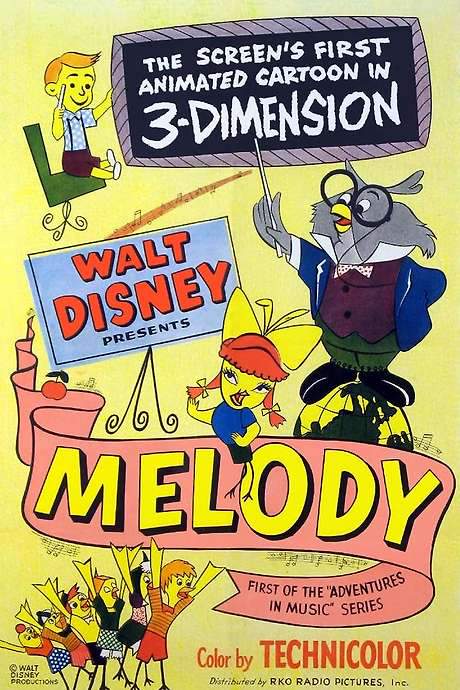
Melody (1953) movie poster

Timeline

Melody (1953) Timeline Explained – Every Event in Order

Release, runtime and language
1953 · 10 mins · English
Directed by
Ward Kimball, Charles August Nichols
Starring
Bill Thompson, Harry Stanton

The screen’s first 3‑D animated cartoon follows an owl teaching a flock of birds about melody, noting that singing fills nature and even human speech. It links life stages to songs—alphabet chant, “Here Comes the Bride,” “The Old Gray Mare”—and lists themes like love, sailing, trains, the West and motherhood, while joking we never sing about brains.

On this page (5)
  1. 1 Events in order (14)
  2. 2 Timeline questions answered
  3. 3 Movie threads
  4. 4 Movies like Melody
  5. 5 Every angle

14 events in order · contains spoilers

Melody Timeline: Events in Chronological Order

Every key event of Melody (1953) in order, scene by scene, with when and where it takes place. Use it to untangle flashbacks, time jumps and parallel storylines, to refresh your memory before the sequel or to find the exact scene you are thinking of.

  1. Lesson kickoff and demonstration

    Professor Owl begins the lesson by instructing his class of birds on how melodies are formed. He demonstrates on a small piano, showing how notes become a tune. The class watches and prepares to explore melodies in their world.

    Where
    Professor Owl's classroom
  2. Birds venture into nature to find melodies

    The birds take to the skies in search of natural sounds that form melodies. They listen to wind, water, and rustling leaves, shaping their understanding of music. The moment emphasizes that music can be found all around them.

    Where
    Outdoors
  3. Chorus captures nature's sounds

    The chorus sings about the sounds of nature, including 'The Bird and the Cricket and the Willow Tree'. The scene links musical ideas to the living world and reinforces the lesson's theme. Professor Owl reminds the class of the harmony between creatures and song.

    Where
    Nature setting
  4. Only birds and humans can sing

    Professor Owl notes a key idea: only birds and humans have the capacity to sing. The observation sets a boundary for the musical exploration and invites the class to reflect on their own voices. It underscores the special role of singing in human culture.

    Where
    Lecture hall
  5. Birth depicted with Rock-a-bye Baby

    The lesson illustrates birth through the lullaby 'Rock-a-bye Baby'. A gentle melody accompanies the first stage of life, introducing how music marks a major life event. The simple tune acts as the seed for later musical growth.

    Where
    Animated sequence
  6. School journey with The Alphabet Song

    The next sequence uses 'The Alphabet Song' to represent schooling. It follows a child's path from early learning to literacy, tying education to a familiar tune. The moment shows how melodies map life milestones.

    Where
    Animated sequence
  7. College years with Far Above Cayuga's Waters

    As life advances, the tune 'Far Above Cayuga's Waters' stands for college years. The melody underscores intellectual growth, friendship, and the pursuit of knowledge. The sequence links higher education to a traditional college anthem.

    Where
    Animated sequence
  8. Courtship with Drink to Me Only with Thine Eyes

    The film uses 'Drink to Me Only with Thine Eyes' to symbolize courtship and romantic beginnings. The melody accompanies courtship rituals and early love, flowing with lighthearted scenes. It emphasizes music's role in human relationships.

    Where
    Animated sequence
  9. Wedding moment with Here Comes the Bride

    The wedding moment brings 'Here Comes the Bride (and there goes the groom)' to the forefront. The tune marks the formal union and the next life chapter. The sequence ties song to celebration and social ceremony.

    Where
    Animated sequence
  10. Later life songs: Home, Birthday, and more

    The montage covers later life with 'Home! Sweet Home!' and 'Happy Birthday to You'. The melodies signal home, family, and personal milestones, blending nostalgia with celebration. The sequence continues to map time through familiar refrains.

    Where
    Animated sequence
  11. Aging reflections with Silver Threads, The Old Gray Mare, and more

    Older years are represented by 'Silver Threads Among the Gold' and 'The Old Gray Mare'. These tunes evoke memory and the passing of time. The songs connect aging to shared musical heritage and sentiment.

    Where
    Animated sequence
  12. Farewell and reminiscence with Auld Lang Syne and Oh, Dem Golden Slippers

    The sequence moves toward reminiscence with 'Auld Lang Syne' and ends with 'Oh, Dem Golden Slippers'. The tunes reflect friendship, reminiscence, and joyful retirement. Music acts as a bridge between past and present.

    Where
    Animated sequence
  13. From simple tune to symphony

    The cartoon demonstrates how a simple melody can be expanded into a symphony. An elaborate version of the opening tune expands harmonies and structure, illustrating the growth of musical ideas. The transformation emphasizes creativity and orchestration within the lesson.

    Where
    Animated sequence
  14. Return of the willow-tune and final reprise

    The film ends with a reprise of 'The Bird and the Cricket and the Willow Tree'. The final notes echo the opening lesson, bringing the exploration full circle. The closing moment ties together the journey from observation to musical synthesis.

    Where
    Animated sequence

Last updated: February 24, 2026 at 10:06

Was this helpful?

Timeline questions answered

Melody Timeline Explained: Your Questions Answered

When does it happen, and why in that order? The questions people ask about the chronology of Melody (1953): time jumps, flashbacks, cause and effect between scenes and the correct order of events, each answered with spoilers.

Q1

Why does Professor Owl say only birds and humans can sing?

Professor Owl establishes early in the lesson that only birds and humans possess the capacity to sing, distinguishing them from other creatures like crickets that merely produce sounds. This sets up the educational framework for the entire film, positioning birds as natural musicians who can teach humans about melody while also acknowledging humans as the only other beings with true singing ability.

  • professor owl
  • birds
  • singing
  • teaching lesson
Q2

Why were specific songs chosen to represent each life stage?

The film carefully selects recognizable traditional songs to map the human life cycle: 'Rock-a-bye Baby' for birth, 'The Alphabet Song' for school, 'Far Above Cayuga's Waters' for college, 'Drink to Me Only with Thine Eyes' for courtship, 'Here Comes the Bride' for wedding, and nostalgic tunes like 'Silver Threads Among the Gold' and 'Auld Lang Syne' for aging. Each melody carries cultural resonance that instantly communicates the emotional tone of that life stage.

  • life stages
  • songs
  • traditional melodies
  • life cycle
Q3

Why does the film end with a reprise of the opening tune?

The cyclical structure, returning to 'The Bird and the Cricket and the Willow Tree', reinforces the film's central theme that melody is eternal and connected to nature. By circling back to the exact tune from the opening, the film demonstrates that music creates an endless loop connecting all stages of life and the natural world.

  • cyclical ending
  • reprise
  • musical theme
  • nature harmony
Q4

How was 3-D animation used in Melody?

Melody was the screen's first 3-D animated cartoon, utilizing stereoscopic camera techniques to give depth to the animated characters and settings. The film employs parallax between foreground and background elements, making Professor Owl and his bird students appear to exist in a three-dimensional space rather than flat planes.

  • 3-d animation
  • stereoscopic
  • technical innovation
  • first 3-d cartoon
Q5

What is the connection between nature sounds and human music in the film?

The film illustrates that melody surrounds us in nature, the wind, water, rustling leaves, birds, and crickets all contribute to an ambient musical landscape. Professor Owl teaches that human singing and speech evolved from these natural sounds, bridging the gap between the musical world and everyday communication.

  • nature sounds
  • human music
  • environment
  • harmony
Q6

What does the symphony sequence demonstrate about melody?

The sequence showing a simple tune expanding into a full symphony illustrates how musical ideas can grow and develop through variation and orchestration. The original melody played on Professor Owl's small piano becomes elaborated with new harmonies, instruments, and arrangements, proving that even the simplest musical idea contains the seed for grander expression.

  • symphony
  • melody development
  • orchestration
  • musical variation
Q7

Why does the wedding scene use 'Here Comes the Bride'?

The film uses 'Here Comes the Bride (and there goes the groom)' to mark the formal union and transition into married life. The comedic addition of 'there goes the groom' adds gentle humor while the familiar tune immediately signals the celebration and social ceremony of marriage within the life cycle progression.

  • wedding
  • here comes the bride
  • marriage
  • celebration
Q8

What is the significance of 'The Bird and the Cricket and the Willow Tree'?

This refrain appears multiple times throughout the film as a thematic anchor, representing the harmony between creatures and their environment. The willow tree specifically evokes themes of nature, tranquility, and the passing of time, while the bird and cricket represent the musical voices of the natural world that Professor Owl celebrates.

  • willow tree
  • nature harmony
  • refrain
  • thematic anchor

Movie threads

More Movies Like Melody, by Mood & Story

Curated lists built around what makes Melody tick: the same mood, the same kind of story or the same emotional payoff. Each list explains why these movies belong together.

Gentle animated adventures like Melody

Whimsical educational journeys that make learning feel like a magical discovery. Discover more movies like Melody that blend educational content with whimsical animation. These gentle films use playful storytelling to explore concepts like music, nature, and life lessons in ways that feel like magical discoveries.

  • educational
  • whimsical
  • gentle
  • soothing
  • charming
  • playful
  • Tone: whimsical, educational, gentle
  • Pacing: steady, flowing
Why these movies?

The story pattern: Stories in this thread typically follow a gentle educational journey, often guided by a wise character who introduces concepts through exploration and discovery. The narrative flows smoothly from introduction to revelation without conflict or high stakes, focusing instead on wonder and understanding.

Why they belong together: These films share a focus on gentle education through charming animation, creating a soothing viewing experience that combines learning with whimsy. They maintain low intensity while delivering meaningful content through engaging visual storytelling.
Musical life journey stories like Melody

Stories where music becomes the soundtrack to life's meaningful moments. Find more movies like Melody that explore life's stages through musical storytelling. If you enjoyed seeing how songs mark life's milestones, these films offer similar melodic journeys through meaningful life transitions.

  • melodic
  • nostalgic
  • uplifting
  • sentimental
  • reflective
  • hopeful
  • Tone: nostalgic, uplifting, sentimental
  • Pacing: steady, reflective
Why these movies?

The story pattern: Narratives in this thread follow characters through different life stages, with musical elements serving as markers for growth and change. The stories often progress linearly, using songs to highlight emotional milestones and transitions.

Why they belong together: These films share a focus on music as a storytelling device that accompanies life's journey. They use melodic elements to explore universal experiences and emotional transitions, creating a nostalgic and uplifting viewing experience.

If you liked this

Movies Like Melody

Similar movies to Melody: the same genre, themes or kind of story. Each one comes with its own plot summary, timeline and ending explained.

Browse all movie summaries

Every angle

Melody (1953) Explained: Plot, Timeline & Characters

Everything about Melody in one place: what happens in the plot summary, the timeline in chronological order, the characters and meaning and a spoiler-free summary. What's After the Movie adds the cast, box office and post-credit scenes.

Coming soon on iOS and Android

The Plot Explained Movie Summary App

Plot summaries, endings explained and timelines on your phone. Catch up on any movie in minutes, save your favorites and never miss a twist again.

Be the first to know when we launch. Your email stays private, always.

Learn more about the app