











Plot Explained Spoilers guaranteed!
Plot Explained

Browse by genre

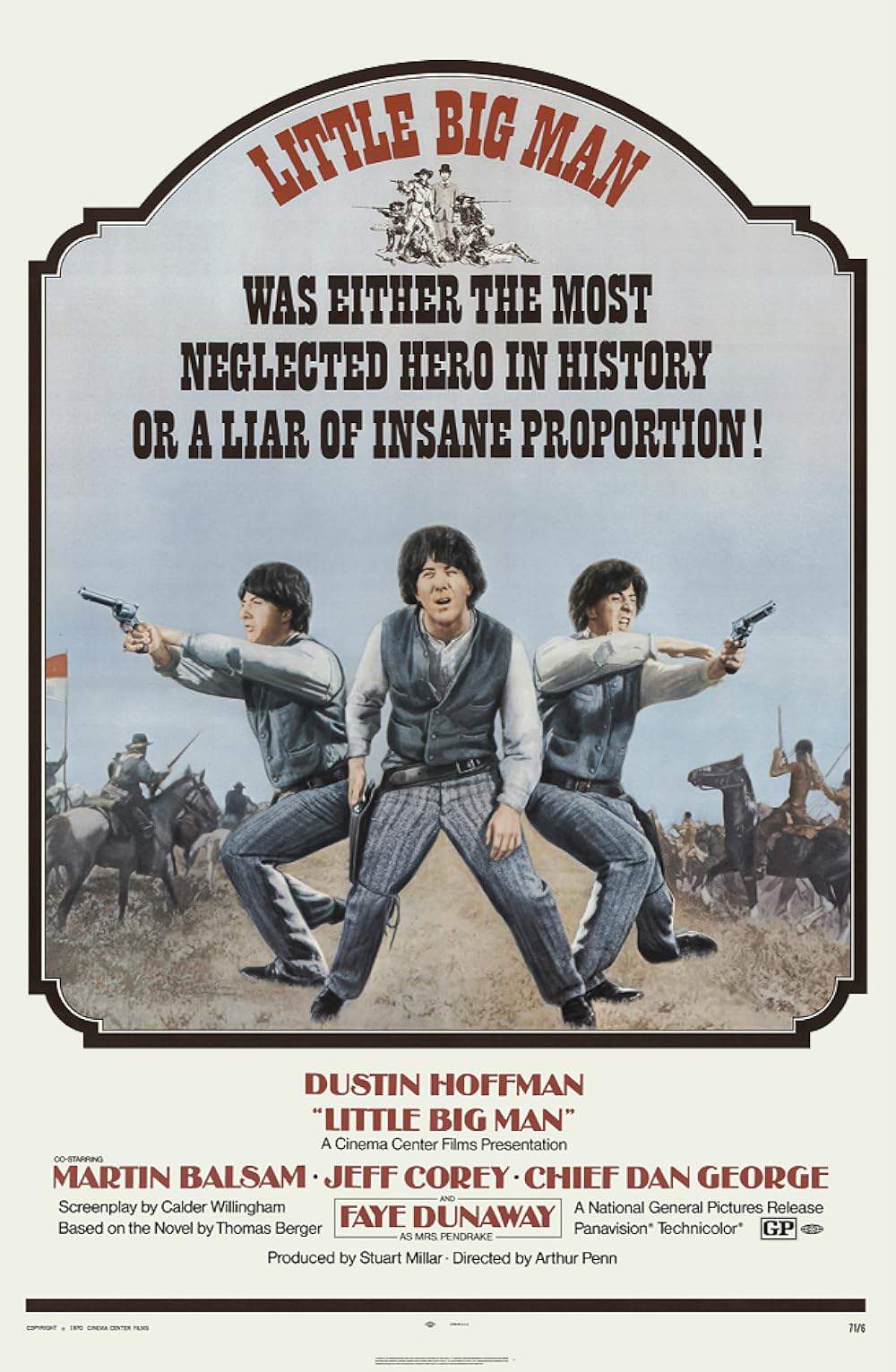
Little Big Man (1970) movie poster

Timeline

Little Big Man (1970) Timeline Explained – Every Event in Order

Release, runtime and language
1970 · 139 min · English
Directed by
Arthur Penn
Starring
Faye Dunaway, Dustin Hoffman

Two brothers find themselves lost and struggling to survive in the harsh, unforgiving landscape of the American West. Facing dwindling resources and the relentless desert heat, they must overcome both the dangers of the environment and their own personal conflicts to find a way back to civilization. Their journey tests their resilience and reveals the true depths of their bond.

On this page (7)
  1. 1 Where to watch
  2. 2 Events in order (15)
  3. 3 Timeline questions answered
  4. 4 The book behind the movie
  5. 5 Movie threads
  6. 6 Movies like Little Big Man
  7. 7 Every angle

Where to watch

Where to Watch Little Big Man (1970)

Where can you watch Little Big Man? Stream, rent or buy it in the US, including on fuboTV, MGM Plus and Philo: current JustWatch availability with up-to-date prices.

Streaming availability powered by JustWatch

15 events in order · contains spoilers

Little Big Man Timeline: Events in Chronological Order

Every key event of Little Big Man (1970) in order, scene by scene, with when and where it takes place. Use it to untangle flashbacks, time jumps and parallel storylines, to refresh your memory before the sequel or to find the exact scene you are thinking of.

  1. Jack's Birth

    Jack Crabb is born, marking the beginning of a life filled with remarkable events. Growing up, he becomes part of significant historical moments, which shape his unique perspective.

    When
    1849
  2. Pioneer Family Massacre

    In 1859, when Jack is just ten years old, he witnesses the tragic massacre of his family by the Pawnee tribe. This horrifying event forces him and his sister, Caroline, into a life they never anticipated.

    When
    1859
  3. Adoption by the Cheyenne

    After his family's massacre, Jack is taken to a Cheyenne village by a warrior. He is adopted by Old Lodge Skins, the tribal leader, and begins a new life within the Cheyenne community.

    When
    1859-1865
    Where
    Cheyenne Village
  4. Rivalry and Bonding

    During his time among the Cheyenne, Jack unintentionally creates a rivalry with Younger Bear. However, when Jack risks his life to save Younger Bear from a Pawnee warrior, they become friends.

    When
    1865
    Where
    Cheyenne Village
  5. Capture by U.S. Cavalry

    At 16 years old, Jack is captured by U.S. cavalry troops during a skirmish. In an effort to survive, he renounces his Native American roots, leading him to a different fate.

    When
    1865
  6. Life with Reverend Pendrake

    After his capture, Jack is placed under the care of Reverend Silas Pendrake and his wife, Louise. Struggling with Louise's conflicting nature, Jack ultimately leaves their home after a shocking discovery.

    When
    1865-1866
  7. Apprenticeship and Reunion

    Jack becomes an apprentice to a snake-oil salesman named Merriweather. Their fraudulent schemes lead to a joyful reunion with Caroline, who seeks to transform Jack into a gunslinger.

    When
    1866
  8. Meeting Wild Bill Hickok

    Jack encounters the legendary Wild Bill Hickok in a saloon. Inspired by him, Jack gains valuable skills, but a fatal confrontation forces him to reevaluate his life choices as a gunslinger.

    When
    1866
    Where
    Saloon
  9. Marriage and Store Ownership

    Jack eventually marries a Swedish woman named Olga and partners in a general store. Unfortunately, their plans collapse due to deceit, leading to further struggles in their lives.

    When
    Late 1860s
  10. Olga's Capture

    While seeking a new beginning in the West, tragedy strikes when their stagecoach is attacked by Cheyenne warriors. Jack's frantic search for Olga draws him back to his Native connections.

    When
    Late 1860s
  11. Becoming a Muleskinner

    Jack joins Custer's 7th Cavalry as a muleskinner, desperately seeking information about his wife. His experiences during military confrontations lead him to witness horrific acts against the Cheyenne.

    When
    Early 1870s
    Where
    Military Camp
  12. Tragedy Strikes Again

    Jack faces unimaginable loss when a violent assault on a Cheyenne camp results in the deaths of Sunshine, the woman he loves, and their child. This loss indicates the weight of his increasingly complex past.

    When
    Winter 1876
  13. Battle of Little Bighorn

    On June 25, 1876, Jack witnesses the infamous Battle of Little Bighorn. The events unfold around him, encapsulating a moment of both personal and collective tragedy, as he confronts loyalty and vengeance.

    When
    June 25, 1876
    Where
    Little Bighorn
  14. Descent into Despair

    Following the war, Jack's life deteriorates as he spirals into alcoholism while in Deadwood, South Dakota. A brief encounter with Wild Bill Hickok gives him a moment of clarity before more losses strike.

    When
    Late 19th century
    Where
    Deadwood, South Dakota
  15. Reflections in Old Age

    In 1970, now 121 years old, Jack reflects on his extraordinary life in a conversation with a historian. His tales reveal a deep sense of loss and longing, as memories of a bygone era surround him.

    When
    1970

Last updated: November 03, 2024 at 13:14

Was this helpful?

Timeline questions answered

Little Big Man Timeline Explained: Your Questions Answered

When does it happen, and why in that order? The questions people ask about the chronology of Little Big Man (1970): time jumps, flashbacks, cause and effect between scenes and the correct order of events, each answered with spoilers.

Q1

Why does Jack get the nickname Little Big Man?

Jack earns the nickname "Little Big Man" when he, a small white boy adopted by the Cheyenne, saves Younger Bear from a Pawnee warrior despite his small stature. His act of bravery impresses the tribe, who see his courage as greater than his physical size would suggest.

Foreshadowing: Earlier in the village, Jack unintentionally creates a rivalry with Younger Bear, making their eventual bond more meaningful.

  • nickname
  • cheyenne
  • younger bear
  • bravery
  • adopted
Q2

Why does Jack renounce his Cheyenne ties when captured at age 16?

When Jack is captured by U.S. cavalry troopers during a skirmish, he renounces his Native American identity to survive. As a 16-year-old considered a minor, he chooses to adopt white society's ways rather than face potentially fatal consequences as a perceived enemy.

Foreshadowing: This choice marks the first of many times Jack will switch between his two cultural identities throughout his life.

  • capture
  • cavalry
  • survival
  • identity
  • cheyenne
Q3

Why does Jack leave the Pendrake home?

Jack leaves Reverend Silas Pendrake and his wife Louise after discovering Louise in a compromising situation with another man. This revelation shatters his perception of her piety and forces him to leave, ending his time in that household.

Foreshadowing: Louise's conflicting nature, appearing pious yet harboring hidden desires, has been established throughout Jack's stay with them.

  • louise pendrake
  • reverend
  • departure
  • discovery
Q4

Why does Jack turn against his fellow soldiers during a confrontation with the Cheyenne?

Jack turns against the U.S. cavalry after witnessing unspeakable atrocities committed against the Cheyenne by the soldiers. Overwhelmed by rage and moral horror at the violence, he acts against his own comrades in that moment.

Foreshadowing: Jack's growing connections to the Cheyenne through Sunshine have already begun to shift his loyalties.

  • atrocities
  • cheyenne
  • cavalry
  • loyalty
  • moral conflict
Q5

What happens to Sunshine and Jack's child?

During a surprise winter assault by Custer on a Cheyenne encampment, Sunshine and Jack's child are killed. This tragic loss propels Jack toward seeking revenge against Custer.

Foreshadowing: Jack's earlier decision to protect Sunshine during a military confrontation established his deep connection to her tribe.

  • sunshine
  • death
  • child
  • custer
  • revenge
Q6

Why does Jack hesitate when he has the chance to kill Custer?

Jack hesitates to kill Custer when faced with the opportunity because of the complex web of loyalty, resentment, and historical significance surrounding their relationship. Despite wanting revenge for Sunshine's death, Jack cannot bring himself to act in that moment.

Foreshadowing: Jack's earlier service as a muleskinner under Custer created an ambiguous relationship between them.

  • custer
  • hesitation
  • revenge
  • loyalty
  • battle of little bighorn
Q7

What is Jack's role in the Battle of Little Bighorn?

Jack witnesses the Battle of Little Bighorn on June 25, 1876, from inside the conflict. After hesitating to kill Custer, he watches Custer's arrogance lead to the defeat of his troops. Jack later guides Custer into a trap, witnessing the tragic irony of fate unfold.

Foreshadowing: Jack's earlier decision to guide Custer's troops stems from his complex mix of resentment and lingering loyalty.

  • little bighorn
  • custer
  • indians
  • battle
  • witness
Q8

Why does Younger Bear save Jack at the end of the movie?

Younger Bear saves Jack because of the bond they formed in childhood when Jack rescued him from a Pawnee warrior. Despite their rivalry and the years of conflict between their peoples, the friendship and loyalty established in their youth remains powerful.

Foreshadowing: Their childhood bond, forged when Jack saved Younger Bear, has been foreshadowed throughout the film as a defining relationship.

  • younger bear
  • rescue
  • childhood bond
  • loyalty
  • friendship
Q9

What does Old Lodge Skins mean when he says "It is a good day to die"?

Old Lodge Skins, waiting for death with dignity, declares it is a good day to die, a traditional Cheyenne expression about facing death without fear. When rain falls upon them afterward, it symbolizes hope and renewal, suggesting life continues even in the face of inevitable death.

Foreshadowing: This moment represents the culmination of Old Lodge Skins' philosophical acceptance of his fate developed throughout the film.

  • old lodge skins
  • death
  • dignity
  • cheyenne
  • philosophy
Q10

Why does Jack return to the Cheyenne after Olga is captured?

Jack returns to the Cheyenne desperately searching for Olga after she is captured during a stagecoach attack. Old Lodge Skins welcomes him back with joy, and Jack joins Custer's 7th Cavalry as a muleskinner specifically to learn Olga's fate while maintaining his connection to both worlds.

Foreshadowing: Jack's earlier marriage to Olga established his deep personal stake in the situation.

  • olga
  • capture
  • return
  • cheyenne
  • search
Q11

Why does Jack become the Soda Pop Kid and then abandon gunslinger life?

Jack's sister Caroline transforms him into a gunslinger called the Soda Pop Kid, hoping to give him a new identity. However, after witnessing Wild Bill Hickok kill a man in self-defense, Jack loses his appetite for the violent lifestyle and eventually abandons it.

Foreshadowing: Jack's meeting with Hickok establishes the mentor-student relationship that shapes his understanding of violence.

  • soda pop kid
  • gunslinger
  • hickok
  • violence
  • abandon
Q12

How is Jack Crabb still alive in 1970 to tell his story?

Jack Crabb claims to have been born in 1849, making him 121 years old in 1970 when he recounts his extraordinary life to a historian. His longevity is presented as remarkable and somewhat miraculous, framing the entire narrative as a historical account from the last surviving witness to these events.

Foreshadowing: The film's opening establishes Jack as an ancient man reflecting on a lifetime of historical significance.

  • age
  • 121
  • historian
  • survival
  • old age
Q13

What is Jack's relationship with Native American vs white society throughout his life?

Jack constantly shifts between Native American and white society throughout his life, reflecting his identity crisis as a white man raised by the Cheyenne. He struggles to fully belong to either world, moving between them depending on circumstances, sometimes by choice, sometimes by force. This creates his unique perspective as a cultural bridge.

Foreshadowing: His childhood adoption by Old Lodge Skins established this fundamental duality from the very beginning.

  • identity
  • cheyenne
  • white society
  • culture
  • bridge
Q14

Why does Jack guide Custer into a trap at the end?

Jack guides Custer into a trap as an act of calculated revenge and irony, using his knowledge of the terrain and Custer's arrogance against him. This decision reflects Jack's complicated position, benefiting from white society yet resentful of its treatment of Native peoples.

Foreshadowing: Jack's earlier witnessing of atrocities and loss of Sunshine has built toward this moment of betrayal.

  • custer
  • trap
  • revenge
  • guide
  • betrayal

Movie threads

More Movies Like Little Big Man, by Mood & Story

Curated lists built around what makes Little Big Man tick: the same mood, the same kind of story or the same emotional payoff. Each list explains why these movies belong together.

Epic personal history movies like Little Big Man

Vast historical events witnessed through the intimate, tragic life of a single character. If you liked the way Little Big Man wove a century of American history into one man's life story, you'll appreciate these movies. This collection features similar historical fiction and epic dramas where vast events are experienced through a single, intimate, and often tragic personal journey.

  • epic
  • melancholic
  • reflective
  • tragic
  • historical
  • nostalgic
  • Tone: melancholic, reflective, tragic
  • Pacing: variable, epic scope
Why these movies?

The story pattern: The narrative often spans decades or a lifetime, using a framing device like an elderly narrator recounting their past. The plot intertwines the protagonist's personal milestones with iconic historical moments, creating a reflective and often melancholic exploration of memory, loss, and the passage of time.

Why they belong together: They share a focus on the individual's perspective within history, a melancholic tone born from witnessing irreversible change, and a complex narrative structure that jumps across time to build a poignant, cumulative emotional impact.

Bittersweet survival stories similar to Little Big Man

Stories of enduring survival that are tinged with the profound loss of a way of life. For viewers who appreciated the heavy emotional weight and bittersweet ending of Little Big Man. These movies explore themes of cultural conflict, identity, and survival, where characters endure great trials but are left to grapple with the tragic cost of their endurance.

  • bittersweet
  • grim
  • tragic
  • grief
  • survival
  • cultural conflict
  • Tone: bittersweet, grim, tragic
  • Pacing: variable, character-driven
Why these movies?

The story pattern: The central journey is one of physical and spiritual survival against overwhelming odds, often involving cultural displacement or conflict. The narrative builds towards a conclusion where the protagonist's resilience is affirmed, but the emotional resonance is profoundly bittersweet, emphasizing what was destroyed in the process.

Why they belong together: They are united by a heavy emotional weight, a focus on the cost of survival, a bittersweet or tragic ending feel, and themes of cultural erosion, identity crisis, and grief amidst a backdrop of historical inevitability.

If you liked this

Movies Like Little Big Man

Similar movies to Little Big Man: the same genre, themes or kind of story. Each one comes with its own plot summary, timeline and ending explained.

Browse all movie summaries

Every angle

Little Big Man (1970) Explained: Plot, Timeline & Characters

Everything about Little Big Man in one place: what happens in the plot summary, the timeline in chronological order, the characters and meaning and a spoiler-free summary. What's After the Movie adds the cast, box office and post-credit scenes.

Coming soon on iOS and Android

The Plot Explained Movie Summary App

Plot summaries, endings explained and timelines on your phone. Catch up on any movie in minutes, save your favorites and never miss a twist again.

Be the first to know when we launch. Your email stays private, always.

Learn more about the app