Plot Explained Spoilers guaranteed!
Plot Explained

Browse by genre

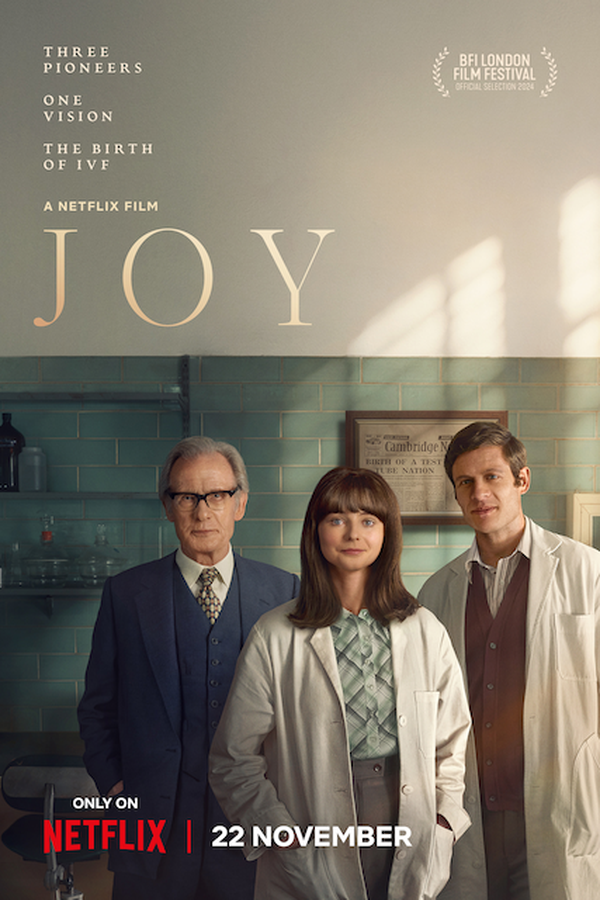
Joy (2024) movie poster

Ending Explained

Joy (2024) Ending Explained – Final Scene & Meaning

Release, runtime and language
2024 · 1 h 55 m · English
Echo score 70
Starring
Thomasin McKenzie, Bill Nighy, Robert Wilfort, Rish Shah, James Norton, Joanna Scanlan

This film portrays three pioneering individuals – a nurse, a scientist, and a surgeon – who face considerable resistance from the church, government, media, and medical community as they strive to achieve the birth of the world's first baby conceived through in vitro fertilization, Louise Joy Brown.

On this page (6)
  1. 1 What happens at the end
  2. 2 Final events in order
  3. 3 Ending questions answered
  4. 4 Movie threads
  5. 5 Movies like Joy
  6. 6 Every angle

Ending explained · contains spoilers

What Happens at the End of Joy?

How Joy (2024) ends, what the final scene means, which earlier moments set it up and how to read the ending if the film leaves it open. The full ending explained, with every spoiler.

Throughout the film, we see how Jean Purdy, a dedicated nurse and embryologist, was the unsung hero behind the first successful in vitro fertilization. Despite the immense scientific achievement and the joy of witnessing Louise Brown’s birth, Jean and her colleagues faced relentless societal opposition, media vilification, and institutional rejection. Their work was groundbreaking, laying the foundation for reproductive medicine, but it also involved personal sacrifices, especially for Jean, who struggled with her faith, personal doubts, and her role as a woman in a male-dominated field.

The climax arrives with the birth of Louise Brown, a milestone that embodies ten years of perseverance, suffering, and hope. Robert Edwards named the baby “Joy,” symbolizing the triumph of hope and life. However, the ending underscores a powerful truth: Jean’s contribution was essential but historically overlooked. She spent years fighting for recognition, only to die of cancer at 39 without seeing her name celebrated alongside her male colleagues. Her story highlights how women’s contributions have often been erased by systemic sexism, a theme still relevant today.

Ultimately, the film’s ending is both a celebration and a reminder—that scientific breakthroughs often come at great personal cost, especially for women whose roles are undervalued or forgotten. Louise Brown’s birth stands as a testament to what relentless dedication and unrecognized sacrifices can achieve, inspiring us to acknowledge the invisible yet vital work of those like Jean Purdy who push the boundaries of science and humanity. The story leaves us with a reflection on the ongoing struggle for recognition and the importance of honoring those who truly make history.Joy is not just about a medical breakthrough; it’s about recognizing the often unseen women whose resilience changes the world.**

Last updated: June 25, 2025 at 09:03

Was this helpful?

The last 4 events

How Joy Ends: The Final Events in Order

The last events of Joy (2024) in chronological order, the run-up to the ending explained above. The complete timeline has all 15 events, scene by scene.

Open the full timeline
  1. Lab shutdown and personal setbacks

    A year after the setbacks, Robert shuts down the research lab and Jean contends with the consequences. Arun, a lab assistant who later becomes a new father, reconnects with Jean as she returns to the issue. The period marks a pause but not the end of the dream.

    When
    1974
    Where
    Cambridge, UK
  2. Funeral and renewed resolve

    Jean's mother dies, and Patrick Steptoe and Matron Muriel attend the funeral. This personal loss fuels Jean's renewed determination to resume the research. The team sees a path forward as Jean re-engages with the project.

    When
    1974-1975
    Where
    Cambridge, UK
  3. First successful test tube baby

    Following Jean's idea to monitor each woman's natural cycle, the team resumes work and, in the summer of 1978, produces the first 'test tube baby' named Joy. The achievement cements their place in medical history and confirms the viability of IVF.

    When
    Summer 1978
    Where
    Cambridge, UK
  4. Jean Purdy’s death and Nobel recognition

    The epilogue reveals that Jean Purdy dies of cancer at age 39. It also notes that Robert Edwards is awarded the Nobel Prize in 2010 for their shared IVF work, commemorating Purdy's essential role. The legacy of the trio endures in medical history.

Ending questions answered

Joy Ending: Your Questions Answered

The questions people ask most about the ending of Joy (2024): what the final scene means, how the twist works, what happens to each character and how to read the ending. Each answer contains spoilers.

Q1

Why was Jean Purdy overlooked in IVF history?

Jean Purdy was a nurse and embryologist who was essential to developing the IVF technique, yet her contributions were largely erased from historical accounts. The film shows that systemic sexism in the medical and scientific communities of the 1970s-80s undervalued women's work, preferring to credit the male researchers Robert Edwards and Patrick Steptoe. Jean died at 39 without ever seeing her name celebrated alongside her male colleagues.

  • jean purdy
  • ivf history
  • forgotten scientist
  • women in science
  • systemic sexism
Q2

What happens to Jean Purdy at the end of Joy?

Jean Purdy dies of cancer at age 39, never receiving formal recognition for her crucial role in achieving the world's first successful IVF birth. The film's epilogue reveals this tragic fate, showing that despite her groundbreaking work, she passed away before the scientific community acknowledged her contributions.

  • jean purdy death
  • jean purdy fate
  • ivf pioneer death
Q3

Why is the baby named Joy in the film?

Robert Edwards named the baby "Joy" to symbolize the triumph of hope and life that the successful IVF birth represented. The name reflects the emotional journey of the team who persisted through a decade of failure, opposition, and personal sacrifice to achieve this medical breakthrough.

  • louise brown named joy
  • ivf baby name
  • joy meaning
Q4

Does Jean Purdy ever receive recognition in the movie?

The film portrays Jean Purdy fighting for recognition throughout her life, but she dies before receiving it. The ending emphasizes that her contributions were historically overlooked, highlighting the broader issue of women's work being erased from scientific history.

  • jean purdy recognition
  • ivf credit
  • unsung hero
Q5

What is the message of Joy's ending?

The ending delivers a bittersweet message: scientific breakthroughs come at great personal cost, especially for women whose contributions are undervalued or forgotten. While Louise Brown's birth represents a triumphant medical achievement, Jean's story reminds viewers to recognize and honor the invisible yet vital work of those who truly make history.

  • joy ending meaning
  • film message
  • theme recognition
Q6

How does the film portray women's contributions to science?

The film directly addresses how women's contributions in science have often been erased by systemic sexism. Jean Purdy's story exemplifies this - her essential work as a nurse and embryologist was credited primarily to the male researchers, despite her being one of the pioneers who developed the IVF technique.

  • women scientists
  • gender bias science
  • jean purdy role
Q7

What is the significance of Louise Brown's birth in the story?

Louise Brown's birth represents the climax of the film and the culmination of ten years of perseverance, suffering, and hope. As the world's first baby conceived through IVF, her birth marks a revolutionary breakthrough in reproductive medicine that would eventually help millions of couples worldwide.

  • louise brown first ivf baby
  • ivf breakthrough
  • birth significance
Q8

Why is the ending of Joy considered bittersweet?

The ending is bittersweet because the joyful celebration of Louise Brown's birth is immediately tempered by the epilogue revealing Jean Purdy's early death and lack of recognition. The film achieves its scientific triumph but at tremendous personal cost to its female pioneer, creating a poignant mix of celebration and tragedy.

  • bittersweet ending
  • emotional ending
  • triumph tragedy

Movie threads

More Movies Like Joy, by Mood & Story

Curated lists built around what makes Joy tick: the same mood, the same kind of story or the same emotional payoff. Each list explains why these movies belong together.

Against-the-odds scientific pioneer stories like Joy

True stories of innovators battling institutions to change the world. If you enjoyed Joy, explore more movies about real-life innovators battling institutional resistance. These films share a determined, hopeful tone and a steady pace, chronicling the personal sacrifices behind major scientific and medical breakthroughs.

  • determined
  • inspiring
  • against-the-odds
  • resilient
  • sober
  • contemplative
  • Tone: hopeful, determined
  • Pacing: steady, chronological
Why these movies?

The story pattern: Narratives in this thread follow a linear, goal-oriented path, often over many years. The central conflict pits a small group of dedicated pioneers against powerful, skeptical institutions like the government, church, or medical establishment. The journey is marked by repeated setbacks and small victories that build towards a historic achievement.

Why they belong together: These movies are grouped by their shared focus on scientific perseverance, a hopeful core tone despite adversity, and a narrative structure that celebrates real-world innovation. They deliver an inspiring yet sobering experience centered on conviction and resilience.

Bittersweet historical triumph movies like Joy

Stories where great achievements are shadowed by poignant personal cost. Find more films like Joy that explore major historical achievements with a bittersweet conclusion. These stories balance hope and hardship, ending with a mix of triumph and poignant personal cost, perfect for viewers who appreciate emotionally complex dramas.

  • bittersweet
  • poignant
  • inspiring
  • sobering
  • contemplative
  • historic
  • Tone: bittersweet, hopeful
  • Pacing: steady, character-driven
Why these movies?

The story pattern: The narrative pattern follows a difficult struggle towards a clear, historically significant goal. The climax delivers on the promised success, but the resolution or epilogue reveals the deep personal price paid for that victory. This structure emphasizes that progress often comes with sacrifice, leaving the audience with a mix of admiration and sadness.

Why they belong together: Movies in this thread share a specific emotional arc: a medium emotional weight, a primarily hopeful tone during the journey, and a conclusively bittersweet ending feel. This creates a uniquely resonant experience that acknowledges the complexity of real-world accomplishments.

If you liked this

Movies Like Joy

Similar movies to Joy: the same genre, themes or kind of story. Each one comes with its own plot summary, timeline and ending explained.

Browse all movie summaries

Every angle

Joy (2024) Explained: Plot, Ending, Timeline & Characters

Everything about Joy in one place: what happens in the plot summary, the timeline in chronological order, the characters and meaning, the ending explained and a spoiler-free summary. What's After the Movie adds the cast, box office and post-credit scenes.

Coming soon on iOS and Android

The Plot Explained Movie Summary App

Plot summaries, endings explained and timelines on your phone. Catch up on any movie in minutes, save your favorites and never miss a twist again.

Be the first to know when we launch. Your email stays private, always.

Learn more about the app