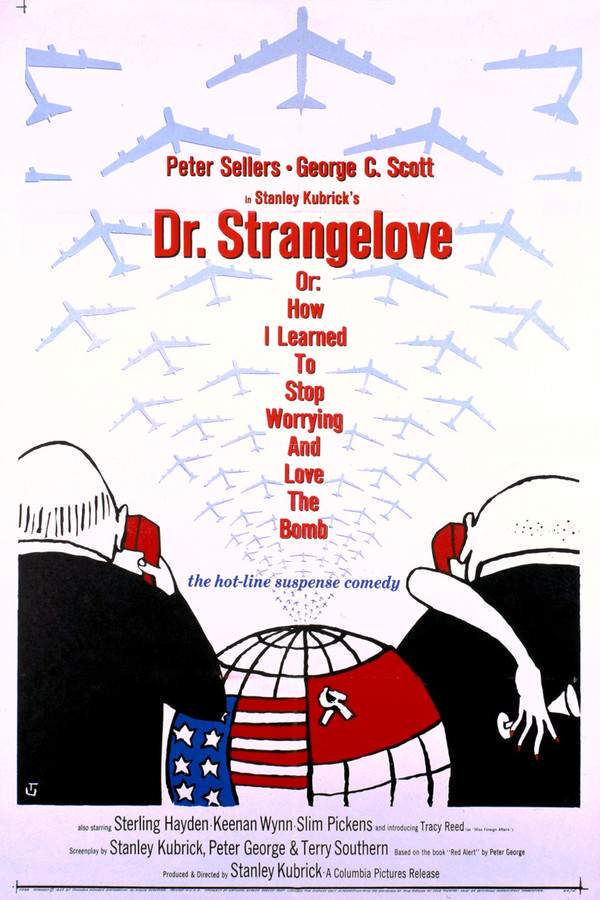
Year: 1964
Runtime: 95 min
Language: English
Director: Stanley Kubrick
Budget: $1.8M
A rash Air Force commander triggers a catastrophic sequence of events, initiating a surprise nuclear attack on Russia. As the world descends into chaos, the U.S. President convenes an emergency war room meeting. Alongside his advisors, he seeks the help of the peculiar Dr. Strangelove and the Soviet premier in a desperate attempt to avert global destruction and find a solution to the unfolding crisis.
Find where to stream, rent, or buy Dr. Strangelove or: How I Learned to Stop Worrying and Love the Bomb (1964) in the US with current JustWatch availability, up-to-date pricing, and platform listings for subscription, rental, and digital purchase options.
Warning: spoilers below!
Haven’t seen Dr. Strangelove or: How I Learned to Stop Worrying and Love the Bomb yet? This summary contains major spoilers. Bookmark the page, watch the movie, and come back for the full breakdown. If you're ready, scroll on and relive the story!
Explore the full timeline and setting of Dr. Strangelove or: How I Learned to Stop Worrying and Love the Bomb (1964). Follow every major event in chronological order and see how the environment shapes the story, characters, and dramatic tension.
Last updated: January 18, 2025 at 14:33
Meet the key characters of Dr. Strangelove or: How I Learned to Stop Worrying and Love the Bomb (1964), with detailed profiles, motivations, and roles in the plot. Understand their emotional journeys and what they reveal about the film’s deeper themes.
Last updated: January 18, 2025 at 14:33
Explore the central themes of Dr. Strangelove or: How I Learned to Stop Worrying and Love the Bomb (1964), from psychological, social, and emotional dimensions to philosophical messages. Understand what the film is really saying beneath the surface.
Last updated: January 18, 2025 at 14:33
Browse frequently asked questions about Dr. Strangelove or: How I Learned to Stop Worrying and Love the Bomb (1964) focused on characters, relationships, themes, symbols, setting, and story context. This movie info FAQ gives spoiler-aware explanations for character arcs, world details, and thematic interpretation so readers can better understand what the film is really about.
The movie takes place primarily at Burpelson U.S. Air Force Base in the continental USA and the Pentagon in Washington D.C., with the Soviet Union serving as the target of the nuclear attack. These settings represent the nerve centers of U.S. military command and the geopolitical adversary of the Cold War.
The film is set during the height of the Cold War, a period defined by intense geopolitical tension between the United States and the Soviet Union. This era was marked by nuclear arms races, mutual assured destruction fears, and widespread public anxiety about potential nuclear annihilation.
The film uses nuclear war as its central theme to explore the absurdity and terrifying reality of global conflict. It depicts how military and political leaders become detached from the human consequences of their decisions, showing the paranoia and willingness to precipitate disaster that defined Cold War-era governance.
The film saturates its grave subject matter with absurd situations and ridiculous logic employed by characters in crisis. This satire reveals how far rational thought can stretch when those in power face impending doom, highlighting the gross ineptitude and irrational decision-making that the filmmakers saw in Cold War military leadership.
President Merkin Muffley is portrayed as a calm but bewildered leader attempting to maintain control as events spiral into chaos. His rational approach contrasts sharply with the extreme warmongering of his military advisors, making him a figure of reason trapped in a situation beyond his control, symbolizing the helplessness of leadership during a nuclear crisis.
General Buck Turgidson embodies a hawkish, aggressive military mentality, constantly advocating for preemptive strikes against the Soviet Union. His cold willingness to accept massive civilian casualties starkly illustrates the disconnect between military strategy and human life, serving as a sharp critique of warmongering attitudes prevalent during the Cold War.
Dr. Strangelove is a former Nazi scientist and eccentric military strategist who appears as a consultant in the war room. His bizarre behavior, including alien hand syndrome, and his absurdist proposals for post-apocalyptic survival add surreal humor to the film while representing the chaotic blending of scientific intelligence with moral bankruptcy.
Dr. Strangelove is both a thriller and a comedy, blending life-or-death nuclear stakes with dark absurdist humor. The film maintains a consistently dark tone about total annihilation while undercutting it with satirical caricatures of military and political figures, creating a uniquely dark comedy that uses laughter to commentary on serious geopolitical issues.
The Doomsday Machine is a Soviet automated nuclear retaliation system referenced in the film. Its existence becomes crucial to the plot as characters realize that once triggered, it cannot be stopped, making any nuclear attack on the Soviet Union an unstoppable act of mutual destruction.
Discover curated groups of movies connected by mood, themes, and story style. Browse collections built around emotion, atmosphere, and narrative focus to easily find films that match what you feel like watching right now.
Stories where flawed institutions and human folly lead to absurd, catastrophic outcomes.If you enjoyed the sharp political and military satire of Dr. Strangelove, explore more movies like it that showcase bureaucratic failure and institutional absurdity. These similar comedies and thrillers use dark humor to critique systems on the brink of self-destruction, offering a cathartic and cynically funny viewing experience.
The narrative typically follows a chain reaction of failures within a large, powerful system. A single, often minor, flaw or a misguided individual triggers a series of events that exposes the inherent absurdity and danger of the entire structure. The plot accelerates towards an inevitable, often bleak, conclusion that serves as the ultimate punchline to the satire.
Movies are grouped here for their shared foundation in satire aimed at large-scale systems, their darkly comedic tone that finds humor in dire circumstances, and their focus on how human error and institutional design flaws can lead to disaster. They share a cynical but hilarious perspective on power.
High-stakes thrillers where a catastrophic event races towards an unavoidable climax.Fans of the frantic, high-anxiety pacing and bleak ending of Dr. Strangelove will find more movies like it in this collection of doomsday countdowns. These similar thrillers and dramas feature fast-paced narratives about impending global catastrophe, capturing a feeling of chaotic inevitability and high tension.
The narrative structure is defined by a ticking clock. A catastrophic event is set in motion, and the plot follows the frantic, often futile, attempts to stop it. The story jumps between different locations and characters—from leaders in command centers to individuals on the front lines—creating a mosaic of mounting panic that accelerates towards a devastating, frequently bleak, conclusion.
These movies are grouped by their shared high-stakes premise, their fast and chaotic pacing that creates a palpable sense of urgency, and their emotionally heavy, often bleak, tone. The core experience is one of riding a wave of anxiety towards an inevitable, world-altering event.
Don't stop at just watching - explore Dr. Strangelove or: How I Learned to Stop Worrying and Love the Bomb in full detail. From the complete plot summary and scene-by-scene timeline to character breakdowns, thematic analysis, and a deep dive into the ending - every page helps you truly understand what Dr. Strangelove or: How I Learned to Stop Worrying and Love the Bomb is all about. Plus, discover what's next after the movie.
Read a complete plot summary of Dr. Strangelove or: How I Learned to Stop Worrying and Love the Bomb, including all key story points, character arcs, and turning points. This in-depth recap is ideal for understanding the narrative structure or reviewing what happened in the movie.
Track the full timeline of Dr. Strangelove or: How I Learned to Stop Worrying and Love the Bomb with every major event arranged chronologically. Perfect for decoding non-linear storytelling, flashbacks, or parallel narratives with a clear scene-by-scene breakdown.
Get a quick, spoiler-free overview of Dr. Strangelove or: How I Learned to Stop Worrying and Love the Bomb that covers the main plot points and key details without revealing any major twists or spoilers. Perfect for those who want to know what to expect before diving in.
Visit What's After the Movie to explore more about Dr. Strangelove or: How I Learned to Stop Worrying and Love the Bomb: box office results, cast and crew info, production details, post-credit scenes, and external links - all in one place for movie fans and researchers.
Discover movies like Dr. Strangelove or: How I Learned to Stop Worrying and Love the Bomb that share similar genres, themes, and storytelling elements. Whether you’re drawn to the atmosphere, character arcs, or plot structure, these curated recommendations will help you explore more films you’ll love.
Dr. Strangelove or: How I Learned to Stop Worrying and Love the Bomb (1964) Plot Summary & Movie Recap
Dr. Strangelove or: How I Learned to Stop Worrying and Love the Bomb (1964) Scene-by-Scene Movie Timeline
Dr. Strangelove or: How I Learned to Stop Worrying and Love the Bomb (1964) Spoiler-Free Summary & Key Flow
Movies Like Dr. Strangelove or: How I Learned to Stop Worrying and Love the Bomb – Similar Titles You’ll Enjoy
Airplane! (1980) Detailed Story Recap
Catch-22 (1970) Complete Plot Breakdown
The Sum of All Fears (2002) Story Summary & Characters
Air Force One (1997) Complete Plot Breakdown
Fail-Safe (1964) Film Overview & Timeline
Fail Safe (2000) Movie Recap & Themes
Dr. Plonk (2007) Full Movie Breakdown
By Dawn’s Early Light (1990) Spoiler-Packed Plot Recap
Panic in the City (1968) Plot Summary & Ending Explained
Invasion, U.S.A. (1952) Spoiler-Packed Plot Recap
The Flying Missile (1950) Full Summary & Key Details
Dr. Goldfoot and the Girl Bombs (1966) Complete Plot Breakdown
Twilight’s Last Gleaming (1977) Detailed Story Recap
Rocket Attack U.S.A. (1960) Ending Explained & Film Insights
Atomic War Bride (1960) Spoiler-Packed Plot Recap