Plot Explained Spoilers guaranteed!
Plot Explained

Browse by genre

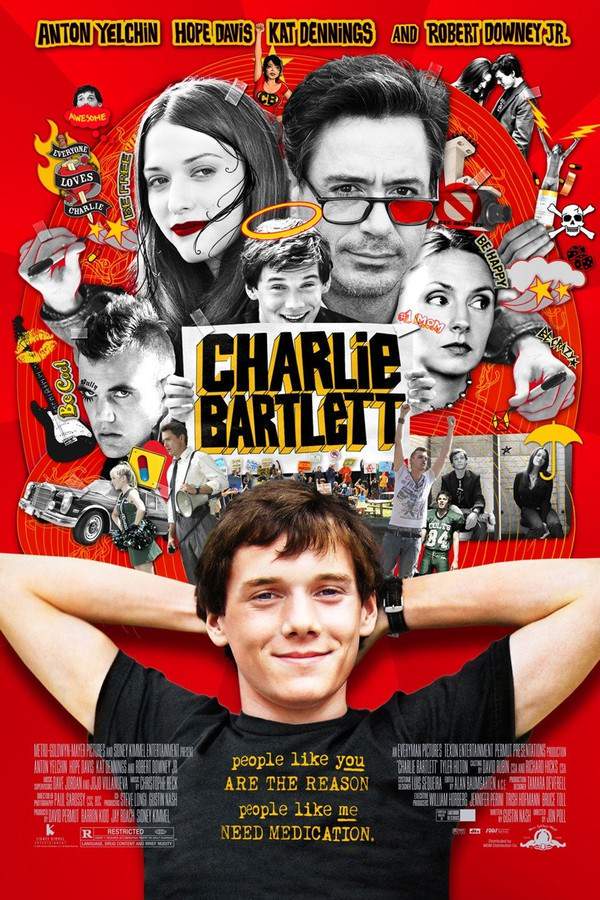
Charlie Bartlett (2008) movie poster

Plot Summary

Charlie Bartlett (2008) Plot Summary Explained

Release, runtime and language
2008 · 97 min · English
Directed by
Jon Poll
Starring
Robert Downey Jr., Anton Yelchin, Hope Davis
Budget
$12M

Expelled from one boarding school after another, Charlie Bartlett enrolls in public high school and unexpectedly becomes a confidant and mentor to his classmates. Sharing his unconventional wisdom and advice, he offers support and guidance to students struggling with various issues. Through his interactions, Charlie inspires positive change at Western Summit High, demonstrating that anyone can make a difference.

On this page (5)
  1. 1 Where to watch
  2. 2 What happens: full plot
  3. 3 Plot questions answered
  4. 4 Movie threads
  5. 5 Every angle

Where to watch

Where to Watch Charlie Bartlett (2008)

Where can you watch Charlie Bartlett? Stream, rent or buy it in the US, including on Hoopla, Kanopy and Fandango at Home Free: current JustWatch availability with up-to-date prices.

Streaming availability powered by JustWatch

Full plot summary · contains spoilers

What Happens in Charlie Bartlett: Full Plot Summary

The whole story of Charlie Bartlett (2008) explained, from the opening scene to the final frame: every key event, every twist and what it all adds up to. Read it as a quick recap before the sequel, to check a scene you missed, or to finally understand what really happened.

As the conflicted child of a devoted mother, Hope Davis, who battles her own emotional struggles, and a father in prison for financial crime, wealthy teenager Charlie Bartlett finds himself at a pivotal moment in his life. After being expelled from several prestigious private schools due to his reckless behavior, Charlie must face the tough realities of life by enrolling in a public school ruled by the jaded yet intelligent Principal Nathan Gardner, whose previous passion for teaching has faded, leaving him as a disillusioned administrator.

As Charlie steps into this new environment, he quickly learns that his natural charm and likability have turned him into an unexpected confidant among his peers. His rising popularity allows him to forge a bond with school bully Murphy Bivens, who becomes intrigued by Charlie's unconventional methods of offering advice and distributing medication in the boys' bathroom without concern for consequences.

However, Charlie's ascent into social prominence leads him to become romantically involved with Principal Gardner's rebellious daughter, Susan. Yet, the sense of belonging that Charlie craves is threatened when another student, Kip Crombwell, grappling with profound depression, attempts suicide by swallowing pills given to him by Charlie. This traumatic event forces Charlie to introspect and reconsider the weight of his decisions.

Through this period of reflection, Charlie befriends Kip and learns that he is passionately writing a play about the struggles of adolescence. Believing in the beneficial power of creative expression, Charlie suggests the idea to Principal Gardner, who, despite initial hesitation, chooses to support the endeavor when Kip expresses that it could aid in his recovery.

As Charlie becomes more invested in his role as a therapist and confidant, he makes the tough choice to stop selling drugs, opting instead to offer free therapy sessions, drawing upon his unique blend of compassion and street wisdom to help his fellow students tackle their own issues.

In a touching turn of events, Charlie's relationship with Susan takes a complicated turn when he arrives to pick her up for a date, only to be mistaken for a drug dealer by Principal Gardner. This misunderstanding leads to a confrontation where Charlie's pent-up frustration culminates in a punch directed at the embittered principal.

In the aftermath, as Charlie and Susan drive away, the pharmacy bag that once symbolized so much chaos now contains nothing more harmful than nicotine gum, highlighting Charlie's journey toward maturity and his commitment to wielding his influence in a positive way.

As the night progresses, the school lounge erupts into chaos when the police arrive and take Charlie away, sparking outrage among his peers. This disturbance prompts the administration to take severe action by dismissing Principal Gardner. Once released, Charlie visits Mr. Gardner at his home and discovers him in a vulnerable state, prompting a heated argument that ends with Charlie accidentally falling into a pool. This moment turns into a pivotal interaction, wherein Mr. Gardner, momentarily revitalized, rescues Charlie and engages in a heartfelt conversation about their intertwined struggles, including Charlie's tumultuous relationship with his father and Susan.

The resolution of this emotional exchange sees Mr. Gardner reclaiming his position as a teacher, while Charlie finds the courage to confront his absent father—an encounter he had long evaded. As the film concludes, Charlie takes a significant step toward self-discovery by applying for a summer internship at a distinguished psychiatric institute, signaling his growth and commitment to understanding himself and helping others.

Last updated: November 19, 2024 at 18:00

Was this helpful?

Plot questions answered

Charlie Bartlett Plot Explained: Your Questions Answered

The questions people ask most about Charlie Bartlett (2008): what happens in the confusing scenes, why the characters do what they do, the twists, hidden details and what the ending means. Each answer contains spoilers.

Q1

Why does Charlie decide to act as a therapist for his classmates?

Charlie becomes an unofficial therapist because he himself is a troubled teen seeking purpose and belonging. With his father in prison and his mother emotionally unavailable, Charlie finds identity in helping others. His natural charm and ability to listen make him popular, and he genuinely wants to help students who are struggling, though his methods are unconventional and sometimes harmful.

Foreshadowing: Early scenes show Charlie seeking approval and connection after being expelled from multiple schools, establishing his need to find a place where he belongs.

  • charlie bartlett
  • therapist
  • high school
  • popularity
  • motivation
Q2

Why does Kip attempt suicide after getting pills from Charlie?

Kip Crombwell is profoundly depressed and struggling with his issues, and he sees Charlie's pills as a solution to end his pain. While Charlie distributes medication thinking he's helping, Kip uses them for a suicide attempt. This tragedy forces Charlie to realize his actions have serious consequences beyond his intentions.

Foreshadowing: Charlie's casual distribution of medication in the bathroom establishes that he doesn't fully understand the risks of his actions.

  • kip crombwell
  • suicide attempt
  • depression
  • pills
  • consequences
Q3

Why does Charlie decide to stop selling medication to students?

After Kip's suicide attempt, Charlie realizes his well-intentioned actions have caused real harm. The traumatic event forces him to reflect on the responsibility that comes with his influence. He transitions from distributing pills to offering free therapy sessions, believing conversation and empathy are safer ways to help his peers.

Foreshadowing: Kip's suicide attempt directly follows Charlie's distribution of pills, making the cause-and-effect clear.

  • charlie bartlett
  • stop selling
  • medication
  • therapy
  • growth
Q4

Why does the school dismiss Principal Gardner after the police incident?

Principal Gardner is dismissed because the police arriving to take Charlie away causes chaos in the school lounge, and students react with outrage. The administration blames Gardner for failing to maintain order and for the broader situation involving drug distribution on campus. His previous disillusionment and failure to connect with students also factor into the decision.

Foreshadowing: Gardner's jaded attitude and detachment from students throughout the film establish his vulnerability to criticism.

  • principal gardner
  • dismissed
  • police
  • school
  • administration
Q5

Why does Charlie punch Principal Gardner?

Charlie punches Gardner because he believes the principal has misjudged him. When Gardner mistakes Charlie for a drug dealer during the date pickup, Charlie feels his genuine intentions have been completely misunderstood. His frustration builds from all the tension between them, and he lashes out physically rather than continuing to defend himself verbally.

Foreshadowing: Throughout the film, tension builds between Charlie and Gardner as they clash over Charlie's methods and influence at school.

  • charlie bartlett
  • principal gardner
  • punch
  • confrontation
  • frustration
Q6

Why does Charlie apply for a psychiatric internship at the end?

Charlie applies for a summer internship at a psychiatric institute because he wants to understand himself and help others in a legitimate way. After witnessing Kip's struggles and reflecting on his own family issues, Charlie decides to channel his desire to help people through proper mental health training rather than acting as an unlicensed therapist.

Foreshadowing: Charlie suggests therapy concepts and creative expression to help Kip, showing his genuine interest in mental health.

  • charlie bartlett
  • internship
  • psychiatric
  • mental health
  • growth
Q7

Why does Principal Gardner return to teaching?

Gardner returns to teaching after his emotional conversation with Charlie by the pool. During their heart-to-heart, Charlie shares his own struggles with his father and Susan, which reminds Gardner why he originally entered education. Charlie's honesty and vulnerability inspire Gardner to reconnect with his passion for teaching rather than remaining a disillusioned administrator.

Foreshadowing: Gardner's earlier flashback to his passion for teaching, combined with his initial hesitation about the play, hints at his desire to return to the classroom.

  • principal gardner
  • teacher
  • reform
  • passion
  • inspiration
Q8

Why does Charlie finally confront his absent father?

Charlie confronts his father because his journey of helping others and reflecting on his own issues gives him the courage to face his deepest wound: his father's absence due to imprisonment. By the end of the film, Charlie has grown enough to tackle this difficult confrontation instead of continuing to avoid it.

Foreshadowing: Charlie mentions his father throughout the film, establishing this unresolved issue as a central emotional thread.

  • charlie bartlett
  • father
  • confrontation
  • family
  • prison
Q9

What does the pharmacy bag contain at the end of the movie?

At the end, the pharmacy bag contains only nicotine gum instead of medication. This symbolizes Charlie's transformation from distributing pills to using something harmless. It represents his maturity and commitment to helping people in healthier ways, even if it means giving up his previous methods.

Foreshadowing: Earlier scenes show Charlie regularly carrying the pharmacy bag, establishing its significance to his identity.

  • pharmacy bag
  • nicotine gum
  • symbol
  • transformation
  • medication
Q10

Why does Susan Gardner get involved with Charlie?

Susan is described as rebellious and is the daughter of Principal Gardner, who is emotionally distant. She connects with Charlie because he genuinely listens to her and treats her with respect. Their shared experience of complicated family situations, her father's emotional absence and his parents' issues, creates a bond between them.

Foreshadowing: Early scenes show Susan's rebellious behavior and her father's failure to connect with her.

  • susan gardner
  • romance
  • relationship
  • dating
  • principal daughter
Q11

Why does Principal Gardner agree to let Kip's play be performed?

Gardner initially hesitates because he doubts the production's quality and fears complications. However, when Kip explains that the play could aid his recovery from depression, Gardner agrees. Charlie's belief in the therapeutic power of creative expression, plus Kip's evident passion, convinces Gardner to support the project.

Foreshadowing: Charlie befriends Kip after the suicide attempt and learns about his writing, establishing the foundation for this plotline.

  • kip play
  • creative expression
  • recovery
  • depression
  • drama
Q12

Why does school bully Murphy Bivens become interested in Charlie?

Murphy Bivens, the school bully, is intrigued by Charlie because he offers unconventional advice and methods that Murphy hasn't encountered before. Charlie's charm and confidence appeal to Murphy, who sees him as someone with real insight into handling problems, even if Charlie's solutions are questionable.

Foreshadowing: The timeline notes Murphy becoming attracted to Charlie's unconventional methods in the bathroom.

  • murphy bivens
  • bully
  • interest
  • popularity
  • advice
Q13

Why was Charlie expelled from so many private schools?

Charlie was expelled from multiple prestigious private schools due to his reckless behavior. The film establishes that his troubled home life, having a father in prison and a mother with emotional struggles, contributes to his acting out. His pattern of being expelled leads his mother to enroll him in public school as a last resort.

Foreshadowing: The opening establishes Charlie's troubled background and his mother's desperation to find him a school that will accept him.

  • charlie bartlett
  • expelled
  • private schools
  • behavior
  • expelled multiple times

Movie threads

More Movies Like Charlie Bartlett, by Mood & Story

Curated lists built around what makes Charlie Bartlett tick: the same mood, the same kind of story or the same emotional payoff. Each list explains why these movies belong together.

Movies with an unlikely teenage confidant like Charlie Bartlett

Outsider teens who become unexpected guides and healers for their peers. Discover movies like Charlie Bartlett where an outsider teen becomes a mentor. These similar coming-of-age stories feature charismatic leads who guide their peers, blending serious themes with character-driven drama and comedy.

  • coming-of-age
  • quirky
  • empathetic
  • redemptive
  • hopeful
  • confrontational
  • Tone: bittersweet, hopeful
  • Pacing: steady, character-driven
Why these movies?

The story pattern: These narratives typically follow an outsider or new student who uses their unique perspective or resources to become a source of advice and support for fellow students. The journey involves rising popularity, unforeseen consequences, and a final reckoning that leads to authentic personal growth and a redefined place in the community.

Why they belong together: Movies are grouped here for their shared focus on a specific character archetype: the teen who transforms from an outcast to a central, if controversial, figure by addressing the unspoken struggles of adolescence, all while navigating their own path to maturity.

Bittersweet and realistic high school movies like Charlie Bartlett

Teen stories that balance serious issues with hopeful, character-driven growth. If you liked the mix of serious themes and hopefulness in Charlie Bartlett, explore these grounded teen dramas. Find movies with similar emotional weight, tackling real issues faced by teenagers in a reflective and ultimately redeeming way.

  • reflective
  • hopeful
  • coming-of-age
  • empathetic
  • confrontational
  • redemptive
  • Tone: bittersweet, reflective
  • Pacing: steady
Why these movies?

The story pattern: The narrative pattern involves a high school setting where the central conflict arises from real-world issues like mental health, disillusionment, or social anxiety. The story avoids easy resolutions, instead focusing on incremental personal growth, the power of connection, and achieving a hard-won but authentic sense of hope by the end.

Why they belong together: These films are grouped together because they share a specific tonal balance: they confront dark or difficult themes relevant to teenagers but are ultimately defined by their empathy and a message of redemption, making the emotional journey impactful yet uplifting.

Every angle

Charlie Bartlett (2008) Explained: Plot, Timeline & Characters

Everything about Charlie Bartlett in one place: what happens in the plot summary, the timeline in chronological order, the characters and meaning and a spoiler-free summary. What's After the Movie adds the cast, box office and post-credit scenes.

Coming soon on iOS and Android

The Plot Explained Movie Summary App

Plot summaries, endings explained and timelines on your phone. Catch up on any movie in minutes, save your favorites and never miss a twist again.

Be the first to know when we launch. Your email stays private, always.

Learn more about the app