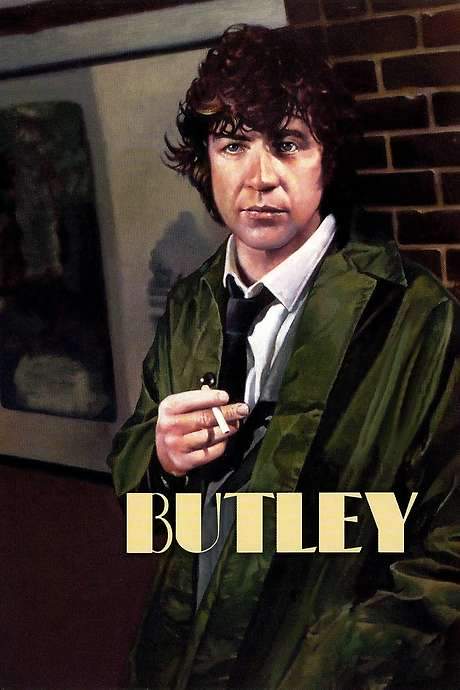
After his wife abandons him for another man and his lover walks out, middle‑aged English professor Ben Butley—once a renowned T.S. Eliot scholar—finds his world in disarray at Queen Mary’s College, London. With his protégé Joey, a gay instructor, also gone, Butley confronts solitary life with caustic wit, profanity and heavy drinking.
Find where to stream, rent, or buy Butley (1974) in the US with current JustWatch availability, up-to-date pricing, and platform listings for subscription, rental, and digital purchase options.
Warning: spoilers below!
Haven’t seen Butley yet? This summary contains major spoilers. Bookmark the page, watch the movie, and come back for the full breakdown. If you're ready, scroll on and relive the story!
Read the complete plot breakdown of Butley (1974), including all key story events, major twists, and the ending explained in detail. Discover what really happened, and what it all means.
Butley, Alan Bates is a literature professor and longtime T. S. Eliot scholar who has recently shifted some of his focus to Beatrix Potter. He is, on the surface, a cultivated man, yet he exists on a tightrope of self-destruction as a suicidal alcoholic who loses both his wife and his male lover on the same day. The film follows a few hours in his day, a darkly comic cascade of confrontations and collapses, most of them taking place within the cluttered walls of his university office, with a brief opening that shows him waking in the flat he shares with Joey and moving through the city—an urban ritual punctuated by Underground rides and lunchtime escapes to the pub. The pattern that emerges is not just a single crisis but a portrait of a man whose authority over others is matched only by his inability to control himself.
Joey Keyston, Richard O’Callaghan, is a former student who has become Butley’s assistant, a position that has grown complicated and intimate as Butley admits to having “groomed” him in a way that crosses professional boundaries. Their relationship, spoken of in bleak, sometimes abusive terms, becomes a central thread in the day’s unraveling. Joey’s tenure at the university is precarious, tied to Butley’s will and mood, and as the day progresses, Joey’s own loyalties and feelings begin to shift in ways that threaten both of their fates. The film builds this dynamic in tight, intimate scenes where dialogue often slips into sarcasm, control, and moments of stark vulnerability.
Reg Nuttall, Michael Byrne, is a colleague who circles the chaos with a mix of skepticism and weary tolerance. He becomes an unwitting catalyst in the day’s cascade when he articulates the sense that Butley is living through multiple divorces at once. As Reg puts it, Butley seems to be dividing his life into separations: from a wife who is no longer present, from Joey who has discovered he’s fallen for someone else (a fact Butley pretends not to hear), and from a new undergraduate that Butley has managed to lure away from her tutor, Edna. These revelations unfold through a string of encounters that reveal Butley’s talent for manipulation, his appetite for control, and his growing isolation. The tension between what Butley says and what his actions reveal grows with each scene, a deliberate pacing that lets the audience watch a mind fray in real time.
Edna Shaft, Jessica Tandy, appears as a younger undergraduate drawn into the orbit of Butley’s authority and charm. Her presence sharpens the sense that Butley’s influence is both seductive and corrosive, drawing people closer only to expose the fragility of their own choices. The office becomes a stage where the lines between teacher and mentor, predator and prey, blur in uneasy, unsettling ways. As the hours tick by, the atmosphere thickens with the weight of unspoken histories, unfulfilled promises, and the constant risk of an outburst that could shatter what little stability remains.
The day intensifies as Butley’s feigned normalcy collapses into a relentless barrage of insults and manipulation aimed at students and colleagues alike. The dialogue, sharp and merciless, traverses a spectrum of intellectual bravado, personal cruelty, and bitter self-satire. It culminates in a moment of violence when Reg, having previously turned away, finally interrupts the pattern with a punch that halts the escalating cruelty. Joey, who has shown a rare glimmer of compassion, gathers his belongings and moves to a new, smaller office that stands in the vacated space once occupied by Edna—an ending that signals a complete break from the man he has been serving.
The emotional weather of the film is brutal and unflinching, yet the comedy remains dark and sardonic, never fully releasing the tension that builds as each scene reveals another layer of Butley’s self-destruction. The relationship threads—between Butley and Joey, between Butley and Reg, and between Butley and Edna—are traced with a clinical eye for the way power, desire, and fear can coexist in a single temperament. The setting—the office that becomes both sanctuary and trap—acts as a microcosm of Butley’s psyche, a space where the scholar’s language and the bully’s voice collide.
In the end, the film returns to the idea that the surface of erudition and courtesy can mask a volatile, retaliatory core. The final tutorial—with a new, unnamed student—begins as a measured continuation of pedagogy, but quickly dissolves into a monologue of venom and control. Butley’s tirade reasserts itself, and the student exits with a look of clear disdain, a somber bookend to a day that started with loss and ended in further rupture. The film nods to the deeper tensions underlying the outwardly refined world, hinting at a sexuality that surfaces only in the most corrosive and cruel forms, a thread that is briefly touched upon when Butley refers to the chair as “a fairy queen.”
Harold Pinter’s direction frames this uneasy odyssey with a precision that makes every pause, every raised voice, and every insinuation feel loaded with consequence. The result is a darkly funny, devastatingly precise portrait of a man unraveling under the weight of his own ambitions and appetites, a study in how power can corrode intimacy, how grooming can masquerade as mentorship, and how the language of the educated mind can be weaponized to wound those closest to us. The film remains a stark, unflinching examination of a psyche in crisis, delivered with a cool, controlled wit that makes the moments of cruelty feel almost inevitable—until they cease to be mere performances and become the truth of a life come apart.
Last updated: December 03, 2025 at 23:58
Explore frequently asked questions about Butley (1974) with spoiler-rich answers covering the full plot summary, major story beats, character motivations, hidden details, and ending meaning. This movie summary FAQ helps explain confusing scenes, plot twists, and narrative decisions in clear, searchable detail.
Joey leaves because he finally recognizes Butley's toxic control and discovers a genuine connection with Reg Nuttall. Throughout the day, Joey realizes his relationship with Butley has been built on grooming and manipulation rather than mutual respect. When Joey gathers his belongings and moves to Edna's vacated office, it marks his concrete step toward freedom from Butley's psychological hold.
Earlier scenes show Joey's growing discomfort with Butley's abusive behavior and his clandestine meetings with Reg, hinting at his eventual departure.
Reg punches Butley after enduring relentless verbal abuse and witnessing Butley's cruel treatment of others throughout the day. The confrontation represents the breaking point for Reg's patience, as Butley's insults and manipulative behavior have accumulated relentlessly. The physical violence shatters Butley's illusion of control and serves as the film's most dramatic rupture.
Reg's earlier skepticism and weary tolerance of Butley's behavior builds toward this violent release, with each insult adding to the tension.
Butley's wife abandoned him for another man, leaving him on the same day as Joey's departure. This abandonment represents one of the multiple divorces Butley is experiencing simultaneously. The loss compounds his existing crisis and contributes to his suicidal alcoholism and self-destructive behavior throughout the film.
Butley's mention of "divorces" early in the film hints at his wife's departure, establishing the breadth of his personal collapse.
Butley's cruelty stems from his inability to process profound personal loss and his underlying self-loathing as a suicidal alcoholic. His academic authority masks deep insecurity, and he uses verbal attacks as a defense mechanism to maintain power before others can abandon him. The cruelty also reflects his corrupted use of intellectual prowess as a weapon rather than a tool for genuine mentorship.
The opening sequence establishes his self-destructive pattern through hungover commuting and heavy drinking, showing his psychological fragility beneath the bravado.
Butley and Joey have a grooming dynamic where Butley, as a professor, brought Joey into his life as both assistant and lover. Butley openly admits to having "groomed" Joey, crossing professional boundaries. The relationship is characterized by power imbalance, dependency, and emotional abuse, with Butley treating loyalty as currency while Joey serves as an unwilling confidant and assistant.
Butley's reference to having "groomed" Joey early in the film reveals the exploitative foundation of their relationship.
Butley uses his position of academic authority to groom students like Joey and Edna because it satisfies his need for control and power over others. His grooming serves as a mechanism to bring vulnerable individuals into his personal orbit, creating relationships where he can exert influence. This pattern reflects his deeper inability to form healthy connections based on equality rather than domination.
Edna's arrival and Butley's immediate charm offensive demonstrate his habitual approach to seducing students into his influence.
Butley pretends not to hear Joey mention Reg because the revelation that Joey has found someone else represents an unbearable betrayal. His refusal to acknowledge this information is a psychological defense mechanism, allowing him to maintain the illusion that he still controls Joey. This denial intensifies the irony of his situation, as everyone around him recognizes what he refuses to accept.
Joey's nervous disclosure about meeting someone else, followed by Butley's deliberate non-response, establishes the dynamic of denial that permeates the day.
The ending signifies that Butley's cycle of abuse will continue indefinitely, as he immediately begins verbally attacking a new student in his final tutorial. The bleak conclusion offers no redemption or hope of change, reinforcing the film's message about the permanence of destructive patterns. His isolation is complete, yet the abusive behavior persists, suggesting a tragic inevitability to his collapse.
The repeated pattern of Butley's verbal attacks throughout the day, combined with his inability to connect meaningfully with anyone, foreshadows this unchanging conclusion.
Butley's heavy drinking is a manifestation of his suicidal alcoholism and his attempt to numb the pain of multiple abandonments. The film establishes him as existing on a "tightrope of self-destruction," using alcohol as a coping mechanism for his profound sense of loss and self-loathing. His drinking pattern, established in the opening sequence, fuels his emotional volatility throughout the day.
The opening hungover sequence immediately establishes his alcoholism as a central, self-destructive force in his life.
Edna vacates her office space, which then becomes Joey's new, smaller workspace after he leaves Butley. Her departure represents another consequence of Butley's corrosive influence on those around him. The physical space, once occupied by Edna and now taken by Joey, serves as a literal marker of the turnover in Butley's circle of influence.
Edna's presence earlier in the film is marked by Butley's manipulative attention, suggesting her vulnerability to his methods.
When Butley refers to the chair as a "fairy queen," he uses derogatory language that hints at the homoerotic undercurrents of his character. This moment reveals how his sexuality surfaces only in the most corrosive and cruel forms, weaponizing language to wound. The comment reflects his internalized shame and his tendency to express intimate observations through insult and degradation.
Throughout the film, Butley's relationship with Joey demonstrates his complicated relationship with his own sexuality, often expressed through abuse.
Discover curated groups of movies connected by mood, themes, and story style. Browse collections built around emotion, atmosphere, and narrative focus to easily find films that match what you feel like watching right now.
Stories where volatile protagonists implode within a single oppressive setting.Explore movies like Butley where a character's psychological collapse unfolds in real-time within a single, oppressive location. If you enjoyed the raw, confined tension of Butley, you'll find similar stories of volatile individuals unraveling under the weight of their own despair.
Narratives in this thread often unfold in real-time or over a very short period, set primarily in one location. They focus on a protagonist whose grip on their life, career, or sanity is slipping, and the confined space becomes a physical manifestation of their trapped mental state. The drama is driven by verbal sparring, painful revelations, and a slow, inevitable descent.
Movies are grouped here for their shared use of a limited setting to create intense psychological pressure, their focus on a single character's volatile self-destruction, and their bleak, unflinching tone. The experience is defined by claustrophobia and a deep dive into a troubled mind.
Unflinching stories of intellectuals undone by their own toxicity and vices.Discover more movies like Butley that explore the dark side of academic life, featuring self-destructive intellectuals and toxic relationships. If you liked the portrayal of a bitter professor's collapse in Butley, these films offer similar journeys of despair within university settings.
Stories in this thread typically follow an academic—a professor, writer, or researcher—whose professional stature is undermined by profound personal flaws such as addiction, cruelty, or emotional incompetence. Their downfall is often self-inflicted, driven by sabotaged relationships, professional jealousy, and a corrosive wit that isolates them, leading to a solitary and bleak conclusion.
These films are connected by their setting in the world of academia, their focus on intellectually gifted but deeply flawed protagonists, and their exploration of themes like isolation, toxic dependency, and the gap between intellectual prowess and emotional intelligence. The tone is consistently dark and emotionally heavy.
Don't stop at just watching - explore Butley in full detail. From the complete plot summary and scene-by-scene timeline to character breakdowns, thematic analysis, and a deep dive into the ending - every page helps you truly understand what Butley is all about. Plus, discover what's next after the movie.
Track the full timeline of Butley with every major event arranged chronologically. Perfect for decoding non-linear storytelling, flashbacks, or parallel narratives with a clear scene-by-scene breakdown.
Discover the characters, locations, and core themes that shape Butley. Get insights into symbolic elements, setting significance, and deeper narrative meaning - ideal for thematic analysis and movie breakdowns.