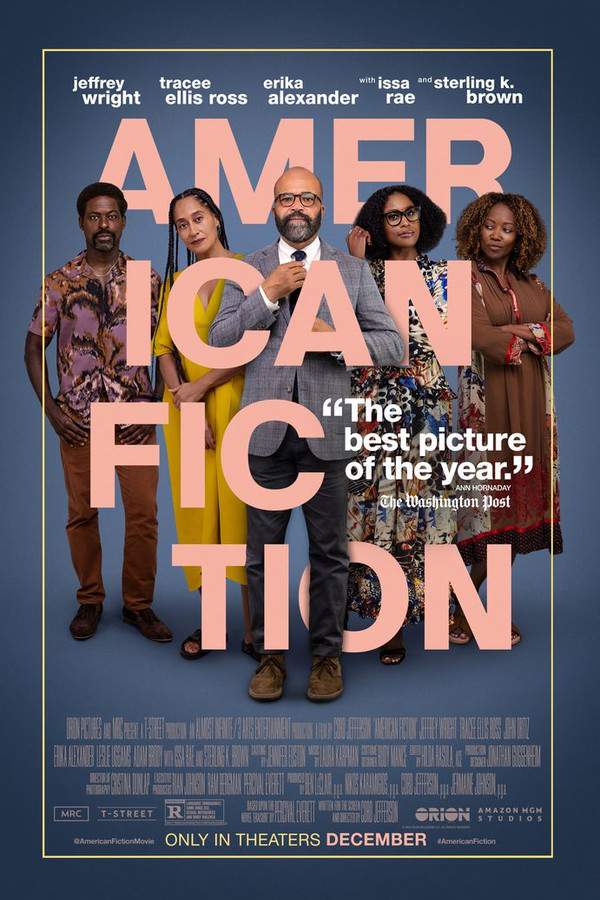
American Fiction

American Fiction

Year: 2023

Runtime: 1 h 57 m

Language: English

Director: Cord Jefferson

Echo Score: 78

Budget: $16M

ComedyDrama

Jeffrey Wright stars as Monk, a frustrated novelist who ironically writes a deliberately stereotypical "Black" novel as a commentary on the commodification of Black culture. To his surprise, the book becomes a massive success, thrusting him into a whirlwind of media attention and forcing him to confront the uncomfortable truths about race, identity, and the publishing industry. As the lines between his cynical creation and reality become increasingly blurred, Monk must navigate a world where the satire he intended has unexpected and challenging consequences.

Where to Watch American Fiction?

Find where to stream, rent, or buy American Fiction (2023) in the US with current JustWatch availability, up-to-date pricing, and platform listings for subscription, rental, and digital purchase options.

Warning: spoilers below!

Haven’t seen American Fiction yet? This summary contains major spoilers. Bookmark the page, watch the movie, and come back for the full breakdown. If you're ready, scroll on and relive the story!

Timeline – American Fiction (2023)

Trace every key event in American Fiction (2023) with our detailed, chronological timeline. Perfect for unpacking nonlinear stories, spotting hidden connections, and understanding how each scene builds toward the film’s climax. Whether you're revisiting or decoding for the first time, this timeline gives you the full picture.

1

Monk's Career Struggles

Thelonious 'Monk' Ellison, a distinguished African-American professor and writer in Los Angeles, faces significant challenges in his literary career. Despite receiving acclaim for his previous works, his latest manuscript is rejected, not meeting the racial expectations prevalent in the publishing world.

Los Angeles
2

University Setbacks

At the university, Monk’s confrontational discussions on race lead to tensions with students and faculty, further complicating his professional life. Consequently, he is encouraged to take a break by attending a literary seminar and reconnecting with his family in Boston.

University in Los Angeles
3

The Literary Seminar

During the literary seminar in Boston, Monk encounters Sintara Golden, whose successful book resonates with a large audience. He feels a profound contrast between their careers, seeing her work *We's Lives in Da Ghetto* as a reinforcement of negative stereotypes about African-Americans.

Boston
4

Family Reunion

Back home in Los Angeles, Monk takes time to strengthen his relationship with his mother, Agnes, who is showing early signs of Alzheimer's disease. He also reconnects with his sister Lisa, who is devoted to her medical career.

Los Angeles
5

Tragic Loss

Monk faces a devastating blow when his sister Lisa suffers a heart attack and dies suddenly. This tragedy brings Monk's estranged brother Cliff back into his life, introducing further complications within the family dynamic.

Los Angeles
6

Cliff's Return

Cliff, now a divorced plastic surgeon with issues related to addiction, complicates Monk’s return to normalcy. Their familial relationships face scrutiny as Cliff's chaotic lifestyle clashes with Monk’s struggles and aspirations.

Los Angeles
7

New Romance

While dealing with grief, Monk begins a romantic relationship with Coraline, a lawyer who lives nearby. This budding romance adds a layer of complexity to Monk's life as he navigates his evolving family situation and professional frustrations.

Los Angeles
8

Writing *My Pafology*

In a moment of frustration surrounding the success of Sintara and the financial burden of caring for his mother, Monk decides to write *My Pafology*. This satire critiques the stereotypical narratives often associated with black authors, filled with themes of neglect and violence.

Los Angeles
9

A Surprising Deal

Monk submits *My Pafology* in an act of defiance, only to be shocked when he is offered a lucrative advance of $750,000. Encouraged by his agent Arthur, he adopts the alter ego 'Stagg R. Leigh' to navigate the demands of the publishing industry.

Los Angeles
10

Success as 'Stagg R. Leigh'

As Stagg, Monk finds unexpected success in the literary world, landing a movie deal with producer Wiley. His unconventional proposals, including changing the book's title to 'Fuck', surprisingly gain acceptance, leading to further involvement in the industry.

Los Angeles
11

Literary Award Judging

Part of Monk's journey involves judging a literary award aimed at increasing diversity among selections. Facing Sintara again, he realizes they share a conviction despite their contrasting views, prompting deep reflections on their work.

Los Angeles
12

Family Crisis

As Agnes is moved to an assisted-living facility, Monk's relationships continue to strain under the pressure of Cliff's reckless behavior. Monk struggles to maintain the delicate balance of family obligations while managing his own successes.

Los Angeles
13

Conflicts with Coraline

Monk's dual identity as an author begins to take a toll on his relationship with Coraline, who enjoys his work without knowing his secret life. Their differing perspectives culminate in a heated argument, resulting in the end of their relationship.

Los Angeles
14

The Award Ceremony

At a pivotal literary award ceremony, Monk faces the consequences of living a dual existence. On stage, he prepares to reveal his truth about *Fuck* and confronts the broader implications of his choices and identity.

Los Angeles
15

Resolution and Future

The narrative concludes with a twist as the entire story has been Monk’s screenplay, crafted as an alternative to the adaptation of *Fuck*. Although separated from Coraline, Monk contemplates new beginnings as he drives off into an uncertain future with Cliff.

Los Angeles

Last updated: October 24, 2024 at 09:13

Was this helpful?

American Fiction (2023) Timeline Questions Answered – Chronology FAQ

Find frequently asked questions about the American Fiction (2023) timeline, including chronological order, nonlinear jumps, cause-and-effect links, and scene sequence clarifications. This timeline FAQ helps explain when key events happen, how moments connect, and why the story unfolds in that specific order.

Q1

Why does Monk write My Pafology as a satire?

A.

Monk writes My Pafology in a moment of frustration after seeing Sintara Golden's successful book We's Lives in Da Ghetto, which he perceives as reinforcing negative stereotypes about Black people. Combined with the financial burden of caring for his mother and resentment over his own serious novels being rejected for not being 'Black enough,' he deliberately writes a stereotypical story filled with deadbeat dads and gang violence to expose how the publishing industry rewards racial tokenism. He submits it expecting rejection, but is shocked when offered a $750,000 advance.

The seminar encounter with Sintara earlier planted the seed of frustration that leads to Monk's satirical response.

My Pafologysatirepublishing industrystereotypesracial expectations
Q2

Why does Monk criticize Sintara Golden's book?

A.

Monk views Sintara's book We's Lives in Da Ghetto as a harmful reinforcement of negative stereotypes about African-Americans. He believes it panders to white publishers and readers by depicting Black characters through tired tropes like poverty and violence. Despite recognizing her intelligence, Monk sees her success as evidence that the publishing industry values stereotyped 'Black stories' over nuanced, complex narratives written by actual Black authors.

Monk's own novels being rejected for not meeting racial expectations sets up the irony of his criticism.

Sintara GoldenWe's Lives in Da Ghettostereotypespublishing industry
Q3

What happens to Monk's sister Lisa?

A.

Monk's sister Lisa dies suddenly from a heart attack. Her death is sudden and devastating for Monk, bringing his estranged brother Cliff back into their lives. The tragedy occurs during an already difficult period for Monk as he deals with career frustrations and his mother's declining health due to Alzheimer's.

Lisa's dedicated nature as a physician is established early, making her sudden death more impactful.

Lisa Ellisonheart attackdeathfamily tragedy
Q4

Who is Stagg R. Leigh and why does Monk use this name?

A.

Stagg R. Leigh is the pseudonym Monk adopts when his satirical book My Pafology gets accepted for publication. His agent Arthur suggests he create a mysterious alter ego to meet the publishing world's demands for a certain type of Black author. Monk uses the fake identity to distance himself from his satire while allowing the book to succeed, essentially proving his point about how the industry operates.

The pseudonym mirrors how Monk believes the publishing industry creates and commodifies 'Black' identities.

Stagg R. Leighpseudonymalter egoMy Pafology
Q5

Why does Monk's satirical book become successful?

A.

The book succeeds because it fits exactly what publishers believe the market wants from Black authors. The industry sees the stereotypical elements, gang violence, absent fathers, as authentic 'Black stories,' proving Monk's point about commodification of Black culture. Even when Monk proposes absurd changes like renaming the book 'Fuck,' the publisher accepts it, demonstrating how far the industry will go to market what they perceive as 'diverse' voices.

Monk's rejection for not writing 'Black enough' content foreshadows this ironic success.

book successpublishingFuckmovie dealWiley
Q6

Why does Monk's relationship with Coraline end?

A.

Coraline and Monk break up after she reads and enjoys his book Fuck without knowing he wrote it. When she expresses how much she loved it, Monk criticizes her taste, leading to a heated argument where he reveals his true feelings about the book and the hypocrisy of its success. The argument exposes the growing divide between his public persona as Stagg and his private identity, ultimately ending their relationship.

Monk's secret creates mounting tension throughout their relationship.

Coralinerelationship breakupFuckargumentsecret identity
Q7

What is the twist at the end of American Fiction?

A.

The entire film is revealed to be Monk's screenplay that he wrote for producer Wiley as an alternative to the film adaptation of his book Fuck. The story we watched was his creative pitch, not actual events. This meta-twist reframes Monk's journey as he contemplates new endings and different paths forward, while also allowing him to explore his dilemmas through fiction.

Monk's career as a screenwriter and his meetings with producer Wiley set up this possibility.

twist endingscreenplayWileymeta narrativeFake
Q8

Why does Monk plan to reveal his identity at the award ceremony?

A.

Monk decides to confess on stage at the literary award ceremony because he can no longer live with the duality of his existence. As both the respected author Monk and the controversial Stagg R. Leigh, he faces pressure from all sides. The award ceremony forces him to confront the consequences of his experiment in exposing the publishing industry's hypocrisy, and he chooses to expose himself rather than continue the lie.

The dual existence creates mounting tension throughout the film.

award ceremonyconfessionidentity revealStagg R. Leigh
Q9

What happens to Monk's mother Agnes?

A.

Monk's mother Agnes is shown to be in the early stages of Alzheimer's disease. As the film progresses, her condition worsens to the point where she must move from her home into an assisted-living facility. This transition adds to Monk's emotional and financial burden as he cares for her while navigating his career crisis and family complications.

Agnes's memory issues are introduced early when Monk visits her in Boston.

Agnes EllisonAlzheimer'sassisted livingfamily
Q10

Why does Cliff return and what problems does he bring?

A.

Cliff returns to the family after Lisa's death, appearing as a divorced plastic surgeon struggling with addiction and living a chaotic lifestyle of fleeting relationships. His reckless behavior creates additional stress for Monk, especially as Agnes moves to assisted living and Monk tries to manage his own success. Despite their differences, Monk and Cliff ultimately bond during the film, with Monk driving off with his brother at the end.

Lisa's death is what brings Cliff back into the family fold.

Cliff Ellisondivorceaddictionbrotherfamily drama
Q11

Why does Monk's novel get rejected by publishers?

A.

Monk's latest manuscript gets rejected by publishers because it doesn't meet what they perceive as sufficient racial content. Despite his acclaim as a writer, they feel his work doesn't cater to racial expectations, the exact opposite problem from what Sintara Golden experiences. This rejection is what fuels Monk's cynical decision to write the deliberately stereotypical My Pafology as a commentary.

This rejection directly leads to Monk's satirical experiment.

manuscript rejectionpublishingracial expectationscareer
Mobile App Preview

Coming soon on iOS and Android

The Plot Explained Mobile App

From blockbusters to hidden gems - dive into movie stories anytime, anywhere. Save your favorites, discover plots faster, and never miss a twist again.

Sign up to be the first to know when we launch. Your email stays private, always.

Explore Movie Threads

Discover curated groups of movies connected by mood, themes, and story style. Browse collections built around emotion, atmosphere, and narrative focus to easily find films that match what you feel like watching right now.

Movies where satire backfires like American Fiction

Stories where a witty deception spirals out of control, blurring the lines between critique and reality.If you enjoyed the clever premise of American Fiction, you'll like these movies about characters whose satirical creations take on a life of their own. This list features sharp social comedies and dramas where a cynical joke becomes a serious problem, exploring themes of identity, hypocrisy, and the unintended consequences of art.
satiricalwittyironicuncomfortableintrospectivemetasocial commentaryfarce

Narrative Summary

The narrative typically begins with a frustrated intellectual or artist devising a high-concept satire. Their creation, intended as a cynical commentary, is mistakenly embraced by the establishment it mocks, leading to fame, fortune, and a profound personal crisis. The story escalates as the protagonist struggles to maintain the ruse while their original ideals are compromised, culminating in a moment of reckoning where the satire and their reality collide.

Why These Movies?

Movies in this thread share a specific narrative structure built on irony and moral ambiguity. They mix sharp, intellectual humor with a growing sense of unease, creating a unique tone that is both witty and uncomfortably introspective. The pacing is often steady, methodically building the farce until the protagonist is trapped by their own success.

Bittersweet family dramas like American Fiction

Character-driven stories that balance genuine grief and familial love with sharp, observant humor.Fans of the heartfelt family dynamics in American Fiction will appreciate these movies. This collection features dramas and dramedies that blend sharp, witty writing with authentic portrayals of grief, aging parents, and sibling relationships, creating stories that are both emotionally impactful and cleverly written.

bittersweetwittyfamilialheartfeltintrospectivegriefobservational humorresilient

Narrative Summary

These stories often revolve around a protagonist returning to or re-engaging with their family during a crisis. The narrative weaves together threads of personal failure, unresolved history, and the practical challenges of caregiving. Throughout this emotional journey, the characters use humor as a coping mechanism and a form of connection, leading to moments that are simultaneously funny and poignant.

Why These Movies?

These films are grouped by their masterful tonal balance. They avoid being overly saccharine or bleak by grounding their drama in witty, intelligent character interaction. The pacing is character-driven and steady, allowing the emotional beats to land with authenticity. The overall feeling is one of complicated love and resilience, tempered by a wry acceptance of life's absurdities.

Unlock the Full Story of American Fiction

Don't stop at just watching - explore American Fiction in full detail. From the complete plot summary and scene-by-scene timeline to character breakdowns, thematic analysis, and a deep dive into the ending - every page helps you truly understand what American Fiction is all about. Plus, discover what's next after the movie.

American Fiction Summary

Read a complete plot summary of American Fiction, including all key story points, character arcs, and turning points. This in-depth recap is ideal for understanding the narrative structure or reviewing what happened in the movie.

American Fiction Summary

Characters, Settings & Themes in American Fiction

Discover the characters, locations, and core themes that shape American Fiction. Get insights into symbolic elements, setting significance, and deeper narrative meaning - ideal for thematic analysis and movie breakdowns.

Characters, Settings & Themes in American Fiction

American Fiction Ending Explained

What really happened at the end of American Fiction? This detailed ending explained page breaks down final scenes, hidden clues, and alternate interpretations with expert analysis and viewer theories.


American Fiction Ending Explained

American Fiction Spoiler-Free Summary

Get a quick, spoiler-free overview of American Fiction that covers the main plot points and key details without revealing any major twists or spoilers. Perfect for those who want to know what to expect before diving in.

American Fiction Spoiler-Free Summary

More About American Fiction

Visit What's After the Movie to explore more about American Fiction: box office results, cast and crew info, production details, post-credit scenes, and external links - all in one place for movie fans and researchers.

More About American Fiction

Similar Movies to American Fiction

Discover movies like American Fiction that share similar genres, themes, and storytelling elements. Whether you’re drawn to the atmosphere, character arcs, or plot structure, these curated recommendations will help you explore more films you’ll love.