Plot Explained Spoilers guaranteed!
Plot Explained

Browse by genre

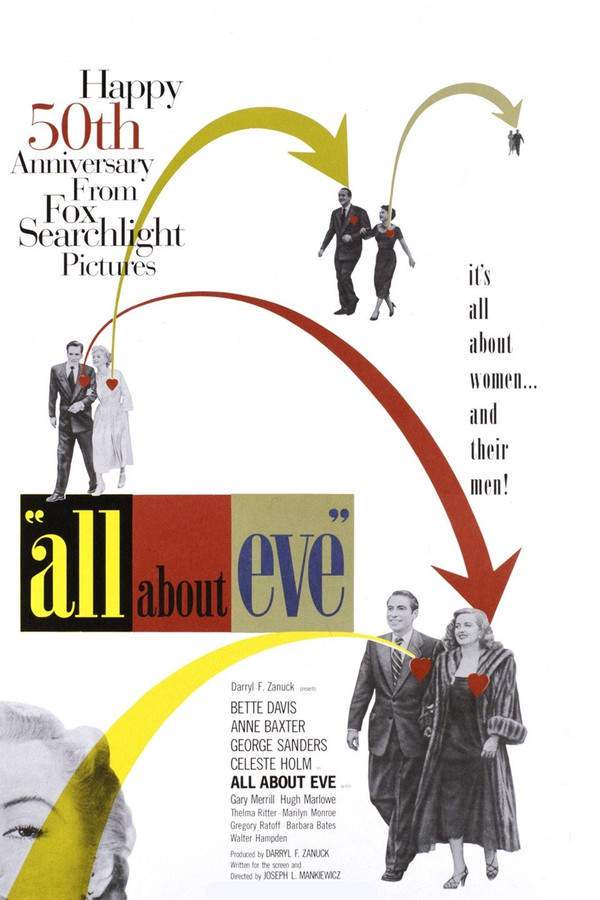
All About Eve (1950) movie poster

Plot Summary

All About Eve (1950) Plot Summary Explained

Release, runtime and language
1950 · 138 min · English
JustWatch #5,009 22
Directed by
Joseph L. Mankiewicz
Starring
Bette Davis, Thelma Ritter, George Sanders, Marilyn Monroe, Hugh Marlowe, Anne Baxter

A captivating story of ambition and rivalry takes place behind the scenes of a Broadway production. Eve Harrington, an aspiring actress, ingeniously manipulates her way into the life of established star Margo Channing, skillfully exploiting her vulnerabilities and insecurities. As Eve’s popularity grows, she expertly undermines Margo’s position, creating a tense and destructive dynamic that threatens to unravel the lives of everyone involved. The pursuit of fame and recognition leads to complex relationships and shocking betrayals.

On this page (6)
  1. 1 Where to watch
  2. 2 What happens: full plot
  3. 3 Plot questions answered
  4. 4 Movie threads
  5. 5 Movies like All About Eve
  6. 6 Every angle

Where to watch

Where to Watch All About Eve (1950)

Where can you watch All About Eve? Stream, rent or buy it in the US, including on Artiflix, BroadwayHD and Amazon Video: current JustWatch availability with up-to-date prices.

Streaming availability powered by JustWatch

Full plot summary · contains spoilers

What Happens in All About Eve: Full Plot Summary

The whole story of All About Eve (1950) explained, from the opening scene to the final frame: every key event, every twist and what it all adds up to. Read it as a quick recap before the sequel, to check a scene you missed, or to finally understand what really happened.

At a prestigious awards ceremony, the theatrical elite gathers to celebrate one of their most dazzling new stars: the extraordinary young Eve Harrington (Anne Baxter), whose unparalleled ascent to fame has captivated many. Among the attendees are notable figures from the theater world, including the renowned director Bill Simpson (Gary Merrill), the accomplished playwright Lloyd Richards (Hugh Marlowe) and his wife Karen (Celeste Holm), alongside the luminous Broadway icon, Margo Channing (Bette Davis). As they gaze upon Eve, their expressions reveal a mix of skepticism and disdain. Off to the side sits the infamous theater critic, Addison DeWitt (George Sanders), who, with an amused demeanor, begins to recount Eve's intriguing journey.

Not long ago, Eve was merely a starry-eyed admirer who haunted the theater's stage door, yearning for a fleeting glimpse of her idol, Margo Channing. When brought into Margo's orbit by Karen, Eve gushes with gratitude and humility, swiftly embedding herself as a general assistant in Margo's busy life. She impresses Margo's partner, Bill, as an innocent and eager girl eager to help out. Eventually, Eve finds herself living in Margo's home, answering phones and serving breakfast in bed. However, Margo's maid, Birdie (Thelma Ritter), grows increasingly wary of Eve, sensing her unnerving tendency to scrutinize Margo closely.

With Birdie’s cautioning in mind, Margo becomes suspicious. While everyone else assures her of Eve’s goodwill, Margo’s intuition tells her to stay alert for potential schemes. During Bill's birthday party, after one too many drinks, Margo lashes out at everyone around her. Later, Eve confides in Karen, seeking her help to win a coveted role as Margo’s understudy in Lloyd’s new play. Karen agrees, believing it could benefit them all.

Eve soon seizes her chance. Margo, known for her tardiness, misses a read-through, allowing Eve to shine in her absence, leaving even Addison DeWitt impressed and intrigued. A new star is rising, but Margo, feeling overshadowed, confronts Bill, leading him to consider leaving her. Karen and Lloyd also express their frustrations with Margo, creating a rift within their camaraderie.

An unexpected empty gas tank keeps Margo from returning in time for a performance, allowing Eve to take the stage. Impressed, Addison DeWitt begins to closely follow Eve's burgeoning career. Outside her dressing room, he overhears Eve attempting to woo Bill, who ultimately rebuffs her advances, prompting DeWitt to step into the picture.

In the following days, Eve's manipulations intensify. She seeks to solidify her position, but when a note arrives for Karen during a dinner celebration, tensions mount. In the ladies’ room, Eve pleads her case to Karen, claiming that DeWitt has twisted her words, insisting she never meant to harm Margo. Karen, although hesitant, finds herself swayed, particularly when Eve threatens to expose her role in Margo's recent predicament regarding the gas tank.

Soon, Eve lands the lead role in Lloyd's play. As the opening night approaches, she masterfully maneuvers relationships, simultaneously sowing discord among her rivals while maintaining a façade of kindness. With Addison DeWitt guiding her, Eve feels unstoppable, but unbeknownst to her, he has other plans and is aware of her true nature—an ambitious chameleon who has fabricated her identity.

Confronting Eve, DeWitt reveals his understanding of her deceptions, making it clear that he intends to control her career. Despite her initial resistance, Eve realizes the precariousness of her position and ultimately succumbs to DeWitt’s power over her future.

The narrative loops back to the prestigious ceremony, where Eve Harrington stands before her peers, collecting accolades while revealing the lengths she has gone to achieve her ambitions. Cold and isolated, she has sacrificed all meaningful connections for her success. As she returns to her empty hotel room, she encounters a young admirer named Phoebe, who idolizes her—provoking Eve's ire. Just as Eve begins to settle, Addison DeWitt reappears, and through a single knowing glance at Phoebe, he recognizes the cyclical nature of ambition and manipulation, hinting that a new chapter is about to unfold.
Last updated: October 27, 2024 at 23:24

Was this helpful?

Plot questions answered

All About Eve Plot Explained: Your Questions Answered

The questions people ask most about All About Eve (1950): what happens in the confusing scenes, why the characters do what they do, the twists, hidden details and what the ending means. Each answer contains spoilers.

Q1

Why does Margo Channing lose her position to Eve Harrington?

Margo's downfall stems from a combination of her own insecurities and Eve's calculated manipulation. Margo's tardiness and age-related anxiety make her vulnerable, while Eve strategically exploits these weaknesses. When Margo misses the read-through due to her punctuality issues, Eve seizes the opportunity to demonstrate her talent, impressing director Lloyd Richards and critic Addison DeWitt. This moment marks the turning point where Margo's star begins to fade as Eve's rises.

Foreshadowing: Birdie's early warnings about Eve's scrutinizing behavior hint at her manipulative nature.

  • margo channing
  • eve harrington
  • broadway
  • career downfall
  • ambition
Q2

Why does Karen Richards help Eve become Margo's understudy?

Karen agrees to help Eve secure the understudy role believing it could benefit everyone involved. She sees potential in Eve and thinks having a capable understudy would be practical for the production. Karen also hopes that supporting Eve might strengthen her own position with her husband Lloyd. However, Karen fails to recognize Eve's true manipulative intentions until it's too late.

Foreshadowing: Karen's willingness to help Eve is established early when she brings Eve into Margo's circle.

  • karen richards
  • eve harrington
  • understudy
  • manipulation
  • lloyd richards
Q3

What does Addison DeWitt want from Eve?

Addison DeWitt wants complete control over Eve's career. After discovering her fabricated background and manipulative nature, DeWitt confronts Eve and makes clear he intends to guide, and dominate, her professional trajectory. He sees in Eve a fellow predator and wants to harness her ambition for his own purposes, essentially becoming the power behind her rising stardom.

Foreshadowing: DeWitt's amused observation of Eve from the beginning suggests he's studying her.

  • addison dewitt
  • eve harrington
  • control
  • manipulation
  • career
Q4

Why does Eve try to manipulate Bill Simpson?

Eve attempts to seduce Bill Simpson to advance her position in Margo's circle. By turning Bill against Margo, Eve could potentially destabilize Margo's relationship and remove a key protector. Bill ultimately rejects her advances, but the attempt demonstrates Eve's willingness to exploit romantic relationships as tools for advancement.

Foreshadowing: Eve's close observation of Margo's life extends to understanding her relationships.

  • eve harrington
  • bill simpson
  • seduction
  • manipulation
  • margo channing
Q5

Why does Margo miss the crucial read-through?

Margo is known for her tardiness, which is a character flaw that Eve exploits. While the exact cause isn't detailed in every detail, Margo's consistent punctuality problems give Eve the opening she needs to step in and impress the creative team. This absence becomes the pivotal opportunity for Eve's ascent.

Foreshadowing: Margo's tardiness is mentioned as a characteristic trait early in the narrative.

  • margo channing
  • read-through
  • eve harrington
  • opportunity
  • broadway
Q6

Why does the cycle of ambition repeat with Phoebe at the end?

The film concludes with young Phoebe idolizing Eve, mirroring how Eve once idolized Margo. This cyclical structure suggests that the entertainment industry's hunger for fame creates an endless loop of manipulation and exploitation. Eve's harsh reaction to Phoebe indicates she recognizes the predatory relationship that will now unfold, while DeWitt's knowing glance confirms the pattern will continue.

Foreshadowing: Eve's own backstory as a starry-eyed admirer establishes this cyclical pattern.

  • phoebe
  • eve harrington
  • cycle
  • ambition
  • repetition
Q7

Why does Eve become dependent on Addison DeWitt?

Eve needs DeWitt's support because he has uncovered her fabricated background and manipulative true nature. While DeWitt initially helps advance her career, he uses this knowledge to exert control over her. Eve realizes that without DeWitt's backing, her dreams of Broadway stardom could be destroyed, so she submits to his influence despite her initial resistance.

Foreshadowing: DeWitt's close tracking of Eve's career hints at his ulterior motives.

  • eve harrington
  • addison dewitt
  • dependency
  • control
  • blackmail
Q8

Why does Eve react with anger toward Phoebe at the end?

Eve's ire toward Phoebe stems from recognizing the predatory dynamic that will now consume the young admirer. Eve knows exactly how this relationship will unfold, she was once in Phoebe's position, and now she'll become the Margo figure, exploitative and manipulative. Her cold rejection reflects both her awareness of the cycle and her own corrupted nature.

Foreshadowing: The opening scenes establish Eve's journey from admirer to manipulator.

  • eve harrington
  • phoebe
  • anger
  • cycle
  • recognition
Q9

Why does Bill Simpson consider leaving Margo Channing?

Bill considers leaving Margo because her jealousy and insecurity become overwhelming after Eve's rise. During Bill's birthday party, Margo's drunken outburst alienates him and the others. Additionally, Bill is impressed by Eve's talent and charm, creating further distance from Margo. The combination of Margo's behavior and Eve's advances leads Bill to contemplate ending their relationship.

Foreshadowing: Margo's birthday party outburst serves as the breaking point in their relationship.

  • bill simpson
  • margo channing
  • leave
  • jealousy
  • eve harrington
Q10

Why is Eve ultimately isolated despite her success?

Eve achieves her goal of becoming a Broadway star but sacrifices all meaningful human connections in the process. Her manipulative tactics have destroyed her relationships with Margo, Bill, and Karen. She now lives in an empty hotel room, completely alone, with only her career achievement for company. The film presents this as a hollow victory, the cost of her ambition has left her emotionally destitute.

Foreshadowing: Eve's ruthless pursuit of the understudy role comes at the expense of genuine connections.

  • eve harrington
  • isolation
  • success
  • sacrifice
  • loneliness

Movie threads

More Movies Like All About Eve, by Mood & Story

Curated lists built around what makes All About Eve tick: the same mood, the same kind of story or the same emotional payoff. Each list explains why these movies belong together.

Cynical Dramas of Ambition like All About Eve

Stories where ambition fuels psychological manipulation and bitter rivalries in high-stakes settings. Discover movies like All About Eve that delve into the dark side of ambition. These films feature sharp dialogue, complex rivalries, and psychological manipulation in competitive worlds, perfect for viewers who enjoy tense character-driven stories with a cynical edge.

  • cynical
  • tense
  • calculating
  • unsettling
  • bitter
  • claustrophobic
  • Tone: dark, cynical, tense
  • Pacing: steady, methodical
Why these movies?

The story pattern: The narrative typically follows an ambitious newcomer who infiltrates and undermines an established figure within a competitive microcosm. The plot unfolds methodically, revealing layers of deceit and betrayal, often leading to a hollow victory for the manipulator, suggesting the cycle of ambition is endless.

Why they belong together: Movies are grouped here for their shared focus on the corrosive nature of ambition, their tense and calculating mood, and their exploration of psychological manipulation within closed, high-stakes environments. They deliver a similarly heavy emotional weight and a bittersweet or cynical conclusion.

Slow-Burn Dramas of Betrayal like All About Eve

Narratives where a character is systematically dismantled by a cunning rival over time. Explore more movies like All About Eve that master the art of the slow-burn character assassination. These films feature a steady, deliberate pace where tension builds methodically as one character systematically destroys another, leading to heavy emotional consequences.

  • tense
  • methodical
  • unsettling
  • melancholic
  • psychological
  • gripping
  • Tone: tense, dark, melancholic
  • Pacing: steady, slow-burn
Why these movies?

The story pattern: The narrative pattern involves a patient, calculating antagonist who identifies and exploits the vulnerabilities of a protagonist. The story unfolds not with sudden shocks, but with a series of carefully plotted maneuvers that erode the protagonist's status, relationships, and sanity, creating a pervasive sense of unease.

Why they belong together: These films are united by their specific pacing and narrative structure—a steady, methodical build-up of psychological tension. They share a high intensity derived from emotional manipulation rather than physical action, and a heavy focus on character-driven conflict that results in a bittersweet or bleak resolution.

If you liked this

Movies Like All About Eve

Similar movies to All About Eve: the same genre, themes or kind of story. Each one comes with its own plot summary, timeline and ending explained.

Browse all movie summaries

Every angle

All About Eve (1950) Explained: Plot, Timeline & Characters

Everything about All About Eve in one place: what happens in the plot summary, the timeline in chronological order, the characters and meaning and a spoiler-free summary. What's After the Movie adds the cast, box office and post-credit scenes.

Coming soon on iOS and Android

The Plot Explained Movie Summary App

Plot summaries, endings explained and timelines on your phone. Catch up on any movie in minutes, save your favorites and never miss a twist again.

Be the first to know when we launch. Your email stays private, always.

Learn more about the app