Plot Explained Spoilers guaranteed!
Plot Explained

Browse by genre

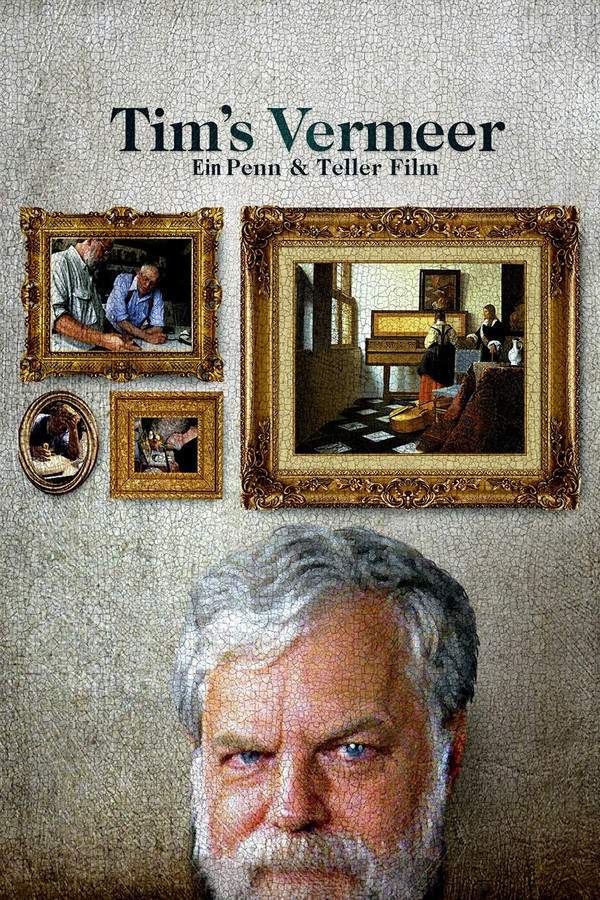
Tim's Vermeer (2013) movie poster

Timeline

Tim's Vermeer (2013) Timeline Explained – Every Event in Order

Release, runtime and language
2013 · 80 min · English
Loading streaming availability…
Directed by
Teller
Starring
Penn Jillette, Tim Jenison

Driven by a fascination with Johannes Vermeer's incredible painting technique, inventor Tim Jenison undertakes a detailed exploration to understand how the Dutch master achieved such photorealistic results. He meticulously investigates the tools and methods Vermeer might have used, ultimately attempting to recreate Vermeer's process himself. Through inventive experimentation and a deep artistic curiosity, Jenison’s quest reveals a compelling intersection of art and scientific innovation, blurring the lines between the two disciplines.

On this page (5)
  1. 1 Where to watch
  2. 2 Events in order (18)
  3. 3 Movie threads
  4. 4 Movies like Tim's Vermeer
  5. 5 Every angle
Loading streaming availability…

18 events in order · contains spoilers

Tim's Vermeer Timeline: Events in Chronological Order

Every key event of Tim's Vermeer (2013) in order, scene by scene, with when and where it takes place. Use it to untangle flashbacks, time jumps and parallel storylines, to refresh your memory before the sequel or to find the exact scene you are thinking of.

  1. Tim Jenison, Inventor and Art Enthusiast

    The film introduces Tim Jenison, a successful inventor and founder of NewTek, the company behind the 3D modeling software LightWave 3D. Although he has no classical artistic training, Jenison is both an engineer and a lifelong art enthusiast. This unusual combination of skills and passions sets the stage for his investigation into Vermeer.

  2. Captivated by Vermeer's Photographic Quality

    Jenison becomes fascinated with the paintings of Johannes Vermeer, the 17th-century Dutch painter whose works are often said to exhibit a photographic quality. He becomes determined to understand how Vermeer achieved such lifelike precision without any formal training. This mystery becomes the driving force of the entire project.

  3. The Camera Obscura Hypothesis

    Spurred by David Hockney's 2001 book Secret Knowledge and Philip Steadman's Vermeer's Camera, Jenison theorizes that Vermeer used a camera obscura to guide his painting technique. The idea had been around for some time, even appearing in the 1970 Ladybird Book 'Great Artists: Book 1.' Jenison resolves to put the contested theory to a practical test.

  4. Discarding the Projection Idea

    Jenison's initial theory is that Vermeer simply painted over a simple light projection. He quickly abandons this idea after concluding that matching paint colors over a projection is nearly impossible. The setback forces him to rethink how optical tools could actually have been used.

  5. The Mirror Epiphany

    Jenison has an epiphany: by placing a small, fixed mirror above the canvas at a 45-degree angle, he can view the original image and his canvas simultaneously. By continuously comparing the reflection with his painting, he can achieve a precise color match, moving from area to area by slightly shifting his point of view. When the edge of the mirror 'disappears,' he knows he has the color exactly right.

  6. First Prototype: A Portrait of His Father-in-Law

    Building a quick, crude prototype of the mirror setup, Jenison uses a photographic portrait of his father-in-law as his subject. Despite having no classical art education, he produces an oil painting that looks nearly identical to the photograph. The successful experiment proves the concept can work in practice.

  7. Painting a Vase with the Lens Prototype

    Jenison then builds a prototype with a lens capable of capturing a real-life object. He and architecture professor Philip Steadman, neither of whom has a classic artistic education, take turns painting an impressive oil painting of a vase. The result further validates the mirror-and-lens technique.

  8. Controversy in Art Historian Circles

    Hockney and Steadman both note that their books have caused controversy among art historians, who viewed the optical hypothesis as an 'intrusion of crass rationalists' and 'the misunderstanding of the nature of art.' The art establishment has largely resisted the idea that Vermeer used mechanical aids. This tension gives Jenison's experiment a much greater significance.

  9. The Ambitious Plan: Recreating The Music Lesson

    Jenison believes he may be able to reproduce Vermeer's The Music Lesson with his technique, but rather than copy the painting directly, he plans to physically recreate the original scene. This decision means rebuilding the entire room and every object in it from scratch. It becomes the most ambitious art-reconstruction project he has ever attempted.

  10. Modeling the Scene in LightWave

    As his first step, Jenison models the entire painting digitally in LightWave 3D, the software created by his own company. The digital model lets him study the spatial relationships of the room before building anything physically. It serves as the blueprint for the full-scale reconstruction to come.

  11. Seven Months of Handiwork

    Jenison engages in a painstaking process of recreating the objects and setting from the original scene. He performs woodworking and carpentry, and even saws a lathe in half to recreate one of the props. The reconstruction consumes almost seven months of his life.

  12. Staying True to the 17th Century

    Jenison insists on using only techniques and tools available to Vermeer in the 17th century. He mixes his own paint from raw pigments and polishes his own lens by hand. This commitment to historical authenticity strengthens the credibility of his experiment.

  13. The Scene Is Set: Painting Begins

    With the room rebuilt and visually identical to the original painting, Jenison sits down and meticulously begins to paint. Working area by area, he compares the reflection in his mirror against the canvas to match every color exactly. Months of painstaking oil painting begin in earnest.

  14. Vermeer's Photographic Oddities

    During the process, Jenison observes a variety of oddities in Vermeer's work that support the idea of mechanical help. The hyper-accurate recreation of diffuse lighting would be impossible to achieve by eyesight alone because of color constancy. He also notes that Vermeer's paintings show chromatic aberration and bokeh depth of field, which are features of a photographic lens rather than the human eye.

  15. The Curvature of the Virginal

    While painting the virginal, Jenison accidentally notices that the curvature of his lens almost causes him to add a slight bend to the instrument's seahorse pattern, even though he sketched its outline with a straightedge. Curious, he examines a print of the original painting and discovers the exact same curvature in Vermeer's version. It becomes a striking piece of evidence that Vermeer's hand was guided by a lens.

  16. The Painting Is Finished

    After four months of meticulous work, Jenison finally finishes his copy of The Music Lesson. He adds a final layer of varnish and has an emotional moment taking a last look at his finished work. The reproduction is remarkably faithful to the Vermeer original.

  17. The Hypothesis Is Vindicated

    Observing the results of Jenison's work, Steadman and Hockney both feel confident in their hypothesis that Vermeer used the same or similar tools to create his paintings. They reflect that 'the painting itself is a document,' meaning the artwork carries its own evidence of how it was made. Jenison's hands-on experiment lends powerful support to their long-contested theory.

  18. The Copy Above the Fireplace

    The film closes with a final shot of Jenison, his reproduction of The Music Lesson hanging above his fireplace. The image represents the culmination of years of obsession, engineering, and craftsmanship. What began as a contested theory ends as a finished painting on his wall.

Last updated: November 23, 2026 at 21:14

Was this helpful?

Movie threads

More Movies Like Tim's Vermeer, by Mood & Story

Curated lists built around what makes Tim's Vermeer tick: the same mood, the same kind of story or the same emotional payoff. Each list explains why these movies belong together.

Reverse-Engineering Art and Craft Like in Tim's Vermeer

A celebrated method is investigated, rebuilt, and tested until its hidden logic emerges. If you liked Tim's Vermeer, explore documentaries and factual stories featuring obsessive research, reconstructed processes, and experiments that test how celebrated artists, inventors, or craftspeople achieved remarkable results. These patient, absorbing stories pair art history with hands-on discovery and culminate in satisfying expert verification.

  • curious
  • meticulous
  • ingenious
  • artistic
  • absorbing
  • quietly suspenseful
  • Tone: curious, methodical, quietly triumphant
  • Pacing: steady, process driven
Why these movies?

The story pattern: An investigator begins with a specific artistic mystery, gathers visual and historical evidence, and turns those clues into a workable hypothesis. The middle follows patient research, fabrication, and trial-and-error, with experts evaluating each step. The final recreation tests the theory and resolves the inquiry, rewarding persistence with a clear, quietly triumphant answer.

Why they belong together: Each film centers on a clear question and lets methodical evidence drive the answer. The shared appeal lies in watching abstract history or artistry become tangible through construction and testing, then seeing outside expertise confirm a long-held hypothesis. The tone remains focused and restrained rather than sensational.
Quietly Absorbing Process Documentaries Like Tim's Vermeer

Patient demonstrations and technical discovery create calm suspense without dramatic danger. If you liked Tim's Vermeer, find similar documentaries that unfold through careful observation, specialist interviews, detailed demonstrations, and incremental problem-solving. These low-intensity, steady-paced films make the joy of understanding and making the central attraction, with light emotion and a satisfying sense of discovery.

  • patient
  • absorbing
  • meticulous
  • curious
  • quiet suspense
  • craftsmanship
  • Tone: neutral, curious, quietly hopeful
  • Pacing: steady, unhurried
Why these movies?

The story pattern: These stories move from an initial question through observation, explanation, experimentation, and refinement. Specialists provide context while repeated demonstrations make progress tangible; obstacles alter the method without creating personal or physical jeopardy. The ending usually rewards the process with a completed experiment, a clearer explanation, or a satisfying answer.

Why they belong together: These films are grouped by their viewing texture rather than a single subject: measured narration, unhurried demonstrations, close-up craft, and incremental reveals. They create suspense through the question of whether a method will work, keep emotional stakes light, and end with the quiet satisfaction of understanding or successful completion.

If you liked this

Movies Like Tim's Vermeer

Similar movies to Tim's Vermeer: the same genre, themes or kind of story. Each one comes with its own plot summary, timeline and ending explained.

Browse all movie summaries

Every angle

Tim's Vermeer (2013) Explained: Plot, Timeline & Characters

Everything about Tim's Vermeer in one place: what happens in the plot summary, the timeline in chronological order, the characters and meaning and a spoiler-free summary. What's After the Movie adds the cast, box office and post-credit scenes.

Coming soon on iOS and Android

The Plot Explained Movie Summary App

Plot summaries, endings explained and timelines on your phone. Catch up on any movie in minutes, save your favorites and never miss a twist again.

Be the first to know when we launch. Your email stays private, always.

Learn more about the app