Plot Explained Spoilers guaranteed!
Plot Explained

Browse by genre

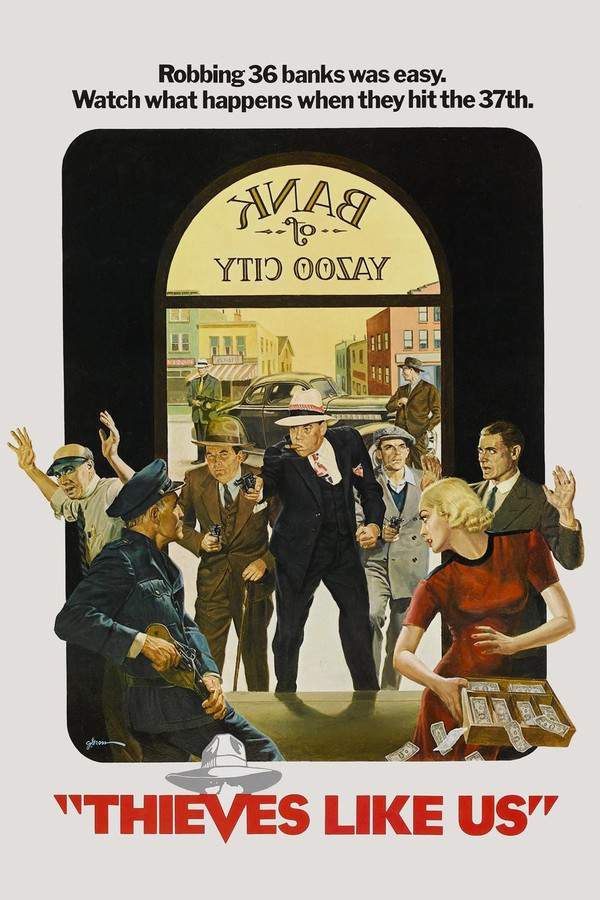
Thieves Like Us (1974) movie poster

Plot Summary

Thieves Like Us (1974) Plot Summary Explained

Release, runtime and language
1974 · 123 min · English
Directed by
Robert Altman
Starring
Louise Fletcher, Al Scott, Ann Latham, Bert Remsen, John Roper, John Schuck

A charming outlaw evades conviction and joins forces with old friends for a series of crimes in this gritty drama. He finds himself drawn to Keechie, a spirited young woman yearning for a life beyond their lawless existence. As their passionate romance develops against a backdrop of danger and criminal pursuits, the relentless pressure of the authorities threatens to shatter their fragile world and bring their escapades to an end.

On this page (6)
  1. 1 What happens: full plot
  2. 2 Plot questions answered
  3. 3 The book behind the movie
  4. 4 Movie threads
  5. 5 Movies like Thieves Like Us
  6. 6 Every angle

Full plot summary · contains spoilers

What Happens in Thieves Like Us: Full Plot Summary

The whole story of Thieves Like Us (1974) explained, from the opening scene to the final frame: every key event, every twist and what it all adds up to. Read it as a quick recap before the sequel, to check a scene you missed, or to finally understand what really happened.

In the throes of the 1930s, three men from desperate backgrounds, Bowie (Keith Carradine), T-Dub (Bert Remsen), and Chicamaw (John Schuck), make a daring escape from prison, compelled by poverty that has gripped the nation. Their audacious plan is to rob banks, seeking both financial freedom and a sense of exhilaration while staying one step ahead of the law. Seeking refuge, they find solace with Dee Mobley (Tom Skerritt) and his partner Keechie (Shelley Duvall), as well as T-Dub's authoritative in-law, Mattie (Louise Fletcher). Together, they plan their future heists, glued to the unfolding drama of their crimes through the radio and newspapers, a modern-day chronicle that both thrills them and adds to their peril.

However, their once unshakeable camaraderie begins to fracture, fed by the sensational press coverage depicting their exploits. This excitement breeds a competitive jealousy within Chicamaw, which culminates in a violent act when he shoots a bank teller—an event that dramatically alters their fate and elevates their status to "wanted dead or alive." The gravity of their situation forces a separation, with a plan to reconvene for future escapades.

Tragedy strikes when Bowie suffers an injury from a car crash, leaving him vulnerable and needing care. The gang brings him to Dee's home, where Keechie tends to his wounds. In the midst of chaos, a deep romance blossoms between Bowie and Keechie, who dream of a peaceful life together in Mexico, away from the chaos of their current existence. The stakes heighten when T-Dub meets his demise at the hands of the police and Chicamaw is ushered into prison. In a moment of desperation, Bowie performs a daring act to free Chicamaw but ultimately abandons his former ally, grappling with a harsh moral dilemma.

As the noose tightens around their plans for a serene life, hope begins to slip away for Bowie and Keechie. Their aspirations are overshadowed by the relentless pursuit of the law, rendering their dreams of escape and tranquility increasingly elusive. The journey of crime, love, and conscience unfolds, illustrating the profound struggles woven into the fabric of their lives.

Last updated: January 18, 2025 at 14:36

Was this helpful?

Plot questions answered

Thieves Like Us Plot Explained: Your Questions Answered

The questions people ask most about Thieves Like Us (1974): what happens in the confusing scenes, why the characters do what they do, the twists, hidden details and what the ending means. Each answer contains spoilers.

Q1

Why does Chicamaw shoot the bank teller during the heist?

Chicamaw shoots the bank teller because he becomes consumed by jealousy over the sensational media coverage of the gang's exploits. As their crimes become more publicized, he grows resentful of the attention Bowie and the others are receiving, and his impulsive act transforms their criminal status from wanted to 'dead or alive,' fundamentally changing their fate.

Foreshadowing: Earlier scenes show the gang obsessively listening to radio reports about their own crimes, hinting at how the media attention is affecting their dynamics.

  • chicamaw
  • bank teller
  • shooting
  • jealousy
  • media coverage
Q2

Why does Bowie abandon Chicamaw during the prison rescue?

Bowie abandons Chicamaw because he experiences a moral awakening about the futility of their criminal lifestyle. While he initially attempts a daring rescue, his conscience takes over as he realizes that continuing this cycle of crime only leads to more tragedy. He chooses to walk away, effectively ending both his criminal career and his friendship with Chicamaw.

Foreshadowing: The escalating violence and loss of T-Dub have already planted seeds of doubt in Bowie's mind about their lifestyle.

  • bowie
  • chicamaw
  • prison rescue
  • abandonment
  • moral dilemma
Q3

How do Bowie and Keechie meet and fall in love?

Bowie and Keechie meet when the gang hides out at Dee Mobley's home. Their relationship deepens after Bowie is injured in a car crash and Keechie tends to his wounds. During his recovery, they spend time together and begin dreaming of a peaceful life away from crime, eventually falling deeply in love.

Foreshadowing: The moment Bowie is brought wounded to Dee’s home establishes the intimate setting where their bond can develop.

  • bowie
  • keechie
  • romance
  • falling in love
  • recovery
Q4

Why does the gang decide to separate after the bank teller shooting?

The gang decides to split up because Chicamaw's act of shooting the bank teller has escalated their criminal status to 'wanted dead or alive,' making their situation extremely dangerous. The increased heat from law enforcement forces them to scatter temporarily with plans to reconvene later, though trust and loyalty begin to deteriorate.

Foreshadowing: The media coverage that fueled Chicamaw's jealousy also signals the growing danger to all of them.

  • gang separation
  • chicamaw
  • shooting
  • danger
  • law enforcement
Q5

What happens to T-Dub in the story?

T-Dub is killed by the police during a confrontation. His death is a devastating loss for Bowie and marks a turning point in the story, showing the inevitable end that awaits outlaws. This tragedy further isolates Bowie and Keechie and reinforces the fatalistic tone of the film.

Foreshadowing: The gang's decision to split up already hints at the dangers that lie ahead for each member.

  • t-dub
  • death
  • police
  • killed
  • shooting
Q6

Why do Bowie and Keechie want to go to Mexico?

Bowie and Keechie want to escape to Mexico because they dream of leaving their criminal past behind and starting a peaceful, normal life together. Mexico represents freedom from the constant pursuit by law enforcement and a chance at the normal existence that Keechie, especially, has always yearned for.

Foreshadowing: Keechie's character is established as someone yearning for a life beyond their lawless existence, making her desire for escape central to her arc.

  • mexico
  • escape
  • dream
  • normal life
  • bowie
  • keechie
Q7

Why can't Bowie and Keechie escape to Mexico?

Bowie and Keechie cannot escape to Mexico because the relentless pressure of the authorities continues to close in on them. With T-Dub dead, Chicamaw imprisoned, and the law tightening its grip, their dreams of a peaceful life become increasingly impossible. The external forces of pursuit and the internal fracturing of their group ultimately prevent any escape.

Foreshadowing: The news of T-Dub's death and Chicamaw's imprisonment earlier signals that the law will not allow them to evade capture.

  • mexico
  • escape
  • law enforcement
  • pursuit
  • impossible
Q8

How does media coverage affect the gang's dynamics?

The sensational press coverage of their crimes creates tension and jealousy within the gang, particularly in Chicamaw. The media attention that excites Bowie and the others becomes destructive, fueling competition and ultimately leading to Chicamaw's violent act that changes everything. The gang's unity fractures as their fame grows.

Foreshadowing: The gang is consistently depicted listening to radio reports about themselves, showing how obsessed they become with their own coverage.

  • media
  • press
  • coverage
  • jealousy
  • gang tension
Q9

Why does Bowie get into the car accident?

Bowie gets into the car accident while attempting to flee from the authorities. The injury leaves him severely wounded and vulnerable, which forces the gang to bring him to Dee Mobley's home where Keechie can care for him. This accident becomes the catalyst for his romantic relationship with Keechie.

Foreshadowing: The gang's earlier decision to split up and flee sets the stage for this dangerous escape attempt.

  • bowie
  • car accident
  • injury
  • flee
  • rescue
Q10

Why does Chicamaw become jealous of the other gang members?

Chicamaw becomes jealous because the sensational media coverage portrays the gang's exploits in a way that makes him feel overshadowed. He craves recognition and importance, but as the press focuses on the group's activities collectively, his personal desire for attention and status goes unmet, leading to resentment and ultimately violent action.

Foreshadowing: The scene where the gang listens eagerly to radio reports establishes their collective hunger for recognition and fame.

  • chicamaw
  • jealousy
  • media
  • fame
  • recognition

Movie threads

More Movies Like Thieves Like Us, by Mood & Story

Curated lists built around what makes Thieves Like Us tick: the same mood, the same kind of story or the same emotional payoff. Each list explains why these movies belong together.

Movies about doomed lovers on the run like Thieves Like Us

Where a desperate love story unfolds against the relentless chase of the law. Discover movies like Thieves Like Us, where a romance blossoms amidst crime and flight. This collection features similar stories of lovers on the lam, fugitive couples yearning for normalcy, and gritty crime dramas with a heavy romantic and emotional core.

  • yearning
  • desperate
  • fatalistic
  • on the run
  • doomed romance
  • gritty
  • Tone: melancholic, desperate, tragic
  • Pacing: steady, character-driven
Why these movies?

The story pattern: The narrative follows a couple, often an outlaw and a civilian drawn into their world, as they attempt to build a life together while evading capture. The central conflict is between their intimate, fragile hope for a future and the crushing, inevitable force of the law or fate that closes in around them.

Why they belong together: These movies are grouped by the powerful combination of a high-stakes fugitive plot and a deeply emotional romance. They share a melancholic, fatalistic tone where the thrill of escape is overshadowed by the heavy weight of impending tragedy, focusing on character connection amidst chaos.

Gritty period crime dramas with bleak endings like Thieves Like Us

Stories of desperate criminal undertakings set against a harsh historical backdrop. If you liked the gritty Great Depression setting of Thieves Like Us, explore these similar period crime stories. Find movies with a steady pace, heavy emotional weight, and a fatalistic view of characters crushed by their environment and choices.

  • gritty
  • melancholic
  • fatalistic
  • historical
  • desperate
  • downward spiral
  • Tone: melancholic, bleak, gritty
  • Pacing: steady, methodical
Why these movies?

The story pattern: The narrative typically follows a group or individual engaging in crime as a means of survival or ascent within a socio-economically harsh era. The plot is a straightforward chronicle of their exploits and subsequent disintegration, where the historical context amplifies the futility of their struggle against a system stacked against them.

Why they belong together: These films share a cohesive vibe built from a specific historical setting, a straightforward but heavy crime narrative, and a consistently melancholic or bleak tone. The similarity comes from the immersive period detail combined with the thematic focus on shattered dreams and fatalism.

If you liked this

Movies Like Thieves Like Us

Similar movies to Thieves Like Us: the same genre, themes or kind of story. Each one comes with its own plot summary, timeline and ending explained.

Browse all movie summaries

Every angle

Thieves Like Us (1974) Explained: Plot, Timeline & Characters

Everything about Thieves Like Us in one place: what happens in the plot summary, the timeline in chronological order, the characters and meaning and a spoiler-free summary. What's After the Movie adds the cast, box office and post-credit scenes.

Coming soon on iOS and Android

The Plot Explained Movie Summary App

Plot summaries, endings explained and timelines on your phone. Catch up on any movie in minutes, save your favorites and never miss a twist again.

Be the first to know when we launch. Your email stays private, always.

Learn more about the app