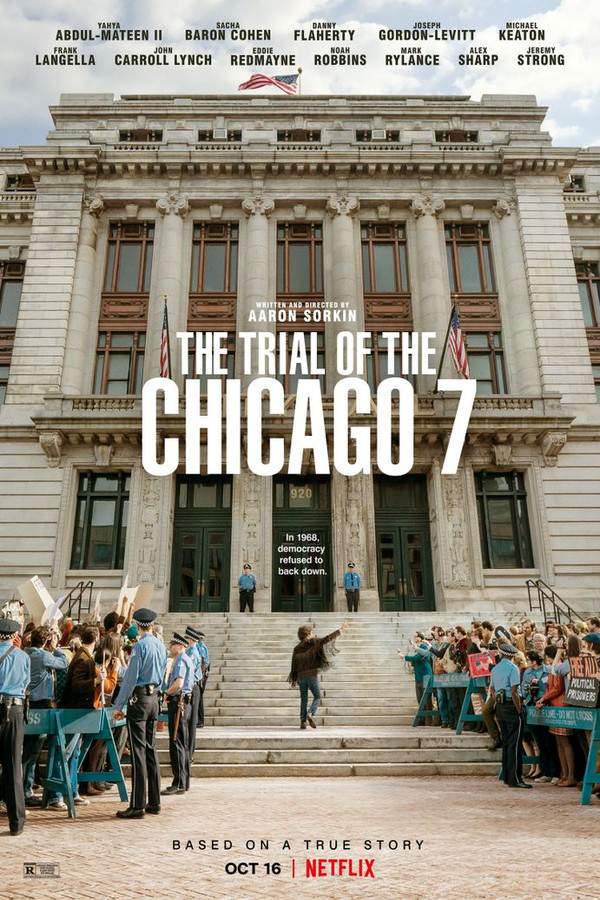
#23,7741 Year: 2020
Runtime: 129 min
Language: English
Director: Aaron Sorkin
Echo Score: 89Budget: $35M
During the 1968 Democratic National Convention, a planned demonstration turns violent, leading to clashes between protesters and police. Seven activists, known for their counterculture views and leadership in the anti-Vietnam War movement, are subsequently charged with conspiracy. Their trial becomes a high-profile legal battle, testing the boundaries of free speech and challenging the government's response to dissent during a time of significant social unrest.
Find where to stream, rent, or buy The Trial of the Chicago 7 (2020) in the US with current JustWatch availability, up-to-date pricing, and platform listings for subscription, rental, and digital purchase options.
Warning: spoilers below!
Haven’t seen The Trial of the Chicago 7 yet? This summary contains major spoilers. Bookmark the page, watch the movie, and come back for the full breakdown. If you're ready, scroll on and relive the story!
Trace every key event in The Trial of the Chicago 7 (2020) with our detailed, chronological timeline. Perfect for unpacking nonlinear stories, spotting hidden connections, and understanding how each scene builds toward the film’s climax. Whether you're revisiting or decoding for the first time, this timeline gives you the full picture.
Last updated: May 12, 2025 at 07:04
Find frequently asked questions about the The Trial of the Chicago 7 (2020) timeline, including chronological order, nonlinear jumps, cause-and-effect links, and scene sequence clarifications. This timeline FAQ helps explain when key events happen, how moments connect, and why the story unfolds in that specific order.
The defendants were arrested five months after the protest on charges of 'crossing state lines to incite a riot.' While they had planned the demonstration and were present in Chicago during the convention, the prosecution argued their earlier speeches and planning constituted conspiracy to incite violence. The government targeted them for their leadership roles in the anti-war movement rather than any specific violent action they personally committed during the riot.
Bobby Seale was gagged and chained after repeatedly demanding his right to counsel. His attorney, Charles Garry, was ill and unable to attend, but Judge Hoffman refused to delay the trial. When Seale continued to protest this, Judge Hoffman ordered him forcibly removed, beaten, and returned to the courtroom in chains and a gag. This brutal treatment was intended to silence Seale's vocal demands for representation.
Earlier in the film, Seale's attorney is shown being unable to attend due to illness, creating the initial conflict.
Fred Hampton was a close ally of Bobby Seale and a founding member of the Black Panther Party. When Seale learned that Hampton had been killed in a police raid, it intensified his outrage at the justice system. This loss fueled Seale's increasingly vocal demands for representation and his refusal to remain silent, directly leading to his confrontation with Judge Hoffman.
Seale receives support from Fred Hampton earlier in the trial, establishing their relationship.
During the chaotic night of the riot, Tom Hayden saw police assaulting Rennie Davis and shouted 'If blood is going to flow, then let it flow all over the city!' This inflammatory statement was later used by the prosecution to argue Hayden had incited violence. While Hayden claimed it was rhetorical anger in the moment, the statement became a key piece of evidence against him during the trial.
Earlier, Hayden is shown noticing police following Davis, setting up the confrontation.
Ramsey Clark, who served as Attorney General during the 1968 events, was called by the defense to testify that he had declined to prosecute the defendants because evidence showed the Chicago Police Department instigated the riots. Judge Hoffman denied Clark the opportunity to speak before the jury, ruling his testimony was irrelevant. This prevented the defense from presenting crucial context about who actually started the violence.
Abbie Hoffman recognized that Hayden's 'blood' statement could be used to destroy him during cross-examination. When Hayden asked Abbie to take the stand in his place, Abbie agreed because he understood the weight of the moment and the need to protect Hayden from further exploitation by the prosecution. This was a strategic decision to shield Hayden from questioning about his inflammatory quote.
Earlier, Abbie realizes the prosecution intends to use Hayden's quote against him.
Judge Julius Hoffman showed clear bias throughout the trial, most notably by insisting that he and Abbie Hoffman were not related despite sharing a surname. He consistently ruled in favor of the prosecution, charged defendants with contempt of court repeatedly, and dismissed jurors he suspected might sympathize with the defense. His animosity toward the defendants was evident in his courtroom conduct and rulings.
The film establishes Hoffman's prejudice early when he makes the unusual announcement about his name.
The defendants were found guilty on charges of conspiracy and inciting a riot. However, their convictions were later overturned on appeal. The trial became widely regarded as a miscarriage of justice, with Judge Hoffman's conduct and the government's handling of the case drawing heavy criticism.
David Dellinger attacked a bailiff in response to the escalating tensions and injustices in the courtroom, particularly the mistreatment of Bobby Seale. This violent outburst reflected the intense frustration felt by the defendants amid the biased proceedings. Dellinger was immediately arrested for the assault.
The scene follows the degradation of Seale being gagged and chained, which visibly angers the defendants.
During closing arguments, Judge Hoffman unexpectedly allowed Hayden to speak, expecting him to show remorse. Instead, Hayden named the 4,752 American soldiers who had died in Vietnam since the trial began, turning the moment into a powerful anti-war statement. This emotional plea drew applause from the courtroom, including prosecutor Richard Schultz, transforming what was meant to be a legal proceeding into a moment of moral reckoning.
Discover curated groups of movies connected by mood, themes, and story style. Browse collections built around emotion, atmosphere, and narrative focus to easily find films that match what you feel like watching right now.
Tense legal battles where the system itself is on trial.If you liked the tense, frustrating legal battle in The Trial of the Chicago 7, you'll find more movies like it here. This list features high-stakes courtroom dramas and political trials where defendants fight against a biased system, perfect for fans of stories about civil rights and legal defiance.
These stories typically follow a linear court case where the defense battles not just the prosecution, but an entire prejudiced system. The narrative builds through legal maneuvering, dramatic testimonies, and overt judicial misconduct, creating a rising sense of outrage and a climax that hinges on a moral, if not always legal, victory.
Movies are grouped here for their shared focus on the courtroom as a setting for intense ideological conflict, their portrayal of judicial systems as antagonists, and their heavy emotional weight derived from witnessing a fundamentally unfair process.
Stories of defiant activism where the moral victory outweighs the cost.For viewers who enjoyed the defiant activism and historical context of The Trial of the Chicago 7, this list gathers similar movies about political protests, civil rights movements, and stories of righteous anger against authority. These films share a tense, urgent vibe and often end on a bittersweet note.
The narrative pattern follows a group or individual challenging an oppressive system through public dissent. The story builds through escalating conflict with authorities, leading to a climactic confrontation. The ending is typically bittersweet, acknowledging the personal costs and imperfect results while honoring the courage and moral necessity of the protest.
These films are connected by their focus on historical activism, a tone blending righteous anger with tense urgency, and an emotional arc that finds a bittersweet poignancy in the struggle for social change, prioritizing the moral stand over a clean victory.
Don't stop at just watching - explore The Trial of the Chicago 7 in full detail. From the complete plot summary and scene-by-scene timeline to character breakdowns, thematic analysis, and a deep dive into the ending - every page helps you truly understand what The Trial of the Chicago 7 is all about. Plus, discover what's next after the movie.
Read a complete plot summary of The Trial of the Chicago 7, including all key story points, character arcs, and turning points. This in-depth recap is ideal for understanding the narrative structure or reviewing what happened in the movie.
Discover the characters, locations, and core themes that shape The Trial of the Chicago 7. Get insights into symbolic elements, setting significance, and deeper narrative meaning - ideal for thematic analysis and movie breakdowns.
What really happened at the end of The Trial of the Chicago 7? This detailed ending explained page breaks down final scenes, hidden clues, and alternate interpretations with expert analysis and viewer theories.
Discover movies like The Trial of the Chicago 7 that share similar genres, themes, and storytelling elements. Whether you’re drawn to the atmosphere, character arcs, or plot structure, these curated recommendations will help you explore more films you’ll love.
The Trial of the Chicago 7 (2020) Plot Summary & Movie Recap
The Trial of the Chicago 7 (2020) Scene-by-Scene Movie Timeline
The Trial of the Chicago 7 (2020) Ending Explained & Theories
The Trial of the Chicago 7 (2020) Spoiler-Free Summary & Key Flow
Movies Like The Trial of the Chicago 7 – Similar Titles You’ll Enjoy
The Murder of Fred Hampton (1971) Story Summary & Characters
Detroit (2017) Film Overview & Timeline
Chicago 10 (2008) Story Summary & Characters
Battle in Seattle (2008) Film Overview & Timeline
Skokie (1981) Complete Plot Breakdown
Conspiracy: The Trial of the Chicago 8 (1987) Detailed Story Recap
Police on Trial (2022) Complete Plot Breakdown
Yippie (1968) Ending Explained & Film Insights
Hollywood on Trial (1976) Complete Plot Breakdown
The Trial of Lee Harvey Oswald (1964) Detailed Story Recap
Vladimir and Rosa (1971) Ending Explained & Film Insights
The ’60s (1999) Complete Plot Breakdown
Color of Justice (1997) Movie Recap & Themes
Black Panthers (1968) Full Movie Breakdown
Chicago Confidential (1957) Spoiler-Packed Plot Recap