Plot Explained Spoilers guaranteed!
Plot Explained

Browse by genre

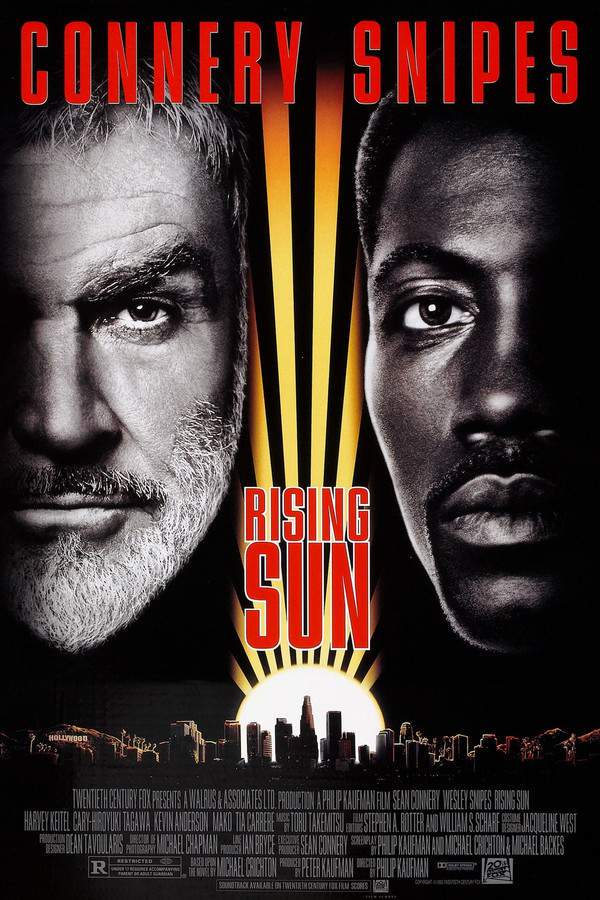
Rising Sun (1993) movie poster

Plot Summary

Rising Sun (1993) Plot Summary Explained

Release, runtime and language
1993 · 129 min · English
Directed by
Philip Kaufman
Starring
Sean Connery, Wesley Snipes

A shocking murder within a Japanese corporation's Los Angeles headquarters sends detectives Conner and Smith into a world of cultural complexities and corporate secrets. Their investigation reveals a deceptive network connected to the victim's past, leading them deeper into a web of deceit. As they pursue the truth, they must confront a powerful and sinister force hidden within the corporation, challenging their understanding of justice and loyalty.

On this page (7)
  1. 1 Where to watch
  2. 2 What happens: full plot
  3. 3 Plot questions answered
  4. 4 The book behind the movie
  5. 5 Movie threads
  6. 6 Movies like Rising Sun
  7. 7 Every angle

Where to watch

Where to Watch Rising Sun (1993)

Where can you watch Rising Sun? Stream, rent or buy it in the US, including on Amazon Video, Apple TV Store and Fandango At Home: current JustWatch availability with up-to-date prices.

Streaming availability powered by JustWatch

Full plot summary · contains spoilers

What Happens in Rising Sun: Full Plot Summary

The whole story of Rising Sun (1993) explained, from the opening scene to the final frame: every key event, every twist and what it all adds up to. Read it as a quick recap before the sequel, to check a scene you missed, or to finally understand what really happened.

During a spectacular commencement gala held at the newly inaugurated Los Angeles headquarters of Nakamoto, a prominent Japanese Keiretsu, the evening takes a dark turn when a call girl, Cheryl Lynn Austin (Tatjana Patitz), is discovered dead, seemingly as a result of a brutal sexual encounter. The case draws in the expertise of Police Detectives Webster "Web" Smith (Wesley Snipes) and John Connor (Sean Connery), the latter of whom is a seasoned former police captain with a deep understanding of Japanese culture and affairs. Assigned as liaisons between the Japanese corporate executives and the investigating officer, Smith's former partner, Tom Graham (Harvey Keitel), both detectives face immense pressure as the Japanese insist on their involvement in the investigation.

Connor, immersed in Japanese customs yet viewed with skepticism by his own police department, finds himself in a precarious position as he tries to navigate diplomatic tensions. Ishihara (Stan Egi), representing Nakamoto, expresses concerns regarding any potential implications linking the call girl’s murder to the high-profile reception taking place nearby, attended by lawmakers and dignitaries. With a resolute and commanding tone, Connor persuades Ishihara to cooperate, uncovering a hidden room behind the boardroom walls that may hold critical evidence.

As the investigation unfolds, Connor and Smith review the surveillance footage, only to discover that a vital disc containing recordings from the time of the incident has mysteriously gone missing. Their inquiries lead them to Eddie Sakamura ([Cary-Hiroyuki Tagawa]), the jealous boyfriend of Cheryl, who is also an agent for a rival company. After a tense interrogation during a house party, they realize that, despite his questionable motives, Sakamura holds key information regarding Cheryl's death. A forensic examination reveals the perpetrator is of Japanese descent, lending more urgency to their pursuit.

Ishihara later presents the missing footage, which initially seems to implicate Sakamura in Cheryl's murder. However, it quickly becomes evident that the footage has been digitally altered, raising alarm bells for Connor and Smith. In a dramatic turn of events, a SWAT raid on Sakamura's residence leads to his demise while attempting to escape in a sports car, deepening the mystery surrounding the case.

Desperate for answers, Smith and Connor consult with Jingo Asakuma ([Tia Carrere]), who has a unique personal history that complicates her role in the investigation. Jingo, grappling with her heritage as the daughter of a Japanese mother and an African-American father, collaborates with Smith to analyze the digitally manipulated disc. Their partnership gradually evolves into something deeper as they explore each other's backgrounds amid the chaos of the case.

Meanwhile, Nakamoto is on the verge of a crucial business deal to acquire an American semiconductor company, with political maneuvering at play involving Senator John Morton (Ray Wise). Connor and Smith suspect that the senator’s actions have become entangled with the murder investigation. As the storyline unfolds, they confront Yoshida, Nakamoto's owner, who expresses dismay over allegations of racism levied against his company amid the scandal.

Amid the increasing complexities, Smith must contend with his own past as he faces accusations of corruption while trying to uphold justice. The tension escalates when they finally obtain the original footage from the surveillance cameras. In a shocking revelation, they see that the sinister act was committed by someone close to the center of power, with Senator Morton shown in a compromising position with Cheryl, further complicating his political ambitions.

In a daring tactical move to draw out the true killer, Smith and Connor show Morton incriminating footage, which leads to a frantic call to Ishihara and Morton’s eventual suicide, veiling the conspiracy in secrecy. The climax builds as the intertwined fates of the detectives, Jingo, and the corporate players come to a head, revealing hidden agendas and the lengths to which individuals will go to protect their interests.

As the dust settles, Connor, Smith, and Jingo expose the truth during tense negotiations, leading to the unexpected demise of Bob Richmond ([Kevin Anderson]), who tries to flee once he is unmasked as the real murderer. In a final act of subtlety, Yoshida manages to divert blame and restore his company's reputation but at a significant personal and moral cost.

In a poignant moment, Jingo confides in Smith, leaving him to ponder their complex relationship as they move forward in a world rife with distrust and intrigue, wondering who could really be the puppeteer orchestrating events from the shadows.

Last updated: January 14, 2025 at 19:25

Was this helpful?

Plot questions answered

Rising Sun Plot Explained: Your Questions Answered

The questions people ask most about Rising Sun (1993): what happens in the confusing scenes, why the characters do what they do, the twists, hidden details and what the ending means. Each answer contains spoilers.

Q1

Who killed Cheryl Lynn Austin?

Bob Richmond, an executive within Nakamoto, was the actual murderer of Cheryl Lynn Austin. He was revealed when the original surveillance footage exposed him as the perpetrator during the confrontation at Nakamoto headquarters. Richmond was subsequently killed by Sakamura's Yakuza associates as they sought revenge.

Foreshadowing: The film hints early on that someone 'close to the center of power' committed the murder, foreshadowing Richmond's involvement.

  • bob richmond
  • murderer
  • cheryl lynn austin
  • killer
Q2

Why was Senator Morton involved in the murder?

Senator Morton was having a compromising encounter with Cheryl Lynn Austin when she was killed. He was also secretly pressuring politicians to support Nakamoto's acquisition of a US semiconductor company, creating a conflict of interest that made him vulnerable to blackmail. When exposed with the original footage, Morton chose to commit suicide rather than face the political and legal consequences.

Foreshadowing: Morton's sudden shift in stance on the bill blocking Nakamoto's acquisition early in the film hinted at his entanglement in the scandal.

  • senator john morton
  • political scandal
  • suicide
  • cheryl
Q3

Why was the surveillance footage altered?

The surveillance footage was digitally altered by Bob Richmond and his conspirators to frame Eddie Sakamura for Cheryl's murder. This cover-up was designed to deflect suspicion away from the real killer and the political conspiracy surrounding Nakamoto's corporate acquisition. Jingo Asakuma identified the tampering by analyzing digital artifacts in the video.

Foreshadowing: The missing disc and Ishihara's suspicious delivery of the footage that 'incriminated' Sakamura were early warning signs of manipulation.

  • surveillance footage
  • digital manipulation
  • evidence tampering
  • sakamura
Q4

What happened to Eddie Sakamura?

Eddie Sakamura was initially a prime suspect but was framed for Cheryl's murder. After a SWAT raid on his home where he allegedly died in a car crash, he later resurfaced alive at Smith's apartment with the original footage. He was ultimately killed by Ishihara's men while attempting to provide evidence to Connor and Smith, though his Yakuza associates later avenged his death by killing Richmond.

Foreshadowing: Sakamura's reappearance at Smith's apartment after his supposed death revealed the depth of the conspiracy.

  • eddie sakamura
  • death
  • frame
  • yakuza
Q5

Why did Nakamoto avoid legal consequences?

Despite the exposure of the murder and corporate conspiracy, President Yoshida managed to divert blame away from the corporation and restore Nakamoto's reputation. Through political maneuvering and carefully orchestrated negotiations, the company evaded true accountability while sacrificing those involved in the cover-up.

Foreshadowing: Yoshida's initial expressions of dismay over racism allegations hinted at his willingness to protect the company at any cost.

  • nakamoto
  • yoshida
  • corporate accountability
  • consequences
Q6

How did Jingo Asakuma help solve the case?

Jingo Asakuma, a computer expert with expertise in digital forensics, analyzed the surveillance disc and confirmed it had been digitally altered. Her technical analysis revealed that the footage implicating Sakamura was fabricated, which led the detectives to seek the original recording. Her partnership with Smith also provided crucial emotional support during the investigation.

Foreshadowing: Jingo's introduction as someone with unique skills and a complicated personal background positioned her as essential to unraveling the digital evidence.

  • jingo asakuma
  • digital analysis
  • evidence
  • computer expert
Q7

What was the connection between the murder and the corporate deal?

The murder was tied to Nakamoto's attempt to acquire an American semiconductor company. Senator Morton was secretly pressuring politicians to support the acquisition while also being involved with Cheryl Lynn Austin. When Cheryl was killed, Morton and other conspirators needed to cover up the scandal to protect both the corporate deal and Morton's political career, leading to the frame-up of Sakamura and the manipulation of evidence.

Foreshadowing: The political maneuvering involving Morton and the acquisition subplot ran parallel to the murder investigation throughout the film.

  • nakamoto acquisition
  • senator morton
  • corporate deal
  • semiconductor
Q8

Why was Eddie Sakamura framed for the murder?

Eddie Sakamura was framed because he was a rival of Nakamoto and dating Cheryl Lynn Austin, making him a convenient suspect. The conspirators manipulated the surveillance footage to show him committing the crime, which would redirect police investigation away from the real killer and the political figures involved. This allowed the cover-up to protect both the corporate deal and those in power.

Foreshadowing: Sakamura's status as Cheryl's jealous boyfriend and his role as an agent for a rival company made him an obvious fall guy.

  • eddie sakamura
  • frame
  • rival company
  • suspect
Q9

What was the relationship between Jingo Asakuma and Web Smith?

Jingo Asakuma and Web Smith developed a romantic relationship during the investigation. Their partnership evolved as they worked together to analyze the digital evidence, with Jingo sharing her personal background as the daughter of a Japanese mother and African-American father. By the end of the film, Jingo confides in Smith about their complex relationship, leaving them to ponder their future together in a world filled with distrust.

Foreshadowing: Their collaboration on analyzing the disc and sharing personal histories created the foundation for their evolving relationship.

  • jingo asakuma
  • web smith
  • romance
  • relationship
Q10

Why did Ishihara order Sakamura's death?

Ishihara, representing Nakamoto, orchestrated the frame-up of Sakamura and later ordered his killing to prevent him from revealing the truth about Cheryl's murder. When Sakamura survived the SWAT raid and obtained the original footage, Ishihara's men tracked him to Smith's apartment and killed him to silence the only witness who could expose the real conspiracy.

Foreshadowing: Ishihara's initial reluctance to cooperate and his suspicious delivery of altered footage hinted at his deep involvement in the cover-up.

  • ishihara
  • kill sakamura
  • cover-up
  • conspiracy
Q11

Why did Bob Richmond kill Cheryl Lynn Austin?

Bob Richmond killed Cheryl Lynn Austin during a violent sexual encounter, as revealed in the original surveillance footage. His exact motivation beyond the act itself was not extensively explored, but his position within Nakamoto and his willingness to manipulate evidence to cover up the murder suggested he was protecting both himself and the corporation's interests.

Foreshadowing: The film established early that the murder occurred during a 'brutal sexual encounter,' pointing to a crime of passion or violence by someone with access.

  • bob richmond
  • motive
  • kill
  • cheryl lynn austin

Movie threads

More Movies Like Rising Sun, by Mood & Story

Curated lists built around what makes Rising Sun tick: the same mood, the same kind of story or the same emotional payoff. Each list explains why these movies belong together.

Corporate Conspiracy Movies like Rising Sun

Investigations that peel back the polished veneer of powerful institutions. If you liked the corporate intrigue and clandestine dealings in Rising Sun, you'll enjoy these movies. This thread features tense thrillers about exposing corruption within powerful institutions, where the real enemy is the system itself.

  • tense
  • paranoid
  • investigative
  • gritty
  • clandestine
  • suspenseful
  • Tone: tense, cynical
  • Pacing: fast, investigative
Why these movies?

The story pattern: The narrative typically follows an investigation, often by an outsider or disillusioned insider, that begins with a single event and spirals into a complex conspiracy. The journey exposes the moral rot at the heart of a powerful organization, challenging the protagonist's perception of justice and authority.

Why they belong together: Movies in this group are united by their focus on institutional power as the antagonist. They share a tense, paranoid atmosphere, complex plots involving cover-ups, and a cynical view of corporate or political entities that operate above the law.

Gritty Detective Movies with Bittersweet Endings like Rising Sun

Cases where finding the truth comes with a heavy personal and moral cost. For viewers who appreciated the gritty, unresolved justice in Rising Sun, this thread collects detective stories where the investigation's conclusion feels more bitter than sweet. These movies explore the heavy toll of seeking truth in a corrupt world.

  • gritty
  • cynical
  • tense
  • suspenseful
  • atmospheric
  • heavy
  • Tone: tense, gritty, cynical
  • Pacing: fast, relentless
Why these movies?

The story pattern: The narrative arc follows a procedural investigation that exposes a larger, unforgivable corruption. The journey is fast-paced and intense, leading to a resolution that, while technically solving the crime, leaves a profound sense of unease and the realization that true power remains unaccountable.

Why they belong together: These films are grouped by their shared mood of cynical realism and their narrative structure that prioritizes thematic resonance over neat closure. They deliver a heavy emotional weight and often end on a note of ambiguous or compromised victory.

If you liked this

Movies Like Rising Sun

Similar movies to Rising Sun: the same genre, themes or kind of story. Each one comes with its own plot summary, timeline and ending explained.

Browse all movie summaries

Every angle

Rising Sun (1993) Explained: Plot, Timeline & Characters

Everything about Rising Sun in one place: what happens in the plot summary, the timeline in chronological order, the characters and meaning and a spoiler-free summary. What's After the Movie adds the cast, box office and post-credit scenes.

Coming soon on iOS and Android

The Plot Explained Movie Summary App

Plot summaries, endings explained and timelines on your phone. Catch up on any movie in minutes, save your favorites and never miss a twist again.

Be the first to know when we launch. Your email stays private, always.

Learn more about the app