Plot Explained Spoilers guaranteed!
Plot Explained

Browse by genre

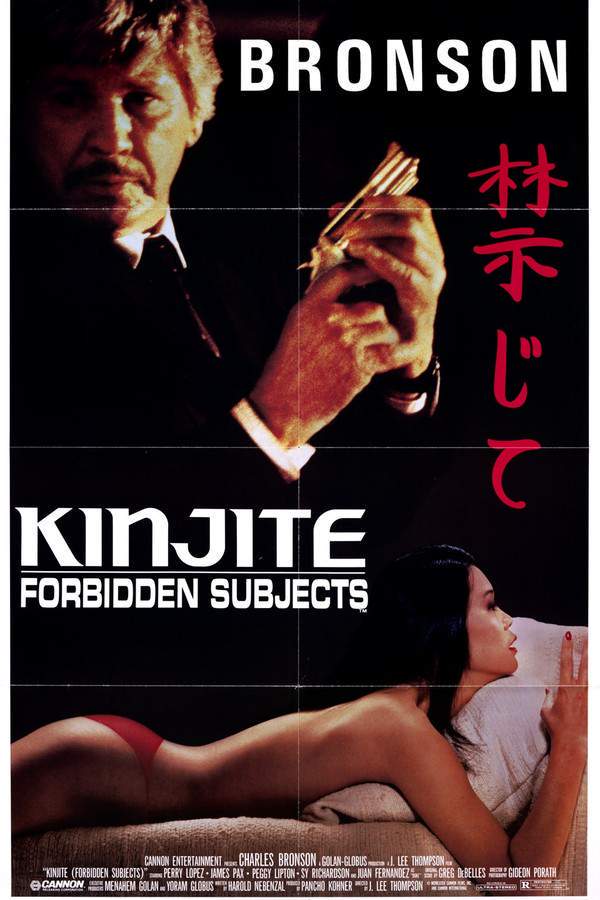
Kinjite: Forbidden Subjects (1989) movie poster

Plot Summary

Kinjite: Forbidden Subjects (1989) Plot Summary Explained

Release, runtime and language
1989 · 97 min · English
JustWatch #25,063 5
Directed by
J. Lee Thompson
Starring
Bill McKinney, Charles Bronson, Peggy Lipton, Perry Lopez, Sy Richardson, Juan Fernández

A veteran detective and his partner navigate the dangerous underbelly of Los Angeles, relentlessly tracking a ruthless pimp who preys on vulnerable teenagers. The investigation leads them deep into a world of exploitation and violence as they work to bring him to justice.

On this page (6)
  1. 1 Where to watch
  2. 2 What happens: full plot
  3. 3 Plot questions answered
  4. 4 Movie threads
  5. 5 Movies like Kinjite: Forbidden Subjects
  6. 6 Every angle

Where to watch

Where to Watch Kinjite: Forbidden Subjects (1989)

Where can you watch Kinjite: Forbidden Subjects? Stream, rent or buy it in the US, including on fuboTV, MGM Plus and Philo: current JustWatch availability with up-to-date prices.

Streaming availability powered by JustWatch

Full plot summary · contains spoilers

What Happens in Kinjite: Forbidden Subjects: Full Plot Summary

The whole story of Kinjite: Forbidden Subjects (1989) explained, from the opening scene to the final frame: every key event, every twist and what it all adds up to. Read it as a quick recap before the sequel, to check a scene you missed, or to finally understand what really happened.

In the midst of a tumultuous marriage, Japanese entrepreneur Hiroshi Hada's attention is drawn to a woman in the chaotic environment of Tokyo's subway system. Her silent yet involuntary climaxes starkly contrast with the violent assault happening nearby. Intrigued by this odd phenomenon, his curiosity deepens when he observes a similar occurrence during a bus ride home. Attempting to replicate the situation himself, Hada's actions provoke a drastically different response from his Caucasian victim, leading to dire consequences: he faces a brutal robbery and assault by a mugger.

As the repercussions of Hada's reckless behavior spiral out of control, several innocent Asian men fall prey to violence, mistakenly identified as the perpetrator and subjected to savage beatings by bystanders. Meanwhile, Hada's daughter, Fumiko, finds herself ensnared in a harrowing child prostitution ring controlled by the notorious "Pimp King," Duke.

In this intricate web of misfortune, Lt. Crowe, father to Rita, a victim of Hada's previous misconduct on the bus, dedicates himself to finding Fumiko. Initially harboring a strong bias against all things Japanese, his perspective shifts dramatically as he witnesses the unwavering love and commitment the Hada family displays for their daughter—a bond that rivals his own protective instincts as a father.

Eventually, the unlikely pair of Crowe and his partner Eddie Rios successfully locate Fumiko, bringing her nightmare to an end, although the psychological scars from her experiences remain haunted and deep. The vicious leader of the gang, Duke, meets a violent fate at the hands of law enforcement, yet his sinister accomplices manage to escape, leaving behind the chilling knowledge that their malevolent actions will have enduring repercussions.

Later, as the Hadas express their gratitude with gifts at Crowe's home, a heavy unease cloaks the atmosphere between Hiroshi and Rita—two lives that intersected under tragic circumstances. The fragile hope for closure is brutally shattered when Fumiko tragically succumbs to an overdose, a poignant reminder that the trauma she endured will forever haunt her soul.

As dusk descends over the serene harbor, Crowe and Rios embark on a reckless journey to hunt down the infamous Duke, ultimately discovering him aboard a vessel in the vibrant marina. The confrontation escalates swiftly, resulting in Rios's brutal demise at the hands of Duke and his remaining gang. However, in a twist of fate, Duke finds himself plunged into the harbor's depths, struggling against the oppressive pressure of his own fate. With a calculated calmness, Crowe offers Duke a chilling ultimatum: succumb to the merciless tides or risk being rescued by his nemesis. Surprisingly, Crowe opts for the latter, only to intensify Duke's despair by condemning him to a maximum-security prison known for its depravity and aggressive inmates.

As the cell door slams shut behind him, Duke is faced with a horrific reality: the sickening whispers and dark intentions of his cellmate trap him in a waking nightmare, forcing him to confront the looming threat of sexual assault in a hell imagined by the darkest of minds. As Crowe departs, a sardonic satisfaction mark his face, as if he is relishing the bitter taste of poetic justice that unfolds before him.
Last updated: November 17, 2024 at 18:17

Was this helpful?

Plot questions answered

Kinjite: Forbidden Subjects Plot Explained: Your Questions Answered

The questions people ask most about Kinjite: Forbidden Subjects (1989): what happens in the confusing scenes, why the characters do what they do, the twists, hidden details and what the ending means. Each answer contains spoilers.

Q1

Why does Hiroshi Hada attack the woman on the bus?

Hiroshi Hada becomes obsessed with replicating what he witnessed on the Tokyo subway, a woman having involuntary climaxes amid chaos. During the bus ride, he attempts to force the same situation on a Caucasian woman, but she reacts with terror rather than the phenomenon he expected. His attempt escalates into a violent assault, which triggers the chain of tragic events that follows.

Foreshadowing: Earlier in the subway, Hada is shown as a man distracted and dissatisfied in his marriage, seeking inappropriate stimulation.

  • hiroshi hada
  • bus assault
  • tokyo subway
  • sexual assault
Q2

Why are innocent Asian men beaten after the bus incident?

After Hada assaults the Caucasian woman on the bus, witnesses describe the attacker as an Asian man. This leads to a wave of retaliatory violence where bystanders and vigilantes attack several innocent Asian men throughout Tokyo, mistakenly identifying them as the perpetrator. The film shows how Hada's individual act of violence triggers broader systemic prejudice and collateral suffering.

Foreshadowing: The chaotic environment of the subway and bus scenes establishes a climate where violence and misunderstanding spread quickly.

  • asian men
  • violence
  • bystanders
  • revenge attacks
  • tokyo
Q3

How does Fumiko end up in Duke's prostitution ring?

The film implies that Duke's criminal network exploits the chaos caused by Hada's assault. While not explicitly shown, Fumiko becomes a target for Duke's child prostitution ring as a result of the societal混乱 following the bus incident. The timing suggests her abduction is a tragic consequence of the family's heightened vulnerability during this crisis period.

Foreshadowing: The film establishes Duke as a powerful pimp who preys on vulnerable teenagers, and the Hada family becomes increasingly exposed to danger after the bus scandal.

  • fumiko
  • duke
  • pimp king
  • child prostitution
  • kidnapping
  • abduction
Q4

Why does Lt. Crowe help find Fumiko after his daughter was victimized?

Lt. Crowe's daughter Rita was the victim of Hada's bus assault, giving him every reason to hate the Hada family. However, as he investigates Fumiko's disappearance, he witnesses the Hadas' genuine anguish and unconditional love for their daughter. This transforms his initial anti-Japanese bias, as he recognizes that their capacity for love and sacrifice mirrors his own feelings for Rita, transcending racial prejudice.

Foreshadowing: Crowe's initial scenes show his deep love for Rita and his anger at what was done to her, making his eventual compassion shift more meaningful.

  • lt crowe
  • rita
  • hada family
  • prejudice
  • father love
  • redemption
Q5

What causes Fumiko to overdose at the end?

Fumiko succumbs to a drug overdose, which the film presents as the lingering psychological trauma from her experiences in Duke's child prostitution ring. While the exact circumstances are not shown in detail, her death symbolizes the long-lasting damage that such trauma inflicts on victims, even after physical rescue, the psychological wounds prove fatal. This tragic outcome underscores the film's dark themes about the irreversible consequences of exploitation.

Foreshadowing: Earlier, the film notes that Fumiko's psychological scars are expected to linger long after her rescue, foreshadowing her inability to recover.

  • fumiko overdose
  • trauma
  • drug overdose
  • psychological scars
  • death
Q6

Why does Lt. Crowe offer Duke the choice between drowning and prison?

After Duke kills Rios during the harbor confrontation, Crowe captures him but chooses a form of poetic justice rather than straightforward execution. He forces Duke to choose between drowning in the harbor or facing imprisonment in a maximum-security facility known for its brutal conditions. This reflects Crowe's desire for revenge while maintaining legal appearance, he wants Duke to suffer the worst possible fate within the system rather than giving him the quick death of drowning.

Foreshadowing: The film establishes Crowe's journey from law enforcement to morally ambiguous justice-seeking, especially after losing his partner Rios.

  • duke
  • crowe
  • drowning
  • prison
  • poetic justice
  • ultimatum
Q7

What happens to Duke in prison at the end?

Duke is sent to a maximum-security prison notorious for its brutality. The final scene shows Duke's cellmate displaying predatory intentions toward him, trapping Duke in a horrifying situation of imminent sexual assault. The film implies Duke will face the same kind of exploitation and violence he inflicted on others, leaving him in a perpetual nightmare, symbolizing a fate worse than death.

Foreshadowing: Duke's crimes centered on sexual exploitation and violence against vulnerable people, making his prison fate an ironic reversal of his past actions.

  • duke prison
  • sexual assault
  • exploitation
  • maximum security
  • cellmate
Q8

Why does Lt. Crowe smile when leaving Duke's prison cell?

Crowe displays a sardonic, satisfied expression as he leaves Duke's cell because he has achieved his version of justice. After Duke killed his partner Rios and caused immense suffering to multiple victims, including Crowe's own daughter, Crowe has delivered Duke to a fate of constant threat and degradation. His smile reflects bitter satisfaction, though the film frames it as morally ambiguous: justice is served, but through revenge rather than proper legal process.

Foreshadowing: Crowe's journey shows his transformation from biased detective to vengeful protector, culminating in this morally questionable conclusion.

  • crowe smile
  • duke
  • revenge
  • justice
  • ending
Q9

Why isn't Fumiko's rescue a happy ending?

While Lt. Crowe and Rios successfully locate and rescue Fumiko from Duke's ring, the victory is hollow. The film makes clear that her psychological trauma is deep and persistent. Her eventual overdose death proves that physical rescue cannot undo the psychological damage inflicted by prolonged exploitation. The narrative demonstrates that child exploitation leaves scars that often prove fatal, challenging any notion of a triumphant resolution.

Foreshadowing: Early notes about Fumiko's lingering psychological scars establish that her rescue is only the beginning of a longer tragedy.

  • fumiko rescue
  • psychological trauma
  • exploitation
  • tragic ending

Movie threads

More Movies Like Kinjite: Forbidden Subjects, by Mood & Story

Curated lists built around what makes Kinjite: Forbidden Subjects tick: the same mood, the same kind of story or the same emotional payoff. Each list explains why these movies belong together.

Grim Urban Crime Thrillers like Kinjite: Forbidden Subjects

Sleuths descend into the city's sordid underworld to confront human depravity. If you liked the relentless, grim investigation in Kinjite: Forbidden Subjects, this thread features similar movies. These are fast-paced, high-intensity crime stories set in oppressive urban environments, focusing on detectives tackling disturbing cases of exploitation and violence.

  • gritty
  • tense
  • disturbing
  • oppressive
  • desperate
  • vengeful
  • Tone: dark, tense, grim
  • Pacing: fast, relentless
Why these movies?

The story pattern: The narrative typically centers on a dogged investigation into a brutal crime, often involving vulnerable victims. The protagonist, usually a jaded or driven detective, follows a trail of clues through a city's underbelly, leading to violent confrontations and a resolution that offers justice but little solace.

Why they belong together: These films are grouped by their shared commitment to a dark, procedural tone, high-stakes pacing, and a setting that feels like a character itself—a corrupt and dangerous city. They deliver a stressful, emotionally heavy experience focused on the grim reality of crime fighting.

Movies with Bittersweet Justice like Kinjite: Forbidden Subjects

Stories where hard-won justice is overshadowed by lasting psychological scars. For viewers who appreciated the complex, bittersweet ending of Kinjite: Forbidden Subjects, this thread collects movies where justice is served, but the cost is immense. These films feature heavy emotional weight, dark themes, and conclusions where trauma overshadows any sense of victory.

  • vengeful
  • disturbing
  • grim
  • heavy
  • traumatic
  • bittersweet
  • Tone: dark, bittersweet, grim
  • Pacing: variable, often fast-paced with a heavy conclusion
Why these movies?

The story pattern: The narrative pattern involves a grievous wrong that demands a response, often vengeance or violent justice. While the perpetrator meets a fitting end, the journey inflicts severe damage on the protagonists or victims. The resolution acknowledges the price paid, leaving characters and audience with a heavy sense of loss amid the justice.

Why they belong together: This thread unites films through their shared emotional trajectory: a descent into darkness in pursuit of justice, culminating in an ending that is morally ambiguous and emotionally draining. The key similarity is the focus on the lasting impact of trauma, making the 'win' feel hollow and complex.

If you liked this

Movies Like Kinjite: Forbidden Subjects

Similar movies to Kinjite: Forbidden Subjects: the same genre, themes or kind of story. Each one comes with its own plot summary, timeline and ending explained.

Browse all movie summaries

Every angle

Kinjite: Forbidden Subjects (1989) Explained: Plot, Timeline & Characters

Everything about Kinjite: Forbidden Subjects in one place: what happens in the plot summary, the timeline in chronological order, the characters and meaning and a spoiler-free summary. What's After the Movie adds the cast, box office and post-credit scenes.

Coming soon on iOS and Android

The Plot Explained Movie Summary App

Plot summaries, endings explained and timelines on your phone. Catch up on any movie in minutes, save your favorites and never miss a twist again.

Be the first to know when we launch. Your email stays private, always.

Learn more about the app