Plot Explained Spoilers guaranteed!
Plot Explained

Browse by genre

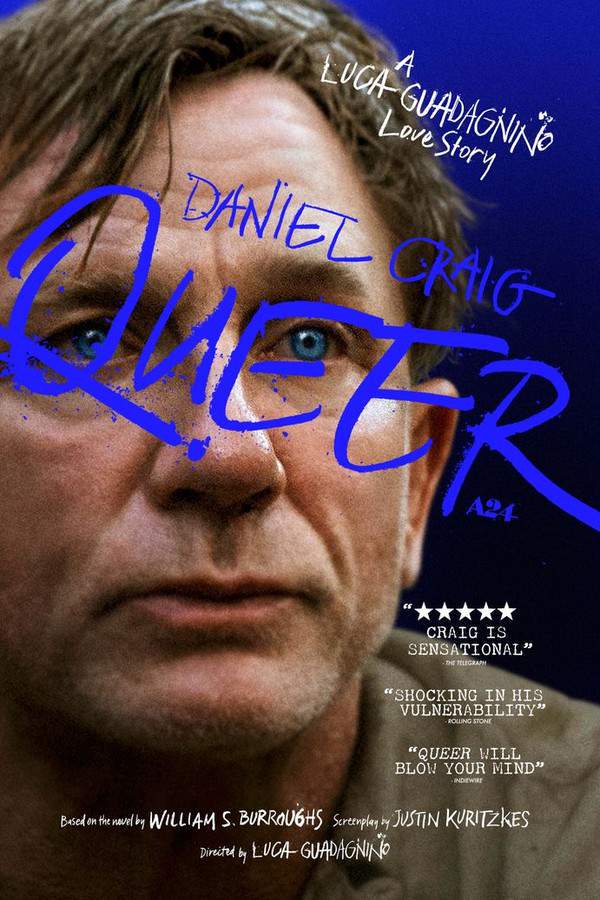
Queer (2024) movie poster

Plot Summary

Queer (2024) Plot Summary & Ending Explained

Release, runtime and language
2024 · 2 h 15 m · English
Echo score 61
JustWatch #18,698 3
Directed by
Luca Guadagnino
Starring
Jason Schwartzman, Gilberto Barraza, Daniel Craig, Drew Starkey, Drew Droege, Henrique Zaga
Budget
$53.4M

In 1950s Mexico City, William Lee, an American expatriate in his late forties, lives a solitary existence within a small American community. His quiet life is disrupted by the arrival of Eugene Allerton, a young student, who encourages William to seek a meaningful connection with someone.

On this page (8)
  1. 1 Where to watch
  2. 2 What happens: full plot
  3. 3 Plot questions answered
  4. 4 How it ends
  5. 5 The book behind the movie
  6. 6 Movie threads
  7. 7 Movies like Queer
  8. 8 Every angle

Where to watch

Where to Watch Queer (2024)

Where can you watch Queer? Stream, rent or buy it in the US, including on Amazon Video, Apple TV Store and Fandango At Home: current JustWatch availability with up-to-date prices.

Streaming availability powered by JustWatch

Full plot summary · contains spoilers

What Happens in Queer: Full Plot Summary

The whole story of Queer (2024) explained, from the opening scene to the final frame: every key event, every twist and what it all adds up to. Read it as a quick recap before the sequel, to check a scene you missed, or to finally understand what really happened.

The film opens with William Lee (Daniel Craig), an American expatriate, wandering through the colorful streets of Mexico City in the 1950s. Here, he encounters a young Jewish man who he suspects is hiding his true self, creating a palpable tension between them. This fleeting encounter sets the tone for Lee’s life, as he struggles to connect genuinely with others, often retreating into a world of casual flings and the comforting embrace of heroin, which he uses to escape his reality.

Among his few companions is Joe Guidry (Jason Schwartzman), who shares his occasional escapades at a gay bar named Ships Ahoy. As Lee navigates the challenges of his sexual identity and addiction, he stumbles upon Eugene Allerton (Drew Starkey), a younger man who initially seems disinterested in Lee’s advances, preferring the company of a woman named Mary. However, Lee's persistence begins to break through Allerton's defenses, leading to a complex relationship fraught with misunderstandings and unreciprocated desires.

On one reflective evening, after a wild night out that leaves him embarrassed and unconscious, Lee experiences a vivid dream featuring a mysterious figure sharpening a knife and a disembodied woman questioning his identity. In this dreamscape, he confesses, “I am not queer, but disembodied,” highlighting his internal struggle to fit into societal labels.

As fate would have it, Lee shares his fascination with yagé (ayahuasca), a hallucinogenic plant he believes could unlock hidden truths and enhance telepathic abilities. Intrigued, Allerton eventually agrees to accompany Lee on a transformative journey to South America, where their adventures take a dramatic turn.

Upon their arrival, Lee faces harrowing withdrawal symptoms and the relentless grip of his addiction. They seek the help of a local doctor, who sternly informs Lee that he must abandon his destructive habits to move forward. In desperation, he contacts a botanist who directs him to Dr. Cotter (played by Lesley Manville), who has expert knowledge about yagé and its effects.

As they trek through the lush jungle, the duo must endure terrifying challenges that test their bond. It is only at Cotter's home that they find solace and enlightenment, yet the experience is anything but ordinary. After drinking the yagé, they plunge into a whirlwind of intense hallucinations, culminating in a hauntingly beautiful moment where their souls appear to intertwine, suggesting a profound connection that transcends physical touch.

However, their journey does not end here; what follows is a painful separation that leaves Lee longing for connection. Fast forward two years, and Lee is back in Mexico City, grappling with the weight of the past. He reunites with Joe, who fills him in on Allerton’s mysterious fate, hinting that his friend may have embarked on another quest in South America.

That night, the boundaries between reality and memory blur once more as Lee has an unsettling dream where he faces Allerton in a game reminiscent of William Tell. Tragedy strikes as he inadvertently harms Allerton, resulting in soul-crushing regret that echoes through his mind. As the dream crumbles into darkness, a poignant metaphor for loss, Lee awakens to the haunting solitude of his life.

In the final moments of his journey, we see an elderly Lee, reflecting on love and loss as Allerton's voice gently reaches out to him from the ether. Alone, he drifts into a dream state, imagining younger Allerton's presence beside him, ultimately succumbing to the silence of death — alone but forever entwined with the memories of a love that could never fully bloom.
Last updated: December 24, 2024 at 10:01

Was this helpful?

Plot questions answered

Queer Plot Explained: Your Questions Answered

The questions people ask most about Queer (2024): what happens in the confusing scenes, why the characters do what they do, the twists, hidden details and what the ending means. Each answer contains spoilers.

Q1

Why does William Lee live in Mexico City instead of staying in the US?

William Lee relocated to Mexico City to escape his heroin addiction and the consequences of his lifestyle in America. His addiction was severe enough that he needed to leave his entire life behind. The move represents both an attempt at starting fresh and a retreat from the societal constraints of 1950s America, where his sexuality and drug use would have been criminalized.

  • addiction
  • heroin
  • mexico city
  • expatriate
  • american
Q2

Why does Eugene Allerton initially reject William Lee's advances?

Eugene Allerton initially rejects William Lee because he is struggling with his own identity and is not openly gay. He prefers the company of women, specifically Mary, as a safer and more socially acceptable option. Additionally, Allerton is inexperienced with men and feels uncomfortable with Lee's persistent advances, which initially come across as aggressive and unwelcome.

  • eugene allerton
  • rejection
  • identity
  • sexuality
  • mary
Q3

What does William Lee's dream about the disembodied woman mean?

During the dream, a disembodied woman questions Lee's identity while he confesses "I am not queer, but disembodied." This reflects his deep internal conflict about his sexuality and existence. He feels disconnected from both society's labels and his own body, using drugs and casual encounters to escape a sense of not fully belonging anywhere. The dream captures his psychological alienation.

  • dream
  • disembodied
  • identity
  • queer
  • psychological
Q4

What happens during the yagé ceremony with Dr. Cotter?

After drinking yagé (ayahuasca), Lee, Allerton, and Dr. Cotter experience intense hallucinations and a sense of telepathic communication. The most significant moment occurs when their souls appear to intertwine and their bodies seem to merge, creating a profound spiritual connection that transcends physical touch. This experience is meant to unlock hidden truths and deepen their bond.

  • yage
  • ayahuasca
  • hallucination
  • dr cotter
  • spiritual connection
Q5

Why do William Lee and Eugene Allerton separate after the yagé experience?

After their profound yagé experience, Lee and Allerton become lost in the jungle, symbolizing the fragility of their connection. Despite the spiritual intimacy they shared, the relationship could not sustain itself in reality. Allerton eventually leaves and returns to South America, while Lee returns to Mexico City alone, suggesting their bond existed more in the psychedelic realm than in everyday life.

  • separation
  • jungle
  • yage
  • relationship
  • eugene allerton
Q6

What happened to Eugene Allerton after he left?

Two years after their separation, Lee learns from Joe that Allerton returned to South America in search of Lee. This suggests Allerton was driven to find him again, possibly seeking to reconnect after their transformative yagé experience. However, their paths never cross again, and Allerton's ultimate fate remains uncertain, he simply disappears into another quest.

  • eugene allerton
  • disappearance
  • south america
  • joe guidry
Q7

What does William Lee's dream about shooting Allerton mean?

Lee dreams of playing a William Tell-style game where he shoots Allerton, causing him fatal harm. This dream represents his deep-seated guilt and fear of loss. He unconsciously harms those he loves, and the dream manifests his belief that his pursuit of connection inevitably destroys it. The dream foreshadows his inability to maintain meaningful relationships and the tragedy of his isolation.
  • william tell
  • dream
  • shooting
  • guilt
  • fear of loss
Q8

Why does William Lee die alone at the end of the movie?

William Lee dies alone because his persistent inability to form genuine connections ultimately defines his life. Despite his intense pursuit of Allerton and his fleeting encounters with other men, he never achieves true intimacy. His addiction, fear of vulnerability, and the era's social constraints keep him isolated. In his final moments, he only imagines Allerton's presence, confirming his lifelong solitude.

  • death
  • alone
  • solitude
  • william lee
  • ending
Q9

What is yagé and why is it important to William Lee?

Yagé (also known as ayahuasca) is a hallucinogenic plant used in traditional South American spiritual practices. Lee becomes obsessed with it because he believes it can unlock hidden truths and enhance telepathic abilities. He sees it as a potential path to genuine connection and self-understanding, hoping it will help bridge the emotional gap between himself and others.

  • yage
  • ayahuasca
  • hallucinogen
  • telepathy
  • spiritual
Q10

Why does William Lee get drunk and embarrass himself at the party?

At the party, Lee becomes excessively drunk in an attempt to impress Allerton and prove his worth. His overdrinking highlights his insecurity in the relationship and his reliance on substances to cope with social situations. The embarrassing incident strains their already fragile relationship, showing how Lee's addiction and desperation push others away.

  • party
  • drunk
  • embarrassment
  • relationship
  • eugene allerton

Ending explained

What Happens at the End of Queer?

How Queer (2024) ends, in short: the final scene, the last twist and what it means for the characters. The full ending explained, with every spoiler, lives on its own page.

Read the full ending explained

The ending of Queer is intentionally elusive and layered with symbolism, leaving viewers with a sense of longing and unresolved tension. Throughout the film, Lee's life is depicted as a continuous struggle with self-acceptance and the loneliness that often accompanies queer identity. His translucent, disembodied self represents his deep internal conflict and shame, revealing that he is often hiding his true feelings behind addictions and a façade of confidence. The telepathic drug, Yage, symbolizes his desire to communicate his innermost truths without fear, showing how much he longs to be truly heard and understood.

In the dream sequences and surreal images, such as the centipede and the disembodied figures, the film explores themes of growth, concealment, and disconnection. The centipede, with its many legs moving in sync or in chaos, signifies the fractured relationships Lee has with others, especially Gene, and his desperate wish for harmony. The prison dream reflects Lee’s subconscious plea for freedom from his inner torment.

Continue reading the ending (2 more paragraphs)

When Lee and Gene finally take Yage together, they experience a moment of unity where their hearts are out in the open, and they transcend physicality to communicate telepathically. In this state, Lee and Gene meld into one, symbolizing their shared longing for love and complete acceptance. However, as the drug's effects fade, they revert to their previous selves, with Gene retreating into his fear of being truly queer and disembodied, and Lee returning to his loneliness and disconnection.

The epilogue presents a haunting reflection two years later, where Lee is alone in a room, contemplating his life and regrets. The visual of the ouroboros, a snake eating its tail, suggests a cycle of rebirth and the hope for eventual reconciliation or peace. The visual of Gene’s silhouette and Lee’s act of shooting a gun at him evoke the tragic possibility of fully letting go, mirroring the tragic death of Burroughs’ wife and Lee’s own self-destructive tendencies. Yet, the final scene, where Lee is older and sees a young Gene once more, holding him in a tender embrace, hints at the faint hope that love, even unfulfilled, can endure beyond life's boundaries. Ultimately, Queer ends on a note of melancholic ambiguity—suggesting that while complete happiness may remain out of reach, the enduring longing for connection and understanding persists, echoing the complex nature of identity and love itself.

Queer ending explained in full

Movie threads

More Movies Like Queer, by Mood & Story

Curated lists built around what makes Queer tick: the same mood, the same kind of story or the same emotional payoff. Each list explains why these movies belong together.

Melancholic character dramas like Queer

Slow, introspective journeys of solitary figures grappling with identity and longing. If you liked the atmospheric, character-driven melancholy of Queer, explore more movies that focus on solitary figures and their introspective journeys. These films share a slow pacing, heavy emotional weight, and a deep dive into themes of identity, longing, and unrequited love.

  • melancholic
  • introspective
  • lonely
  • haunting
  • dreamlike
  • solitary
  • Tone: melancholic, introspective, haunting
  • Pacing: slow, deliberate, immersive
Why these movies?

The story pattern: These narratives follow a central, often isolated character as they navigate a period of intense personal reflection or crisis. The plot is secondary to the exploration of their internal state, which is frequently communicated through dreamlike sequences, a deliberate pace, and a pervasive sense of yearning that may or may not be resolved.

Why they belong together: They are grouped by their shared commitment to mood and character depth over complex plotting. The unifying elements are a melancholic tone, slow pacing that allows for introspection, and a central theme of grappling with a profound sense of loneliness or a fractured identity.

Movies about hallucinogenic journeys and obsessive love like Queer

Intense explorations of addiction and obsessive love, blurred by psychological distress. For viewers who appreciated the intense, drug-fueled hallucinations and the theme of destructive, unrequited love in Queer. This thread collects films about psychedelic self-discovery, addiction, and psychologically intense romantic obsessions that challenge perception.

  • hallucinogenic
  • distressing
  • obsessive
  • addiction
  • psychological
  • unrequited love
  • Tone: intense, distressing, melancholic
  • Pacing: variable, often slow with intense bursts
Why these movies?

The story pattern: The narrative pattern involves a protagonist falling into a spiral of obsession, often romantic or existential, exacerbated by substance use. Their perception becomes unreliable, leading to hallucinogenic sequences that mirror their inner turmoil. The journey is typically one of self-destruction, culminating in a bleak or sad realization of their isolation.

Why they belong together: These films are connected by their exploration of altered states of consciousness and the psychological unraveling of a character. They share a high intensity, disturbing themes, and a focus on how desire and addiction can distort reality and lead to emotional collapse.

If you liked this

Movies Like Queer

Similar movies to Queer: the same genre, themes or kind of story. Each one comes with its own plot summary, timeline and ending explained.

Browse all movie summaries

Every angle

Queer (2024) Explained: Plot, Ending, Timeline & Characters

Everything about Queer in one place: what happens in the plot summary, the timeline in chronological order, the characters and meaning, the ending explained and a spoiler-free summary. What's After the Movie adds the cast, box office and post-credit scenes.

Coming soon on iOS and Android

The Plot Explained Movie Summary App

Plot summaries, endings explained and timelines on your phone. Catch up on any movie in minutes, save your favorites and never miss a twist again.

Be the first to know when we launch. Your email stays private, always.

Learn more about the app