Plot Explained Spoilers guaranteed!
Plot Explained

Browse by genre

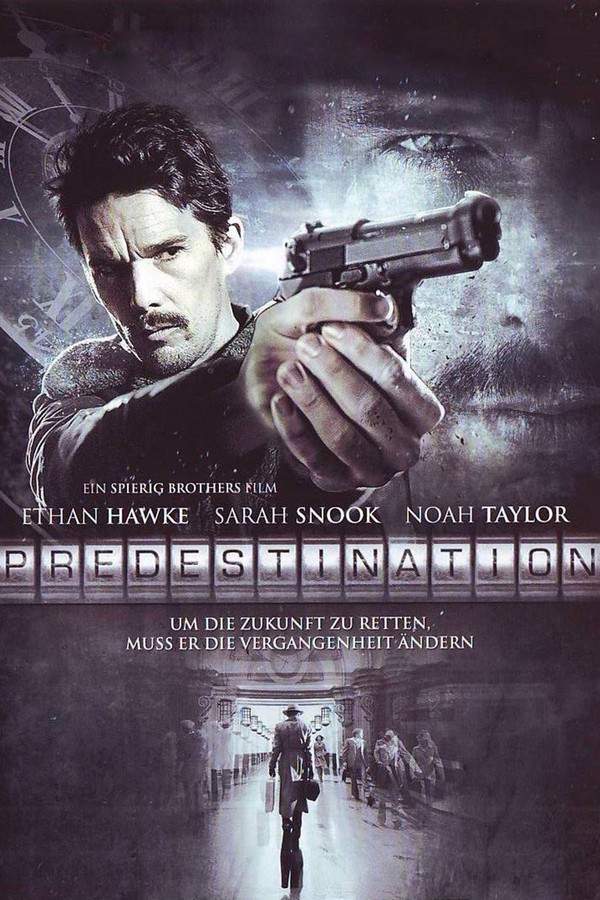
Predestination (2015) movie poster

Plot Summary

Predestination (2015) Plot Summary & Ending Explained

Release, runtime and language
2015 · 97 min · English
Loading streaming availability…
Directed by
Michael Spierig, Peter Spierig
Starring
Sarah Snook, Noah Taylor, Freya Stafford, Madeleine West

A seasoned temporal agent, portrayed by Ethan Hawke, is tasked with a dangerous mission to stop a criminal’s destructive plans. The agent pursues the suspect through time, facing increasingly complex paradoxes and challenges as they race to prevent a catastrophic attack with devastating consequences. The pursuit tests the agent's resolve and understanding of time itself.

On this page (8)
  1. 1 Where to watch
  2. 2 What happens: full plot
  3. 3 Plot questions answered
  4. 4 How it ends
  5. 5 The book behind the movie
  6. 6 Movie threads
  7. 7 Movies like Predestination
  8. 8 Every angle
Loading streaming availability…

Full plot summary · contains spoilers

What Happens in Predestination: Full Plot Summary

The whole story of Predestination (2015) explained, from the opening scene to the final frame: every key event, every twist and what it all adds up to. Read it as a quick recap before the sequel, to check a scene you missed, or to finally understand what really happened.

In March 1975, an agent finds himself embroiled in a gunfight while attempting to thwart a bombing in a crowded public building in New York City. The situation escalates, leading to a powerful explosion that leaves him with severe burns. Just as fate would have it, someone unseen intervenes and helps him wield a time-travel device, allowing him to retreat to his employer's facility in 1992. Unfortunately, his mission is deemed a failure; the elusive "Fizzle Bomber" he confronted remains at large, destined to strike again and ultimately causing the deaths of over eleven thousand individuals.

Following his injuries, the agent undergoes facial reconstruction surgery and suffers from vocal cord damage. Despite his recovery, his superiors, aware of the dangerous implications of prolonged time travel, compel him to retire. His doctor identifies signs of psychosis and depression but chooses to keep this information from him.

As he embarks on his final mission, he adopts the guise of a bartender in 1970 New York City. During his shifts, he engages with a customer who pens true confession articles under the pseudonym “The Unmarried Mother”. Thoroughly intrigued, the agent encourages this reserved individual to share his life story.

This customer, born as Jane in a Cleveland orphanage, was gifted with intelligence and physical strength, yet suffered the pain of being an outcast, always overlooked for adoption. These traits eventually led a man named Robertson to enlist her for SpaceCorp, a space organization that sought young women to be companions for male astronauts. However, during a routine aptitude test, a medical examination unveiled a hidden disqualifying condition. Despite promising to help her, Robertson turned Jane away under false pretenses.

Fast forward to 1963, Jane inadvertently encounters a man who brings her a fleeting sense of happiness, only to leave her deserted. It is during this tumultuous period that Robertson ultimately reveals that SpaceCorp serves as a cover for a clandestine government agency seeking operatives without familial obligations. Unfortunately, Jane's future is dimmed when she discovers she is pregnant with her lover's child. During a Caesarean section, doctors uncover Jane's intersex condition, leading to a forced hysterectomy and a series of gender reassignment surgeries.

As tragedy strikes, Jane's infant is abducted, pushing her to adopt the name John, an identity the agent has already come to know. Carrying a deep resentment towards his former lover, John eventually finds himself in New York City.

When the agent learns John's full narrative, he extends an unorthodox offer—providing John a chance to avenge his lover, all while promising him the chance to step into the agent's job. Together, they embark on a time-travel journey back to Cleveland in 1963. There, amidst personal revelations, John unwittingly falls for his younger self, ultimately learning that he has been led into an intricate trap set by the agent.

Departing from protocol, the agent decides to time travel again to March 1975 to confront the Fizzle Bomber once more. During a fierce confrontation, he bears witness to his former self, who suffers from injuries similar to his own, leaving him in a moral dilemma. Surprisingly, Robertson absolves him of consequences, a deviation from the Bureau's standard procedures.

In a significant twist, the agent returns to 1963, preserving Jane's baby—conceived from her self-fertilization with John—back to the Cleveland orphanage in 1945. This intricate series of events forms a predestination paradox, linking Jane, John, and the agent all as the same entity.

Upon returning to 1963, the agent persuades John to depart from Jane at the appropriate moment, integrating John into the Temporal Bureau by 1985. Despite the bittersweet end of his mission, the agent grapples with lingering regrets about the Fizzle Bomber, although Robertson acknowledges the bomber's role in catalyzing the Bureau's growth.

As the story unfolds, the agent settles back in New York City in 1975, just before the looming attack. He decommissions his time-travel device, only to find it still functional. Robertson had bestowed upon him crucial information regarding the Fizzle Bomber's whereabouts, leading to a shocking revelation—the bomber is none other than his future self, who justifies his bombings as a means to prevent even greater disasters in alternate timelines. Convinced of his path, the agent resolves not to follow in the bomber's footsteps and ultimately confronts and eliminates his older self.

In an emotional denouement, John's surgical scars echo the agent's, signifying the profound interconnection among Jane, John, the agent, and the Fizzle Bomber. Ultimately, Robertson orchestrated the agent's very existence, uniting the threads of conception and demise. In a poignant recording intended for John, the agent ponders the potential for change in the future, leaving audiences to muse over the complexities of time, choices, and identity.

Last updated: November 08, 2024 at 02:56

Was this helpful?

Plot questions answered

Predestination Plot Explained: Your Questions Answered

The questions people ask most about Predestination (2015): what happens in the confusing scenes, why the characters do what they do, the twists, hidden details and what the ending means. Each answer contains spoilers.

Q1

Why does the Fizzle Bomber plant bombs?

The Fizzle Bomber is actually the agent's future self. He justifies his bombings as a means to prevent even greater disasters in alternate timelines. He believes his violent actions are necessary to stop worse outcomes from occurring, making him a self-fulfilling prophecy of terrorism that the Temporal Bureau was created to combat.

Foreshadowing: Robertson acknowledges that the Fizzle Bomber's attacks paradoxically catalyzed the Bureau's growth, suggesting the bombings served a hidden purpose.

  • fizzle bomber
  • motivation
  • terrorism
  • time travel paradox
Q2

How are Jane, John, and the agent the same person?

The agent travels to 1945 and returns Jane's infant (conceived through self-fertilization when John impregnated his younger female self in 1963) to the Cleveland orphanage. This baby grows up to become Jane, who later becomes John, who later becomes the agent. It's a closed time loop where the agent creates his own existence by ensuring his birth.

Foreshadowing: John's scars at the end echo the agent's, signifying their physical interconnection.

  • predestination paradox
  • time loop
  • identity
  • jane
  • john
  • agent
Q3

What happened to Jane's baby?

During John's C-section in 1963, doctors discovered Jane's intersex condition and performed a forced hysterectomy. The infant was immediately abducted. The agent later travels back to 1945 and places the baby in the Cleveland orphanage, ensuring the child survives to become Jane. The baby was essentially stolen from its own future self.

Foreshadowing: The agent's decision to 'preserve Jane's baby' back to 1945 is the key to completing the predestination paradox.

  • baby
  • abduction
  • caesarean
  • 1945
  • orphanage
Q4

Why did Robertson recruit Jane for SpaceCorp?

SpaceCorp is a cover for a clandestine government agency seeking operatives without familial obligations. Robertson recruited exceptionally gifted individuals like Jane because they had no family ties that could compromise their loyalty or create vulnerabilities. When Jane's intersex condition was discovered during the aptitude test, Robertson abandoned her under false pretenses, discarding someone who no longer fit their requirements.

  • robertson
  • spacecorp
  • recruitment
  • government
Q5

What medical condition was discovered during Jane's examination?

Jane was born intersex with both male and female reproductive organs. During her medical aptitude test for SpaceCorp, doctors discovered this hidden condition, which disqualified her from serving as an astronaut companion. Later, during her C-section in 1963, doctors again found her intersex condition and performed a forced hysterectomy along with gender reassignment surgeries, transforming Jane into John.

Foreshadowing: This condition is what allows the predestination paradox to occur, as Jane/John possesses both reproductive systems needed to fertilize themselves.

  • intersex
  • hysterectomy
  • medical
  • gender reassignment
Q6

Why does the agent become the Fizzle Bomber?

The agent learns that his future self became the Fizzle Bomber after witnessing the devastating consequences of the 1975 bombing that killed over 11,000 people. Believing he could prevent even greater catastrophes in alternate timelines through selective bombings, his older self justified terrorism as a necessary evil. The agent initially resolves not to follow this path but is trapped in the predestination paradox.

Foreshadowing: Robertson's comment that the bomber's attacks paradoxically helped the Bureau grow hints at this cyclical nature.

  • future self
  • radicalization
  • terrorism
  • cycle
Q7

Why does the agent kill his older self?

After learning that the Fizzle Bomber is his future self, the agent faces a moral dilemma. Rather than allowing himself to become the bomber who kills thousands, he chooses to eliminate his older self to break the cycle. However, this act itself may be part of the predestination paradox, as the cycle appears inescapable.

Foreshadowing: The agent's confrontation with his injured former self in 1975 foreshadows this final encounter with his future self.

  • confrontation
  • suicide
  • morality
  • cycle breaking
Q8

Why did Robertson orchestrate the agent's entire existence?

Robertson orchestrated everything from Jane's conception to the agent's creation to serve the Temporal Bureau's needs. By uniting the threads of conception and demise, Robertson ensured the agent would exist to pursue the Fizzle Bomber, thereby creating the very organization that would hunt him. It's a self-serving loop where Robertson manipulates time to build the Bureau through its own greatest threat.

Foreshadowing: Robertson appears at multiple points in the timeline, always guiding events toward the agent's creation.

  • robertson
  • manipulation
  • conspiracy
  • temporal bureau
Q9

How does the time-travel device function in this movie?

The time-travel device appears to be a handheld box that allows instantaneous travel through time when activated. However, it's revealed that the device can still function even after being decommissioned. The Bureau uses these devices for temporal agents to pursue criminals across different time periods, though prolonged use causes psychological deterioration and visible aging effects.

Foreshadowing: The agent's severe burns and aging from time travel foreshadow the physical toll the technology takes.

  • time machine
  • device
  • temporal bureau
  • technology
Q10

What happens when John meets Jane in 1963?

The agent takes John back to 1963 Cleveland, where John encounters his younger self (Jane). During this encounter, John unknowingly falls in love with Jane, and they conceive a child together through self-fertilization, this is the same child that will become Jane, then John, then the agent. It's an intricate trap set by the agent to ensure the predestination paradox completes.

Foreshadowing: This meeting explains why Jane's mysterious lover in 1963 brought her brief happiness before abandoning her.

  • self-fertilization
  • incest
  • time paradox
  • 1963
Q11

Why is the agent forced to retire from the Temporal Bureau?

The agent is forced to retire due to the dangerous implications of prolonged time travel. His superiors note that extended temporal displacement causes severe psychological and physical deterioration. Additionally, his doctor identifies signs of psychosis and depression but chooses to conceal this information, possibly as part of Robertson's long-term manipulation to guide the agent toward his destined role.

Foreshadowing: The agent's psychological decline mirrors the transformation that leads to his future identity as the Fizzle Bomber.

  • retirement
  • psychosis
  • depression
  • temporal bureau
Q12

Who is The Unmarried Mother that the agent meets?

The Unmarried Mother is John, who writes true confession articles under that pseudonym while working as a bartender's customer. John is the post-surgical male identity of Jane, who was born intersex and underwent forced gender reassignment. The agent becomes intrigued by John's life story, which ultimately reveals the complete narrative of Jane's abandonment, pregnancy, and transformation.

Foreshadowing: The agent's curiosity about John's story is purposeful, he already knows the key details and is setting up the predestination paradox.

  • confession articles
  • pseudonym
  • john
  • identity

Ending explained

What Happens at the End of Predestination?

How Predestination (2015) ends, in short: the final scene, the last twist and what it means for the characters. The full ending explained, with every spoiler, lives on its own page.

Read the full ending explained

The ending of Predestination reveals a complex and mind-bending revelation about the true identity of the Fizzle Bomber: it is actually the protagonist, Agent Doe, who has traveled through time and become his own worst enemy. Throughout the film, we learn that the entire loop is centered around a series of interconnected events caused by a time travel paradox. Jane, who was born intersex, undergoes surgeries and later falls in love with a mysterious man, only to discover that she is actually the same person as John, who was originally Jane before her surgeries. This means that John, Jane, and the child she conceived are all the same individual caught in a circular timeline. When John becomes an agent, he is tasked with stopping the Fizzle Bomber, but ironically, he is the very person who turns into the bomber himself, completing the tragic cycle. The film shows that his failure to prevent his destiny leads him to kill the Fizzle Bomber—who turns out to be himself—thus sealing his fate. The crucial figure behind all these manipulations is Mr. Robertson, who is revealed to have orchestrated the entire loop—recruiting Jane, ensuring her transformation, and ultimately creating the circumstances for the agent's life and actions. The implications are profound: this is a story about predestination, where free will seems to be an illusion, and characters are trapped within a set cycle of their own making. The ending prompts viewers to reflect on whether the future can truly be changed or if these events are written in the fabric of time. In the final moments, the protagonist leaves a message questioning if the future is ever alterable, hinting at the hope that perhaps, with awareness, he can break free from the cycle. Ultimately, the ending underscores the film's philosophical exploration of fate, trauma, and the relentless nature of predestined events, leaving audiences pondering whether the cycle can ever be truly broken.

Predestination ending explained in full

Movie threads

More Movies Like Predestination, by Mood & Story

Curated lists built around what makes Predestination tick: the same mood, the same kind of story or the same emotional payoff. Each list explains why these movies belong together.

Time Loop Tragedies like in Predestination

Stories where characters are trapped in circular, self-destructive fates. If you liked the tragic, circular logic of Predestination, explore more movies like it. This collection features complex sci-fi and thrillers where characters confront mind-bending paradoxes and self-fulfilling prophecies, leading to heavy, often melancholic conclusions.

  • mind-bending
  • fatalistic
  • tragic
  • paradoxical
  • existential
  • tense
  • Tone: dark, melancholic, fatalistic
  • Pacing: fast-paced, puzzle-driven
Why these movies?

The story pattern: Stories in this thread are built around intricate, often paradoxical, narrative structures. The plot unfolds as a puzzle box, revealing connections that trap the protagonist in a cycle they cannot break. The emotional journey is one of grim realization and existential dread as freedom is proven to be an illusion.

Why they belong together: These movies are grouped by their shared narrative structure of a closed temporal loop and their thematic focus on fatalism. They create a similar viewing experience of intellectual challenge paired with profound emotional weight, leaving the audience to ponder the nature of fate and identity.

Existential Thrillers similar to Predestination

Thrillers where the physical danger is matched by psychological horror. For viewers who enjoyed the high-stakes action and deep philosophical questions in Predestination. This list includes similar fast-paced, high-intensity thrillers and sci-fi movies that grapple with heavy themes like identity, fate, and isolation amidst a dangerous mission.

  • tense
  • paranoid
  • anxious
  • isolated
  • mind-bending
  • high-stakes
  • Tone: dark, tense, paranoid
  • Pacing: fast, urgent
Why these movies?

The story pattern: The narrative typically follows a protagonist on a urgent, high-stakes mission that forces them to confront fundamental questions about their own nature or reality. The plot's external conflicts serve as a catalyst for an internal, philosophical breakdown, escalating the tension on both fronts simultaneously.

Why they belong together: These films share a specific blend of a fast-paced, high-intensity thriller structure with the emotional and intellectual weight of existential themes. They are united by a dark tone and a focus on the psychological unraveling of a character under extreme pressure.

If you liked this

Movies Like Predestination

Similar movies to Predestination: the same genre, themes or kind of story. Each one comes with its own plot summary, timeline and ending explained.

Browse all movie summaries

Every angle

Predestination (2015) Explained: Plot, Ending, Timeline & Characters

Everything about Predestination in one place: what happens in the plot summary, the timeline in chronological order, the characters and meaning, the ending explained and a spoiler-free summary. What's After the Movie adds the cast, box office and post-credit scenes.

Coming soon on iOS and Android

The Plot Explained Movie Summary App

Plot summaries, endings explained and timelines on your phone. Catch up on any movie in minutes, save your favorites and never miss a twist again.

Be the first to know when we launch. Your email stays private, always.

Learn more about the app