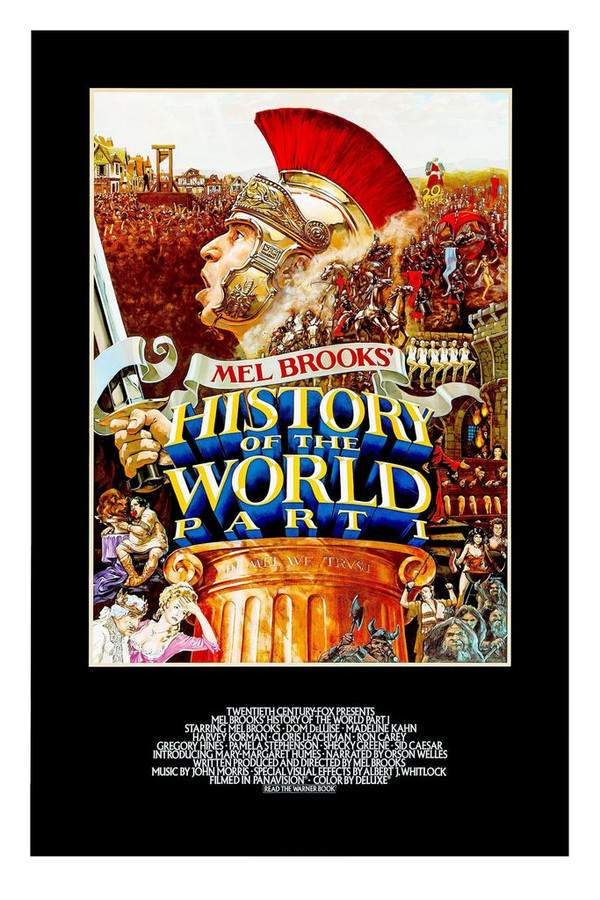
History of the World: Part I

History of the World: Part I

Year: 1981

Runtime: 92 min

Language: English

HistoryComedy

A comedic look at significant moments in human history, from the dawn of humankind to the Middle Ages. The film playfully depicts cavemen discovering fire, Moses receiving the Ten Commandments, the excesses of Emperor Nero's Rome, and the Spanish Inquisition, all while incorporating irreverent humor and memorable musical numbers. It’s a hilarious and imaginative reimagining of familiar historical events.

Where to Watch History of the World: Part I?

Find where to stream, rent, or buy History of the World: Part I (1981) in the US with current JustWatch availability, up-to-date pricing, and platform listings for subscription, rental, and digital purchase options.

Warning: spoilers below!

Haven’t seen History of the World: Part I yet? This summary contains major spoilers. Bookmark the page, watch the movie, and come back for the full breakdown. If you're ready, scroll on and relive the story!

Timeline – History of the World: Part I (1981)

Trace every key event in History of the World: Part I (1981) with our detailed, chronological timeline. Perfect for unpacking nonlinear stories, spotting hidden connections, and understanding how each scene builds toward the film’s climax. Whether you're revisiting or decoding for the first time, this timeline gives you the full picture.

1

Inventions in the Stone Age

The adventure begins in the Stone Age, where early humans, including the comedic genius Sid Caesar, are seen making groundbreaking inventions. They ignite fire, create art, and develop music, laying the foundation for humor and critique within their society.

Stone Age
2

Moses and the Tablets

In ancient Egypt, Moses, played by Mel Brooks, returns from Mount Sinai eager to share divine laws with the people. However, in an amusing turn of events, he accidentally drops one of the tablets, humorously revising the 15 Commandments down to 10.

Ancient Egypt
3

Comicus's Rise

Comicus, another role by Mel Brooks, embarks on a journey as a philosopher-turned-stand-up comic, called upon by his flamboyant agent, Ron Carey. This marks the beginning of his comedic adventures in the heart of Roman society.

Roman Empire
4

Encountering Miriam and Josephus

During his travels, Comicus meets Miriam, a captivating Vestal Virgin, and Josephus, an Ethiopian slave portrayed by Gregory Hines. This trio’s dynamic becomes pivotal as they maneuver through the complexities of their era's politics.

Roman Empire
5

Schemes of Emperor Nero

Comicus and Josephus find themselves entangled with the pompous Emperor Nero, humorously brought to life by Dom DeLuise. The situation escalates when they face a comedic death sentence due to a misunderstanding involving gladiatorial combat.

Caesar's Palace
6

Hide and Seek in the Palace

To evade capture, the trio disguises themselves as eunuch guards in Empress Nympho's palace. Their cover is hilariously almost blown when Josephus's behavior raises eyebrows, leading to a wild chase.

Empress Nympho’s Palace
7

The Great Escape

In a frantic bid for freedom, Comicus, Josephus, and Miriam flee in a horse-drawn cart concealed by the smoke of a massive marijuana joint. This absurdity causes their pursuers to become completely disoriented and confused.

Roman Empire
8

Clumsy Service at the Last Supper

Comicus stumbles into the Last Supper, interrupting Jesus and his disciples with his comical service blunders. His antics disrupt the solemn dinner, much to the chagrin of Leonardo da Vinci, who attempts to capture the moment artistically.

Judea
9

Torquemada’s Musical Extravaganza

In a lavish and absurd number, Mel Brooks plays Torquemada, showcasing a theatrical routine that parodies historical inquisition. The scene features nuns performing water ballet, twisting traditional concepts through comedy.

Spain
10

Madame Defarge and the French Revolution

In a Parisian tavern, Madame Defarge ignites a revolutionary fervor among the people. King Louis, oblivious to the brewing rebellion, enjoys ludicrous pastimes while his advisers attempt to warn him of the impending uproar.

Paris
11

The King's Deception

To escape the chaos, King Louis seeks refuge by using a look-alike as a decoy. Unaware, Mademoiselle Rimbaud arrives at the decoy's chambers, leading to a humorous encounter filled with unexpected twists and liberation.

King's Palace
12

Race Against Time

As peasants storm the palace to seize the decoy, Rimbaud's panic crescendos into a plea for a miracle. In a twist of fate, Josephus arrives just in time in a cart, allowing their daring escape amidst chaos.

Paris
13

The Closing Scene

The adventure wraps up with Mel Brooks introducing a hilarious imaginary trailer for a sequel. This teaser presents a series of ludicrous upcoming sketches including 'Hitler on Ice' and 'Jews in Space', leaving audiences in stitches.

N/A

Last updated: November 19, 2024 at 21:03

Was this helpful?

History of the World: Part I (1981) Timeline Questions Answered – Chronology FAQ

Find frequently asked questions about the History of the World: Part I (1981) timeline, including chronological order, nonlinear jumps, cause-and-effect links, and scene sequence clarifications. This timeline FAQ helps explain when key events happen, how moments connect, and why the story unfolds in that specific order.

Q1

Why does Moses drop the commandments tablets?

A.

Moses drops the tablets because he is excited about sharing the divine laws with the people after returning from Mount Sinai. In a moment of enthusiasm, he accidentally drops one tablet, which then causes him to revise the original 15 Commandments down to the familiar 10.

mosesten commandmentstabletsmount sinai
Q2

Why do Comicus and Josephus have to fight in the arena?

A.

Comicus and Josephus receive a death sentence from Emperor Nero after Josephus mistakenly answers 'yes' when asked if they want to engage in gladiatorial combat. The Roman officer interprets their conversation as a request to fight to the death in the arena.

comicusjosephusnerogladiatorsarenaroman empire
Q3

Why do Comicus, Josephus and Miriam disguise as eunuchs?

A.

After escaping the gladiatorial arena, the trio takes refuge in Empress Nympho's palace and disguises themselves as eunuch guards to avoid detection by Nero's soldiers who are searching for them. The disguise provides cover but nearly fails when Josephus's obvious attraction to the women gives away their true identity.

comicusjosephusmiriameunuchsempress nymphodisguise
Q4

How does the marijuana joint help them escape?

A.

The trio flees Empress Nympho's palace in a horse-drawn cart while smoking an enormous marijuana joint. The thick smoke clouds the vision of their pursuers, leaving them confused and unable to track the escapees effectively.

marijuanacartescapechasesmoke
Q5

Why does the fake King Louis grant Rimbaud's request?

A.

Mademoiselle Rimbaud approaches the decoy king (Jacques, a lookalike) hoping to free her father from the Bastille. Jacques, who is actually a peasant pretending to be the king, surprisingly grants her request out of kindness rather than demanding the romantic favor that the real King Louis would have required.

jacquesrimbaudbastilleking louisdecoyfrench revolution
Q6

How does Josephus arrive in time to save them?

A.

As the peasants prepare to execute the decoy king, Mademoiselle Rimbaud cries that only a miracle can save him. At that exact moment, Josephus arrives driving a cart drawn by an apparent miraculous force, allowing the group to escape together toward a mountain marked with 'THE END'.

josephusrimbaudmiracleescapeparisfrench revolution
Q7

Why is Comicus serving at the Last Supper?

A.

Comicus stumbles into the Last Supper scene while on the run in Judea. He works as a clumsy waiter who repeatedly interrupts the solemn dinner between Jesus and his disciples, disrupting Leonardo da Vinci's attempts to paint the famous scene.

comicuslast supperjesusleonardo da vincijudea
Q8

What is the Torquemada musical number about?

A.

Mel Brooks appears as Torquemada, the infamous Spanish inquisitor, performing an absurd song-and-dance routine featuring nuns doing water ballet, a spinning iron maiden, and various exaggerated tortures. The scene parodies both classic Hollywood musicals and the historical brutality of the Inquisition through over-the-top comedy.

torquemadainquisitionmusicalnunsspainmel brooks
Q9

What is the purpose of the sequel trailer at the end?

A.

After the main story concludes, Mel Brooks appears as himself to present a fake trailer for 'History of the World, Part II' which never existed. The trailer humorously teases impossible segments like 'Hitler on Ice,' 'A Viking Funeral,' and 'Jews in Space,' serving as a final comedic bit that satirizes movie marketing and sequel culture.

sequeltrailerpart iihitler on icejews in spacemel brooks
Q10

Who is Miriam and why is she important to Comicus?

A.

Miriam is a Vestal Virgin whom Comicus meets during his time in the Roman Empire. She captures his heart immediately, and she becomes part of his traveling companion group alongside Josephus, joining them in their various escapes throughout the historical periods.

miriamvestal virgincomicusroman empire
Mobile App Preview

Coming soon on iOS and Android

The Plot Explained Mobile App

From blockbusters to hidden gems - dive into movie stories anytime, anywhere. Save your favorites, discover plots faster, and never miss a twist again.

Sign up to be the first to know when we launch. Your email stays private, always.

Explore Movie Threads

Discover curated groups of movies connected by mood, themes, and story style. Browse collections built around emotion, atmosphere, and narrative focus to easily find films that match what you feel like watching right now.

Irreverent Historical Comedies like History of the World: Part I

Wildly funny and absurdist satires of well-known historical events.If you loved the madcap historical sketches of History of the World: Part I, you'll enjoy these movies. This section features films that share a similar vibe of gleeful historical satire, comedic musical numbers, and an overall sense of absurd, good-natured fun. Find your next favorite spoof of history here.

sketch comedyhistorical spoofabsurdsillymadcapmusical numbersirreverentplayful

Narrative Summary

Narratives in this thread are typically episodic, moving through a series of loosely connected sketches that parody famous moments from history. The plot is secondary to the comedic set-pieces, with stories structured to deliver a rapid-fire sequence of gags, visual puns, and musical interludes centered on historical themes.

Why These Movies?

Movies in this thread are grouped by their shared approach to comedy: they all use history as a backdrop for broad, irreverent humor. They share a fast-paced, anthology-like structure, a light emotional weight that avoids genuine darkness, and a whimsical tone that celebrates silliness above all else.

Ensemble Comedy Anthologies with a vibe like History of the World: Part I

Fast-paced comedic collections of short stories with a large, zany cast.Looking for more movies with the sprawling, sketch-based fun of History of the World: Part I? This section gathers ensemble-driven comedy anthologies that share its fast pacing, playful tone, and madcap spirit. Discover similar films built on a series of hilarious, interconnected or thematic short stories.

ensemble castsketch comedymadcapzanyfast-pacedplayfulanthologyshort stories

Narrative Summary

The narrative pattern is defined by its anthology structure. Instead of a single through-line, the film presents multiple self-contained comedic segments. The journey is one of variety and surprise, with the overall experience feeling like a curated selection of the funniest ideas, united by a common stylistic approach or overarching concept.

Why These Movies?

These movies are grouped by their unique comedic structure and energetic vibe. They share a fast pacing driven by short segments, a lighthearted tone that avoids heavy drama, and a focus on ensemble performances where the collective zaniness of the cast is more important than any single character's arc.

Unlock the Full Story of History of the World: Part I

Don't stop at just watching - explore History of the World: Part I in full detail. From the complete plot summary and scene-by-scene timeline to character breakdowns, thematic analysis, and a deep dive into the ending - every page helps you truly understand what History of the World: Part I is all about. Plus, discover what's next after the movie.

History of the World: Part I Summary

Read a complete plot summary of History of the World: Part I, including all key story points, character arcs, and turning points. This in-depth recap is ideal for understanding the narrative structure or reviewing what happened in the movie.

History of the World: Part I Summary

Characters, Settings & Themes in History of the World: Part I

Discover the characters, locations, and core themes that shape History of the World: Part I. Get insights into symbolic elements, setting significance, and deeper narrative meaning - ideal for thematic analysis and movie breakdowns.

Characters, Settings & Themes in History of the World: Part I

History of the World: Part I Spoiler-Free Summary

Get a quick, spoiler-free overview of History of the World: Part I that covers the main plot points and key details without revealing any major twists or spoilers. Perfect for those who want to know what to expect before diving in.

History of the World: Part I Spoiler-Free Summary

More About History of the World: Part I

Visit What's After the Movie to explore more about History of the World: Part I: box office results, cast and crew info, production details, post-credit scenes, and external links - all in one place for movie fans and researchers.

More About History of the World: Part I