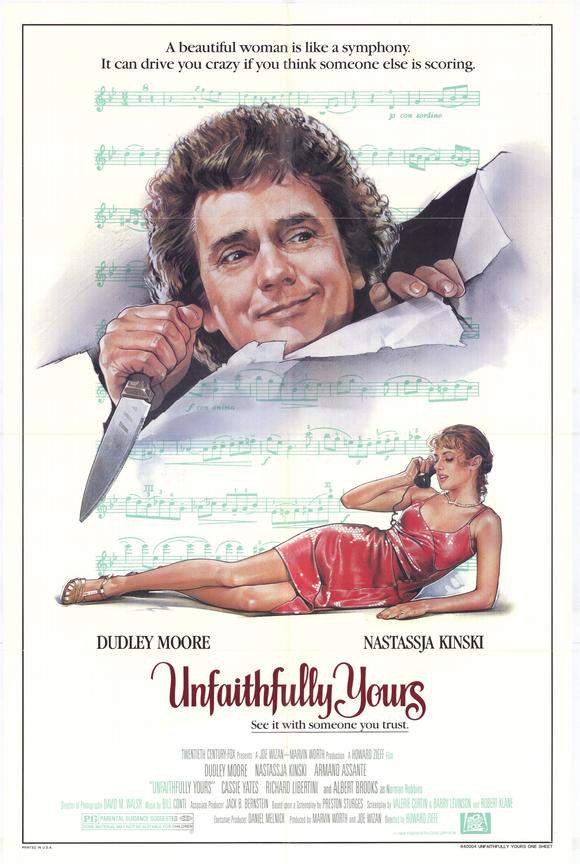
Claude Eastman is a renowned composer and the conductor of a prestigious symphony who has recently married a beautiful, much younger woman, Daniella. While on tour, he sends a message to his friend Norman Robbins to keep an eye on his wife, but the message is garbled by Claude’s Italian valet, Giuseppe. Norman, worried and curious, hires a private detective named Keller to investigate. What begins as a routine check soon spirals into a web of misunderstandings that threaten to unravel both trust and stability.
The private eye’s report arrives with a fuzzy video that seems to show Daniella in an encounter with a man—an appearance aided by Argyle socks that supposedly hint at Maxmillian Stein, a striking violinist who is a rising star in the orchestra and Claude’s protégé, notorious for his charm with women. In truth, the footage reveals a simpler truth: Max had used Claude’s flat to meet Norman’s wife, Carla. The misreadings pile up, and Claude’s suspicions intensify. Rather than admitting the truth, Daniella wrestles with guilt over keeping the affair secret from her husband, while Max offers only a casual apology for using Claude’s space, not for any deeper indiscretion. The lack of clear communication among the three players fuels a dangerous tension.
Driven by a desire to confront the supposed treachery, Claude schemes to spring a dramatic confrontation on Max and Daniella. He intends to catch them off-guard, but the plan backfires in a cascade of misinterpretations. The tension makes itself felt most vividly when Claude, in a display of raw jealousy, meets Max at a restaurant where the two men exchange a volley of unspoken accusations. The clash intensifies as Claude, overwhelmed by jealousy, performs a bold act: he matches Max’s artistry on the violin by delivering a Csárdás, the virtuosic piece made famous by Vittorio Monti, turning music into a weapon in a tense duel of skill and emotion.
The dynamics remain fraught as Claude separately confronts Daniella and Max. Daniella’s guilt is palpable, but she tries to maintain a fragile equilibrium, while Max apologizes for his choice to use Claude’s flat, rather than for any deeper breach of trust. The conversation never fully clarifies who was meeting whom, leaving Claude to interpret the silence as confirmation of his worst fears. He becomes convinced that the only way to restore order is through a drastic, deadly plan.
As the idea of murder takes root, Claude’s thoughts turn toward a scheme: to kill Daniella and frame Max for the crime, while trying to preserve the illusion of innocence. He rehearses the plan while conducting Tchaikovsky’s Violin Concerto, a haunting soundtrack to his growing hysteria. The plot is crafted in a chilling moment of arrogance and paranoia, but real-world obstacles—unforeseen circumstances—begin to disrupt the execution.
Keller’s understanding of the situation shifts when he notices Carla leaving Claude’s apartment on the tape, revealing that the supposed affair was not what it seemed. He races to catch Claude at the concert and, failing that, travels to Claude’s flat to intervene during the moment when murder appears imminent. Daniella’s reaction upon learning the truth is complex: anger flares at first, not only at the possibility that she was thought capable of unfaithfulness, but at the idea that Claude’s jealousy could drive him to violence. Yet her anger eases as Claude explains his love for her and his inability to fully suppress his jealousy. The couple’s path to reconciliation is fragile but real, underscored by a recognition of their mutual devotion despite the chaos that nearly tore them apart.