


Plot Explained Spoilers guaranteed!
Plot Explained

Browse by genre

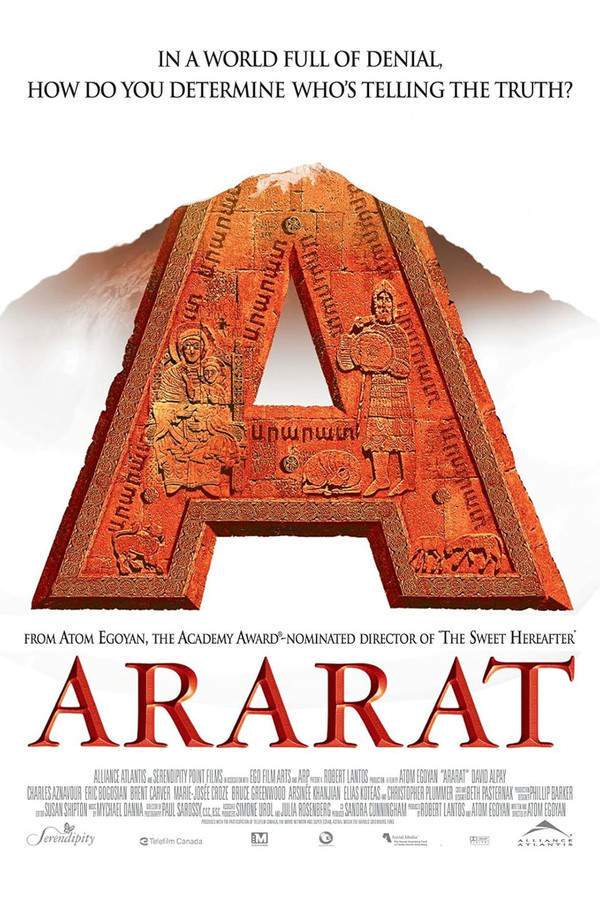
Ararat (2002) movie poster

Timeline

Ararat (2002) Timeline Explained – Every Event in Order

Release, runtime and language
2002 · 115 min · English
Directed by
Atom Egoyan
Starring
Brent Carver, Charles Aznavour
Budget
$15.5M

A filmmaker sets out to create a film about the Armenian genocide that occurred during World War I. The project becomes a deeply personal exploration as he researches his family's history and the tragic events that impacted them. Through a blend of documentary footage and fictionalized scenes, he seeks to remember the victims and confront the complexities of identity, memory, and the possibility of redemption.

On this page (6)
  1. 1 Where to watch
  2. 2 Events in order (14)
  3. 3 Timeline questions answered
  4. 4 Movie threads
  5. 5 Movies like Ararat
  6. 6 Every angle

Where to watch

Where to Watch Ararat (2002)

Where can you watch Ararat? Stream, rent or buy it in the US, including on Google Play Movies and YouTube: current JustWatch availability with up-to-date prices.

Streaming availability powered by JustWatch

14 events in order · contains spoilers

Ararat Timeline: Events in Chronological Order

Every key event of Ararat (2002) in order, scene by scene, with when and where it takes place. Use it to untangle flashbacks, time jumps and parallel storylines, to refresh your memory before the sequel or to find the exact scene you are thinking of.

  1. Introduction to Arshile Gorky

    The film opens with an introduction to Arshile Gorky, a renowned painter known for his profound impact on the art world. His life story is revealed as a combination of talent and tragedy, marked by the Armenian genocide's historical weight.

  2. The Armenian Massacre

    The narrative delves into the atrocities of the Armenian massacre of 1915, showcasing the profound effect it had on Gorky's life and work. This tragic event serves as a backdrop that influences both his artistry and personal struggles.

    When
    1915
  3. Gorky's Artistic Journey

    As Gorky channels his pain into his art, he emerges as a key figure in the realms of Surrealism and Abstract Expressionism. His paintings reflect the chaos and beauty of his experiences, drawing attention from critics and collectors alike.

  4. Gorky's Relationships

    Throughout the film, Gorky’s relationships with those around him, such as fellow artists and family, are explored. These connections highlight how his legacy and art impact the people who love and admire him, revealing layers of emotional complexity.

  5. Gorky's Suicide

    The film poignantly portrays Gorky's tragic suicide in 1948, marking a significant turning point. His death leaves a profound emptiness, influencing the perceptions and lives of those left behind.

    When
    1948
  6. A Legacy in Spirits

    Following Gorky's death, the narrative reveals how his spirit manifests in the lives of various characters. Each individual perceives his legacy differently, from inspiration to painful reminders of loss.

  7. The Director's Admiration

    The character of the director views Gorky as a cultural emblem, representing the struggles and richness of Armenian history. This perspective drives the narrative, emphasizing the importance of remembering one's heritage through art.

  8. Ani's Book Project

    Ani, an art historian, finds herself captivated by Gorky as she prepares for her upcoming book. She immerses herself in his life and work, showcasing how his legacy continues to inspire scholarly exploration.

  9. Celia's Reflection

    Celia, Gorky's stepdaughter, experiences complex emotions as she confronts her father’s unclear fate through his memories. This struggle highlights the personal repercussions of Gorky's choices and the impact on family dynamics.

  10. Raffi's Quest for Identity

    Raffi connects with Gorky's life as a means of exploring his own identity. His journey intertwines with Gorky’s legacy, reflecting how art can be a catalyst for personal understanding and connection to cultural roots.

  11. Gorky Among Art Titans

    The film draws comparisons between Gorky and other art giants like Willem de Kooning and Mark Rothko. This placement underscores Gorky's essential role in shaping modern art movements and his lasting influence.

  12. Intersection of Personal and Collective Histories

    As the stories unfold, they beautifully illustrate how personal and collective histories are intertwined through art. The film conveys that creativity serves as a healing mechanism for both individuals and communities grappling with trauma.

  13. The Film's Conclusion

    The narrative concludes with a testament to Atom Egoyan’s artistry, cementing the film as both a historical recount of Gorky’s life and a commentary on the role of art in society. It invites viewers to reflect on the profound impact of creativity on healing.

  14. Final Reflections

    As the credits roll, the audience is left with a poignant exploration of what art signifies for those touched by its influence. The film serves as a lasting reminder of the power of creativity to articulate human experience and memory.

Last updated: November 03, 2024 at 20:48

Was this helpful?

Timeline questions answered

Ararat Timeline Explained: Your Questions Answered

When does it happen, and why in that order? The questions people ask about the chronology of Ararat (2002): time jumps, flashbacks, cause and effect between scenes and the correct order of events, each answered with spoilers.

Q1

Why does Arshile Gorky commit suicide in 1948?

Gorky takes his own life in 1948 after years of physical suffering from a studio fire that destroyed his work and left him with severe burns, combined with the emotional toll of the Armenian genocide he survived. The film portrays his suicide as the tragic culmination of both personal tragedy and the deeper trauma carried from losing his mother and experiencing the massacre of his people.

Foreshadowing: Earlier scenes show Gorky's physical decline and his repeated references to the loss he endured during the genocide.

  • Gorky suicide
  • artist death
  • 1948
  • personal tragedy
  • genocide trauma
Q2

How does the Armenian genocide influence Gorky's artwork?

The 1915 genocide, which killed much of Gorky's family including his mother, deeply shapes his artistic vision. His paintings channel the chaos and beauty of his traumatic experiences, evolving from realistic works into the surrealist and abstract expressionist styles that would influence artists like Pollock and de Kooning. The genocide becomes the unspoken foundation of his artistic breakthrough.

Foreshadowing: The film opens by establishing how Gorky transforms personal pain into revolutionary art.

  • Armenian genocide
  • Gorky art
  • abstract expressionism
  • surrealism
  • artistic inspiration
Q3

Why does Gorky's spirit appear differently to each character?

After Gorky's death, his spirit manifests uniquely to different people based on their individual relationships to him and their own emotional needs. The director sees him as a cultural hero, Ani views him as an intellectual subject for her book, Celia perceives him as a painful reminder of her father's uncertain fate, and Raffi sees him as a pathway to understanding his own identity. This reflects how legacy is subjective and shaped by personal experience.

Foreshadowing: The film establishes early that Gorky's death leaves voided spaces in different people's lives.

  • Gorky spirit
  • legacy
  • manifestation
  • character perspectives
  • memory
Q4

Why is Mount Ararat significant in the film?

Mount Ararat, the sacred Armenian mountain visible from Istanbul, represents the lost homeland and the displaced Armenian identity. The film's title references this landmark as a symbol of the homeland that no longer feels accessible to survivors and their descendants. It serves as a visual reminder of what was taken during the genocide and what persists in memory and art.

Foreshadowing: The mountain appears throughout visual sequences, reinforcing its symbolic presence.

  • Mount Ararat
  • Armenian homeland
  • lost homeland
  • symbolism
  • identity
Q5

Why does Celia struggle with her father's fate?

Celia, Gorky's stepdaughter, grapples with not knowing what happened to her father, whether he died in the genocide or survived elsewhere. This uncertainty haunts her throughout the film. Gorky's own memories and eventual suicide force her to confront this unresolved loss, making her journey one of coming to terms with ambiguous grief.

Foreshadowing: Early scenes establish Celia's emotional distance and her difficulty discussing her family history.

  • Celia
  • stepdaughter
  • father fate
  • unresolved grief
  • family trauma
Q6

Why does the director's film project become personal?

The director's project to make a film about the Armenian genocide starts as a professional endeavor but transforms into a deeply personal journey as he uncovers his own family's connection to the events. Through researching Gorky and the genocide, he confronts his ancestral trauma and discovers how the historical tragedy directly impacted his lineage, making the film an act of personal remembrance.

Foreshadowing: The opening establishes the director as someone seeking to understand his cultural heritage through Gorky's story.

  • director
  • personal journey
  • family history
  • Armenian genocide
  • filmmaking
Q7

Why does Raffi use Gorky to explore his identity?

Raffi connects with Gorky's life as a means of understanding his own Armenian identity in the diaspora. As a young man uncertain of his cultural roots, Gorky's journey from survivor to influential artist provides Raffi with a framework for finding meaning in his heritage. Gorky becomes a bridge connecting Raffi to a history he otherwise might never have engaged with.

Foreshadowing: Raffi is introduced as a character seeking purpose and connection to his ancestry.

  • Raffi
  • identity
  • Armenian heritage
  • diaspora
  • cultural roots
Q8

Why does the film blend documentary footage with fictional scenes?

Atom Egoyan deliberately mixes documentary footage of the actual Armenian genocide with fictional narrative to blur the line between historical record and personal memory. This technique reinforces the film's theme that memory and art are intertwined, the documentary provides truth while the fictional elements represent how individuals process and internalize trauma through creative expression.

Foreshadowing: The film immediately establishes its hybrid style from the opening sequences.

  • documentary
  • fictional
  • narrative technique
  • memory
  • historical truth
Q9

What is the film's stance on Armenian genocide denial?

The film directly confronts the Turkish government's denial of the Armenian genocide by presenting documented historical footage alongside the fictional narrative. Egoyan uses this contrast to emphasize that denial is itself a form of violence against memory. The characters' struggles to uncover their histories reflect the broader political resistance to acknowledging this historical atrocity.

Foreshadowing: The film's intensity increases when characters encounter documents and testimonies that face denial.

  • genocide denial
  • Turkish government
  • historical truth
  • memory
  • acknowledgment
Q10

Why does Ani dedicate her book to Gorky?

Ani, an art historian, becomes deeply absorbed in researching Gorky for her forthcoming book because his life represents the intersection of personal tragedy and artistic achievement. Her scholarly work becomes a form of remembrance, a way to ensure Gorky's contribution to art and his experience of the genocide are not forgotten. Through academic study, she participates in the healing process the film explores.

Foreshadowing: Ani's intellectual pursuit is established early as both professional and emotionally motivated.

  • Ani
  • art historian
  • Gorky book
  • remembrance
  • scholarly research

Movie threads

More Movies Like Ararat, by Mood & Story

Curated lists built around what makes Ararat tick: the same mood, the same kind of story or the same emotional payoff. Each list explains why these movies belong together.

Movies about personal historical grief like Ararat

Intimate stories where uncovering a painful past shapes present identity. If you were moved by the personal exploration of historical trauma in Ararat, this collection features similar dramas. These movies focus on characters uncovering family histories linked to major tragic events, blending personal grief with collective memory in a deeply reflective and emotionally heavy way.

  • historical
  • somber
  • reflective
  • heavy
  • personal
  • melancholic
  • Tone: melancholic, somber, reflective
  • Pacing: slow, methodical
Why these movies?

The story pattern: Stories in this thread often follow a protagonist's investigative or reflective journey into a suppressed or painful historical event that directly impacted their ancestors. The narrative structure may blend past and present, documentary and fiction, to explore how intergenerational trauma shapes identity, memory, and the quest for acknowledgment or healing.

Why they belong together: These films are grouped together because they share a profound focus on the intersection of personal identity and collective historical trauma. They feature a melancholic tone, heavy emotional weight, and a slow, deliberate pacing that allows for deep reflection on loss, legacy, and the power (and difficulty) of remembering.
Movies about art and memory like Ararat

Stories where the act of creating art becomes a way to process profound loss. For viewers who appreciated how Ararat wove together filmmaking and historical memory, this section highlights similar movies. These films focus on artists—painters, writers, filmmakers—whose work is a direct response to trauma, exploring the complex relationship between creativity, remembrance, and healing.

  • contemplative
  • metafictional
  • melancholic
  • atmospheric
  • creative
  • bittersweet
  • Tone: melancholic, contemplative, bittersweet
  • Pacing: slow, reflective
Why these movies?

The story pattern: The narrative pattern involves an artist protagonist embarking on a project that forces them to confront a difficult history, often their own. The film itself may reflect on the creative process, blurring lines between reality and representation, and culminating in a resolution that acknowledges the pain of the past while finding a fragile redemption or purpose in the act of creation itself.

Why they belong together: These movies share a meta-fictional or self-referential quality, examining the power and limitations of art. They are united by a complex narrative structure, a bittersweet ending feel, and a deep thematic exploration of how art can serve as a vessel for memory, a confrontation with truth, and a tentative step towards understanding.

If you liked this

Movies Like Ararat

Similar movies to Ararat: the same genre, themes or kind of story. Each one comes with its own plot summary, timeline and ending explained.

Browse all movie summaries

Every angle

Ararat (2002) Explained: Plot, Timeline & Characters

Everything about Ararat in one place: what happens in the plot summary, the timeline in chronological order, the characters and meaning and a spoiler-free summary. What's After the Movie adds the cast, box office and post-credit scenes.

Coming soon on iOS and Android

The Plot Explained Movie Summary App

Plot summaries, endings explained and timelines on your phone. Catch up on any movie in minutes, save your favorites and never miss a twist again.

Be the first to know when we launch. Your email stays private, always.

Learn more about the app